Kongsberg, Norway — premier native-silver locality famed for wire silver in Precambrian gneiss veins, diverse sulfoselenides and arsenides, and a rich mining h…
Key facts
Kongsberg is the classic collector locality for native silver: not merely a productive mine district, but the place that fixed the visual idea of “wire silver” in European mineral collecting. The silver occurs in a hydrothermal vein system hosted by Precambrian gneisses of the Kongsberg Complex, where Permian fluids deposited narrow calcite-dominated veins. The richest ore shoots formed where those veins crossed north-south sulphide-bearing wall-rock zones known locally as fahlbands. That intersection control is the key to the district: many calcite veins are barren or only weakly mineralized, but where they cut sulphide-rich bands the reaction chemistry favored exceptional native silver.
The collector assemblage is anchored by native silver with calcite, but the district is far more mineralogically subtle than the familiar museum pieces suggest. Acanthite and historically labelled “argentite,” pyrargyrite, polybasite, tetrahedrite/freibergite, Ag-Hg and Ag-Sb silver alloys, allargentum, dyscrasite, naumannite-bearing sulfoselenides, cobalt-nickel-iron sulfarsenides, pyrite, pyrrhotite, chalcopyrite, galena, sphalerite, fluorite, quartz, baryte, and rarer tellurides and selenides all belong to the Kongsberg story. To the advanced collector, the locality is not just “silver on calcite”; it is a native silver-cobalt-nickel arsenide type deposit whose ore mineralogy records multiple pulses of sulphidation, arsenide formation, silver remobilization, and late oxidation/desulphidization.
Historically, Kongsberg is one of Europe’s great mining names. Silver was discovered in 1623, King Christian IV founded the mining town in 1624, and Kongsberg Sølvverk worked the field, with interruptions and changing fortunes, until the last silver was smelted in 1958. Total production was about 1,350 tonnes of silver, and the best specimens were separated, weighed, appraised, sold, gifted, and shipped to royal and private collections from the earliest years of mining. That is why old Kongsberg silvers appear in European museum cabinets with seventeenth-, eighteenth-, and nineteenth-century provenance, and why a serious Kongsberg label can be as important as the specimen itself.
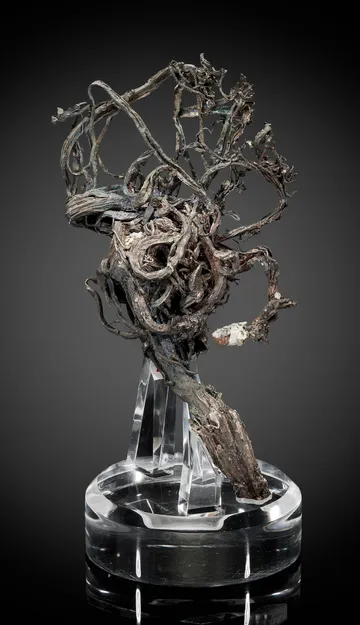
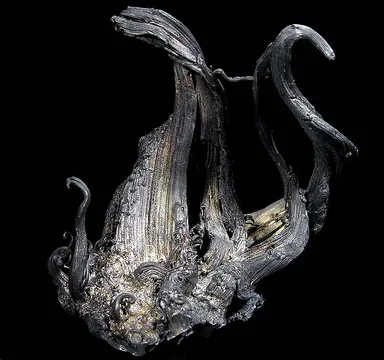
At its best, Kongsberg silver has motion. The finest pieces are not simply rich; they are sculptural: curled ropes, loops, antler-like branches, feathered masses, herringbone sprays, hackly plates, and bright to smoky grey wires emerging naturally from white or translucent calcite. Great specimens show the metal piercing, wrapping, or growing through the gangue rather than merely resting on it. Thick, graceful wire forms on clean calcite are the signature look; large historic masses and dramatic arborescent groups are trophy-level objects.
Regional View
Country View
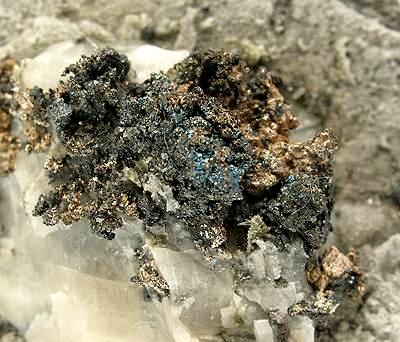
Photo: Wikimedia Commons
The Kongsberg field is also unusually important because it joins geology, collecting history, and national history in one place. The same mines that yielded the famous cabinet specimens also supported a mining town, a smeltery, a minting economy, a technical culture, and Norway’s earliest higher technical education. For collectors, that breadth matters: a Kongsberg specimen is rarely just an isolated mineral object. It may be a vein fragment from one of the world’s great native-silver systems, a survivor from a royal specimen trade, a museum duplicate, a nineteenth-century teaching piece, or a labelled remnant of a mine whose underground workings are now protected cultural heritage.
Search for specimens: View all specimens from Kongsberg, Norway
The Kongsberg silver district lies around Kongsberg in Buskerud, southeastern Norway, with the historic mines concentrated west of the town in the Gruveåsen, Overberget, Underberget, Saggrenda, and related fields. The district is hosted by Mesoproterozoic gneisses and schists of the South Norwegian Basement Province, specifically the Kongsberg Complex. The economically important veins are Permian hydrothermal fracture fillings, formed during the same broad tectono-magmatic episode associated with the Oslo Rift. In collector terms, the essential vein material is calcite, commonly with quartz and subordinate fluorite or baryte; in ore terms, the defining association is native silver with cobalt-nickel-iron arsenides and sulphides.
The most important structural and geochemical control is the crossing of calcite veins with fahlbands. These fahlbands are rusty, sulphide-bearing, mica-rich schists and gneisses that are broadly concordant with the country rock. Their sulphides include pyrite and pyrrhotite, with lesser chalcopyrite, sphalerite, galena, arsenopyrite, and cobalt-bearing minerals. The Overberget and Underberget fahlbands were the great ore-bearing zones west of Kongsberg, striking north-south; the Overberget fahlband alone is described as hundreds of metres wide and more than 10 km long. The old miners learned the practical rule long before modern geochemistry explained it: silver was best where the calcite veins cut the sulphide zones.
The district contains two principal vein generations. An older quartz-dominant set carries minerals such as pyrite, pyrrhotite, sphalerite, and galena. The younger and economically decisive set is calcite-rich and contains cobalt-nickel arsenides together with native silver. Modern microprobe work has refined that picture into a multi-stage paragenesis: early silver-bearing sulphides and sulfosalts, including acanthite, were followed by breakdown and remobilization events that produced native silver; Ni-Co-Fe sulfarsenides and niccolite formed at particular stages; later Ag-Hg and Ag-Sb silver alloys, allargentum, dyscrasite, pyrargyrite, polybasite, tetrahedrite/freibergite, and selenide-bearing phases occur in restricted parts of the district.
Mining began after the 1623 discovery and was formalized under Christian IV, who founded Kongsberg in 1624. Kongsberg Sølvverk became Norway’s greatest historical mine enterprise. Sources differ slightly in whether they count the operating years as 1623–1958 or 1624–1957, depending on whether discovery, mining, closure decision, and final smelting are included, but the practical collecting history spans the whole 335-year story from the first silver finds to the final smelting in 1958. Production came from about 130 larger and smaller mines in the official Geological Survey of Norway summary, and from a broader landscape of hundreds of shafts, adits, and prospects when small workings are included.
Kongens gruve, the King’s Mine, was the largest and deepest mine in the district. It reached a depth of about 1,068 m and alone produced roughly 601 tonnes of silver, nearly half the total Kongsberg output. Samuel gruve, in the Underberget province, was another major producer: discovered in 1630, worked first until 1805 and again from 1889 to 1934, it reached about 665 m depth and produced roughly 100,000 kg of pure silver. Gottes Hülfe in der Noth, Segen Gottes, Juel’s Mine, Mildigkeit Gottes, Armen Mine, and numerous other named workings recur in the history of specimens and mineralogical study.
Collectors should understand that Kongsberg was not a modern specimen mine. Specimens were by-products of a working silver enterprise, removed when attractive masses, wires, or crystal-lined cavities appeared during ore extraction. The best material came from calcite vein cavities where silver had room to grow, and from rich ore zones where later collectors, dealers, or museums preserved sculptural pieces rather than sending them all to the furnace. Some specimens are massive hackly silver with calcite; others are delicate wire groups; still others are pseudomorphs or paramorphs involving acanthite/argentite textures, silver after sulphide, or calcite casts.
Today the central mining landscape is protected as the Kongsberg Sølvverk cultural environment. The protected area covers the historical mine field, surface remains, dumps, water-management systems, adits, and underground workings. Collecting, digging, breaking rock, entering mine workings, or disturbing dumps within protected zones is not casual rockhounding; it requires permission from the relevant authorities. The practical modern collector market is therefore supplied overwhelmingly by old collections, museum deaccessions or exchanges, historic dealer stock, and a limited amount of material from earlier legal recovery. Visitors can still experience the district through Norsk Bergverksmuseum and the King’s Mine tour at Saggrenda, where the mine train goes about 2,300 m into the mountain to the public route 342 m below the surface. As of 2026, the Silver Mines visitor operation continues, while the museum’s Smeltehytta building has been undergoing renovation.
The most famous specimen episodes are part of Kongsberg’s identity. A 95.6 kg lump from the Segen Gottes mine was found in 1630 and immortalized in a contemporary painting. Another great specimen from Juel’s Mine in 1695 contained 41.5 kg of pure silver and was depicted with the town and mine landscape behind it. In 1769, a spectacular wire-silver specimen shaped like a large “C,” complete with a crown-like form, was sent to King Christian VII and remains one of the celebrated Copenhagen pieces. In the twentieth century, major finds continued: for example, an 11.5 kg silver specimen from Mildigkeit Gottes gruve was found in 1947, showing that even late in the mine’s life Kongsberg could still produce dramatic native silver.
Native silver is the defining Kongsberg mineral and the standard by which wire silver from all other localities is judged. It occurs chiefly in calcite veins where ore shoots intersect sulphide-rich fahlbands, and the best specimens show silver as twisted, ropey, curled, looped, arborescent, herringbone, feathered, hackly, or crystalline masses, commonly rising from or penetrating white to translucent calcite. Fresh silver is bright metallic white, but old Kongsberg pieces often carry a desirable grey, smoky, or blackish patina that gives depth to the wires and records long cabinet history. Sizes range from thumbnail curls and small matrix pieces to miniatures, small cabinets, and museum-scale masses; historically, extraordinary pieces weighed tens of kilograms. Associations with calcite are most valued visually, while acanthite, argentite-labelled Ag2S, sulphosalts, pyrrhotite, arsenides, and rarer Ag-Hg or Ag-Sb alloys are important scientifically. A good Kongsberg silver has natural architecture, undamaged wire tips, convincing matrix attachment, and ideally old provenance; an ordinary one is merely rich metal without form, balance, or locality character.
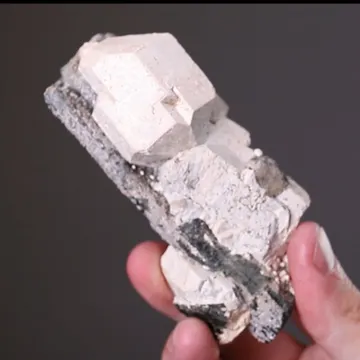
Calcite is the principal gangue mineral of the productive Kongsberg silver veins, and for collectors it is the stage on which the silver performs. It occurs as massive white vein material, coarse crystalline fill, colorless to white rhombohedral or cleaved masses, and crystalized pockets, sometimes with silver wires grown into, through, or out of the calcite rather than merely lying on its surface. Calcite from Kongsberg is not usually sought as a stand-alone show mineral in the way the silver is, but it is critical to specimen quality because clean white calcite provides the best contrast and the strongest geological proof of natural matrix growth. Fine pieces show silver threading through translucent or crystalline calcite, perched on bright white vein calcite, or partly enclosed in the carbonate; inferior examples have bruised, stained, broken, or acid-etched calcite that leaves the silver looking isolated. Minor fluorescence has been reported on some calcite-bearing Kongsberg specimens, but it is a secondary collecting point compared with form, contrast, integrity, and old labels.
Acanthite, Ag2S, is a key silver sulphide at Kongsberg and is especially important because modern work shows early Ag-bearing sulphides and sulfosalts participated in the reactions that later produced native silver. On specimens it appears as dark grey to black metallic material, commonly associated with native silver and calcite, and sometimes as masses or crystal-like forms historically called argentite. Kongsberg acanthite is most collectible when it is intimately intergrown with wire or crystalline silver, when it preserves pseudomorphic or paramorphic texture after high-temperature Ag2S, or when it comes with reliable old locality and mine attribution. Acanthite-rich pieces lack the bright theatrical contrast of pure wire silver on calcite, but they are scientifically richer: the best show the silver-sulphide relationship clearly, with black Ag2S providing context for silver growth, remobilization, and replacement. Condition is judged by sharpness of sulphide form, lack of greasy handling polish, and whether the dark mineral is genuinely part of the Kongsberg assemblage rather than a vague black coating on an unproven silver specimen.
Argentite is the traditional name encountered on many old Kongsberg labels for silver sulphide, but collectors should treat the term carefully: cubic argentite is the high-temperature Ag2S polymorph, while the stable room-temperature phase is acanthite, so old “argentite” specimens from Kongsberg are generally acanthite, acanthite paramorphs after argentite, or historical argentite usage unless supported by modern analytical context. The Kongsberg material occurs with native silver, calcite, and the broader silver-sulphide-sulfosalt assemblage, typically as dark metallic masses, coatings, or crystal-like forms rather than the dramatic wire habits that make the locality famous. Good argentite-labelled Kongsberg specimens are valuable when they have old labels, convincing association with native silver, and preserved sulphide morphology that helps explain the paragenesis; ordinary pieces are easily confused with nondescript black silver sulphide unless the provenance is strong. For serious collectors, “argentite” from Kongsberg is less a simple species purchase than a historically and mineralogically nuanced Ag2S specimen tied to one of the classic localities where old terminology and modern mineralogy overlap.
Beyond the four species above, Kongsberg is notable for an unusually rich silver-ore suite and for one important type-locality mineral: armenite, a barium-calcium aluminosilicate named for the Armen Mine near the King’s Mine. The district also contains allargentum, dyscrasite, pyrargyrite, polybasite, tetrahedrite/freibergite, naumannite-bearing Ag2S-Ag2Se solid solutions, hessite and other rare telluride or selenide phases, argentopentlandite, niccolite, safflorite, rammelsbergite, cobaltite, gersdorffite, arsenopyrite, pyrite, pyrrhotite, chalcopyrite, galena, sphalerite, fluorite, quartz, baryte, and many secondary arsenates or sulphates. Most of these are not showy cabinet minerals from Kongsberg, but they are crucial to the locality’s scientific importance: they show that the famous wires are the visible finale of a complex native silver-cobalt-nickel arsenide hydrothermal system.
Kongsberg silver is among the most desirable classic European minerals, and that desirability creates predictable authenticity problems. The first is over-attribution: not every old wire silver is Kongsberg. Saxon, Freiberg-area, Himmelsfürst, Imiter, Batopilas, Cobalt-Gowganda, and other silver localities can produce wire or arborescent habits, and detached wires without calcite matrix are the easiest to mislabel. A convincing Kongsberg piece should be assessed by morphology, matrix, associated minerals, patina, label history, and, for important purchases, comparison with old catalogue dimensions, accession numbers, photographs, or dealer descriptions.
The second concern is label switching. Kongsberg labels can carry real monetary value, especially when they connect a specimen to a named mine, a European museum, an old university collection, or a documented dealer such as Krantz, Böhm, or historic Scandinavian sources. An impressive label attached to an inferior or ambiguous silver should invite scrutiny, not automatic confidence. Dimensions, handwriting, old glue marks, label language, collection numbers, and the physical fit of the specimen to old trays or boxes all matter.
The third concern is artificial or altered silver. Synthetic metallic crystal growths, electrolytic silver wires, and unrelated silver-plated or laboratory products are common enough in the general market that they should be considered whenever a specimen lacks provenance. Artificial wires attached to calcite are less often encountered than generic fake “native silver,” but the value of Kongsberg pieces makes the possibility real. Acid cleaning is a separate issue: some natural specimens have been etched to expose silver formerly enclosed in calcite, and others have been brightened or overcleaned. Cleaning is not automatically fatal, but a raw, unnaturally bright surface can reduce charm and value, particularly when it removes the old cabinet patina that collectors prize.
Condition is central because silver is soft and malleable. Kongsberg wires bend, flatten, and snap; loops can be compressed; delicate branch tips are easily lost; and old repairs may hide beneath tarnish. Calcite matrix is also vulnerable to cleavage, bruising, acid etching, and edge chipping. Examine wire terminations, contact points, and any unusually smooth breaks under magnification. A thick wire is not necessarily safer than a thin one if it projects from calcite at a narrow root.
Handling should be conservative. Do not polish native silver as if it were bullion. Do not scrub it, dip it, or remove patina without a serious conservation reason. Handle matrix specimens by the rock or calcite, never by the wires. Store them so no wire touches foam under pressure, and avoid cotton fibers that can snag projections. For detached wire silvers, a custom base or deep perky box is usually safer than loose storage.
Availability is better than for many classic European localities because Kongsberg specimens were distributed for centuries and appear regularly from old collections, but truly fine pieces are scarce. Small wires, thumbnails, and modest matrix specimens are obtainable. Miniatures with graceful form and clean calcite are much harder. Cabinet-size wire groups, large historic masses, named-mine pieces, museum-provenance specimens, and highly aesthetic old examples are premium objects, often competing across mineral, history, and institutional collecting audiences.
The Kongsberg story begins with a scene that still feels almost too perfect for a mining legend. In early July 1623, the shepherd children Jacob Grosvold and Helga Verp were out with cattle in the hills of Sandsvær. The later tradition says an ox scraped the mountainside and revealed a bright metal. The children brought the shining material home, and Helga’s stepfather, Arne Verp, recognized enough value in it to melt some and try to sell it in Skien. That is where secrecy failed. The price he offered was suspiciously low, and the authorities arrested him on suspicion of theft. To escape the charge, he revealed the findspot. Within months the deposit was being investigated, and by 1624 Christian IV had traveled to Norway and founded the mining town whose name means the King’s Mountain.
From the first years, Kongsberg specimens were not just ore. They were curiosities, diplomatic objects, royal gifts, and cabinet treasures. The smeltery workers set aside beautiful pieces, and account books recorded buyers, weights, estimated silver contents, and prices. The numbers are startling. In normal years during the seventeenth and eighteenth centuries, specimen silver averaged about 9.5 kg of pure silver annually, less than 0.3 percent of total silver production, yet the cultural impact was huge. The sale lists suggest that during the main period before 1805, perhaps more than 30,000 and possibly as many as 50,000 specimens left the mines as collectible natural silver rather than coinage metal.
Royal appetite shaped that traffic. Christian IV received rich silver specimens during his 1624 visit. Frederik III’s collection can be traced to 1648, when he visited Norway and received 99 rich silver specimens plus silver ore containing pyrargyrite. In 1661, the year the crown took over the Silver Mines, 70 kg of pure silver contained in specimens was sold, most of it to the king and crown prince. In 1665, no fewer than 1,210 specimens were sent to the king. It is easy to imagine the Copenhagen Kunstkammer glittering with Norwegian wires, lumps, and sulphide ores while alchemists at Rosenborg Castle entertained the old dream of making gold from silver minerals.
Some specimens became almost characters in their own right. In 1630, shortly after the Segen Gottes mine was discovered, a huge lump of silver weighing 409 marks, or 95.6 kg, was found and painted by Adam van Breen. It was not described as especially beautiful, but its sheer mass made it a royal marvel. In 1695, another great specimen from Juel’s Mine contained 41.5 kg of pure silver. The painting of that piece is more than a mineral portrait: behind it are Kongsberg town and the mining landscape, complete with conical horse whims, dams, aqueducts, water wheels, and lines of wooden power-transmission rods.
The most famous of the royal presentation pieces was found in 1769 at Gottes Hülfe in der Noth. It stood 25 cm high and formed a great letter “C,” the initial of Christian VII, topped by a crown-like shape. It was the sort of object that seemed to prove providence had an eye for monarchy: a natural silver emblem, made in the mountain, ready for a king. Today it remains one of the celebrated silver specimens in Copenhagen’s geological collections.
Kongsberg was also a town of pressure, hunger, and organized labor. By around 1770 the works employed about 4,000 men, and Kongsberg was Norway’s second-largest town after Bergen, but the mine was entering crisis as richer ore became harder to reach and technical problems increased with depth. Lars Storhoff, a miner who had worked his way into a position as a hauer, helped organize a major complaint. He and a companion carried a petition to Copenhagen signed by 1,748 adult workers, demanding investigation of abuses in wages and supplies. A commission worked for three years, some suppliers and pay officials were punished, and in 1774 a provisioning system was introduced so workers could receive part of their wages as subsidized food. Storhoff was not satisfied. He returned to Copenhagen in 1775 to press the case again. This time the authorities arrested him. He never came back to Kongsberg; his wife was told he had been forced into military service in the Danish West Indies. In the social history of the Silver Works, Storhoff became a martyr of the mining community.
Even the underground method left vivid traces. Before modern drilling and blasting, miners used firesetting: they built fires against the rock to heat it, then attacked the fractured surface. The technique opened hard Kongsberg gneiss, but it made the air nearly unbreathable in narrow headings. In the late eighteenth century, the mine physician Henrik Rosted described the ordeal in language that still cuts through the centuries: it was almost unbelievable what a worker had to endure from heat in such a cramped space, where the air was so thin “that he could hardly breathe.” The beautiful silver wires in cabinets came from a mountain worked under those conditions.