






A collector's guide to Norway: its geology, mining history and notable minerals, illustrated with the 115 specimens documented from this locality on EarthWonders.
Key facts
Norway is not a single-mineral collecting locality so much as a chain of classic mineral provinces, each with a different personality. For specimen collectors, three settings dominate the national story: the rare-element granitic pegmatites of Evje–Iveland in Agder, the alkaline syenite pegmatites and larvikite quarries around Langesundsfjord and Larvik in the Oslo Rift, and the great titanium-bearing anorthosite province of Rogaland. Add to those the native silver veins of Kongsberg, corundum-bearing rocks of the Bamble–Froland region, Seiland’s zircon-bearing nepheline syenite pegmatites, and the Fen carbonatite complex, and Norway becomes one of Europe’s most rewarding countries for a mineral cabinet built around locality character rather than sheer abundance.
The Evje–Iveland district is the collector’s emotional center. Its pegmatites are coarse, feldspar–quartz–mica bodies in Sveconorwegian basement rocks, not lithium-tourmaline pockets of the Maine or Minas Gerais type, but they have yielded extraordinary rare-earth and scandium minerals: thortveitite, gadolinite-(Y), monazite-(Ce), aeschynite-(Y), euxenite-(Y), fergusonite-(Y), xenotime-(Y), allanite-(Ce), columbite-group minerals, beryl, spessartine-almandine garnet, quartz, and fluorite among many others. The best specimens have the look of old European pegmatite material: black to brown, heavy, glassy rare-earth crystals in pale feldspar or mica; smoky or clear quartz crystals from cavities; and cabinet-sized feldspar matrices carrying one sharply isolated accessory crystal.
Regional View
Country View
Norway’s scientific importance is just as strong as its collecting importance. Thortveitite, the first described scandium mineral, was recognized from Iveland material in 1911 and became a key mineral in the early history of scandium. Langesundsfjord is one of the world’s classic alkaline-pegmatite districts, with type-locality species and nineteenth-century descriptions that shaped the mineralogy of zirconium, beryllium, thorium, and complex alkali silicates. The Fen Complex near Ulefoss helped establish the igneous interpretation of carbonatite and supplied the rock names fenite, søvite, rauhaugite, damtjernite, and melteigite to the geological vocabulary.

Photo: Wikimedia Commons

Photo: Wikimedia Commons
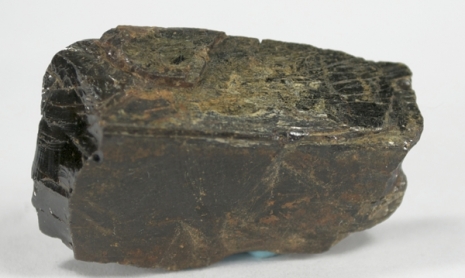
Photo: Wikimedia Commons
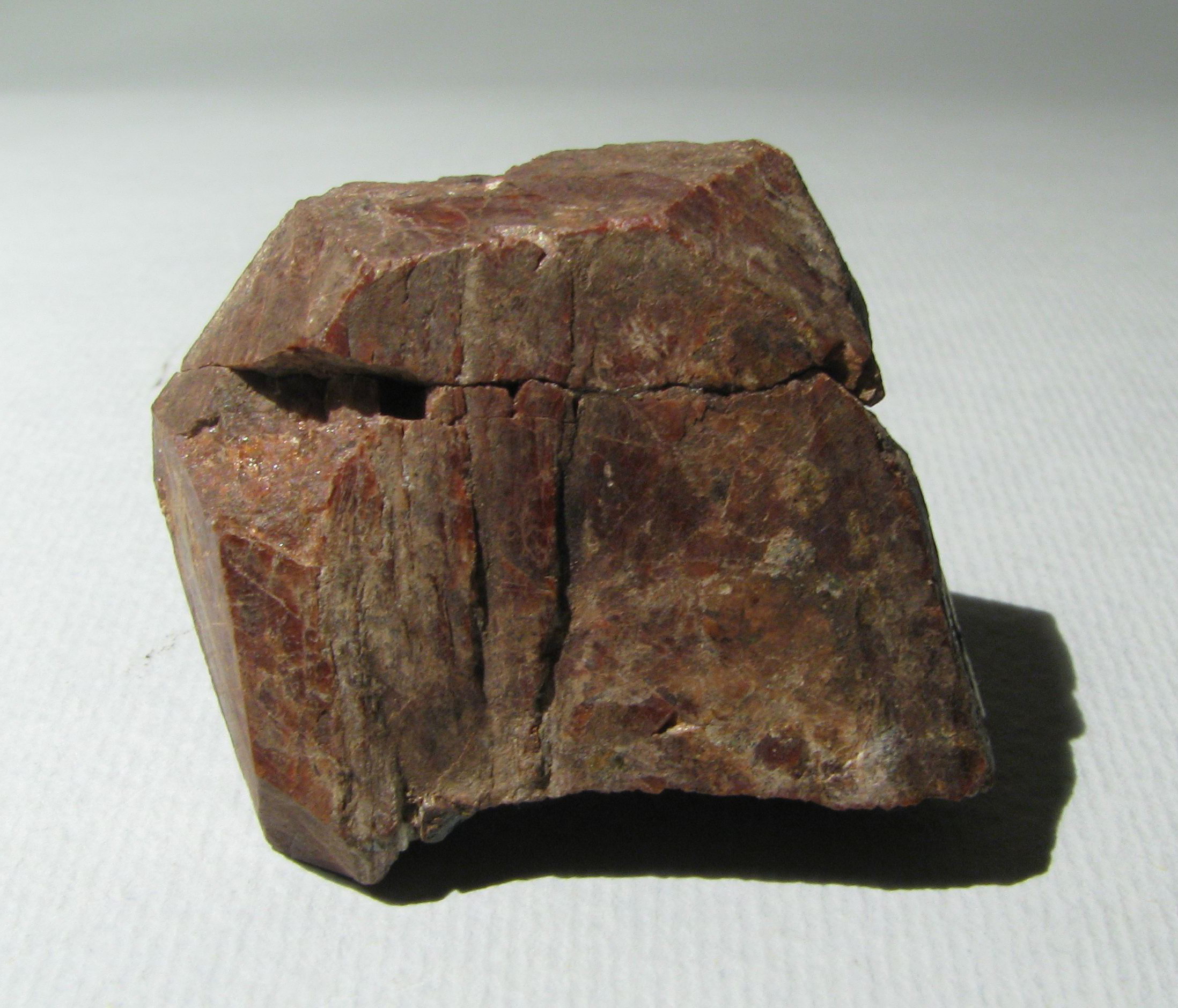
Photo: Wikimedia Commons
The best Norwegian specimens tend to reward the collector who values provenance. A Seiland zircon is not simply a zircon; it is a deep red-brown to orange crystal in biotite and nepheline from a remote Arctic nepheline syenite pegmatite. An Iveland thortveitite is not merely a rare scandium silicate; it is tied to a short-lived postwar mining rush when a gray-green mineral from small feldspar quarries became more valuable than gold. A Kongsberg silver is part of a mining field worked from the seventeenth century into the twentieth. Norway’s great appeal is that its minerals usually carry their history with them.
Search for specimens: View all specimens from Norway
The most important specimen-producing deposit type in Norway is the rare-element granitic pegmatite. Evje–Iveland, about 50 km north of Kristiansand, is the benchmark district. The pegmatites belong to the South Scandinavian pegmatite province and are hosted mainly by amphibolitic gneisses, gabbroic amphibolites, and metadiorites. They are generally feldspar–quartz–mica pegmatites rather than highly pocketed gem pegmatites, yet their accessory mineralogy is exceptional. Major minerals are K-feldspar, plagioclase, quartz, biotite, and muscovite; accessory species include beryl, monazite-(Ce), gadolinite-(Y), allanite-(Ce), fergusonite-(Y), euxenite-(Y), xenotime-(Y), zircon, rutile, ilmenite, thortveitite, columbite-group minerals, garnet, and many secondary phases.
The ore bodies of Evje–Iveland are not large continuous ore deposits in the modern mining sense. They are numerous pegmatite dikes, lenses, and irregular bodies, some rich enough in feldspar, quartz, mica, beryl, or rare-earth minerals to support small-scale quarrying. Landsverk I is among the best-known bodies: a broad pegmatite in dark amphibolite, historically worked for quartz, feldspar, mica, amazonite, and rare accessories. Landsverk III, Frikstad–Tuftane, Knipan, Slobrekka, Birkeland, Mølland, Håverstad, Steli, Solås, and other small quarries produced much of the material collectors now recognize as classic Iveland.
Mining began there because quartz was needed in the smelting of nickel ore from the Flåt mine at Evje. Feldspar later became the dominant commodity, especially after rail transport reduced costs. During the most active period around the early twentieth century, feldspar, quartz, and mica came out of many small workings. The pegmatites were never merely industrial holes in the ground, however; miners regularly encountered heavy black rare-earth oxides, large beryl, monazite, gadolinite, thortveitite, and other specimens that were sold, exchanged, or preserved in local collections.
Several Evje–Iveland workings are now collector destinations rather than industrial mines. Evje Mineralsti at Landsverk permits collecting on a managed basis during the season, and the trail passes old workings including Landsverk I and nearby mines. Iveland’s collecting sites, including Knipane, Solås, and Steli in the broader Ivelandsgruvene system, have also been promoted as fee-collecting localities with information boards and self-service arrangements. Collecting conditions change, and serious collectors should confirm access locally before visiting; many old quarries are private, partly overgrown, hazardous, or historically protected.
Langesundsfjord and the Larvik district form Norway’s other great cabinet-specimen province. Here the collecting is tied to alkaline rocks of the Oslo Rift, especially larvikite and syenite pegmatites. The mineralogy is rich in zirconium, beryllium, rare earths, titanium, and volatile-bearing alkali silicates. Zircon, eudialyte-group minerals, catapleiite, astrophyllite, eudidymite, hambergite, leucophanite, meliphanite, homilite, wöhlerite, thorite, and many other species made the fjord a classic European locality. Specimens are commonly dark, sharp, and complex: reddish-brown zircon, black aegirine, brown eudialyte/eucolite, honey to brown catapleiite, white natrolite or feldspar, and lustrous accessory minerals in coarse syenitic matrix.
Rogaland, especially the Åna–Sira anorthosite province, is Norway’s industrial titanium country. The Tellnes ore body at Sokndal is a world-class ilmenite-norite intrusion in anorthosite and has been mined since 1960. Its specimen interest is more limited than its industrial importance, because massive ilmenite ore rarely yields the crisp isolated crystals collectors want. For collectors, classic Norwegian ilmenite is more often associated with older localities such as Åmdal/Omdal in Froland, Kragerø, Arendal, and Bamble, where sharp metallic crystals and thick bladed groups are known.
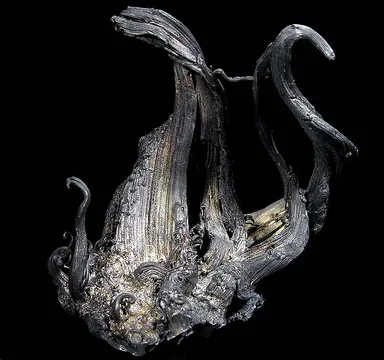
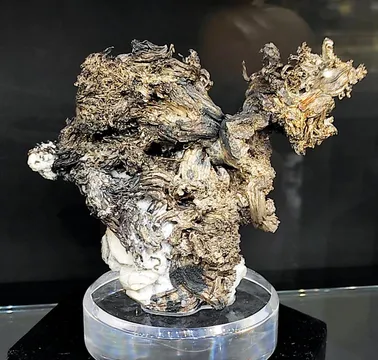
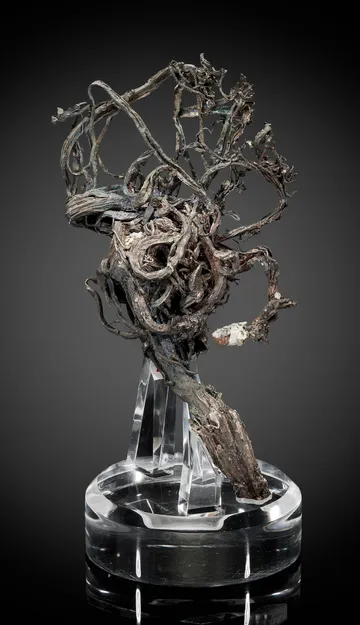
Kongsberg deserves mention even in a guide centered on the species represented here. The Kongsberg silver mines operated from 1623 to 1958 and produced some of the world’s finest native silver specimens, especially wires, sheets, and arborescent aggregates with calcite, fluorite, quartz, acanthite, and other silver minerals. The district is now a historical mining landscape; collecting at the protected mines and dumps is not legal, and specimens on the market are old material from collections, mine-era dispersals, or historic dealer stocks.
The corundum and ruby material comes principally from the Froland area in the Bamble Sector of southern Norway. Kleggåsen Ruby Quarry is the best-known collector locality, with purplish-red to violet corundum in light-colored, biotite-rich gneiss and associated alteration minerals. The material is generally mineralogical rather than gem-grade: tabular to hexagonal crystals, often fractured or included, attractive on contrasting matrix when well exposed. Other corundum-bearing rocks are documented in Froland and the wider Bamble region.
Seiland, in northern Norway, supplies a very different type of specimen: zircon in nepheline syenite pegmatite, typically on or in black biotite with pale nepheline or feldspathic matrix. The Store Kufjord material is prized because the zircon crystals can be lustrous, well formed, deep orange-red to brown, and locally translucent or gemmy. Much of the better collectible material was found during earlier working and collecting periods; modern collecting is more difficult because of remote terrain, depleted exposed material, and land-access restrictions near protected areas.
The Fen Complex at Nome is less a cabinet-specimen locality than a foundation stone of carbonatite geology. Its carbonatites, alkaline silicate rocks, fenites, rødbergites, and associated REE minerals are scientifically important, and parts of the area have been mined historically for iron and niobium. The complex is also a modern rare-earth exploration target. Collectors should approach Fen as a geological reference area rather than an open collecting ground; some localities are protected, and many of the interesting minerals are fine-grained, radioactive, or locked in research-oriented rock types.
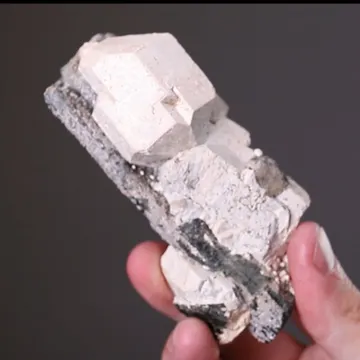
Norwegian zircon is best collected as two very different styles: the chocolate-brown, lustrous, commonly sharp crystals from the alkaline syenite pegmatites of Langesundsfjord, and the deeper orange-red to reddish-brown crystals from the Store Kufjord nepheline syenite pegmatites on Seiland. Langesundsfjord pieces are usually smaller but highly classic, often associated with feldspar, aegirine, eudialyte-group minerals, melanite, and other alkaline accessories; Seiland pieces are typically prized for color, translucency, and display on black biotite or pale nepheline/feldspathic matrix. The best Norwegian zircons show crisp tetragonal form, glassy luster, saturated color, and undamaged terminations; ordinary pieces tend to be embedded, fractured, or only partly exposed in coarse rock.
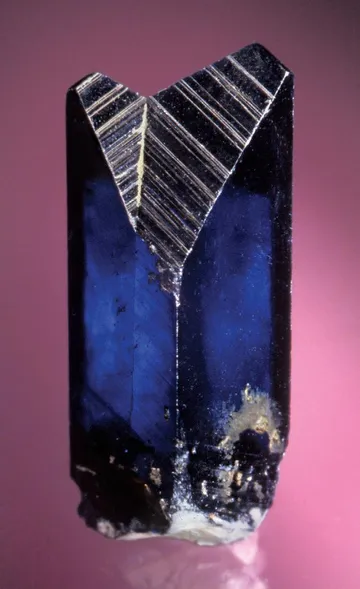
Norway’s ilmenite reputation rests on both immense titanium deposits and fine historical crystals. Tellnes in Rogaland is the industrial giant, an ilmenite-rich norite body in the Åna–Sira anorthosite province, but the most collectible crystals are more often attributed to southern localities such as Åmdal/Omdal in Froland, Kragerø, Arendal, and Bamble. Good Norwegian ilmenite specimens are heavy, black to dark steel-gray, submetallic to metallic, and may form thick bladed or tabular crystals, sometimes with rusty alteration coatings. Top pieces have sharp form, broad reflective faces, and clear locality provenance; lesser pieces are massive ore lumps, crude aggregates, or crystals so coated and altered that the form is hard to read.
Thortveitite is Norway’s great rare-mineral signature, described from Iveland material and named for Olaus Thortveit after the new scandium silicate was recognized from the Ljosland–Knipan area. In Evje–Iveland it occurs in granitic pegmatites as gray-green, gray, brownish, or nearly black crystals, often prismatic, flattened, radial, or embedded in quartz and feldspar; type material included crystals exceeding 25 cm in length and 4 cm in thickness arranged in radial rosettes. Collector-quality specimens are judged by visible crystal form, size, surface preservation, association with feldspar or quartz matrix, and firm old-locality provenance from Knipan, Tuftane/Frikstad, Landsverk, or related Iveland workings; unattractive but genuine masses are commoner than sharp, three-dimensional display crystals.
Norwegian monazite for collectors is chiefly monazite-(Ce) from the Evje–Iveland pegmatites, where it occurs as brown, yellowish-brown, reddish-brown, or dark tabular to blocky crystals in feldspar, cleavelandite, quartz, and mica-rich pegmatite zones. Landsverk I is especially notable because the RW-1 monazite reference crystal, a 44 g yellowish-brown crystal from the quarry, has been used for U-Th-Pb microbeam dating work, while Rostadheia and other Iveland occurrences have produced handsome tabular cabinet pieces. The best specimens are isolated, well-faced crystals with enough matrix contrast to show the form; ordinary pieces are embedded, broken, or confused visually with other brown-black rare-earth accessories unless backed by analysis or reliable labels.
Norwegian corundum is most collectible from Kleggåsen Ruby Quarry in Froland, where purplish-red to violet crystals occur in a light-colored, biotite-rich gneiss and associated corundum-bearing metamorphic rocks of the Bamble Sector. Crystals commonly show basal tabular hexagonal form, with basal faces generally in the 1–4 cm range and larger crystals reported; thickness is often modest, and many crystals are fractured, included, or partly altered. The best pieces display a distinct ruby-colored crystal standing free or well exposed against pale feldspathic or mica-rich matrix; ordinary material is massive, dull, highly included, or so embedded that the corundum identity is visually weak.
Gadolinite-(Y) from Evje–Iveland is one of the classic heavy black rare-earth silicates of European pegmatite collecting, especially from Slobrekka, Birkeland, Frikstad, and nearby Iveland workings. At Slobrekka, historic production was large enough to be measured in tons, and individual crystals of extraordinary mass were recorded, but collector pieces range from small glossy crystals to nearly 10 cm examples found after the quarry was opened to collectors in the early 2000s. The mineral may be embedded in microcline or plagioclase, associated with muscovite, garnet, allanite-(Ce), monazite-(Ce), aeschynite-(Y), fergusonite-(Y), and secondary REE carbonates such as tengerite-(Y) and kamphaugite-(Y). The finest specimens show coherent crystal form and bright surfaces; lesser pieces are metamict, cracked, altered, or easily mistaken for dark garnet, euxenite, aeschynite, or smoky quartz without analysis.
Aeschynite-(Y) is a defining rare-earth oxide of the Evje–Iveland pegmatites, with the Mølland quarry particularly celebrated for world-class crystals collected by the owner Knut Mølland from the 1970s through the mid-1990s. Norwegian specimens are typically brown to nearly black, resinous to submetallic, and orthorhombic in habit, occurring in feldspar-rich pegmatite and especially at contacts between biotite and K-feldspar; reported display crystals can be several centimeters, and museum pieces from Mølland and related Iveland localities are much larger. Good aeschynite is all about form: sharp edges, intact terminations, glossy faces, and an unmistakable matrix setting; average material is dark, metamict, chipped, or visually interchangeable with euxenite, polycrase, gadolinite, or other “black minerals” unless documented.
Norway produces quartz in immense industrial quantity, but collectible quartz is more selective: smoky and rock-crystal specimens from Evje–Iveland, Hurum and the Oslofjord region, Hardangervidda cleft-style occurrences with anatase or rutile, and pegmatite cavities such as those at Landsverk and Ljoslandåsen. At Evje–Iveland, quartz can be massive industrial material, milky pegmatite core quartz, smoky crystals, clear “bergkrystall,” and cavity crystals with albite, adularia, fluorite, stilpnomelane coatings, or phantom growth; Ljoslandåsen is documented for quartz with phantoms on albite. The best Norwegian quartz is judged by transparency, undamaged terminations, attractive smoky zoning or inclusions, and locality-specific associations; common milky chunks and blasted pegmatite quartz have little collector value unless they carry other species.
Biotite is one of the structural minerals of Norway’s pegmatite story rather than a frequent showpiece on its own. In Evje–Iveland it is a major mica in the feldspar–quartz pegmatites, occurring as dark books and flakes in bodies such as Landsverk I, Steli, and many Iveland quarries, and it is a common matrix partner for rare-earth minerals including gadolinite, monazite, aeschynite, euxenite, zircon, and garnet. At Steli it is described as large flakes, commonly altered to chlorite, and in Seiland zircon specimens it forms the dark mica matrix that makes the reddish-brown zircon crystals stand out. Collectible biotite from Norway is best when it serves as an aesthetic matrix or forms unusually large, coherent books; ordinary weathered flakes are fragile, altered, and easily shed from specimens.
Norwegian ruby is the purplish-red to violet corundum from Kleggåsen Ruby Quarry at Froland, a locality valued more by mineral collectors than by gem cutters. The crystals are typically tabular hexagonal plates or thick flattened crystals in contrasting pale and dark metamorphic matrix, with associated biotite-rich gneiss and local alteration minerals such as diaspore around corundum. Good Norwegian ruby specimens have saturated color, a recognizable hexagonal outline, relief above the matrix, and minimal crushing around the edges; most material is opaque to translucent at best, included, fractured, or too dark and impure to be considered gem ruby, but strong matrix contrast makes the best pieces highly displayable.
Almandine in Norway occurs both in metamorphic rocks and in pegmatitic associations, but much of the Evje–Iveland garnet suite sits along the almandine–spessartine series rather than as pure end-member material. Steli Feldspar Quarry is a documented Iveland locality where analyzed garnets have an almandine-dominant component, with small red-brown crystals in feldspar matrix; other almandine occurrences are recorded from Arendal, Froland, Risør, Kragerø, Tvedestrand, Rogaland localities, and the Bodø–Fauske region. The best Norwegian almandine specimens show sharp dodecahedral or trapezohedral form, good wine-red to brown-red color, and matrix contrast; many pieces are dark, fractured, weathered, or compositionally intermediate enough that “garnet” or “almandine-spessartine series” is more honest than a confident end-member label.
Beyond those species, Norway is exceptionally rich in type-locality and rarity material. Evje–Iveland includes the type locality of thortveitite and is associated with davidite-(Ce), tombarthite-(Y), and a deep list of REE, Nb-Ta-Ti, Be, Sc, U, and Th minerals. Langesundsfjord and the Larvik area are classic for astrophyllite, eudidymite, hambergite, homilite, leucophanite, meliphanite, nordenskiöldine, rosenbuschite, thorite, wöhlerite, eudialyte-group minerals, catapleiite, aegirine, and zircon. The Fen Complex anchors carbonatite petrology and rare-earth mineralization, while Jølster is historically tied to euxenite-(Y). Kongsberg native silver, Modum cobalt minerals, Hardangervidda anatase on quartz, Byrud emerald, Åheim forsterite, Sulitjelma sulfates and sulfides, and the Bamble Sector’s metamorphic rarities all broaden Norway beyond the pegmatite cabinet.
Norwegian locality labels matter. “Norway” alone is rarely adequate for better specimens, because the same species may have radically different value and appearance from different districts. Zircon from Langesundsfjord, zircon from Seiland, and zircon from an Evje pegmatite are not interchangeable. Ilmenite from Åmdal/Omdal, massive Tellnes ore, and old “Arendal” or “Kragerø” crystals occupy different collecting categories. For garnets, “almandine” should be treated cautiously unless the label or analysis supports it; Evje–Iveland garnets commonly sit in the almandine–spessartine range, and many old labels use broader or outdated terminology.
The greatest identification problem in Norwegian pegmatites is the group of dark, heavy, commonly metamict rare-earth and high-field-strength-element minerals. Gadolinite, aeschynite, euxenite, polycrase, fergusonite, samarskite, allanite, thortveitite, xenotime, monazite, ilmenorutile, and altered zircon can look deceptively similar when broken, weathered, or embedded in feldspar. Serious specimens should be retained with old labels, mine names, collector notes, and analytical history. If a dark Iveland crystal is expensive, attractive, or represented as a rare species, visual identification alone is not enough.
Condition is another major issue. Many Norwegian rare-earth minerals are metamict or partly altered by radiation damage and hydration. They may show internal cracking, dull or greasy surfaces, crumbly edges, secondary crusts, or a tendency to break along altered zones. Gadolinite and aeschynite can be brittle; monazite and xenotime may be small but dense and easily chipped; thortveitite may be massive, friable on weathered surfaces, or contacted where it grew against feldspar and quartz. Cleaned pieces should not be aggressively acid-treated without knowing the matrix and accessory minerals, because feldspar alteration, iron oxides, carbonate fillings, and secondary REE minerals may be part of the specimen’s identity.
Radioactivity is a normal consideration for Norwegian rare-element pegmatite and carbonatite material. Monazite, thorite, euxenite, samarskite, allanite, aeschynite, gadolinite, uraninite, cleveite, and related minerals may contain thorium, uranium, or radiogenic lead. Most small cabinet specimens are easily managed with ordinary precautions: store them in ventilated boxes or cabinets, wash hands after handling, avoid inhaling dust, never grind or saw radioactive specimens indoors, and keep crumbly material sealed. Large masses, especially old ore pieces or radioactive black minerals from Evje–Iveland or Fen, deserve measurement and sensible storage away from living spaces.
Documented outright fakes specific to Norway are not a major theme in the literature, but mislabeling is common. Old European labels may use broad district names such as “Arendal,” “Iveland,” “Evje,” “Langesundfjord,” “Bamble,” or “Kragerø” when the exact quarry is unknown. “Ruby from Norway” is sometimes promoted with gem-language that overstates transparency or gem value; most Froland ruby is mineral-specimen corundum, not facetable gem material. “Citrine” from pegmatite areas should be viewed with the same caution applied worldwide, because heat-treated quartz is common in the mineral trade; Norwegian provenance should be supported by locality-specific labels and appearance.
Access is a practical concern. Managed collecting sites such as Evje Mineralsti and Iveland collecting quarries are the best route for visitors. Kongsberg’s historic silver mines and dumps are protected; collecting there is illegal. Active quarries, including larvikite and industrial mineral operations, require permission and proper safety arrangements. National parks, protected geological sites, private land, and mine hazards are real limitations. Norway has a strong outdoor tradition, but mineral collecting is not a license to damage outcrops, enter unsafe workings, or remove material from protected areas.
Market availability is uneven. Small Norwegian quartz, feldspar, mica, garnet, and common pegmatite pieces are readily available in local and online trade. Good Seiland zircon, sharp Iveland thortveitite, large well-formed gadolinite, strong Mølland aeschynite, fine Langesundsfjord zircon, and old Kongsberg silver are much scarcer and increasingly provenance-driven. The best pieces are often in Norwegian municipal collections, the Fennefoss museum, the Natural History Museum in Oslo, older European private collections, or long-settled dealer inventories. When a genuinely sharp, well-labeled specimen appears, the label is part of the specimen.
In the 1950s, Iveland had its own mineral Klondike. The metal driving the rush was not gold, and the mineral did not look glamorous: thortveitite is grayish to greenish, heavy, and easy to overlook beside prettier pegmatite minerals. But after the Second World War, scandium suddenly mattered. The United States and Soviet Union were racing into the atomic and space age, laboratories were exploring high-performance materials and laser-related uses, and the rare scandium mineral from the small feldspar quarries of inland Agder became astonishingly valuable. For a short period, thortveitite was reported as costing three times as much as gold.
The story had begun decades earlier. In 1903 the geologist and polar researcher Per Schei found the mineral at Evje, but he labeled it as epidote. Seven years later, Olaus Thortveit, a farmer, trader, timber merchant, feldspar exporter, and rare-mineral dealer from Iveland, visited a small quarry at Knipan on Ljosland after fresh blasting. In the broken pegmatite he noticed a mineral neither he nor the quarry workers recognized. Thortveit sent a sample to Professor Jakob Schetelig at the Mineralogical-Geological Museum in Oslo. Schetelig recognized a new species and named it thortveitite for the man who had submitted it.
Olaus Thortveit’s life ended before the mineral bearing his name became famous. In 1914 he received the King’s Medal of Merit in gold for his contribution to mineralogical research and the development of the local feldspar industry. Tuberculosis later brought him to Landeskogen sanatorium, and he died in 1917 at only 44. By then the name “thortveitite” had entered mineralogy, but the spectacular 1950s scandium market was still decades away.
The most vivid postwar episode belongs to the Landsverk brothers: Willy, Orest, and Arthur. In 1955 they began searching systematically for thortveitite in Iveland. During that first year they found about 20 kg. With a price that could reach 20 Norwegian kroner per gram, the result was a serious rural windfall. The work continued for several years, and old photographs by Birger Dannevig in 1958 show the brothers in the thortveitite workings—small-scale mining driven not by a huge ore body, but by the possibility that one dark, overlooked pegmatite mineral could pay more than almost anything else in the rock.
The rush did not last. At its height, around 25 mines in Iveland were reportedly working thortveitite. By the early 1960s, the activity had largely stopped as demand fell and easily workable occurrences became harder to find. Some of the same places later shifted from industrial ground to collecting ground. The result is one of Norway’s great mineral transformations: the old quartz, feldspar, mica, beryl, and thortveitite workings that once supplied smelters, ceramic factories, exporters, and laboratories became the places where collectors now search the dumps for amazonite, cleavelandite, quartz crystals, monazite, euxenite, and an occasional rare black mineral.
Slobrekka has its own memorable chapter. Historic work there yielded enough gadolinite that production before 1935 was calculated at about two tons, and postwar production may also have reached ton-scale quantities. The most astonishing reported crystal exceeded 500 kg and was remembered by the miner Osmund Jensen Frigstad as standing in the pegmatite like a “squatting man.” Nearby workings in the Frikstad and Birkeland area also produced crystals in the 200 kg range. These were not delicate thumbnails for perky boxes; they were dense, black rare-earth minerals quarried as heavy, valuable masses from feldspar pegmatite.
When Slobrekka was opened to collectors in the early 2000s, it became a rare example of an old Norwegian pegmatite locality with renewed specimen production. Collectors found gadolinite-(Y) crystals commonly in the 2–3 cm range, and a few exceptional pieces approached 10 cm. The same quarry yielded aeschynite-(Y), monazite-(Ce), allanite-(Ce), fergusonite-(Y), bismuthinite, spessartine, muscovite, albite, and secondary REE minerals. For the field collector, Slobrekka’s lesson is classic Iveland: the important specimen may be black, dense, and half-hidden in feldspar, but the difference between a common lump and a world-class rare-earth crystal can be a single preserved face.


-432814.jpg)
