A collector's guide to Hardangervidda, Norway: its geology, mining history and notable minerals, illustrated with the 88 specimens documented from this locality on EarthWonders.
Key facts
Hardangervidda is not a mine in the usual sense, and that is part of its fascination. The classic specimens come from alpine-type fissures and low-temperature quartz-adularia veins cutting Caledonian phyllites and mica schists on the high plateau of western Hardangervidda, particularly in the Ullensvang–Odda district above Ringedalsvatnet. For collectors, the name means one thing above all: sharply formed, lustrous, blue-black anatase set on clear to smoky quartz, sometimes with adularia, brookite, rutile, chlorite, pyrite, and minor late alteration products. The best pieces have the clean, architectural look of alpine cleft specimens, but with anatase crystals unusually large and sculptural for the species.
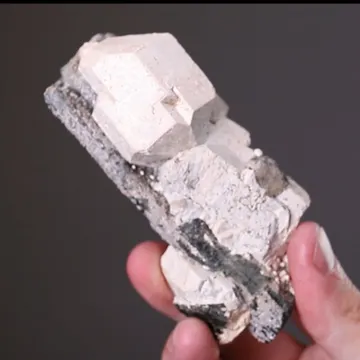
The fame of the locality rests on finds from Matskorhæ and Geiteryggen, with additional material reported from the Ringedalsvann, Storenut, Nibbenut, Endenut, Dyrfonni, and related western Hardangervidda occurrences. Matskorhæ produced the old classic groups: transparent quartz crystals dusted, studded, and sometimes internally included with sharp tetragonal anatase bipyramids. Geiteryggen added a different look—large, thick anatase crystals on white to near-white adularia and quartz, some showing basal pinacoids, brown-blue zoning, and a high metallic luster that made the locality a modern reference point for the species.
Regional View
Country View
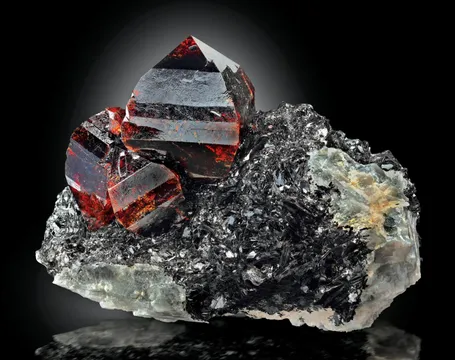
The best Hardangervidda specimens are compact, high-contrast objects: glassy quartz prisms carrying dark metallic pyramids; white adularia plates sprinkled with anatase; or single sharp anatase crystals whose color shifts from black to sapphire blue or brown in transmitted light. Many ordinary pieces are merely attractive alpine quartz with scattered tiny anatase; the great ones combine unabraded crystal edges, strong luster, visible crystal geometry, and a matrix that frames rather than hides the anatase.

Photo: Wikimedia Commons
Search for specimens: View all specimens from Hardangervidda, Norway
The collectible material belongs to alpine-type fissure and vein mineralization in the western part of Hardangervidda, a high mountain plateau divided historically among Hordaland, Telemark, and Buskerud and now represented in part by Vestland. In recent mineralogical literature, the productive collector district is commonly called Hardangervidda West. The host rocks at Geiteryggen are described as dark gray to green, lime-free phyllite in a Caledonian nappe over basement rocks that crop out roughly two kilometers to the north and east. The phyllite is folded, locally biotite-bearing, and cut by several vein generations.
At Geiteryggen, NGU fieldwork distinguished four vein generations. The oldest two are quartz-dominated, folded, and generally unproductive for display specimens. The economically and aesthetically important mineralization is in the younger V3 and V4 systems. V3 veins are quartz-rich and locally as much as 2.5 m thick; in their thicker parts they contain druses with free-grown quartz, and anatase may occur on or included in those quartz crystals. V4 veins are narrow, steep, open fissures lined with millimeter-scale adularia. Where these later adularia-bearing fissures cut and brecciate the quartz-rich V3 veins, the best anatase is developed. That crossing of vein generations explains why the finest crystals are pocket-controlled and difficult to predict from surface exposure alone.
Matskorhæ, east of Ringedalsvatnet and outside the border of Hardangervidda National Park, is the best-known older locality. Its famous specimens are transparent quartz clusters carrying sharp blue-black anatase bipyramids, typically in the 5–10 mm range. The locality was already known and protected by the 1970s, and it is now considered exploited. It also acquired the collector nickname “Grisebingen,” meaning “the pig pen,” because of the dirty working conditions in the phyllite and clay-rich pocket material.
Geiteryggen, also called Dyrfonni in some accounts, became a major modern source. The occurrence was investigated by NGU in 1999 after heavy unauthorized collecting the previous year. The report describes anatase in the rock mass as fine grains and, much more importantly for collectors, as free-grown crystals in cavities in veins. The most desirable crystals were those on quartz and low-temperature feldspar, especially adularia, with additional brookite, titanite, chlorite, and pyrite in the assemblage. Specimen production there was not ordinary mining; it was high-altitude, hand-tool extraction of collector pieces from fissures, druses, and brecciated vein intersections, complicated by short snow-free seasons and difficult transport.
There are no conventional ore bodies here in the sense of a worked metal mine. The “ore” was collector value: anatase crystals and quartz groups. The mineralization is titanium-bearing but specimen-grade, and the productive zones were pockets rather than continuous extractive ore. The same geological setting also explains the strong quartz component of the district—clear rock crystal, smoky quartz, rutilated quartz, and pocket quartz from alpine clefts occur across the western Hardangervidda occurrences, while anatase is concentrated in fewer, more celebrated sites.
Collecting access is now a serious issue. Some Hardangervidda anatase and quartz localities are inside Hardangervidda National Park, where mineral collecting and removal are prohibited. Matskorhæ is protected and collecting there is strictly forbidden. Other localities lie on state common land or land with specific ownership and mineral-rights complications, and historical enforcement around the anatase occurrences has been unusually strict by Norwegian collecting standards. For modern collectors, Hardangervidda is principally a provenance and acquisition locality, not a casual field-collecting destination.
Hardangervidda anatase is the locality’s calling card: sharp TiO2 crystals in tetragonal bipyramids, commonly deep blue, blue-black, brown-black, or nearly opaque black with metallic luster, and locally brown to sapphire-blue zoning visible in strong light or thin edges. Matskorhæ material is classically anatase on and in transparent quartz, with crystals commonly 5–10 mm and the largest known complete or near-complete quartz-hosted examples around 8–9 mm, plus an incomplete 13 mm crystal from a phyllite cavity; the most prized pieces show multiple sharp bipyramids cleanly displayed on glassy quartz. Geiteryggen material is more often associated with white to near-white adularia and quartz, and the finest crystals grew where younger adularia-bearing fissures crossed quartz-rich veins; there, centimeter-scale anatase, basal pinacoids, ribbed faces, polysynthetic color zoning, and cabinet-quality contrast distinguish the best examples from ordinary scattered microcrystals.
Quartz from Hardangervidda is not merely a matrix mineral for anatase; it is one of the district’s specimen attractions in its own right, especially as clear rock crystal from alpine-type vugs and fissures. At Matskorhæ the crystals are long-prismatic and dominated by prism and rhombohedral faces, with occasional trigonal forms; clear crystals from open vugs contrast with smoky material from breccia and vein zones. Reported sizes at Matskorhæ include crystals to about 15 cm long and 5 cm in diameter, with 5–10 cm crystals once common, and a Japan-law twin documented from the locality. The best quartz specimens from Hardangervidda combine glassy transparency, undamaged terminations, a natural pocket surface, and well-placed anatase, rutile, or chlorite inclusions rather than simply being loose, waterworn, or massive vein quartz.
Smoky quartz from Hardangervidda occurs within the same alpine-cleft and vein systems as the clearer rock crystal, especially in breccia and vein material at Matskorhæ and in the Ringedalsvann–Storenut–Nibbenut part of the western district. The color is generally light to medium smoky rather than the dark “morion” style of some granitic pegmatites, and the most collectible pieces are sharp, transparent to translucent crystals that retain the elegant Hardangervidda prismatic habit and carry anatase, adularia, rutile, chlorite, or brookite associations. A good smoky quartz from here should be evaluated less as a smoky quartz rarity and more as a Hardangervidda alpine-cleft composition: clarity, intact terminations, natural luster, and the placement of dark anatase or rutile inclusions are what lift it above common brownish quartz.
Other documented Hardangervidda minerals include brookite, rutile, adularia, albite, orthoclase, pyrite, chalcopyrite, goethite, hematite, titanite, chlorite-group minerals, molybdenite, manganese oxides, opal, hyalite, apatite, and amphibole-group byssolite from the wider western district. Brookite is especially relevant to anatase collectors: at Matskorhæ it occurs as red-brown platy crystals to about 5 mm, and at Geiteryggen as thin reddish translucent flakes with metallic luster, sometimes associated with anatase and adularia. Rutile appears as hairlike crystals to about 1.5 cm in cavities at Matskorhæ and as inclusions in quartz elsewhere. Titanite at Geiteryggen is a micromount-scale rarity, described as honey-yellow, V-shaped twins of about 1–2 mm on adularia, commonly with chlorite. The district is not known as a type-locality suite; its mineralogical importance is instead its world-class anatase-quartz-adularia alpine-cleft assemblage and the exceptional preservation of small but highly sculptural TiO2 crystals.
Hardangervidda provenance matters. Labels reading simply “Hardangervidda” may be accurate but imprecise; more useful labels specify Matskorhæ, Geiteryggen, Dyrfonni, Ringedalsvann area, Storenut, Nibbenut, or another named occurrence. Older labels may use Hordaland rather than Vestland, Odda rather than Ullensvang, or “Ullensvang Statsalmenning” in ways that can be confusing. “Tysse” is a particularly problematic label for some older anatase specimens: it has been used as a broad or obscuring place-name rather than a precise anatase locality, and at least one well-known specimen note indicates that the label may have been used to conceal the exact source.
Mislabelling is not a theoretical issue here. NGU’s 1999 report on Geiteryggen describes unauthorized material from the occurrence being sold internationally with “Valdres” falsely given as the locality, even though Valdres anatase has a different appearance. The report specifically proposed geochemical fingerprinting of anatase and associated adularia as a way to separate material from Geiteryggen, Matskorhæ, and Valdres. For serious buyers, a trustworthy old label, collection history, or dealer chain is unusually important.
Condition is the main value divider. The anatase crystals are hard enough for normal cabinet handling but occur as exposed, sharp-edged bipyramids, and even slight chipping on the pyramid edges noticeably reduces quality. Geiteryggen crystals reported during field investigation were often scratched or edge-damaged; undamaged crystals of similar size are correspondingly scarcer. Quartz may show bruising, rehealed fractures, embedded phyllite, clay films, chlorite dusting, manganese-oxide coatings, or minor limonite from altered pyrite. Some black manganese coatings on Matskorhæ quartz have been reported as removable by gentle brushing, but aggressive cleaning can dull surfaces, loosen small anatase, or alter the natural pocket character.
The market supply is finite and uneven. Matskorhæ is protected and largely exhausted, and many national-park occurrences are closed to collecting. Geiteryggen material entered the market in notable quantities around the late 1990s, but fine specimens are no longer abundant as fresh production. Small anatase-on-quartz pieces and micromounts still appear; large, aesthetic matrix specimens with lustrous centimeter-class anatase, especially on white adularia or sharp clear quartz, are far less common and command strong collector attention.
Fluorescence is not a buying feature for the classic anatase specimens, and the locality should be judged visually under daylight-equivalent lighting and a strong loupe. Backlighting can reveal the best color—blue, brown, or colorless zoning in anatase, and smoky tone or inclusions in quartz—but display lighting should avoid excessive heat. For storage, protect exposed anatase crystals from contact with other specimens, and keep labels with the piece; at Hardangervidda, provenance is part of the specimen.
The most famous Hardangervidda locality earned a name that sounds more like a farmyard insult than a mineral classic. Matskorhæ was nicknamed “Grisebingen”—“the pig pen”—because the collectors who worked it dealt with dirty, clay-rich, phyllitic pocket material. Out of that mess came some of Norway’s most elegant specimens: transparent quartz crystals freckled with blue-black anatase bipyramids, many in the 5–10 mm range. The contrast is the whole story in miniature: miserable working conditions, immaculate geometry.
Geiteryggen’s modern history reads more like a mineral-rights case file than a collecting romance. In 1999, NGU reported that the occurrence, then under a claim associated with K. Moltu of Tau, had been worked the previous year without permission. The amount was not trivial: roughly two hundred anatase specimens were said to have been taken and sold at the Munich and Tucson mineral shows for about 700,000 Norwegian kroner. The report went further, estimating that the price per 300 specimens would put the material well over one million kroner. For a remote high-plateau fissure deposit worked by hand, those figures explain why Hardangervidda anatase became a legal, ethical, and economic problem as much as a mineralogical treasure.
The same report gives a vivid picture of why the Geiteryggen pocket system was so alluring. The best crystals were not scattered randomly through the rock; they formed where two generations of veins met. A quartz-rich V3 vein could contain druses of rock crystal, but when a later adularia-lined V4 fissure cut through and brecciated it, anatase reached its best development. The geologist’s description is almost a collector’s field dream: white adularia, double-terminated quartz, anatase, brookite, titanite, chlorite, and the possibility of crystals several centimeters across. One figure caption notes a roughly 2 cm anatase crystal found underground by Sven Åge Svensen, described with the delighted phrase “Heldiggrisen”—the lucky pig.
There is also a detective story in the labels. Some of the Geiteryggen material, according to the NGU report, was offered with “Valdres” as the locality. That was not a harmless rounding-off of geography; Valdres is a different Norwegian anatase district. The report proposed that anatase and adularia from Geiteryggen, Matskorhæ, and Valdres could be compared by trace-element analysis, essentially giving each locality a geochemical fingerprint. In a district where a few hundred specimens could represent a million-kroner question, the matrix minerals became evidence.
A 2007 field account from the wider Storenut–Ringedalsvann area captures the physical reality of looking for these clefts. In July, the area was still 40–60% snow-covered, forcing the collectors to work only the exposed ground and leftovers from earlier rockhounds. The fissures they observed ran roughly north-south and cut across the mica-schist layering, unlike barren segregation quartz veins that ran parallel to the schist. Some openings were only centimeters high; others were more than a meter, and one fissure system could be traced for about 50 m at the surface. The field note is useful precisely because it is not romantic: large areas of mica schist were barren, the gneiss and migmatite around Storenut seemed almost devoid of fissures, and success came down to recognizing the rare open structures rather than smashing every quartz seam.