






Buskerud, Norway — Kongsberg native-silver veins, Modum cobalt-arsenides, and Snarum magnesite-phosphates; mines and type-mineral finds appeal to collectors.
Key facts
Buskerud is not a single-pocket locality but a compact mineralogical province, and that is why the name carries unusual weight on old labels. Within the county are three quite different collector worlds: the native-silver veins of Kongsberg, the cobalt-arsenide ores of Modum, and the magnesite-serpentine phosphate localities around Snarum. To these must be added the Oslo Rift granites around Drammen, Lier, Eikeren and Skrim, whose miarolitic cavities have produced smoky quartz, feldspar, fluorite, apatite-group minerals and rarer late-magmatic phases. Few European regions pack so much specimen history into such a short drive: royal silver mines begun in the 1620s, a cobalt-blue pigment industry founded in 1776, classic hydroxylapatite at Oksøyekollen, and a cluster of type-locality minerals from the Modum serpentinite-magnesite bodies.
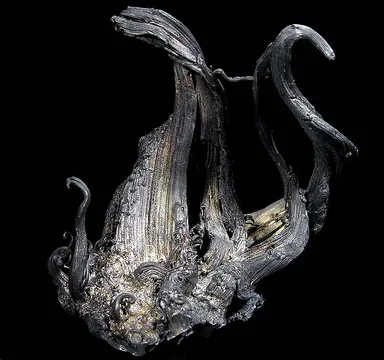
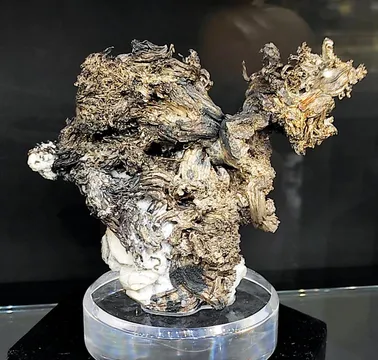
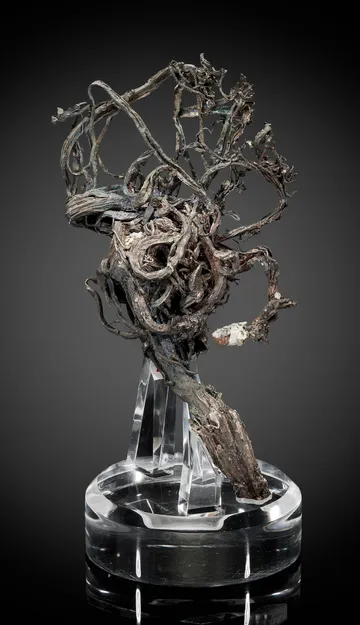
The specimen look is equally varied. Kongsberg’s best pieces are unmistakable: wires, ropes, plates, hackly masses and crystals of native silver, commonly emerging from white to grey calcite and sometimes associated with acanthite, fluorite, quartz, pyrrhotite, sphalerite, cobalt-nickel arsenides and silver sulfosalts. Modum cobalt specimens tend toward metallic arsenides and sulfarsenides with earthy to velvety erythrite alteration. Snarum and Tingelstadtjern material is quieter but highly prized by systematic collectors: pale, massive to nodular magnesium phosphates in serpentine and magnesite, plus the famous off-white to chalky hydroxylapatite crystals from Oksøyekollen, often set with albite and dark amphibole. Buskerud is therefore a locality name that appeals both to the aesthetic collector and to the type-mineral specialist.
Regional View
Country View
Geologically, Buskerud lies across several important Norwegian domains. The Kongsberg-Modum belt belongs to the Precambrian basement along the western side of the Oslo region, while the Drammen, Eikeren-Skrim and related intrusions are part of the Permian Oslo Rift igneous province. The contrast is important for collectors: Kongsberg silver is a hydrothermal vein system controlled by fractures cutting old gneisses and amphibolites, especially where the veins intersect sulphide-rich “fahlband” zones; the Snarum-Tingelstadtjern phosphate assemblages belong to serpentinized, magnesite-bearing rocks in the Modum area; the Drammen-Lier specimens come from late-stage cavities in granite. Buskerud’s mineral wealth is not one event, but a stack of events: deep Precambrian metamorphism, serpentinization and carbonate alteration, Permian rifting and hydrothermal circulation, and centuries of mining that brought the specimens to light.

Photo: Wikimedia Commons

Photo: Wikimedia Commons
Search for specimens: View all specimens from Buskerud, Norway
For mineral collectors, Buskerud is best treated as a county-level locality made up of several classic sub-localities rather than one mine. The greatest of them is Kongsberg, west of Oslo, where native silver was mined from hydrothermal veins in Precambrian gneissic and amphibolitic country rock. The productive silver veins are traditionally understood in relation to sulphide-rich fahlbands: schistose, dark, sulphide-bearing zones containing minerals such as pyrite, pyrrhotite, chalcopyrite, arsenopyrite and other ore phases. The richest silver-bearing calcite veins are most important where the fracture system intersects these zones. This geological relationship explains the classic Kongsberg paragenesis: native silver in calcite, with acanthite, fluorite, quartz, pyrrhotite, sphalerite, galena, silver sulfosalts, cobalt-nickel arsenides and related minerals appearing in different parts of the district.
Kongsberg’s mining history began with the 1623 silver discovery in the northern Sandsvær area and the establishment of the mining town by Christian IV in 1624. Over its long life the Kongsberg Silver Works developed into Norway’s most important historic mining enterprise. The operation ultimately produced about 1,350 tonnes of silver before closure in 1958. At its peak in 1770 it employed 4,075 people, and the town’s institutions, smeltery, mine buildings, coinage, engineering traditions and later museum collections all grew out of that silver industry. For specimen collectors, Kongsberg was significant almost from the beginning: attractive native-silver pieces were recognized as objects of display, not merely ore for the furnace, and the locality became one of the defining world sources for wire silver.
The Kongsberg district was not a single shaft. It consisted of numerous mines and workings spread through the mining fields around Gruveåsen, Saggrenda, Overberget and related areas. The Kongens Mine, Gottes Hülfe in der Noth Mine, Mildigkeit Gottes Mine, Armen Mine and many other names occur on specimen labels. Such sub-locality information matters. A label that says only “Kongsberg” is still meaningful, but a precise mine name, old collection label, or reference to Overberget, Underberget, Vinoren or Svene can add both historical and mineralogical value.
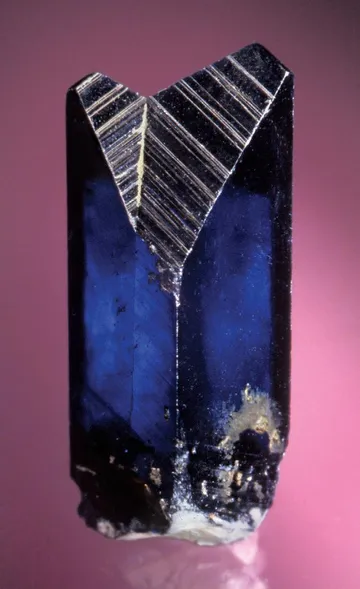
Modum, north and east of Kongsberg, adds a second major chapter. The Skuterud cobalt mines supplied cobalt ore for Blaafarveværket, the Royal Modum Blue Colour Works, founded in 1776. The Modum cobalt mineralization is Norway’s only deposit group mined with cobalt as the primary commodity. The ore assemblage includes cobaltite, glaucodote, safflorite, skutterudite and related arsenide or sulfarsenide minerals, with erythrite as the familiar pink to purple secondary alteration mineral. Skutterudite, CoAs3, takes its name from the Skuterud mines and remains one of Buskerud’s most important type-locality minerals. Ordinary production began in 1776, initially from open pits; underground mining followed from 1827, and the operation declined as reserves fell before final shutdown in 1898.
Snarum and nearby Modum serpentinite-magnesite localities are the third collector focus. Small bodies of serpentine and magnesite in Precambrian rocks were quarried for magnesite and serpentine, and they yielded a suite of magnesium carbonates, hydroxides, borates and phosphates that is far more significant than the size of the workings suggests. Dypingdal is famous as the type locality for hydrotalcite and dypingite, and it also produced hematite crystals embedded in serpentine and hydrotalcite-group material. Tingelstadtjern is especially important for magnesium phosphates: althausite, holtedahlite, heneuite and raadeite are type-locality minerals there, occurring as masses, nodules, veinlets and replacement textures in serpentine-magnesite rock with apatite-group minerals, magnesite, talc, szaibélyite and magnetite. These are not showy minerals in the cabinet sense, but they are major systematic and type-suite species.
Oksøyekollen at Snarum is the county’s key hydroxylapatite locality. It is separate from the serpentine localities of Snarum and has a long history on Norwegian labels, including older spellings such as Oksøykollen and Oxøiekollen. The locality was already known through nineteenth-century work on Norwegian apatite occurrences, and modern analytical work has clarified that the classic crystals from Oksøyekollen are hydroxylapatite rather than simply “apatite” in the older broad sense. Its crystals, often opaque grey-white to chalky white, are found with albite, hornblende or actinolite-group amphibole, quartz, monazite-(Ce), ilmenite and related phases. The best examples are sharply formed, robust hexagonal crystals on matrix, sometimes doubly terminated, and they have long been considered among the finest hydroxylapatite specimens from Scandinavia.
The Oslo Rift part of Buskerud adds a different collecting style. The Drammen Granite and related peralkaline to mildly peralkaline granites locally contain miarolitic cavities formed by late magmatic fluids. In Lier, a 1999 find in Drammens granite exposed a large cavity, about 10 m deep and 2 m wide, with grass-green to yellow dichroic fluorapatite, smoky quartz, orthoclase, muscovite or illite, rutile, anatase, brookite and hematite. Farther southwest, the Eikeren-Skrim granite complex is noted in the literature for abundant miarolitic cavities and late melt-mineral-fluid interaction. These granitic cavities are the source of many small but sophisticated Oslo Rift specimens: smoky quartz, feldspar, fluorite, apatite-group crystals and accessory titanium minerals.
Collecting access in Buskerud today is not a free-for-all. The Kongsberg silver mines are historic, protected and partly operated as a museum landscape; the visitor experience is through the Norwegian Mining Museum and the guided King’s Mine route, not specimen digging. The Modum cobalt mines are likewise a heritage and museum landscape. Many old mine openings, dumps, quarries and forest localities are on private land or within regulated cultural or natural areas. Norway’s right to roam permits access to uncultivated land for recreation, but taking stone or minerals requires landowner permission, and any digging, hammering, metal detecting or work around old mines needs clear permission and attention to safety, cultural-heritage law and local restrictions. For serious collectors, the sensible route is through established Norwegian collectors, local clubs, museums, verified old collections and dealer material with precise provenance.
Buskerud hydroxylapatite means Oksøyekollen, Snarum: stout, sharply hexagonal crystals that are usually opaque grey, cream, beige or chalky white, commonly on albite and accompanied by dark amphibole described on labels as hornblende or actinolite. Good crystals are typically cabinet-miniature to small-cabinet scale; documented classic examples include multi-faced crystals several centimetres across, and dealer and museum descriptions record especially fine pieces with crystals in the 2–5 cm range. Weathering tends to bleach the material toward white, so a fresh greyish tone, strong hexagonal form, clean terminations, matrix balance and association with albite or dark amphibole separate top Oksøyekollen specimens from ordinary chalky masses. The locality is also important analytically because “apatite” and “chlorapatite” labels from Snarum are not automatically reliable; the classic Oksøyekollen material is dominantly hydroxylapatite, with compositional variation in the apatite-group series documented by modern work.
Other Buskerud minerals are among the great names of European mineralogy. Kongsberg is world-class for native silver, especially wire, hackly, arborescent and crystallized forms in calcite, and it is also the type locality for armenite from the Armen Mine. Skuterud in Modum is the type locality for skutterudite, the cobalt arsenide that gave its name to an entire structure type in mineralogy and materials science. Dypingdal at Snarum is the type locality for hydrotalcite and dypingite, with hydrotalcite-group, hydromagnesite and dypingite specimens requiring analytical caution. Tingelstadtjern is a remarkable type-locality cluster for althausite, holtedahlite, heneuite and raadeite, and it also hosts phosphoellenbergerite, chlorapatite, hydroxylapatite, szaibélyite, magnesite, talc, lizardite and magnetite in a compact serpentine-magnesite phosphate assemblage. Rundemyr in Øvre Eiker is historically tied to aegirine, and the broader Kongsberg-Øvre Eiker-Modum region also records anthophyllite, heulandite-Ba and other species of interest to systematic collectors.
Buskerud labels deserve scrutiny because the county contains several classic sub-localities with overlapping mineral names. “Snarum apatite” may refer to Oksøyekollen hydroxylapatite, Tingelstadtjern apatite-group minerals, or other Modum/Snarum occurrences; older labels may use Oksøykollen or Oxøiekollen. Oksøyekollen specimens labelled chlorapatite should be treated cautiously unless accompanied by analysis or a reliable modern provenance. At Dypingdal, hydrotalcite and quintinite are difficult to distinguish visually, and many pieces historically labelled hydrotalcite may actually be quintinite. Hydromagnesite and dypingite can also be confused; well-formed globular aggregates are more characteristic of dypingite at the locality, but XRD or comparable analysis is the only secure basis for important specimens.
Kongsberg silver has its own collector pitfalls. The most desirable pieces are old, fragile and often handled for generations. Native silver wires can be bent, compressed, cleaned, reattached, or darkened by natural tarnish and old cabinet grime. A good Kongsberg silver should be examined for solder, glue, modern mounting, broken wire ends, suspiciously bright scraped areas and unnatural contacts between silver and calcite. Patina is not automatically a defect; many old Kongsberg silvers have soft grey, brownish, coppery or iridescent tarnish that is part of their history. Over-cleaned pieces can look raw and lose much of the antique character that collectors prize.
Condition issues vary sharply by sub-locality. Kongsberg silver is mechanically tough in massive portions but wires and plates are easily bent. Calcite matrix bruises, cleaves and dissolves in acids, so chemical cleaning is risky. Oksøyekollen hydroxylapatite is more robust than many phosphates but commonly has chalky surfaces, contact marks and weathered white crusts; strong acids and aggressive ultrasonic cleaning should be avoided. Tingelstadtjern and Dypingdal systematic material is frequently massive, nodular, fibrous or microcrystalline, and many species require analytical confirmation. For type-suite specimens, a modest but well-documented chip with analysis or old museum/dealer provenance is often more valuable than a larger anonymous piece.
Market availability is uneven. Kongsberg silver appears regularly but fine old wire specimens with sharp form, good matrix and trustworthy provenance are expensive and increasingly competed for. Oksøyekollen hydroxylapatite is scarce but still obtainable; small to medium pieces with albite or hornblende associations appear from Norwegian and European dealers, while large sharp classics are much less common. Dypingdal and Tingelstadtjern minerals are mostly specialist material, often traded through Norwegian collectors, micromount circles and systematic dealers. For all Buskerud material, old labels add real value, especially when they specify mine, quarry, parish and municipality rather than merely “Norway.”
The founding legend of Kongsberg begins on Gruveåsen in the summer of 1623, with two children, Jacob Grosvold and Helga Verp, tending animals in the northern Sandsvær hills. In the best-known version, an ox scraped or struck the rock and exposed something bright. The children carried the material home, and the adults recognized that it was silver. Helga’s stepfather, Arne Verp, later tried to sell the metal in Skien. That sale was his undoing: the authorities suspected stolen silver, arrested him, and he revealed the findspot to clear himself. The silver that might have remained a local secret became a state matter, and by October 1623 officials and mining specialists were examining the ground.
Christian IV did not let the news sit on paper. In April 1624 he travelled to Norway to see the find. He sailed from Nyborg on 24 April, landed at Bragernes two days later, and rode inland over Eiker to the new workings in Sandsvær. On 2 May 1624, back at Akershus, he ordered the founding of a mining town named Konningsberigh, King’s Mountain. From a few early workers, timber orders for buildings, smithies and mills, and a rough mountain discovery, Kongsberg grew into a silver town with a smeltery, churches, schools, technical expertise, and an identity inseparable from the metal in its veins.
Kongsberg’s silver was more than bullion. The miners and officials learned quickly that some pieces were too beautiful to melt. Wires and branching masses were saved, weighed, appraised and passed into royal, institutional and private collections. That habit helped create one of Europe’s great specimen traditions. A Kongsberg silver in a cabinet today is therefore not merely a geological object; it belongs to a chain of decisions made by miners, smelters, officials, dealers and collectors who saw something in a silver wire that the furnace could not improve.
Modum’s cobalt story begins with a different kind of outsider: Ole Witloch, a former worker connected with the Kongsberg silver mines. In 1772 he found cobalt-bearing ore at Skuterudåsen. The discovery was promising enough that experienced prospectors from Kongsberg examined the ground, and trial work led to the founding of the Royal Modum Blue Colour Works by royal decree on 1 April 1776. The product was not metal for coins or ornaments but blue pigment—cobalt colour for glass, porcelain and trade. At its height, Blaafarveværket was among Norway’s major industrial enterprises, and the Skuterud ores gave the world not only pigment but also the type locality for skutterudite.
There is a quieter but equally satisfying story at Oksøyekollen. Its hydroxylapatite has the outward look of an old Scandinavian classic: pale, severe, crystalline and unsentimental. Yet its best pieces are surprisingly sculptural—club-shaped or doubly terminated hexagonal crystals rising from albite or set against dark amphibole. Old descriptions and modern dealer notes agree on the essential character: the crystals weather from grey toward chalky white, and the locality has been pursued for so long that new specimens are uncommon. The attraction is not color in the gemmy sense but form, age and locality authority. A fine Oksøyekollen hydroxylapatite looks like exactly what it is: a nineteenth-century Norwegian classic that analytical mineralogy later made even more interesting.
-120457.jpg)
