A collector's guide to Kami Mine, Bolivia: its geology, mining history and notable minerals, illustrated with the 33 specimens documented from this locality on EarthWonders.
Key facts
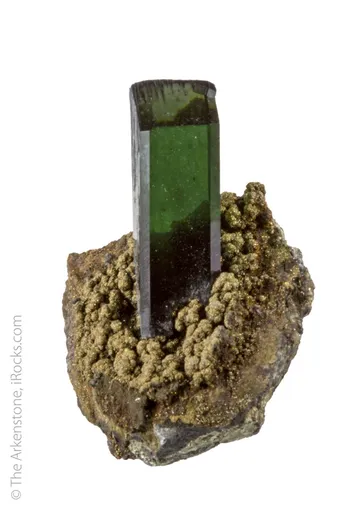
Kami Mine is one of Bolivia’s most distinctive tungsten-tin specimen localities: not a silver-rich Cerro Rico-style Bolivian classic, but a high-temperature hydrothermal vein system cutting tourmalinized hornfels in the eastern Andean belt of Ayopaya Province, Cochabamba. For collectors, its personality is immediately recognizable. The mine is famous for transparent to translucent Japan-law twinned quartz, sharp ferberite, warm brown to green-brown siderite rhombs, and, in the recent specimen market, highly appealing pink fluorapatite perched among colorless quartz sprays and metallic black tungsten minerals. The best pieces have a geometry that is unusually airy for a hard-rock tungsten vein locality: pale pink hexagonal apatite crystals, honey-brown siderite, bright quartz, and occasional black ferberite set in crisp three-dimensional contrast.
Geologically, Kami belongs to the family of Bolivian Sn-W hydrothermal systems, but its collector output is more varied than a simple ore-mineral suite would suggest. The mine has produced quartz with common Japan-law twinning; arsenopyrite, pyrrhotite, marcasite and other sulfides; ferberite and scheelite as tungsten minerals; cassiterite as the tin phase; secondary arsenates such as scorodite and pitticite; uncommon phosphate minerals such as augelite and lazulite; and the formerly accepted arsenic-selenium-sulfur phase “jeromite,” now treated as a discredited amorphous material but still important in the history of the locality. The result is a deposit that appeals both to systematic collectors and to display collectors who want Bolivian specimens with a look unlike the country’s better-known sulfosalt, cassiterite, rhodochrosite, or vivianite localities.
Regional View
Country View
The collecting story at Kami is also a story of timing. Older material made the mine known for Japan-law quartz and ferberite-bearing associations, while more recent finds brought pink fluorapatite-siderite-quartz combinations into fine-mineral circulation. A good Kami specimen is not simply “apatite from Bolivia” or “quartz from a tungsten mine.” The locality’s finest pieces show a very specific balance: sharp hexagonal apatite crystals that keep their pink body color under the right light, glassy quartz that acts as a colorless architectural framework, and siderite or ferberite accents that make the specimen read as a true Kami vein-pocket association rather than an isolated crystal.
Search for specimens: View all specimens from Kami Mine, Bolivia
Kami Mine is in Ayopaya Province, Cochabamba Department, Bolivia, in the high Andean terrain northwest of the city of Cochabamba and southeast of La Paz. Published locality data place the mine at roughly 17°23'15'' S, 66°49'39'' W, with workings spanning a large vertical range from about 2,900 m to 4,350 m. This vertical spread matters: Kami is not a single picturesque pocket locality but a mining district with multiple adits, veins, and named sectors, including Santa Rosa and Patiño-related workings referenced in specimen labels and mineral databases.
The deposit is a lode-style tungsten-tin system developed in metamorphosed Ordovician country rocks. The principal collector-visible gangue is quartz, but the broader alteration and host-rock environment is dominated by tourmalinized hornfels produced in a high-temperature hydrothermal setting. A 2024 thesis on the San José vein recognized two preferred vein orientations, one trending N25-30E and another N45-50E, within an area exceeding 2.5 km2. Fluid-inclusion work reported homogenization temperatures of 401 to 450 °C for hydrothermal quartz from the San José vein, consistent with a hypothermal, high-temperature system. The vein paragenesis was divided into an early mineralizing stage with arsenopyrite, pyrrhotite, wolframite and scheelite; an intermediate stage with quartz, pyrite, stannite and chalcopyrite; and a late stage with chalcedony, later quartz and siderite.
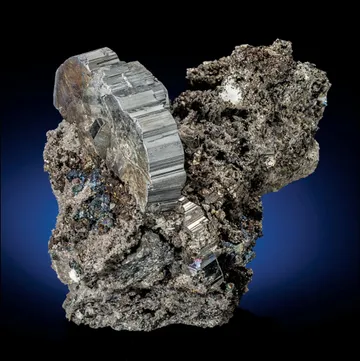
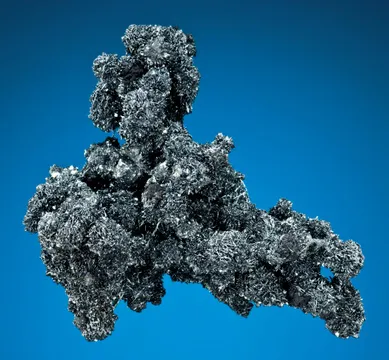
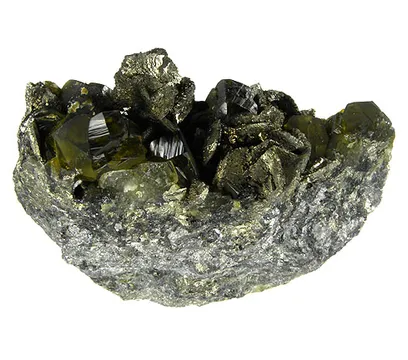
The ore minerals explain the specimen suite. Ferberite, the iron-rich end member of the wolframite series, is the main tungsten species seen on collector specimens, commonly as black, lustrous crystals associated with quartz and, in some cases, pink fluorapatite. Scheelite occurs in the broader paragenesis but is far less familiar as a cabinet-specimen species from Kami. Cassiterite records the tin component, while arsenopyrite, pyrrhotite, pyrite, chalcopyrite, galena, sphalerite, wurtzite and bismuthinite show the polymetallic sulfide side of the system. Late and supergene minerals include siderite, scorodite, pitticite, jarosite, tungstite, malachite, langite, chalcanthite, melanterite and limonite. The Santa Rosa section is described as a small tin mine on the southern periphery of the district, with somewhat lower-temperature mineralization than the better-known central high-temperature wolframite veins.
Mining at Kami began in the early twentieth century; mineral-resource summaries record discovery and first production in 1908. Historical accounts associate the mine with the Patiño group in the 1910s, and the nationalization of Bolivian mining after the 1952 revolution brought major operations under COMIBOL, the Corporación Minera de Bolivia. By the later twentieth century, Kami’s production was closely tied to cooperative mining. Modern references identify Cooperativa Minera El Progreso Kami Ltda. as the principal local mining organization, with the cooperative system controlling ongoing extraction rather than a large mechanized private mine in the style of the major Bolivian tin operations.
Production figures illustrate why Kami has remained economically important even when specimen production is intermittent. U.S. Geological Survey tungsten summaries list Kami as an underground Bolivian tungsten producer, with cumulative production reported as 24,864 tonnes WO3 for 1908–1984 and 539 tonnes W for 1980–1984. Bolivian press reports from 2011 stated that Cooperativa Minera Kami was producing about 30 to 40 tonnes of wolfram per month at that time, while noting that production had exceeded 180 tonnes per month during better periods. Those figures are economic-mining figures, not specimen figures, but they explain the continuing flow of freshly mined quartz, siderite, ferberite and apatite-bearing pieces into the collecting world.
Collecting access should be treated as closed unless permission is explicitly granted. Kami is an active mining district in difficult terrain, with working adits, unstable ground, private or cooperative mineral rights, and high-altitude hazards. Loose specimens seen in the market generally come through miners, Bolivian dealers, or international dealers who bought from Bolivian sources; casual collecting on site is not appropriate without full authorization from the operating cooperative and local rights holders.
Kami’s best-known specimen events can be grouped into three collector chapters. First are the Japan-law quartz specimens, which made the mine a recognized Bolivian quartz locality well before the recent pink apatite finds. These range from small twins to larger matrix groups, with published references noting Japan-law twins from Kami to at least several centimeters. Second are the classic tungsten-vein combinations: quartz with ferberite, arsenopyrite, pyrite, pyrrhotite, siderite and oxidation products. Third are the recent pink fluorapatite finds, especially pieces combining translucent pink apatite crystals, brown siderite rhombs and colorless quartz; some of these circulated through European and American dealers beginning in the early 2020s and were quickly noticed by advanced collectors because the color and association were not typical of older Bolivian apatite material.
Kami fluorapatite is the mineral that recently pushed the locality into the fine-mineral spotlight: translucent to transparent pink hexagonal crystals, commonly tabular to short prismatic, set on colorless quartz and commonly accompanied by siderite, ferberite or sulfides. The best documented pieces show sharply defined hexagonal faces with pinacoid and dipyramid modifications, usually in thumbnail to cabinet-size groups; individual crystals around 2 to 2.5 cm are well recorded, and at least one exceptional specimen has been advertised with an apatite crystal exceeding 10 cm. The color is part of the locality’s appeal and its challenge: many Kami apatites look pale in daylight and warmer or more saturated under incandescent lighting, so top pieces combine genuine body color, luster, completeness and an undamaged matrix association. Some specimens are reported to fluoresce strongly purple under 365 nm longwave UV, making clean, sharply crystallized pieces especially desirable to collectors who appreciate both display aesthetics and luminescent response.
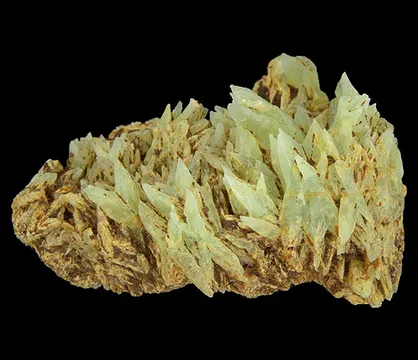
Kami siderite is much more than a background carbonate: on the best fluorapatite-quartz pieces it forms well-defined brown to green-brown rhombohedra that sit aerially among the quartz crystals, while some dealer descriptions note an unusual pseudo-octahedral visual character that gives the siderite a distinctive blocky geometry. In the ore paragenesis, siderite belongs to the later carbonate stage and is especially familiar from the pink apatite pockets, where it provides the warm earthy contrast against colorless quartz and pink fluorapatite. Fine siderite specimens from Kami are judged by crystal definition, luster, separation from the matrix, and whether the siderite enhances the architecture rather than forming dull coatings. A small early-2000s gem-quality siderite find from Kami was also reported in the gem market, producing golden transparent material cut into very small faceted stones, usually under one carat, a useful reminder that the locality’s siderite can occasionally reach real transparency rather than merely specimen-grade translucency.
Quartz is the collector backbone of Kami. It forms colorless to translucent crystal clusters in the tungsten-tin veins and is celebrated for relatively abundant Japan-law twinning, an uncommon habit that gives some Kami pieces their broad, flattened, V-shaped geometry. Many specimens are not pristine single crystals but matrix groups from active mine workings, so the best Kami quartz combines recognizable Japan-law form, transparency, minimal edge wear, and an undamaged placement among normal prismatic quartz crystals. Inclusions and coatings are part of the locality identity: arsenopyrite, pyrrhotite or marcasite may be included in or associated with the quartz, while scorodite, pitticite and the red to orange amorphous “jeromite” material can coat crystals. Fine Japan-law twins with contrasting ferberite or red-orange coatings are considerably more distinctive than ordinary quartz clusters, and large, balanced matrix groups are far less common than small damaged twins.
Other documented Kami minerals make the locality especially rewarding for systematic collectors. Mindat’s current list includes arsenopyrite, augelite, baryte, bismuthinite, brannerite, cassiterite, chalcanthite, chalcopyrite, dravite, ferberite, fluorite, galena, hematite, jamesonite, jarosite, langite, lazulite, limonite, magnetite, malachite, marcasite, melanterite, muscovite, native arsenic, native bismuth, native gold, pitticite, pyrite, pyrrhotite, scorodite, sphalerite, tungstite, vivianite and wurtzite. Particularly notable are thin black brannerite prisms included in quartz and surrounded by radiation halos, XRD-confirmed augelite and dravite, wet-chemistry-confirmed ferberite, and the red amorphous As-S-Se material historically called “jeromite.” Kami should not be presented as the type locality of a currently valid IMA mineral species on the strength of “jeromite,” because jeromite is now discredited; nevertheless, specimens labeled jeromite from Kami remain sought after as historically important examples of a vivid, locality-specific As-S-Se coating on quartz.
Kami specimens require a careful eye because the mine’s most attractive combinations are also its most damage-prone. Quartz sprays are brittle, Japan-law twins often have thin exposed edges, and apatite crystals can have chipped pinacoids, etched faces, contacted edges or broken terminations. Siderite rhombs may show edge wear or partial limonitization, and ferberite blades can be detached, reattached, or partly hidden in dark matrix. Several recent dealer examples explicitly disclose repairs, including a large fluorapatite-ferberite-siderite-quartz specimen described as having minor repairs of less than two percent; repair is therefore not hypothetical at Kami and should be asked about directly when buying cabinet pieces.
The most common labeling problems are not outright fakes but oversimplified or outdated labels. Pink apatite from Kami may be sold simply as “apatite,” even when fluorapatite is the correct species used in documented specimen records. Red to orange coatings may be labeled “jeromite,” but collectors should understand that the name is discredited and refers to an amorphous arsenic-sulfur-selenium material rather than a valid crystalline mineral species. Some Kami material may also be imprecisely labeled “Cochabamba, Bolivia” or “Simon Patiño adit, Kami Mine,” so preserving old dealer labels is important but should be paired with modern locality wording.
There are no well-documented mass-produced fake Kami fluorapatites comparable to the famous fabricated Moroccan or Chinese specimen problems, but the usual risks of repaired matrix specimens, glued quartz tips, stabilized delicate clusters, and enhanced presentation by trimming apply. Strong color photographs can exaggerate the pink of the apatite; reputable descriptions note that the color may be palest under daylight and strongest under incandescent light. When buying online, ask for daylight images, side views, UV images if fluorescence is part of the price, and a direct statement about repairs.
Handling considerations are straightforward but worth respecting. Fluorapatite is softer than quartz and can scratch or chip if packed carelessly against matrix. Siderite has cleavage and can be brittle. Specimens with arsenopyrite, native arsenic, pitticite, scorodite or “jeromite” should be handled as arsenic-bearing mineral specimens: keep them dry, avoid abrasion or dust, wash hands after handling, and do not use them in jewelry, lapidary work, fountains, aquaria or any setting where material can be ingested or inhaled. The brannerite-in-quartz occurrence also means that some pieces may contain uranium-bearing inclusions, usually tiny, but such specimens are best stored and handled as mineral specimens rather than household décor.
Market availability is sporadic but active. Small quartz and Japan-law quartz specimens appear periodically at modest prices, especially when damaged or only weakly twinned. Strong pink fluorapatite with quartz and siderite is much scarcer and can command four-figure prices when crystals are sharp, aesthetic and on matrix. Cabinet-size pieces with pink apatite, ferberite, siderite and quartz are especially competitive because they show both the colorful recent pocket style and the older tungsten-vein identity of the mine. Rich red “jeromite” coatings on quartz, particularly with Japan-law twins or arsenopyrite, occupy a separate niche: not desirable because the name is currently valid, but desirable because the material is visually striking, locality-specific, and historically associated with Kami.
The road to Kami is part of the locality’s character. Travel accounts describe the route from the Cochabamba side as a long highland journey beginning from Quillacollo, following the asphalt road toward Oruro before turning off near Pongo onto a narrow dirt road. In dry weather it is already a slow Andean climb; in the rainy season, the same trip can stretch toward ten hours. The road crosses high, cloud-level country, then passes through places such as Villa Pereira, Lip’ichi and El Abra before reaching the mining center. The landscape is not a gentle mining-camp setting but a steep Cordilleran world of deep cut valleys, riachuelos, cold wind and unstable slopes.
A first visit recorded in 2007 describes a town that seemed to have grown directly out of need rather than planning. Houses stood along the main road without a clear urban order, made of adobe, tapial, straw roofing and calamina. The central “plaza” was not a formal square but a sloping place with a mast and small improvised shops, some with calamina walls, calamina roofs and dirt floors. Past the central settlement, the road descended along an abrupt slope toward the Bolívar adit, then continued in tight zigzags down to the Patiño settlement at the foot of a precipice. The same account emphasizes the physical risk of the place: one wrong movement on the road above the descent could mean a fall of more than 500 meters.
The underground work described from Kami is equally severe. The adits were said to be so narrow that miners had to enter on all fours, “like the mole,” the diameter scarcely more than the length of a person lying down. In some places, workers descended in improvised boxes pulled by hand ropes. Ore came out by muscle: first hauled from the depths by repeated pulling, then moved by wheelbarrow toward the outside. In that context, a collector’s bright pink apatite or delicate Japan-law quartz cluster is also a small witness to the conditions under which much Bolivian mineral wealth has been extracted.
Kami’s social story is inseparable from cooperative mining. After COMIBOL’s period of operation, the mine passed into the hands of cooperatives, and local accounts describe miners working without a fixed schedule, aiming instead to extract a monthly quota of mineral. Women appear in this story as palliris, a Quechua-derived term for women who pick through discarded rock and mine waste for remaining ore. Recent visual-essay work on Kami’s palliris frames their labor around three themes: wolfram extraction, labor inequality and health, and intergenerational work trajectories. Many are widows or single mothers; many work outside the mine rather than underground, but their labor still belongs to the same mineral economy that sends Kami specimens into the world.
In 2011, Kami briefly entered the national political spotlight when President Evo Morales attended the 51st anniversary of Cooperativa Minera El Progreso Kami Ltda. in Ayopaya. At a mass event on the Odelia field, he promised financing for a wolfram processing plant after cooperative leader Guillermo Centellas presented mining projects. His reported words were direct: “no los voy a abandonar.” For collectors, the episode is a reminder that Kami is not merely a label under a specimen; it is a working mining community whose fortunes rise and fall with tungsten prices, machinery, roads, cooperative politics and the possibility of selling more than raw concentrate.
A more collector-specific story unfolded around the early 2020s pink fluorapatite finds. Tom Moore’s Mineralogical Record online report noted a rumored hoard of Kami fluorapatite-siderite-quartz specimens at the 2022 Tucson Show, only for the pieces to have been sent back to Spain before he could examine them. Soon afterward, individual specimens appeared on European dealer pages: tabular gemmy pink fluorapatite crystals to more than 2 cm, yellow-brown siderite rhombs and bristling colorless quartz. That “missed hoard” story fits Kami perfectly. The mine has never behaved like a predictable specimen factory; instead, its best pockets seem to surface suddenly, travel through a narrow dealer channel, and vanish into collections before many collectors ever see them in person.