






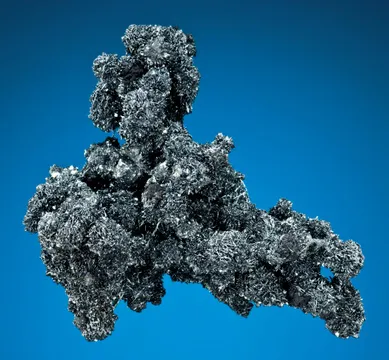
Morococala Mine, Bolivia — renowned for large vivianite crystals with deep bottle-green color, glassy luster, and scarcity that boosts collecting appeal.
Key facts
Morococala is one of the names that serious vivianite collectors learn early. The mine sits in the Santa Fé mining district of Pantaleón Dalence Province, Oruro Department, within the central Bolivian tin belt, a region where Paleozoic metasedimentary rocks, Neogene volcanic cover, and Oligocene–Miocene felsic intrusions combine to produce classic Sn-Zn-Pb-Ag hydrothermal veins. Industrially, Morococala was a tin-polymetallic mine; mineralogically, it became famous for a very different reason: the emergence of superb, large, lustrous vivianite crystals from the 280-meter level during the 1980s and early 1990s.
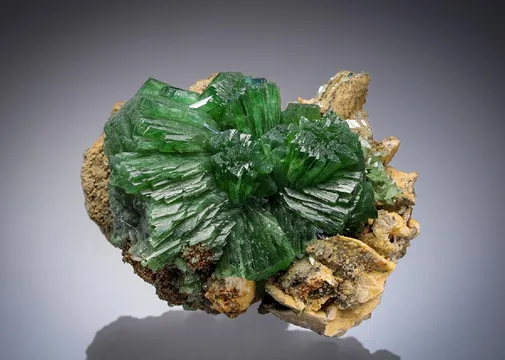
The best Morococala vivianites have a look that is immediately recognizable. They are deep bottle-green to blue-green, commonly prismatic and flattened, with a glassy to pearly luster, strong internal emerald color when backlit, and the familiar vulnerability of vivianite cleavage showing as natural cleaves, contact faces, or healed growth interruptions. Matrix pieces are especially prized when the crystal rises from brassy, sparkling pyrite microcrystals, brown siderite, or pyrite-coated shale. The locality produced thumbnails and miniatures, but its reputation rests on cabinet-scale crystals and plates whose mass and visual force are among the most dramatic for the species.
Regional View
Country View
Morococala’s collector appeal is strengthened by scarcity. The classic vivianite-producing level is reported as flooded, while ongoing or later mining has focused on other, higher-level ore production. That means the market is largely trading older material: specimens from the original boom, pieces dispersed from established collections, and occasional examples with old Bolivian, Tucson, or dealer provenance. For vivianite specialists, Morococala is not just a Bolivian locality; it is one of the benchmark standards by which large hydrothermal vivianite crystals are judged.
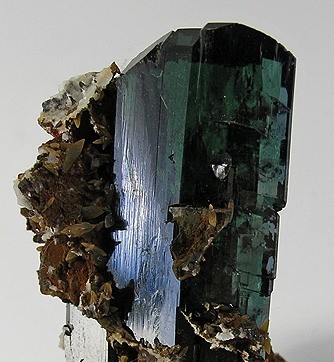
Photo: Rob Lavinsky, iRocks.com, via Wikimedia Commons

Photo:
Search for specimens: View all specimens from Morococala Mine, Bolivia
The Morococala Mine belongs to the Santa Fé mining district, where Japo, Santa Fé, and Morococala are the principal economically important Sn-Zn-Pb-Ag deposits. The district lies in the Bolivian portion of the Central Andean tin belt, a northwest–southeast metallogenic province famous for world-class tin and polymetallic deposits. Morococala and Santa Fé are only about 2 km apart, which helps explain a persistent old-label problem: early and older-market vivianites from Morococala are sometimes encountered as “Santa Fé mine” material.
The geological setting is a classic Bolivian tin-belt association: folded and thrust Paleozoic metasedimentary rocks cut by felsic intrusions and overlain by the volcanic rocks of the Morococala Formation. The older sedimentary pile includes the Cancañiri, Llallagua, Uncia, and Catavi formations, with micaceous sandstones, siltstones, quartzites, shales, and related metasedimentary units. These rocks were deformed into major northwest–southeast structures, including the Santa Fé anticline, and later intruded by felsic magmas related to the San Pablo stock and associated dikes.
The Morococala volcanic field is part of the broader Neogene ignimbrite province of the Central Andes. Its volcanic rocks include rhyolitic and quartz-latitic tuffs, lavas, and domal flows, with peraluminous mineral assemblages such as andalusite, cordierite, biotite, muscovite, quartz, feldspar, monazite, and tourmaline in the volcanic and intrusive suite. Modern geochronological work indicates that some rhyolitic dikes and ignimbrites in the neighboring Huanuni district are around 7.0–6.4 Ma and postdate the older Sn-polymetallic mineralization there, a point that matters because it separates the spectacular volcanic cover from the principal tin-ore event in time.
At Morococala itself, the ore is described as quartz veins a few centimeters to about 0.5 m thick, carrying cassiterite, Zn-Pb-Ag sulfides, and sulfosalts. Two principal mineralization stages are recognized in the district. The early stage is Sn-rich, represented by cassiterite-quartz veins and disseminations. The later, more polymetallic stage carries sphalerite, galena, stannite-group minerals, and complex sulfosalts. In the Santa Fé–Morococala zone, the S1 fracture system hosts mainly Sn ores, while the S2 system is richer in Zn-Pb-Ag. Rutile occurs with a late generation of cassiterite as needle-like crystals.
The mining history reflects the larger history of Bolivian tin. The first mining activity in the Santa Fé district began at Japo early in the 20th century, and by the 1920s Simón I. Patiño controlled the district’s mines. From about 1950, the Bolivian government managed the district, and the period under state control is described as historically the most productive. After Bolivia’s 1980s tin crisis, many deposits were increasingly worked by artisanal miners organized into cooperatives. Recent mineralogical literature describes Japo, Santa Fé, and Morococala as exploited by three different artisanal cooperatives.
Morococala’s specimen fame is much narrower in time than its mining life. The celebrated vivianites came from the 280-meter level, with the best-known production running from 1981 to 1992. These were not casual little accessory crystals; the mine yielded substantial, showy crystals and plates, and collector literature repeatedly describes a short-lived “Vivianite Boom.” The level that produced the great material is now reported flooded, while cassiterite production has continued on higher levels. For field collectors, that distinction is crucial: Morococala remains a real mining locality, but the classic vivianite horizon is not a normal collecting source today.
The documented specimen assemblage is broader than vivianite, though most species are of ore-mineral or microscopic interest. The mine’s list includes cassiterite, sphalerite, galena, pyrite, pyrrhotite, stannite, stannoidite, kësterite, sakuraiite, matildite, gustavite, ourayite, petrukite, jamesonite, zinkenite, teallite, stibnite, quartz, siderite, gypsum, goethite, jarosite, kaolinite, muscovite/sericite, tourmaline, monazite-group minerals, rutile, and phosphates including vivianite, metavivianite, phosphophyllite, and plumbogummite. The indium-bearing stannite-group mineralogy is particularly important to researchers, while the vivianite remains the great cabinet-specimen mineral.
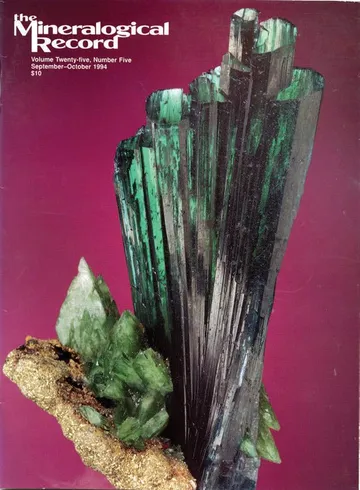
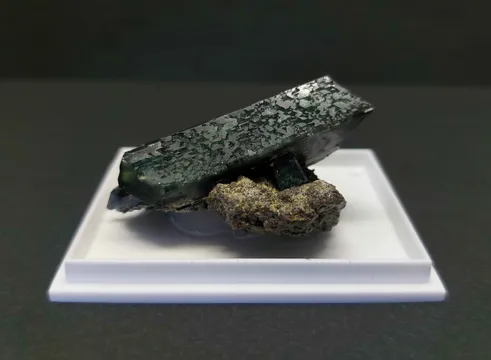
Morococala vivianite is the locality’s defining collector mineral: flattened to blocky prismatic crystals, commonly deep bottle-green, bluish green, or indigo-green at the edges, with glassy luster on major faces and strong emerald translucency when backlit. Fine examples range from sharp miniatures with 2–4 cm crystals on pyrite-coated matrix to cabinet pieces carrying crystals or composite growths well over 10 cm; exceptional examples are known as thick, heavy, parallel-growth clusters or broad plates from the 1980s–early 1990s 280-meter-level find. The classic associations are sparkling brassy pyrite microcrystals, brown siderite, and shale or sulfide-rich vein matrix. The best pieces combine undamaged terminations, strong luster, real translucency through thickness, minimal cleavage scars, and an aesthetic matrix rather than a loose cleaved blade; ordinary pieces tend to be dark, heavily contacted, cleaved, or detached from the distinctive Morococala matrix.
Beyond vivianite, Morococala is valuable to collectors and researchers for its rare sulfides and sulfosalts. It is not generally recognized as a major type locality for mineral species, but it is an important occurrence for indium-bearing stannite-group minerals and related rare phases. Sakuraiite from Morococala has been reported with exceptionally high indium values, and the mine has also produced or documented petrukite, kësterite, stannoidite, stannite, matildite, gustavite, ourayite, lillianite, teallite, zinkenite, and jamesonite. Cassiterite is the principal tin ore mineral, but much of Morococala’s scientific interest lies in tiny grains and intergrowths that would never have been saved for beauty alone: micron-scale cassiterite, indium-bearing sphalerite and stannite, and complex Ag-Bi-Pb-Sn-Cu sulfide assemblages.
Morococala vivianite should be bought with both the eye of a collector and the caution of a conservator. The species is soft, has perfect cleavage, and is prone to contact marks, edge bruising, cleaved terminations, and repaired matrix. Morococala crystals are often thick and heavy, so even old, attractive pieces may have natural cleaves or contact faces where the crystal grew against the pocket wall. A “perfect” large crystal should be examined closely under angled light for reattached ends, filled cracks, or cleavage surfaces disguised as terminations.
Light sensitivity is a real handling issue. Vivianite commonly darkens with exposure to light as Fe2+ oxidizes toward Fe3+, and Morococala material is best displayed sparingly, away from direct sunlight and strong case lighting, and stored in darkness when not on view. The finest crystals are valued for internal green when backlit, but repeated bright-light demonstrations are not kind to the specimen. Avoid heat, ultrasonic cleaning, water soaking, and aggressive dusting; use only a soft brush or air bulb around the crystal and matrix.
The most common locality problem is mislabelling rather than outright fakery. Older Morococala vivianites may carry “Santa Fé” labels, and loose Bolivian vivianite blades can also be confused with Huanuni, Siglo XX, Tomokoni, or other Bolivian sources. Matrix helps: Morococala classics commonly show brassy pyrite microcrystals, siderite, shale, and tin-polymetallic vein associations. Detached crystals without paperwork are harder to place confidently and should trade at a discount unless the provenance is strong.
No well-established Morococala-specific fake-vivianite industry is documented in the mainstream mineral literature, but repairs, detached crystals, and vague “Bolivia” labels are common market realities. For high-end purchases, look for old collection labels, credible dealer history, photographs predating recent ownership, and careful disclosure of repairs. An excellent Morococala vivianite is no longer a routinely replaceable specimen. As seen in recent auction records, showy small-cabinet examples with strong provenance and condition can bring thousands of dollars, while lesser, darker, more contacted, or matrix-heavy pieces remain much more accessible.
The great Morococala story is the “Vivianite Boom,” a phrase that still follows specimens through auction catalogues and old labels. The boom was brief, deep underground, and concentrated on the 280-meter level. During that window, miners encountered pockets and plates that changed how collectors thought about hydrothermal vivianite. Accounts from the trade describe crystal plates “pouring out of the mine,” along with unterminated sections said to have been nearly a foot thick in places. The sheer mass was the revelation. Other localities could beat Morococala for delicacy or gemminess, but Morococala produced heavy green prisms and broad lustrous faces with a visual authority few vivianite finds could match.
The ending of the boom has become one of Bolivian mineral collecting’s sharper bits of lore. Repeated dealer accounts say the mine manager believed miners were becoming too distracted by collecting vivianite underground and decided to destroy the productive section. Whether told at a show table or printed in a catalogue, the story has the same hard edge: the pocket zone was blasted, and the flow of specimens narrowed abruptly. For collectors, that story explains why the mine is remembered not as a steady source but as a flash—abundant for a moment, then gone into old collections.
A very different Morococala survives above ground. Spanish-language accounts of the mining camp describe a high, oxygen-thin community at roughly 4,500 meters elevation, a place where the mine was more than a hole in the mountain. The old management house associated with the tin-baron era reportedly retained most of its original materials, and local residents have proposed tourist routes that would interpret the mining history of the town. The same accounts mention old boilers and stores of taquia, the dried animal dung used as fuel, because 19th-century Morococala mining relied on steam power to bring energy into the workings. That is an unusually concrete reminder that the gleaming vivianite crystals admired in modern cabinets came from a hard industrial landscape of altitude, fuel, water, and labor.
Modern media has also treated Morococala less as a specimen locality than as a living mining community. The television report “21 Días en una Mina” followed Samanta Villar to Bolivia to work as a miner in Morococala, portraying a mining center more than a century old and a small high-altitude community where oxygen is scarce and tin extraction remains part of daily life. For collectors who know Morococala only through polished labels—Oruro, Bolivia; 280-meter level; ex collection—the film record is a useful correction. The locality is not an abstraction. It is a town, a mine, and a long human history wrapped around one of the most charismatic vivianite finds ever to reach the specimen market.
.jpg)
