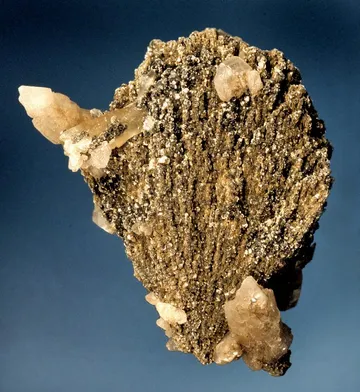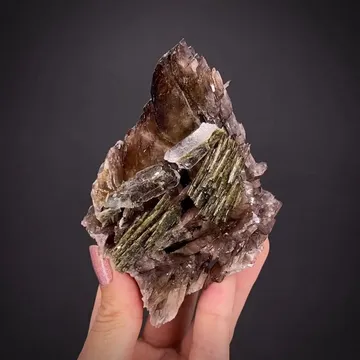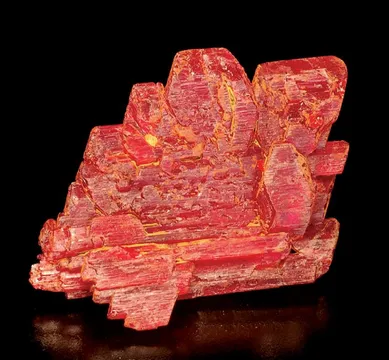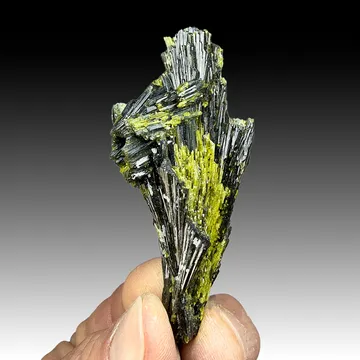
Pampa Blanca epidote: Peruvian classic with black-green radiating fans on quartz; prized for architectural sprays, sharp terminations, and dramatic light play.
Key facts
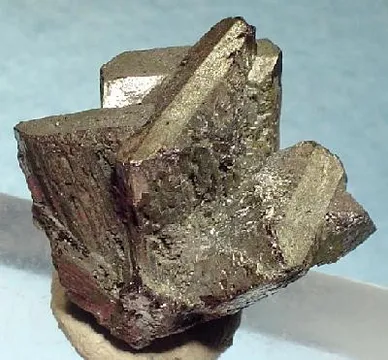
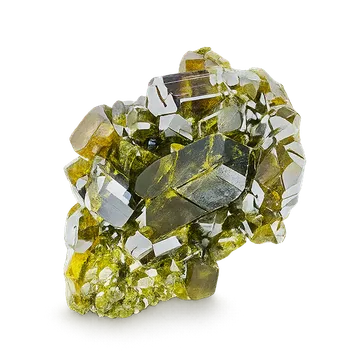
Pampa Blanca epidote is one of those Peruvian classics that announces itself from across a room: black-green fans and sheaves of glossy, striated crystals, often opening like a hand-held fan above pale quartz. Under ordinary light the crystals can look nearly black; under a strong lamp the same faces break into olive, yellow-green, and golden internal flashes. The best pieces combine that dramatic color with sharply chisel-ended crystals and a sculptural radial habit that is difficult to confuse with the blockier epidotes of many other world localities.

Photo: Wikimedia Commons
The material collectors call “Pampa Blanca” is most closely tied to the Rosario Mabel claim, also known in later labeling as Flor de Peru II, in the Pampa Blanca District of Castrovirreyna Province, Huancavelica. The mineralogical setting is a calc-silicate contact zone: epidote formed where granitic intrusive rock met carbonate-rich rock, filling fissures in lime-silicate rock rather than simply coating random fractures in volcanic wall rock. That setting explains the locality’s signature association with quartz, calcite, and andradite, and it explains why the epidote is commonly presented as tight sprays or fans instead of isolated single prisms on bare matrix.

Photo: Wikimedia Commons
Historically, the Pampa Blanca epidote find belongs to the great modern wave of Peruvian specimen discoveries that transformed mineral shows in the 1990s. The significant epidote production appeared after underground work intersected the contact zone in 1995, and by 1996 the material had reached European dealers in force. The locality quickly became known for elegant, lustrous fans, some with crystals approaching three inches long and some spectacularly broad plates or sheaves on white quartz.
Collectors prize Pampa Blanca epidote for three qualities above all: the architecture of the spray, the condition of the terminations, and the play of light through crystals that initially seem opaque. A fine example should not merely be “dark green epidote”; it should have rhythm—crystals rising in parallel or slightly divergent blades, crisp wedge or chisel terminations, minimal bruising along the tips, and, ideally, contrast from white to milky quartz or pale calcite.
Search for specimens: View all epidote specimens from Pampa Blanca, Peru
Pampa Blanca is a village and district locality in Castrovirreyna Province, Huancavelica, in the high Andes of south-central Peru. The collector locality for the classic epidote is the Rosario Mabel claim, now also recorded as Flor de Peru II. Labels vary: older pieces may say Rosario Mabel Mine, Mina Rosario Mabel, Pampa Blanca, Castrovirreyna, Huancavelica, or Flor de Peru II. Mindat treats “Rosario Mabel Mine” as a misnomer and records the site as a claim, which is worth noting when reconciling old labels with modern locality nomenclature.
The broader Castrovirreyna district is an old silver-lead-zinc-copper province of the Peruvian Andes, with mineralization in steep vein systems hosted in Tertiary volcanic rocks and related intrusions. That district setting provides the mining context, but the epidote specimens themselves come from a more specific calc-silicate environment: a contact zone between granite and carbonate rock. In 1995, underground miners reportedly reached a highly metamorphosed zone where epidote filled fissures in lime-silicate contact rock. The resulting specimens were not ordinary mine-wall coatings; they were well-developed radial sprays, fans, and individual prisms, commonly accompanied by quartz, calcite, and locally reddish-brown andradite.
Mining in the Castrovirreyna area has a deep history. Spanish prospectors discovered silver mineralization in the district in the late sixteenth century, and the district was worked intermittently for centuries. Modern mining activity increased in the twentieth century, particularly after deeper vein systems were delineated. The Rosario Mabel operation is described in specimen literature as having opened in the late 1970s and as producing silver and lead, with copper and zinc by-products. The epidote was not the reason for mining; it was a fortunate specimen discovery in the course of underground work.
The principal specimen production period was the mid-1990s. Fine Pampa Blanca epidotes appeared in dealer stocks and at major shows in 1996, with the Munich show repeatedly cited as a turning point in the locality’s reputation. Later labels and dealer records show that specimens continued to circulate from older stocks, collections, and occasional later supply. A 2019-dated dealer specimen confirms that material has appeared beyond the initial 1990s wave, but the classic market identity of the locality remains tied to the original mid-1990s finds.
Collecting access should be treated as closed unless a collector has explicit permission from landholders and mineral-rights holders. This is a claim and mining locality, not a public collecting site. Most serious specimens on the market trace to miners, Peruvian dealers, export dealers, or old collections, rather than to recreational field collecting.
Notable finds include large epidote sheaves on white quartz, broad plates reportedly up to about two feet across, and individual epidote crystals to roughly three inches. The most desirable examples are not necessarily the largest; many small-cabinet pieces have stronger composition, sharper chisel terminations, and better contrast than oversized dense fans.
The hallmark habit is a fan or spray of long, prismatic to tabular crystals, usually subparallel at the base and slightly divergent toward the terminations. The crystals are typically slender, lustrous, and strongly striated, with wedge-like to chisel-shaped ends. In the best examples, the fan reads as a single sculptural unit: a rising comb of dark, glossy blades rather than a chaotic mound of crystals.
Color is usually deep olive green to blackish green. Strong lighting is essential when judging quality, because the most attractive Pampa Blanca crystals can look almost black until light penetrates the edges and reveals olive, golden-green, or yellow-green flashes. This internal fire is one of the locality’s great charms and a useful field mark for better specimens.
Typical collector sizes range from thumbnails and miniatures through small cabinet pieces. Many strong examples are in the 5–10 cm range, where the fan habit can be appreciated without the condition problems that often affect larger plates. Documented cabinet and large-cabinet specimens exist, including broad sheaves and dense multi-fan groups; these are much less common in excellent condition. Individual crystals in classic specimens may reach several centimeters, and the best-documented larger crystals approach three inches.
Quartz is the most important associated mineral. It may occur as small terminated white to milky points, silky quartz sprays, or more transparent crystals that cross or support the epidote fan. Good quartz contrast can elevate a Pampa Blanca epidote dramatically, especially when the epidote appears perched on the quartz rather than buried in it. Calcite is less common but well documented, and can add pale contrast if fresh and undamaged. Andradite, when present as small reddish-brown dodecahedra on or around the epidote, is a distinctive and desirable association. Hematite is recorded from the claim but is not a defining display association for most collector epidotes.
Quality is judged by luster, completeness, crystal separation, and composition. Look for bright faces, sharp terminations, and a fan that presents cleanly from at least one angle. Dense, dark sprays with broken tips are common enough; pristine, balanced fans with visible individual terminations are much scarcer. Combination pieces with quartz are especially desirable when the quartz is not merely a base but part of the architecture of the specimen. Calcite and andradite associations add locality interest, but condition still rules: chipped calcite, dinged quartz tips, or repaired-looking contacts can quickly pull a piece down from fine to merely representative.
Pampa Blanca epidote has not been associated in the literature with a well-known treatment problem. I found no documented locality-specific epidemic of dyed, oiled, heated, or assembled epidote fakes. The authenticity issues are mainly about labels, not treatments.
The first label issue is name variation. “Rosario Mabel,” “Flor de Peru II,” “Pampa Blanca,” and “Huancavelica” may all refer to the classic epidote occurrence, but they are not equally precise. A modern, careful label should ideally read Rosario Mabel claim (Flor de Peru II claim), Pampa Blanca District, Castrovirreyna Province, Huancavelica, Peru. Older “Rosario Mabel Mine” labels should not be rejected automatically, because that wording is common in specimen commerce and older articles, but it is less precise than the current claim terminology.
The second label issue is more serious: Pampa Blanca has been used incorrectly on some Peruvian axinite-group material. Mindat specifically notes that axinite attributed to Pampa Blanca is generally from other Peruvian localities, especially material that came to market with incorrect Pampa Blanca labels. This is not a problem for typical black-green epidote fans, but it matters when buying mixed Peruvian contact-zone suites or old lots labeled only “Pampa Blanca.”
The third issue is species confusion. Very dark epidote sprays can be mistaken by casual buyers for black tourmaline, amphibole, or even kyanite-like sprays in poor photographs. True Pampa Blanca epidote should show the characteristic olive-green transmission or reflections under strong light, a glassy to resinous luster, and the familiar striated prismatic to tabular habit with chisel terminations. When the piece includes quartz or andradite, the locality attribution becomes easier to evaluate.
Condition is the main practical concern. The fan habit is attractive but vulnerable: tips break, edges bruise, and projecting crystals can be incomplete. Some specimens still present beautifully from the front while showing broken or incomplete crystals from the side or back. That is normal for the locality, but pricing should reflect it. Examine all edges of the fan, not only the main display face. Check the termination line carefully; a row of uniformly bright, fresh-looking chips along the tips is very different from natural partial growth or older, inconspicuous contacts.
Current availability is moderate. Representative Pampa Blanca epidote still appears from old collections, dealer back stock, and occasional commercial listings. Small pieces and incomplete fans can be relatively affordable, while large, lustrous, aesthetic examples with strong quartz contrast have moved into the higher collector market. Recent public records show modest small-cabinet specimens selling in the low hundreds of dollars, stronger quartz combinations reaching several hundred dollars, and large cabinet examples offered well above that. The top tier—clean, sculptural, mid-1990s material with provenance and minimal damage—is no longer common.
The Pampa Blanca epidote story begins not with a collector’s hammer but with miners working for ore. Rosario Mabel was a silver-lead operation, high in the Castrovirreyna district, and the epidote was an accidental dividend of underground mining. In 1995, miners broke into a metamorphosed contact zone where granite had met calcium-rich rock. Instead of ordinary ore vein fill, the fissures held green fans and sheaves: epidote crystals in radial sprays, individual prisms as long as three inches, and pale quartz and calcite that set off the dark crystals.
The material reached the mineral market quickly. By 1996, clusters of Pampa Blanca epidote were being offered by dealers in Peru, including material photographed in Ica. In Europe the impact was immediate. At Munich, the black-green fans seemed to be everywhere, and the locality’s look became fixed in collectors’ minds: long, thin, lustrous blades, not so delicate that they lost their terminations, arranged in fans that could stand like dark foliage against quartz.
Some of the early pieces were enormous by specimen standards. Reports describe two-foot-wide pieces with green epidote sheaves on white quartz selling for many thousands of dollars. Those large specimens helped create the excitement, but the most enduring Pampa Blanca aesthetic is often smaller and more refined: a hand-sized fan, a few centimeters of silky quartz at the base, and sharp chisel ends glittering across the top edge.
The claim’s name history adds another layer of collector lore. Rosario Mabel material was later tied to the name Flor de Peru II, after a change in ownership and nomenclature around 1999. That shift created the label puzzle collectors still encounter today. A specimen may be perfectly legitimate whether the old tag says Rosario Mabel, Mina Rosario Mabel, Pampa Blanca, or Flor de Peru II—but the best labels preserve both names, because the mineral market remembers one and the locality databases increasingly use the other.
A few named collection pieces have carried the story forward. Auction records document examples from the Kurt Hefendehl and Jack Halpern collections, including quartz combinations attributed to the mid-1990s find and associated with dealer Harvey Gordon. These are exactly the kinds of provenance details that matter for Pampa Blanca: they connect a specimen not just to Peru, but to the brief, vivid moment when the locality’s fans first entered the international collector bloodstream.