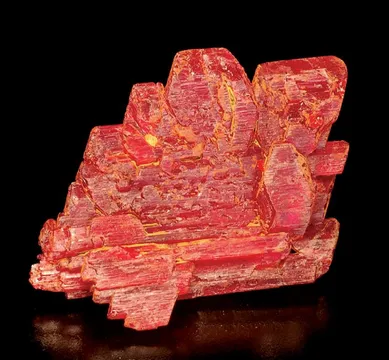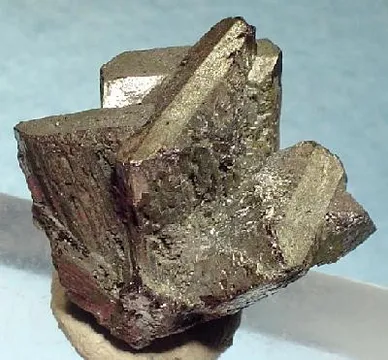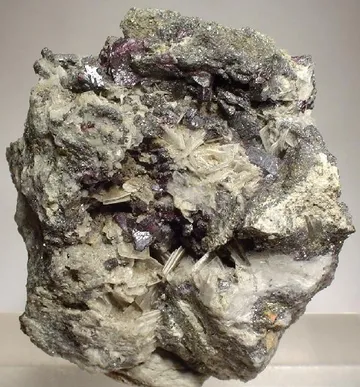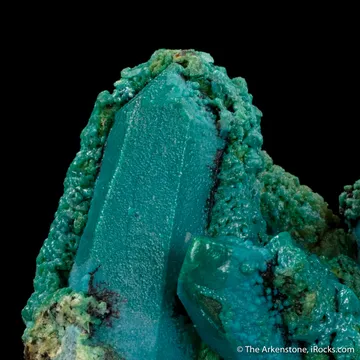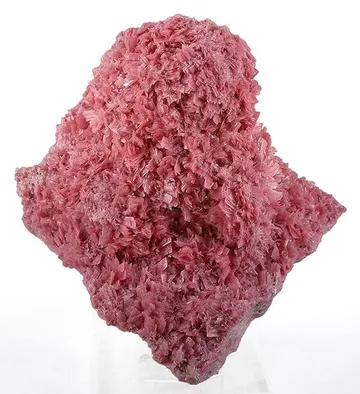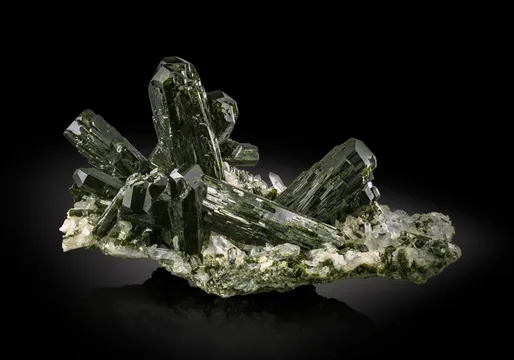
Pampa Blanca, Peru - renowned locality for sculptural epidote on quartz and Japan-law quartz twins; prized by collectors for epidote fans and rare pockets.
Key facts
Pampa Blanca is one of the great modern Peruvian specimen localities: a high, arid, road-cut and mine-claim area on the Huancavelica–Ica borderlands that became famous not for ore minerals, but for sculptural calc-silicate pocket material. In collector usage, “Pampa Blanca” usually refers to a cluster of closely related occurrences in the Pampa Blanca District of Castrovirreyna Province, especially the Rosario Mabel claim, later known as Flor de Peru II, and the Flor de Peru I claim at Mt Ullpac, historically called the Tentadora Mine. The specimens that made the name are dark, glossy, fan-shaped sprays of epidote on white to colorless quartz, together with some of the most distinctive Japan-law twinned quartz produced anywhere in the late twentieth and early twenty-first centuries.
Geologically, the best-known specimen occurrences sit within the broader Castrovirreyna silver–lead–zinc district, a long-mined Andean vein province in Tertiary volcanic country rock cut by intrusive rocks. The ore district is dominated by polymetallic, silver-rich veins; Pampa Blanca’s celebrated collector material belongs to the calc-silicate side of that system, where granite-carbonate contacts and quartz veins produced epidote, andradite, quartz, calcite, vesuvianite, scheelite, chlorite, and minor amethyst. The result is a mineral suite with two quite different personalities: black-green, almost architectural epidote fans from Rosario Mabel/Flor de Peru II, and flattened, frosty to transparent Japan-law quartz twins from Flor de Peru I and related Pampa Blanca occurrences.
Regional View
Country View
Historically, Pampa Blanca entered the international specimen market in the mid-1990s, when underground work at Rosario Mabel encountered fissures filled with lustrous epidote. The material was not merely “good for Peru”; it was good enough to cause a stir at the Munich show, where European dealers and collectors suddenly had access to elegant, three-dimensional epidote fans of a habit unlike the thick Alpine and Pakistani crystals familiar in older collections. Soon afterward, quartz twins from the same general area—and especially from the Tentadora/Flor de Peru I workings at Mt Ullpac—gave the locality a second identity among quartz specialists.

Photo: Wikimedia Commons
The best epidotes are immediately recognizable: slim, parallel to divergent blades, nearly black in ordinary light but flashing deep bottle-green to olive-green on edges and terminations, commonly rising like a fan from a quartz base. Good examples have complete wedge-shaped terminations, high vitreous luster, a pleasing open spray rather than a mashed bundle, and enough contrasting quartz or calcite to make the form legible. The best quartz specimens, by contrast, are about geometry: flattened, beveled Japan-law twins, commonly milky or frosted, sometimes transparent, arranged as V-shaped, heart-shaped, butterfly-like, or more complex groups over drusy quartz.

Photo: Wikimedia Commons
Search for specimens: View all specimens from Pampa Blanca, Peru
Pampa Blanca lies within the collector orbit of the Castrovirreyna mining region of Huancavelica, south-central Peru. The broader district has a long silver-mining history and is characterized by Tertiary volcanic rocks—andesitic to more silicic units—cut by intrusive bodies and by steep, structurally controlled polymetallic veins. Classic mining in the district focused on silver, lead, zinc, copper, and associated sulfosalts; specimen collectors know Pampa Blanca because small parts of this mineralized terrain developed open spaces and calc-silicate assemblages suitable for crystallized epidote and quartz.
The Rosario Mabel claim, later renamed Flor de Peru II after a change of ownership in 1999, is the essential epidote source. Reports from the mid-1990s describe an underground discovery in a strongly metamorphosed contact zone where granitic intrusive rock met carbonate-rich host rock. In fissures through the lime-silicate rock, epidote grew as well-developed sprays and individual crystals, with quartz, calcite, and reddish-brown andradite. The epidote bodies were not the principal ore target; they were a specimen windfall within a mine otherwise associated with silver and lead, with copper and zinc as by-products.
The ore district around Castrovirreyna is structurally complex. Classic studies describe steeply dipping, silver-rich polymetallic veins formed along anastomosing, undulatory faults rather than simple straight fractures. That structural complexity matters to the specimen collector because it explains why attractive pockets are localized and unpredictable: openings at bends, contacts, and dilational segments can be enormously productive, while adjacent ground may be massive, crushed, or barren from the standpoint of aesthetic specimens.
Flor de Peru I at Mt Ullpac, about 3 km north of Pampa Blanca in the literature, is the name most closely tied to the prolific Japan-law twinned quartz finds. The working was an abandoned copper(?) mine known as Tentadora when active, and it began producing notable quartz specimens around 1999. The quartz is reported from simple quartz veins, usually accompanied by untwinned quartz, and only rarely by epidote, green platy vesuvianite, small scheelite crystals, or pale amethyst. Although collectors commonly fold these specimens under the broader Pampa Blanca label, careful labels should retain the claim name when known: Rosario Mabel/Flor de Peru II for the classic epidote and transparent Japan-law twins, Flor de Peru I/Tentadora/Mt Ullpac for much of the abundant flattened twin quartz.
The production story is episodic. The Rosario Mabel epidote discovery of 1995–1996 released substantial quantities of fine material, including large matrix plates and cabinet pieces, and the first southern Peruvian Japan-law quartz twins reached the market around 1997. The Flor de Peru I quartz production that followed in 1999 made the area famous among twin-quartz collectors. Later finds have been smaller and more sporadic; recent market appearances include old-stock 1990s material, pieces from dealer and private collections, and occasional newer specimens such as 2019 epidote crystals from the Rosario Mabel concession.
Pampa Blanca is not a public collecting locality in the casual sense. The important occurrences are claims, mines, or former mines, in rugged Andean terrain, and access depends on the permission of landowners, communities, and mineral-right holders. Modern mining and exploration activity in the wider Castrovirreyna district has also increased the importance of controlled access, safety protocols, and legal clarity. Collectors should treat any field visit as a formal mine-access matter, not as a roadside collecting opportunity.
Pampa Blanca epidote is the locality’s signature mineral, especially from the Rosario Mabel claim, later Flor de Peru II, where the mid-1990s pockets yielded thin, lustrous, dark green to nearly black blades in radiating sprays, sheaves, and sculptural fan groups. Individual blades are commonly several centimeters long, with reports of crystals to about 7.5–10 cm; many cabinet specimens show the sprays rising from or crossing over white to colorless quartz, and less commonly with calcite and reddish-brown andradite. The best pieces have open, three-dimensional architecture, bright luster, intact two-sided wedge terminations, and visible green translucence on edges or in strong light; ordinary pieces tend to be more crowded, contacted along the fan margins, missing terminations, or too dark and massive to show the elegant geometry that made the locality famous.
Quartz from Pampa Blanca is important both as the contrasting white matrix for epidote and as a collectible species in its own right, especially in Japan-law twins from Rosario Mabel/Flor de Peru II and Flor de Peru I at Mt Ullpac. The classic twins are flattened, tabular, V-shaped to heart- or butterfly-shaped crystals, usually colorless, frosty, milky, or translucent, with some more transparent Rosario Mabel examples prized above the more commonly crusted Ullpac material; documented specimens range from miniatures of a few centimeters to major matrix pieces with multiple twins, while quartz crystals at Flor de Peru I have been reported to reach about 20 cm. Superior specimens show unmistakable Japan-law geometry, clean beveled edges, good luster, minimal bruising along the twin plane, and attractive placement on quartz matrix; the special pieces add chlorite phantoms, amethyst scepter terminations, calcite on the twins, or multiple well-oriented twins on a single plate.
Other documented minerals from Pampa Blanca and its named claims include andradite, calcite, chlorite-group minerals, dolomite, hematite, scheelite, sphalerite, vesuvianite, and quartz var. amethyst. Andradite is the most significant accessory for cabinet collectors: reddish-brown to dark brown dodecahedral crystals from the Rosario Mabel/Flor de Peru II contact zone are reported with epidote, usually smaller than the finest epidote crystals but occasionally large enough to stand as display specimens. Vesuvianite, scheelite, chlorite, and pale amethyst are more closely associated with the Flor de Peru I/Tentadora quartz veins at Mt Ullpac, where they are interesting chiefly because they give context to the Japan-law quartz. No approved type-locality mineral is known from Pampa Blanca; its importance is aesthetic and paragenetic rather than type-mineralogical. Axinite deserves special caution: specimens labelled from Pampa Blanca have circulated, but the attribution is considered questionable, with many such pieces apparently belonging instead to Molletambo in Ica.
The first question with a Pampa Blanca specimen is locality precision. A label reading simply “Pampa Blanca, Peru” may be entirely traditional, but a stronger label distinguishes Rosario Mabel claim, Flor de Peru II claim, Flor de Peru I claim, Tentadora Mine, or Mt Ullpac when the information is available. This matters because the habits differ: Rosario Mabel is the classic dark epidote fan locality and also produced transparent Japan-law quartz, while Flor de Peru I/Tentadora is especially important for abundant flattened Japan-law quartz twins, commonly frosted or milky from later quartz overgrowth.
Mislabelling is a real issue. The Rosario Mabel name, the later Flor de Peru II name, and the broader Pampa Blanca label all refer to overlapping collector usage, so older labels may not be “wrong” but may be incomplete. Conversely, axinite labelled Pampa Blanca should be treated skeptically unless supported by unusually strong provenance or analytical context; the better-documented locality for much Peruvian axinite material is Molletambo, and Pampa Blanca attributions have been specifically questioned in mineralogical locality records.
Condition is central to value. Epidote fans from Pampa Blanca are tough in hardness but delicate in architecture: the long blades chip at the terminations, detach along the edges of a fan, or lose isolated cross-blades during extraction and transport. The dark color can hide bruising in dim light, so inspect terminations under strong oblique light and look for small green flashes along edges rather than assuming a black, glossy face is undamaged. Many pieces were removed from pocket walls, so peripheral contacting is common; a few missing tips may be acceptable on a dramatic fan, but a top-quality piece should preserve the main visual crest.
Pampa Blanca Japan-law quartz needs a different inspection routine. Quartz twins can naturally be flattened, frosted, beveled, or oddly “cut off” in growth, so not every irregular outline is damage. True damage usually appears as fresh bruising or chips along the thin edges, terminations, or the compositional plane where Japan-law twins have a natural weakness. Fine examples show the correct angular relationship, distinct tabular habit, and clean, undamaged margins; merely adjacent quartz crystals that happen to form a V shape are not equivalent.
Treatments are not widely documented for Pampa Blanca material, but cleaning history should be considered. Epidote associated with calcite is sometimes prepared by acid removal of carbonate, a practice that can expose attractive blades but may also leave unnaturally isolated sprays or etched-looking residues. Acid cleaning does not normally harm epidote the way it attacks calcite, but it can change the appearance of matrix and associations, so collectors who value paragenetic integrity should look carefully for remnants of calcite and for overly “floated” epidote fans.
Market availability is moderate but uneven. Small to miniature epidote fans and quartz twins appear regularly from old stocks and resold collections, while large, balanced, undamaged epidote-on-quartz cabinet specimens are much scarcer and command strong prices. Fine Japan-law quartz from Pampa Blanca remains especially desirable to twin specialists; the most transparent examples, pieces with multiple twins, and specimens with documented old provenance are far less common than small frosty twins. Newer finds do surface, but the locality’s reputation still rests heavily on the mid-1990s to early-2000s production.
In the mid-1990s, Rosario Mabel was an ore mine before it was a collector name. Then the miners drove into a metamorphosed contact zone: granite against carbonate rock, fissures lined not with ore alone but with dark green blades. What came out of those openings changed the locality’s reputation almost overnight. The epidote grew in fans and sheaves, some individual crystals reaching about three inches, with quartz, calcite, and reddish-brown andradite sharing the pockets. A few matrix pieces were reportedly two feet wide, carrying sprays of green epidote prisms over white quartz, the kind of material that does not remain a local secret once it reaches a European show table.
The 1996 Munich show is the moment older collectors still associate with Pampa Blanca epidote. The material was suddenly everywhere: glossy, black-green, bladed fans, unlike the more familiar thick epidote crystals from many classic localities. The excitement carried into the mineral press in 1997, where the Rosario Mabel find was described as “fantastic,” and the best single fans were the sort of pieces that could “grace any collector’s cabinet.” That is not market hyperbole in hindsight; the habit was genuinely distinctive, and the combination of black-green epidote on pale quartz made even modest specimens visually forceful.
The next twist came from the other side of the road and a different mineral. Collectors who first knew Pampa Blanca for epidote soon encountered Japan-law quartz from nearby workings. The early reports describe secretive local suppliers, changing locality names, and a gradual realization that the source was not a vague “southern Peru” occurrence but the Rosario Mabel claim and the nearby Flor de Peru I claim at Ullpac Mountain. By 1999, the abandoned Tentadora Mine—renamed Flor de Peru I in collector usage—was producing enough Japan-law twins to be called one of the world’s most productive localities for the form.
The numbers attached to the quartz finds are the kind collectors repeat because they sound improbable until one has seen a Peruvian twin plate. Around 2001, a specimen reaching the Lima market reportedly weighed about 200 kg and carried at least ten Japan-law twins, each about 10 cm across. In 2002, an enormous 49-cm twin was reported from Pampa Blanca. Even the more ordinary good specimens had personality: flattened V’s, hearts, butterflies, and rare closed-square forms, commonly on matrices of untwinned quartz. Many were milked over by a later crust of white quartz, but the rare transparent Rosario Mabel twins and the occasional chlorite phantom or amethyst-sceptered twin are the pieces that made specialists lean in.
Lewis, Richard Wheatley Jr. (1964), “The geology, mineralogy and paragenesis of the Castrovirreyna lead-zinc-silver deposits, Peru,” U.S. Geological Survey Open-File Report 64-103. The foundational district-scale geological and paragenetic study for Castrovirreyna, essential background for the silver–lead–zinc vein system around Pampa Blanca.
Wise, James M. (2005), “Undulatory Silver-Rich Polymetallic Veins of the Castrovirreyna District, Central Peru: Fault Growth and Mineralization in a Perturbed Local Stress Field,” Economic Geology, 100(4), 689–705. A structural interpretation of the Castrovirreyna vein system, valuable for understanding why ore shoots and pocket zones are localized in complex, undulatory fractures.
Hyrsl, Jaroslav, and Rosales, Zolina (2003), “Peruvian Minerals: An Update,” The Mineralogical Record, 34(3), 241–254. The key collector-oriented update documenting Pampa Blanca’s epidote, quartz, and associated species, including Rosario Mabel/Flor de Peru II and Flor de Peru I material.
Crowley, Jack A.; Currier, Rock H.; and Szenics, Terry (1997), “Mines and Minerals of Peru,” The Mineralogical Record, 28(4), 1–98. The classic Peru special issue, important context for Peruvian specimen mining and the rise of modern Peruvian mineral collecting.
Moore, Thomas P. (1997), “What’s New in Minerals,” The Mineralogical Record, March–April 1997. Notable for contemporary reporting on the Rosario Mabel epidote appearance on the European market.
Mindat locality record: Pampa Blanca District, Castrovirreyna Province, Huancavelica, Peru. Current compiled mineral list and sublocality structure for Pampa Blanca, including Rosario Mabel/Flor de Peru II, Flor de Peru I/Tentadora, and associated species.
Mindat locality record: Flor de Peru I claim (Tentadora Mine), Mt Ullpac, Pampa Blanca District, Castrovirreyna Province, Huancavelica, Peru. Specific locality record for the prolific Japan-law quartz occurrence at Mt Ullpac.
Mindat photo record: Andradite from Rosario Mabel claim, Pampa Blanca District. Documents a large, sharp andradite crystal from the same skarn claim famous for epidote and Japan-law quartz.