Tentadora Mine, Peru — display-quality quartz, including Japan-law twins, and chrysocolla-coated quartz from Ullpacc–Pampa Blanca, prized by collectors for col…
Key facts
Tentadora is one of those Peruvian names that rewards careful label-reading. For collectors, the specimens that have made the mine famous are not ore minerals from a big modern producing mine, but display-quality quartz pieces from the Ullpac–Pampa Blanca area: first the Japan-law twinned quartz that began appearing in quantity around 1999, and later the vivid chrysocolla-coated quartz specimens that entered the international market as a 2020 Sainte-Marie Virtual Show novelty. The geological picture is a compact Andean one: quartz veins and copper-bearing hydrothermal/skarn-style mineralization in the arid, steep country near the Río Pisco drainage, with older mining activity followed by later exploration on the Ullpacc concession.
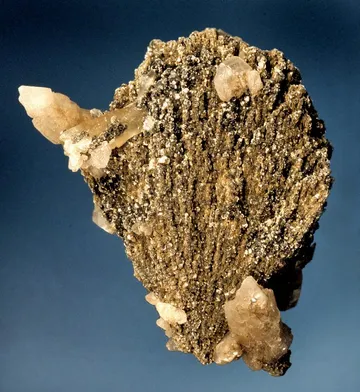
Tentadora’s best-known specimens have two distinct looks. The classic quartz pieces are white to colorless, commonly milky from later quartz overgrowth, with flattened Japan-law twins in V, heart, butterfly, and rarer nearly closed-square forms perched among ordinary prismatic quartz crystals. The later chrysocolla pieces are more immediately eye-catching: quartz crystals, in places smoky, draped in intense greenish-blue to turquoise chrysocolla, sometimes with two visible generations—a smooth earlier coating and later rounded botryoidal growths. The finest examples balance strong color with recognizable quartz form: the copper silicate covers the crystals, but does not reduce them to shapeless lumps.
Regional View
Country View
The locality name has been used in more than one way. Collector labels and online databases record Tentadora as the old name of the Flor de Peru I claim on Mt. Ullpac, close to Pampa Blanca and near the Huancavelica–Ica administrative boundary; modern mineral-specimen listings also place the chrysocolla-on-quartz material at Tentadora mine, Payhuano, Huancano District, Pisco Province, Ica. A separate Tentadora Mine exists in the Julcani mining district of Huancavelica, and that name has caused real confusion. For specimen purposes, the pieces treated here are the Ullpac/Pampa Blanca Tentadora material: Japan-law quartz and the later chrysocolla-on-quartz discovery.
Search for specimens: View all specimens from Tentadora Mine, Peru
Tentadora lies in the dry western Andean flank country above the Pisco drainage, near the small Pampa Blanca–Ullpac area. Official Peruvian mining records for the Tentadora exploration project place the work on the Ullpacc concession in Huancano District, Pisco Province, Ica, roughly 1 km from the right bank of Quebrada Tarayoc, at about 2,800 to 3,200 m elevation. The access described for the project runs from Lima to San Clemente, then to Puente Pacra, Pampa Blanca, and finally the exploration area, a total of about 323 km. The terrain is described as steep, deeply cut, arid, and largely infertile—exactly the sort of unforgiving desert-Andean landscape where old workings, new exploration cuts, and specimen-producing veins can be close together but hard to interpret from labels alone.
The geology recorded for the official Tentadora project is a mixture of recent cover and Cretaceous intrusive rocks of the Coastal Batholith, including tonalites, gabbros, and granites. The deposit was described as hydrothermal, with quartz, pyrite, chalcopyrite, and argentiferous galena, and field evidence led the evaluators to interpret it as a probable Cu-Zn skarn system. That account fits the locality’s copper signature and helps explain why a former copper prospect could also yield attractive quartz-vein specimens and later oxidized copper-silicate coatings. The Japan-law quartz material, in particular, is described from simple quartz veins, with occasional associated epidote, green platy vesuvianite, small scheelite crystals, and pale amethyst.
The best documented mining and exploration history comes in several chapters. When active, the Flor de Peru I claim was known as the Tentadora mine; it was later characterized by collectors as an abandoned copper mine that began producing Japan-law twinned quartz specimens in 1999. Those quartz specimens rapidly became the locality’s first mineralogical claim to fame. In 2009, the Peruvian Ministry of Energy and Mines approved Compañía Minera Caravelí S.A.C.’s Category C Environmental Assessment for the “Tentadora” exploration project on the Ullpacc concession, with a planned execution period of 15 months. The exploration program contemplated underground work on the 2850 and 2880 levels, including galleries, crosscuts, and raises, totaling about 1,100 m, along with access roads, waste-rock and ore stockpile areas, a small camp and offices, and removal of a small quantity of mineral for metallurgical tests.
The recorded ore and exploration minerals—quartz, pyrite, chalcopyrite, and argentiferous galena—are not the minerals collectors chase here. The collector story belongs to the open-space quartz veins and oxidized copper zone. The 1999 quartz production is notable for the abundance of Japan-law twins: crystals to about 20 cm long, twins commonly around 5 cm, occasional twins to 10 cm, and a limited part of the vein that produced groups over 30 cm composed entirely of large Japan-law twins. These were often milky because of later white quartz, but the better pieces show sharp form, good separation, glassier faces, green chlorite phantoms, or pale amethyst scepter terminations.
The chrysocolla-on-quartz specimens appear to represent a later, distinct collecting event rather than the same visual style as the 1999 twinned-quartz production. The best-documented examples were found in March 2020 and shown internationally as a Sainte-Marie Virtual Show novelty. They range from small thumbnails and miniatures around 3 cm to large cabinet pieces around 15 cm, with quartz crystals coated almost completely by vivid greenish-blue chrysocolla. Several published dealer records emphasize that this habit—recognizable quartz crystals smothered in chrysocolla—had not been found previously at the locality.
Access today should be approached as mining access, not casual rockhounding. The mine area is tied to titled concessions and documented exploration and environmental obligations. Records also list later mining environmental liabilities at Tentadora/Ullpacc, including waste-rock material and former infrastructure. Collectors should assume that entry requires permission from the landholder and mineral-rights holder, and that old workings, steep slopes, weak rock, and possible reactive sulfide-bearing waste make casual collecting unsafe.
Quartz is the backbone of Tentadora’s collecting reputation, first through the Japan-law twins from the Flor de Peru I/Tentadora veins and later as the crystal framework beneath the chrysocolla coatings. The classic Japan-law material is generally colorless to milky white, with flattened twins in sharp V, heart, butterfly, and rare closed-square forms, accompanied by ordinary prismatic quartz; individual quartz crystals reached about 20 cm, Japan-law twins averaged around 5 cm and occasionally reached 10 cm, while a limited vein zone produced groups over 30 cm made largely of twinned crystals. Good pieces are those where the twin geometry is unmistakable, the 84° contact is clean, the faces retain luster rather than a dead white crust, and the specimen still has a natural, displayable matrix or cluster context. On the chrysocolla pieces, the quartz is valued differently: the strongest examples retain visible crystal architecture under the copper-silicate coating, with isolated points or smoky crystals still reading as quartz rather than merely as turquoise-blue masses.
Chrysocolla from Tentadora is known chiefly from the March 2020 find of quartz crystals coated in intense greenish-blue to turquoise material, a style publicized as new for the locality at the Sainte-Marie Virtual Show. The best pieces show two generations: an earlier smooth, uniform coating over quartz and a later botryoidal chrysocolla layer that gives the surface a rounded, almost draped texture. Documented specimens range from roughly 3.3 cm miniatures to cabinet examples around 15 cm, including pieces with dominant quartz crystals over 8 cm tall. The finest examples have saturated blue-green color, complete but not visually smothering coverage, strong luster from either the chrysocolla itself or tiny later quartz overgrowth, and minimal bruising on the high points; ordinary examples tend to be flatter, duller, more massive, or too incomplete to show the dramatic quartz-under-chrysocolla architecture that made the find memorable.
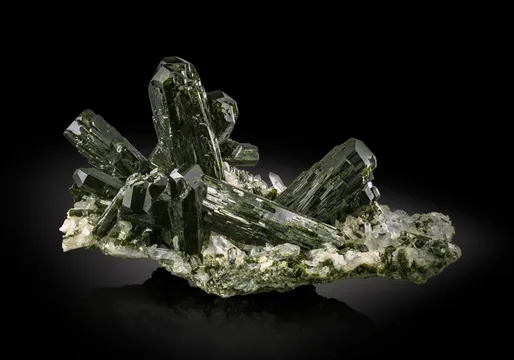
Other minerals documented or credibly reported from the Tentadora/Ullpac setting include pyrite, chalcopyrite, argentiferous galena, epidote, green platy vesuvianite, small scheelite crystals, pale amethyst, and chlorite inclusions or phantoms in quartz. None of these is known as a type-locality species from Tentadora, but several matter to collectors because they sharpen the geological and label context. Vesuvianite, epidote, scheelite, and pale amethyst belong with the simple quartz-vein Japan-law assemblage, while pyrite, chalcopyrite, and galena reflect the underlying hydrothermal/skarn copper-zinc-silver mineralization recorded for the Ullpacc exploration project.
The principal authenticity issue for Tentadora is not a widely documented treatment scandal, but locality confusion. “Tentadora Mine” has been applied to the Ullpac/Pampa Blanca specimen locality associated with Japan-law quartz and chrysocolla-on-quartz, and it is also the name of a distinct mine in the Julcani district of Huancavelica. Some older quartz labels place the locality in Castrovirreyna Province, Huancavelica, while modern mapping and official exploration records place the Ullpacc/Tentadora project in Huancano District, Pisco Province, Ica. A strong label should therefore contain more than “Tentadora, Peru”: look for Ullpac or Mt. Ullpac, Pampa Blanca, Payhuano or Huancano, Pisco/Ica, or Flor de Peru I for the quartz-twin locality. A label simply saying “Tentadora Mine, Huancavelica” may be correct for some database traditions, but it needs scrutiny if it accompanies the 2020 chrysocolla-on-quartz style.
Condition matters sharply. Japan-law quartz twins naturally have a compositional plane where breakage can occur, and many pieces are contacted around the edges where they were removed from vein walls. Repairs are plausible on sharp twin plates and should be checked with magnification, especially along the twin seam, at wing tips, and where a main twin meets matrix. On chrysocolla-coated quartz, examine the tips and ridges of the coated crystals; the color can distract from bruised quartz terminations, rubbed botryoidal high points, and small chips exposing paler interiors. Because the chrysocolla is a coating on harder quartz, careless cleaning can undercut or dull the very surface that gives the specimen value.
Good Tentadora chrysocolla pieces remain market-available, but the best are not common. Since the find was recognized internationally in 2020, specimens have appeared through major dealers, mineral marketplaces, and auctions, with small to medium pieces still circulating and larger, complete cabinet specimens more selectively offered. The most desirable examples combine strong turquoise-to-greenish-blue color, visible quartz morphology, three-dimensional form, and a documented chain back to the 2020 find or a reputable dealer label. For the quartz twins, fine pieces are less about color and more about crystallographic elegance: sharp, symmetrical twins, glassier faces, minimal white overgrowth, and undamaged wing tips are the premium markers.
Handling should be conservative. Quartz itself is durable, but Tentadora specimens are often composite objects: thin twin plates, later drusy quartz, chrysocolla crusts, and botryoidal copper-silicate surfaces all create snag points. Avoid ultrasonic cleaning, acids, aggressive brushing, and prolonged soaking. Dust removal with a soft brush or air bulb is usually safer. Chrysocolla can be porous and variable in hardness, so a specimen that looks robust in a photograph may still have a delicate surface in hand.
Tentadora’s first collecting story reads like a locality identity puzzle. In the late 1990s, Japan-law quartz from southern Peru began to reach the market under shifting names. Local suppliers were described as secretive, and the early labels did not make the source easy to untangle. Collectors already knew Pampa Blanca for epidote; suddenly, from “the other side of the highway,” came quartz twins instead. The old copper working called Tentadora, later identified with the Flor de Peru I claim at Ullpac Mountain, began producing specimens in 1999 and quickly became one of the world’s great modern Japan-law quartz sources.
The numbers explain why collectors still talk about the place. Quartz crystals from the Ullpac veins reached about 20 cm, and the Japan-law twins averaged about 5 cm, with better ones occasionally reaching 10 cm. The shapes ranged from the familiar V to hearts, butterflies, and the much rarer closed-square form. One part of the vein reportedly yielded groups exceeding 30 cm made entirely of large Japan-law twins. The drawback was also memorable: many twins were made milky by a later white quartz coating. That flaw became part of the locality’s character. The great pieces were the exceptions—those with enough luster, clarity, geometry, chlorite phantom, or amethyst scepter accent to rise above the common milky production.
There is also a giant-specimen chapter nearby in the same Pampa Blanca quartz story. A 2001 specimen from the broader Pampa Blanca/Rosario Mabel context reportedly reached the Lima market weighing about 200 kg and carrying at least ten Japan-law twins, each about 10 cm across. In 2002, a 49 cm twin was found at Pampa Blanca. These figures are outsized even for collectors accustomed to Peruvian abundance, and they help explain why the Tentadora–Ullpac quartz veins became a reference point in discussions of Japan-law twinning rather than just another quartz occurrence.
The second act came two decades later. In March 2020, a new style appeared: quartz crystals from Tentadora covered in vivid greenish-blue chrysocolla. The timing was strange—Sainte-Marie-aux-Mines was forced into a virtual format in 2020—but the specimens still made a visual impact. Dealer descriptions emphasized that the material came from a known Peruvian locality, but that this kind of specimen had not been seen from it before. The best pieces looked almost textile: quartz crystals wrapped in a smooth first skin of chrysocolla, then ornamented by later botryoidal blue-green growths. One published example measured 15 x 7.8 x 7.7 cm; another, 11.2 x 3.8 x 3.5 cm, was specifically noted as pictured in Le Règne Minéral no. 154, page 45, as a Sainte-Marie Virtual 2020 novelty.