






Phoenix United Mine, UK - Cornish copper-tin lode yielding chalcosiderite, libethenite, cuprite, malachite; a key type locality with collectible specimens.
Key facts
Phoenix United Mine stands on the south-eastern flank of Bodmin Moor, near Minions in the old Caradon–Phoenix mining area of Cornwall. For collectors it is one of those British localities where history, geology, and specimen character are inseparable: a copper-and-tin lode system worked through granite and killas, with an unusually productive oxidized copper zone that yielded classic 19th-century specimens of cuprite, libethenite, chalcosiderite, malachite, native copper, and a crowded suite of copper phosphates, arsenates, oxides, and sulphates. The locality is especially important because Wheal Phoenix, within the Phoenix United complex, is the type locality for chalcosiderite, and because Phoenix libethenite has long had an outsized reputation among British collectors—small by world standards, but often old, lustrous, dark, sharp, and attached to iron-rich quartz gossan.
The best Phoenix pieces have a distinctly Cornish face. Instead of the open, sculptural display of later African or American copper minerals, many are compact, iron-stained, vuggy veinstones: cellular quartz, limonite and goethite gossan, dense copper ore, and pockets lined with dark green libethenite, grass- to forest-green chalcosiderite, blackish to red-brown cuprite, or hairlike red chalcotrichite. Good specimens reward magnification. Their quality lies in sharp terminations in small cavities, natural patina, reliable old labels, and the mineralogical story of a lode that carried both copper and tin in close association.
Regional View
Country View
The collecting significance of Phoenix United is anchored in the Main Lode and its associated workings—Wheal Phoenix, West Phoenix, Stowe’s and Clanacombe among them. Historic descriptions make clear that the near-surface copper lode was a gossanous, quartz-rich, oxidized environment, while the later economic emphasis shifted back toward tin as copper prices and copper reserves declined. That changing mining focus helped preserve a particularly rich secondary-mineral record: copper oxides and carbonates in the upper workings, phosphate and arsenate species in vugs and cavities, and tin minerals in the granitic portions of the system.

Photo: chris lovelock / Wikimedia Commons

Search for specimens: View all specimens from Phoenix United Mine, UK
Phoenix United Mine is at Minions, Linkinhorne, Cornwall, in the Caradon and Phoenix area on the south-eastern edge of Bodmin Moor. The mine lies in a classic Cornish hydrothermal lode setting close to the Bodmin Moor granite and its contact with Upper Devonian killas, the local term for the metamorphosed slates and sedimentary rocks surrounding the granite. The Caradon/Phoenix granite is described as a medium-grained granite with orthoclase, quartz, plagioclase, two micas, and minor tourmaline, and the Phoenix ground is complicated by a tongue or slab of killas that strongly influenced the mineralization. Collectors should understand Phoenix as a lode system at the granite–killas interface, not as a single dump locality: old labels may read Wheal Phoenix, Phoenix Mine, Phoenix United, West Phoenix, Stowe’s, Clanacombe, or occasionally one of the individual shafts or sections.
The principal geological peculiarity of the mine is that the main lode carried copper and tin in close but distinct parts of the structure. Northern Mine Research Society’s summary of Dines records the lode as unusual because copper and tin lodes lay side by side on an ancient fault plane, produced by two mineralizing episodes. Where wall-rock relationships changed, so did the economic character of the ore: the upper portions and some granitic-footwall horizons were notably copper-rich, while at depth the tin lode became increasingly important. Historic sources name the Main, New South, William’s, Snuff-box, North, and Wolfram lodes, while Heritage Gateway records Stowes Great Lode, New Lode, South Lode, and Snuffbox Lode among the lodes that underpinned the mine’s fortunes.
The oxidized copper zone is the source of the locality’s collector appeal. In the Clannacombe part of the sett, east of the large north–south crosscourse, gossan and hydrated iron oxide were reported to a depth of 200 fathoms. Near surface the lode was described as jasperoid iron ore and limonite with drusy quartz and chlorite, also carrying tin and kaolin material, cut by black copper oxide, copper carbonates, chalcocite, pyrite, chrysocolla, massive and crystallized cuprite, and chalcotrichite. Cavities in cellular quartz were lined with malachite, copper oxides, copper arsenates, and native copper. That description fits the surviving specimen population remarkably well: dense, iron-rich quartz gossan with small but mineralogically rich cavities.
Historically, the mine grew by amalgamation and reinvention. Earlier workings on Stowe’s and Clanacombe ground predate the 19th-century boom, and documentary summaries trace mining on the lodes back to medieval and early modern activity. In 1836 the Cornwall Great United Mining Association brought several smaller mines together, including Wheal Phoenix, South Phoenix, North Phoenix, West Sharp Tor, Clanacombe, and Stowes. The early company exhausted its capital without lasting success, but the ground was taken up again, and Wheal Phoenix became one of the great East Cornwall copper mines after rich copper was struck in 1852. In the 1860s, as copper waned, William West directed a major shift to tin; by 1864–65 the mine was being re-equipped for tin production.
Published production figures differ slightly between sources, which is typical for Cornish mines compiled from cost-book returns and later summaries. Heritage Gateway records 84,538 tons of copper between 1848 and 1889 and 15,996 tons of tin between 1853 and 1898; Explore Cornwall, summarizing Dines and later engine-house research, gives very similar but not identical totals, including 80,520 tons of copper ore averaging 6¾ percent copper for 1824–78 and 4,152 tons of black tin for 1853–75 in one tabulation, and 80,092 tons of copper ore averaging 7 percent copper plus 16,360 tons of black tin in another. Whatever table is used, Phoenix was a major producer: one of the most important copper mines in East Cornwall and later a substantial tin mine.
The main shafts and workings named in modern summaries include Prince of Wales, Seccombe’s, Hamilton’s, Polkinghorne’s, Anna’s or New Engine, Stowe’s, West’s, Old Sump, Elizabeth’s, Juliana’s, Tom or Adit, and Redburrow. Seccombe’s Shaft reached about 225 fathoms and Prince of Wales Shaft about 222 fathoms. The Prince of Wales Shaft belongs to the final phase of the mine. A new 80-inch pumping engine by Holman Brothers of Camborne was installed in 1908–09, and Historic England lists the surviving engine house at Grade II. Despite that substantial investment, drainage remained difficult and the last attempt closed in 1914.
Access today is very different from the specimen-producing years. The ground is open moorland and the mine remains are accessible to walkers from Minions, but the site is also a Site of Special Scientific Interest and part of the Phoenix United Mine and Crow’s Nest Special Area of Conservation. The SSSI is designated for biological interest linked directly to the metal-rich mine waste: rare bryophytes and lichens colonize the contaminated bare ground, including Cornish path moss, Ditrichum cornubicum. Casual collecting should therefore be conservative and permission-aware. Surface picking from loose, already disturbed material is one matter; digging into spoil, enlarging exposures, entering adits, or disturbing protected metallophyte habitat is another. Serious collectors should treat Phoenix as a heritage and conservation site first, a source of historic specimens second.
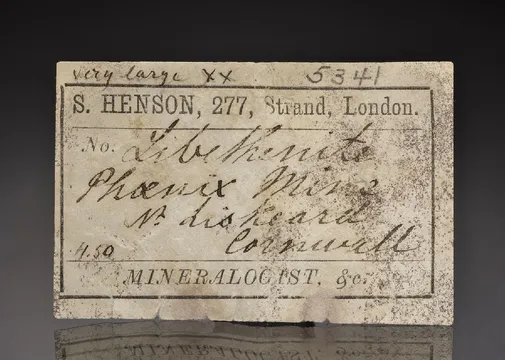
Most notable mineral finds are best understood as old 19th-century material from mine work rather than modern collecting. Libethenite, chalcosiderite, cuprite, and associated copper species came from vugs in iron-rich quartz gossan and copper ore; the classic pieces circulated through British and American collections with old dealer or museum labels. Crystal Classics has documented a Phoenix libethenite with a late 19th-century Samuel Henson label, dating the label to 1878–1888, and provenance through the Kay Robertson collection, Rock Currier’s photography, and the U.S. National Museum’s Washington A. Roebling collection. That kind of paper trail is part of the locality’s value: a small dark green crystal from Phoenix with a strong label can matter more than a larger but anonymous specimen from a more common source.
Cuprite from Phoenix United is a classic oxidized copper-zone mineral, occurring as massive ore, dark red to blackish octahedral crystals, crystals partly dulled by age or alteration, and the capillary variety chalcotrichite as matted blood-red hairs in iron-rich gossan. Historic descriptions of the Clannacombe portion specifically record both massive and crystallized cuprite with chalcotrichite, native copper, malachite, copper oxides, and copper arsenates in cellular quartz cavities, and modern specimen records show old-time cuprite on dark matrix, sometimes with native copper and goethite. Most Phoenix cuprite specimens are small cabinet to miniature pieces with crystals in the millimetre range, though museum and old collection records indicate larger crystals are known, including a British Museum specimen described with a 4.2 cm crystal and a Mindat-referenced exceptional 8.8 x 6 cm specimen noted in connection with Bancroft’s classic-mineral literature. The best Phoenix cuprites are those retaining clear octahedral form, reddish internal colour or chalcotrichite sparkle, and undisturbed vug context; ordinary pieces are often dark, massive, and visually subdued unless the label or association is exceptional.
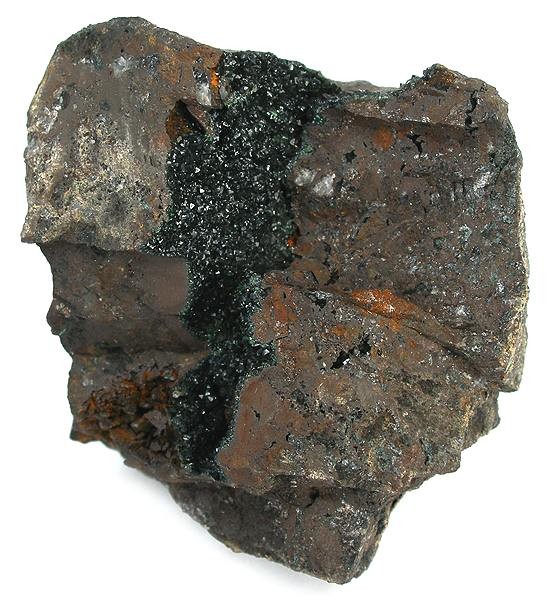
Libethenite is one of Phoenix United’s signature collector minerals, found as very dark bottle-green to blackish-green, lustrous, typically sharp crystals and crystalline patches in vuggy iron-rich quartz gossan and dense copper ore. The standard Phoenix habit is small octahedral or pseudo-octahedral crystals lining cavities; many pieces are better under magnification than at arm’s length, but the locality is notable for having produced some of the largest British libethenite crystals, with documented old specimens carrying individual crystals around 0.9 to 1 cm and one collector-photographed Cornish example described with crystals to 15 mm. Associations include quartz, goethite, pseudomalachite, dufrénite, and other phosphate-rich alteration products of the copper lode. A good Phoenix libethenite has clean, lustrous, isolated or clustered crystals set in a stable vug, ideally with an old label; an ordinary example may show only dark green glassy or massive patches with few well-formed terminations.
Quartz at Phoenix United is not usually collected as a standalone display species in the way alpine quartz is, but it is the essential matrix and pocket-former of the locality’s copper minerals. Historic accounts repeatedly describe drusy quartz and cellular quartz in the gossan, and the Phoenix suite depends on those cavities: quartz-lined veinstone hosts malachite, cuprite, chalcotrichite, chalcosiderite, libethenite, native copper, and arsenate/phosphate microcrystals. Collectible quartz pieces from Phoenix tend to be iron-stained, brecciated, vuggy, or jasperoid rather than pristine; amethyst has also been recorded from the locality in modern collection data, but it is not the mine’s main specimen identity. The best Phoenix quartz specimens are those where the quartz architecture frames a secondary copper mineral cleanly—open cavities, sparkling druse, and contrasting iron gossan—whereas plain milky or rusty bull quartz without associated species is common and of limited collector value.
Beyond cuprite, libethenite, and quartz, Phoenix United is a compact catalogue of Cornish secondary copper mineralogy. Chalcosiderite, CuFe3+6(PO4)4(OH)8 · 4H2O, is the key species historically: Wheal Phoenix is its type locality, with classic material forming minute dark green plates, sheaves, rosettes, and grape-like aggregates in vugs in brecciated quartz-rich gossan. The mine has also recorded allophane, arsenolite, azurite, barbosalite, beraunite, brochantite, cacoxenite, cassiterite, chalcanthite, chalcocite, chalcophyllite, chalcopyrite, chamosite, chenevixite, chrysocolla, connellite, cornubite, cornwallite, covellite, cyanotrichite, dufrénite, faustite, goethite, gorceixite, halloysite, hematite, hentschelite, hisingerite, kaolinite, kidwellite, langite, malachite, muscovite, native copper, olivenite, opal, pharmacosiderite, phenakite, pseudomalachite, pyrite, pyrolusite, rockbridgeite, scorodite, siderite, sphalerite, strengite, tenorite, torbernite, turquoise-group material including rashleighite, and waylandite. “Andrewsite,” historically reported from Wheal Phoenix, is now discredited as a mixture involving hentschelite and rockbridgeite with minor chalcosiderite, and that story is a useful warning that Phoenix’s dark green phosphate minerals often require analytical confirmation.
Phoenix United specimens are usually valued as classic Cornish historical minerals rather than as large display pieces. The strongest market demand is for old-time libethenite, chalcosiderite, cuprite, and chalcotrichite, especially with pre-World War I labels, British dealer labels, museum or named-collection provenance, or precise sublocality wording such as Wheal Phoenix or West Phoenix. Modern field-collected material does appear, but the most desirable pieces are overwhelmingly old material that entered collections during or shortly after the mine’s working life.
The major authenticity issue is not widespread fakery but identification and label discipline. Phoenix labels may use Wheal Phoenix, Phoenix Mine, Phoenix United, West Phoenix, Stowe’s, or Linkinhorne; these are not necessarily errors, but they should be read carefully because they can refer to sections within the broader mine complex. Conversely, vague “Phoenix Mine” labels can be problematic because the name is common worldwide. A good label should include Linkinhorne, Minions, Liskeard District, or Cornwall. Specimens labeled from “Phoenix, Cornwall” without further detail deserve caution, especially if the species or matrix does not fit the iron-rich quartz-gossan Phoenix style.
Mineral misidentification is a real concern. Dark green libethenite, chalcosiderite, pseudomalachite, cornwallite, cornubite, turquoise-group minerals, and old “rashleighite” or “turquoise” labels can be difficult to separate visually on small vuggy pieces. Mindat’s locality notes flag that many specimens labeled scorodite may be rashleighite, and “andrewsite” is a discredited name rather than a valid species. Cuprite may be blackened, altered, or pseudomorphed by other copper minerals; chalcotrichite may be crushed or confused with other red acicular copper minerals. For higher-value pieces, analytical confirmation or a highly credible old provenance is worth the premium.
Condition is often the limiting factor. Phoenix specimens are typically gossanous, porous, and vuggy; iron-rich matrix can shed grains, and exposed microcrystals are easily bruised. Libethenite crystals commonly sit partly hidden in shallow pockets, with broken terminations or incomplete crystals accepted on otherwise important old examples. Chalcotrichite is delicate and should not be brushed, soaked, or subjected to ultrasonic cleaning. Chalcanthite, if encountered, should be treated as potentially unstable and water-soluble. Torbernite is recorded from the locality; any suspected uranium phosphate should be stored sensibly, kept out of dusty handling routines, and not trimmed or abraded without appropriate precautions.
Cleaning should be minimal. A dry air blower, soft artist’s brush used away from fragile acicular minerals, and careful mechanical removal of loose dirt are usually safer than chemical treatment. Acids can damage associated carbonates, destabilize iron gossan, and remove the patina that makes old Cornish material attractive. The dark, antique surface of many Phoenix cuprites and libethenites is part of their identity; over-cleaning can turn a historic specimen into a less convincing object.
On the market, Phoenix United is not rare as a name but genuinely fine examples are scarce. Small, massive, or poorly crystallized gossan pieces remain affordable, while sharp libethenite crystals approaching a centimetre, rich chalcosiderite from the type locality, well-formed cuprite crystals, and attractive chalcotrichite can move into serious classic-mineral prices quickly. Provenance matters unusually strongly here: a modest specimen with a Samuel Henson, Richard Barstow, Roebling, Carnegie, British Museum-associated, or other respected old label may be more desirable than a visually stronger but undocumented piece.
Stand on the Cheesewring ridge and the Phoenix sett makes immediate sense. A Victorian observer in 1863 described the ground as a rectangle 760 fathoms long by 500 fathoms wide, with the western boundary running along the top of the Cheesewring and the mine buildings laid out on a small plateau below. Looking eastward, the whole length of the sett was “laid out like a map”; westward and northward, the view was only bare conical hills and marshy bottoms. That same account captures why Phoenix mattered before Caradon became famous: when the Cornwall Great United adventurers first began, “even the celebrated South Caradon was not as yet dreamt of.” Phoenix was not merely another mine in the district; it was one of the mines that proved the district.
The early lode was almost a landscape feature. Webb and Geach recorded that the back of the lode had been opened by the old men for about a mile in their search for tin, and that it could be seen at a considerable distance. It ran from Upton through East Phoenix, Clanacombe, Stowe’s, and West Phoenix, with four distinct mines working the same remarkable structure. That long, oxidized back is the source of the mental picture collectors should keep: not neat pockets in clean rock, but a great iron-stained, quartz-bearing, copper-altered fault lode, worked and reworked by generations who first chased tin, then copper, then tin again.
Water repeatedly shaped the mine’s history. In 1858, when the workings had become deep and the water “so fast,” more powerful machinery was needed, but the lease was about to expire and the Duchy and the committee could not agree terms. The problem never truly went away. Half a century later, the Prince of Wales Shaft represented a grand technological answer: a new deep shaft, a huge 80-inch pumping engine by Holman Brothers, a Robey winding engine, and pneumatic stamps. Even then, drainage remained difficult, and the last working phase ended in 1914.
The 1907–14 revival has the air of Edwardian optimism colliding with Cornish geology. A company report quoted in British Mining described the old Phoenix as having produced as much as £1,300,000 in tin and copper and paid £230,000 in dividends, while also criticizing the old owners for having made little provision for replacing plant. The revival promoters calculated a possible £100,000 profit, based on hauling 12,000 tons per month and recovering 36 pounds of tin per ton. The vision was large, but the outcome was small: after the Prince of Wales investment, Explore Cornwall’s Dines-based figures record only about 95 tons of black tin for 1907–14, while another summary gives 104 tons.
The mine was also a place of Cornish naming, renaming, and reinvention. Stowes, Clanacombe, Wheal Prosper, Wheal Julia, Wheal Phoenix, Phoenix United, West Phoenix, and Prince of Wales Shaft all belong to the same local story. That is why old mineral labels from this mine are so rewarding and sometimes so maddening: a label saying “Phoenix Mine, Linkinhorne” may be perfectly historic, while a later cataloguer may prefer “Wheal Phoenix, Phoenix United Mine, Minions, Linkinhorne, Cornwall.” The paper trail carries the same layered history as the lode.
.jpg)

