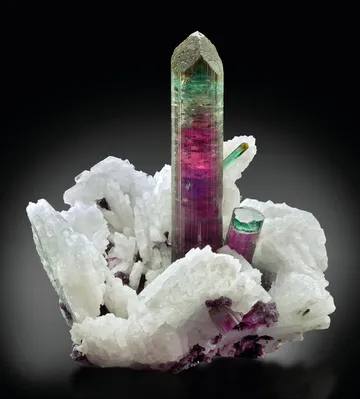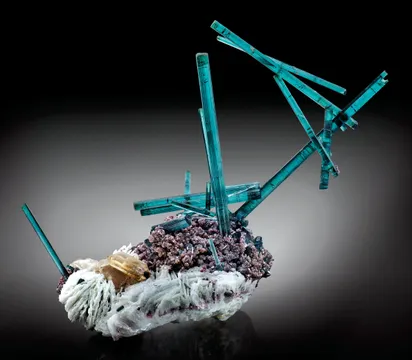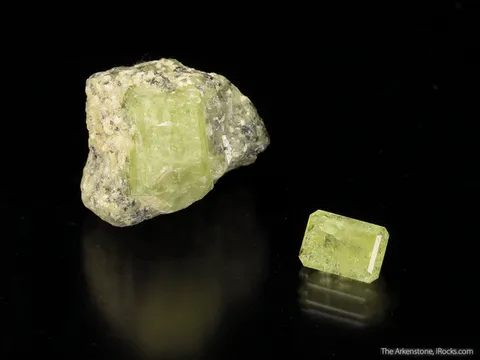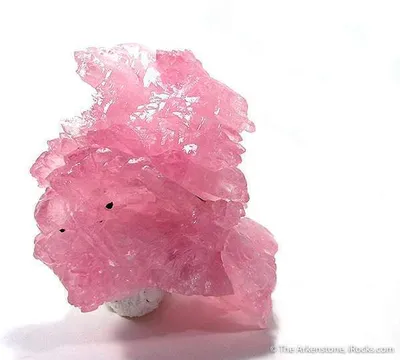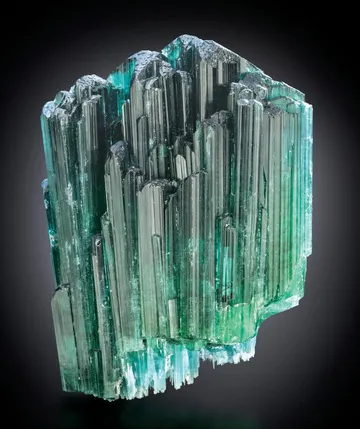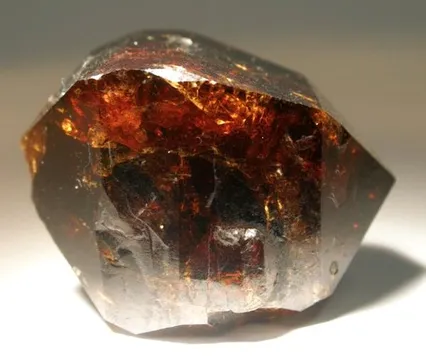
Jenipapo mine, Brazil — pegmatite locality famed for kosnarite crystals, honey-yellow to beige on albite, with a rare-phosphate assemblage prized by collectors.
Key facts
For collectors, “Jenipapo mine” is best understood as the Jenipapo pegmatite field of the Itinga–Taquaral area in the Jequitinhonha Valley of northeastern Minas Gerais: a cluster of small pegmatite workings and claims whose specimens entered the market under labels such as Jenipapo district, Mario Pinto mine, Jorge pegmatite, Murundu mine, and Lavra de Kosnarita. The locality sits in the Eastern Brazilian Pegmatite Province, where late granitic pegmatites cut metasedimentary host rocks of the Salinas Formation and where the ore minerals, gem minerals, and secondary phosphates are strongly controlled by internal pegmatite zoning, albitization, quartz cores, and late miarolitic cavities.
Jenipapo’s collector fame rests above all on kosnarite, KZr2(PO4)3, a rare potassium-zirconium phosphate that is normally a microscopic curiosity but here occurs as sharp, lustrous, pseudo-cubic to pseudo-octahedral crystals large enough to be appreciated with a hand lens. The best pieces show honey-yellow to beige crystals sparkling across snow-white albite or cleavelandite, commonly with brown radial zanazziite, silvery to brown muscovite, montebrasite, quartz, and other phosphate-suite associates. Good Jenipapo kosnarite is not merely “rare mineral on matrix”; it has contrast, architecture, and scale for a species that at many localities barely announces itself.
Regional View
Country View
The same district is also notable for a broader rare-phosphate and rare-element assemblage: albite, montebrasite, muscovite, zanazziite, eosphorite, fluorapatite, goyazite, rockbridgeite, jahnsite-group minerals, ushkovite, lithiotantite, wodginite, cassiterite, beryl, brazilianite, elbaite, and quartz varieties have all been tied to the field or its named workings. The Murundu mine, in particular, has a separate reputation for a zoned pegmatite with a thick quartz core and replacement bodies that yielded elbaite, cassiterite, columbite-tantalite minerals, and the rare tantalate lithiotantite.

Photo: Rob Lavinsky, iRocks.com / Wikimedia Commons
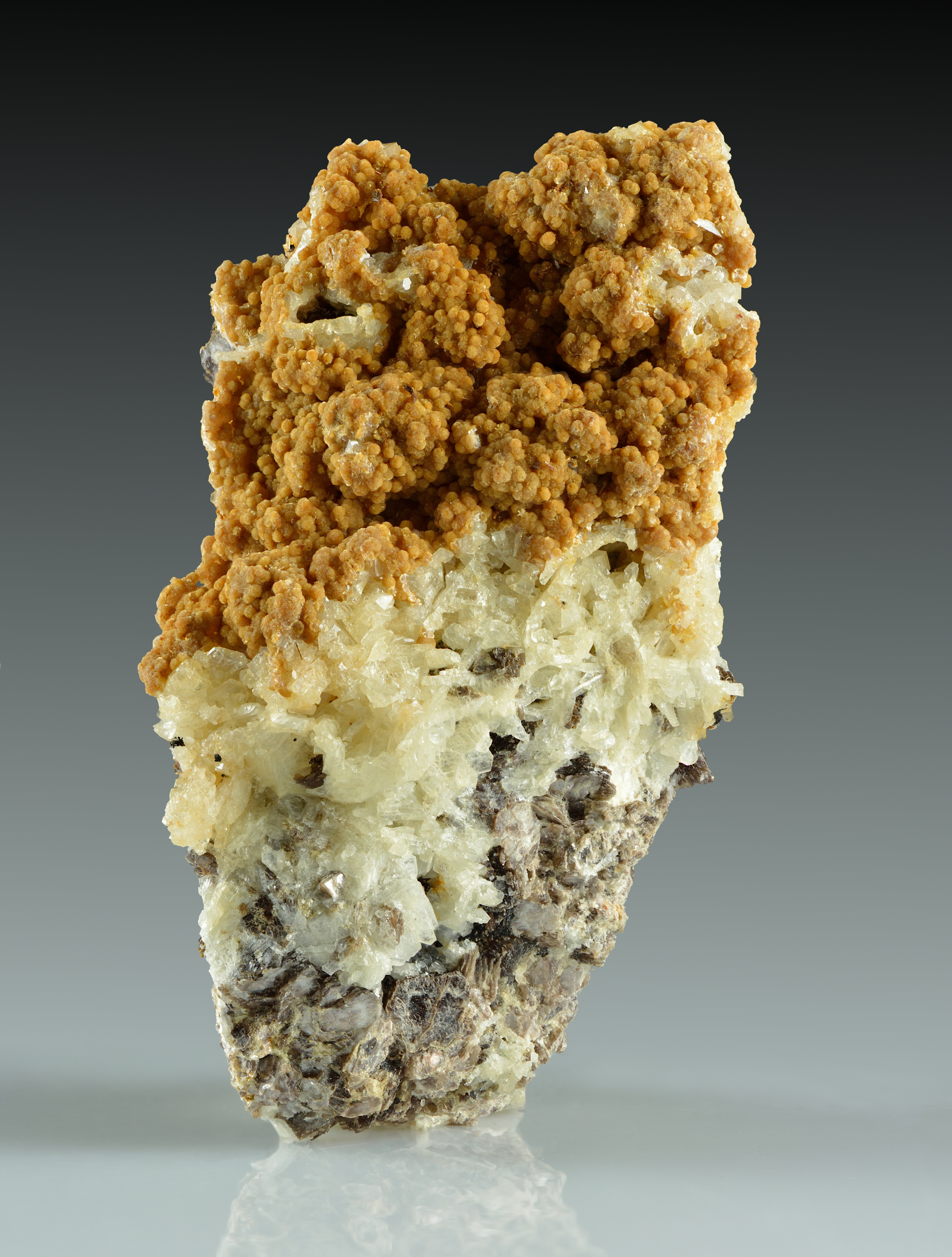
Jenipapo specimens are best judged in the context of pegmatite pocket mineralogy, not by cabinet-mineral size expectations. A 2 mm kosnarite crystal with clean form, bright luster, and isolation on albite can be a more important specimen than a much larger but visually confused plate. Likewise, albite from Jenipapo is most desirable where it is not just matrix but sculptural cleavelandite: ribbed, bladed, porcelain-white to translucent, and clean enough to set off the phosphate crusts and sprays that made the locality famous.
Search for specimens: View all specimens from Jenipapo mine, Brazil
The Jenipapo locality belongs to the Itinga–Taquaral pegmatite country of Minas Gerais, within the broader Eastern Brazilian Pegmatite Province. In this part of the Jequitinhonha Valley, pegmatite bodies occur in metasedimentary rocks, especially schists of the Salinas Formation, and range from small, altered workings to larger zoned bodies with feldspar-rich margins, albite-rich replacement zones, mica-bearing zones, and quartz cores. These are classic rare-element granitic pegmatites: economically modest by modern mine standards, but extraordinarily productive for gem and collector minerals where late fluids concentrated Li, Be, P, Ta, Nb, Zr, Sn, and B into pockets and replacement assemblages.
The name Jenipapo has been used at several scales. On older and dealer labels it may mean the Jenipapo district near Itinga and Taquaral; on locality databases it is more precisely the Jenipapo pegmatite field, with named sublocalities including the Jorge pegmatite, Mario Pinto pegmatite, Murundu mine, João Pego pegmatite, Guta Gusmão claim, Santa Maria claim, Sandro claim, Tião Dutra mine, and Agenor Silistrino pegmatite. The kosnarite-albite specimens most prized by collectors are especially tied to the late-2002 Jenipapo discovery and to the Mario Pinto/Jorge/Lavra de Kosnarita labeling complex. One published account places the Mario Pinto mine in the Taquaral pegmatite field, about 2.5 km south of Murundu, as a zoned pegmatite hosted by biotite schist of the Salinas Formation, striking roughly N40° and dipping vertically, with workings exposing a body on the order of 30 by 10 m and a maximum thickness near 15 m.
At Mario Pinto, the pegmatite is described as medium grained and dominated by muscovite and feldspar flanking an irregular quartz core, with small nearby pockets and some rose quartz. The important kosnarite occurs in late cavities as beige to pale yellow or vivid yellow druses of euhedral pseudocubic to pseudo-octahedral crystals, typically on albite or cleavelandite and commonly associated with brown zanazziite sprays or spherulites. This is the mineralogical heart of the locality for most advanced collectors: the zirconium did not simply remain locked in zircon, but entered a late phosphate framework mineral that crystallized visibly and cleanly in open space.
Murundu adds a different but related chapter. The Murundu pegmatite is a large, subhorizontal, internally zoned body in Salinas schist, with a thick quartz core. It was worked at the surface until the end of the 1980s, chiefly for industrial feldspar, beryl, and montebrasite. Its core yielded cavities with well-formed quartz and yellow muscovite, while replacement bodies around the core produced pockets with green to blue elbaite, cassiterite, columbite-tantalite minerals, and other rare-element species. Later mineralogical work documented dark red lithiotantite from Murundu, in tabular twinned crystals on milky quartz or associated with reddish-brown tantalite and black cassiterite.
The district’s mining was largely small-scale, opportunistic, and pocket-driven. Pegmatite miners followed feldspar, beryl, montebrasite, tourmaline, cassiterite, and tantalum-niobium oxides; specimen production came when open cavities and altered phosphate zones happened to yield crystals. This is why the finest Jenipapo specimens have the character of a limited pocket find rather than a continuously available production run. Reports of the Lavra de Kosnarita describe several hundred kilograms of albite containing kosnarite, but the percentage of that material suitable as fine mineral specimens was necessarily much smaller: trimming, crystal exposure, luster, and survival of fragile albite blades all determine what becomes a collection-grade specimen.
Collectors should also note a persistent locality trap. There is a Jenipapo gold mine in Itapirapuã, Goiás, with gold-bearing quartz veins in gneiss, and it is unrelated to the Minas Gerais kosnarite-albite pegmatite material. A Jenipapo label on a kosnarite, albite, zanazziite, montebrasite, or rare phosphate specimen should point to the Itinga/Taquaral pegmatite district in Minas Gerais, not to the Goiás gold locality.
Access today should be treated as private-claim access unless proven otherwise by the landowner and mineral-rights holder. The historic workings are not public collecting sites in the North American club-field-trip sense; they are Brazilian garimpo and mine localities, some inactive, some obscure, and some potentially unsafe. Old pegmatite pits, shallow underground workings, weathered feldspar zones, and unsupported pocket areas are hazardous even when they look small. For collectors, the realistic route to Jenipapo material is the specimen market, not casual field collecting.
Jenipapo kosnarite is the locality’s signature species: sharp, lustrous, beige, cream, honey-yellow, orange-yellow, or vivid yellow pseudocubic to pseudo-octahedral crystals, typically 1–2 mm and exceptionally reported to about 3–4 mm, scattered or drused on white albite and cleavelandite. The best specimens come from late cavities and albite-rich zones in the Jenipapo district, especially the Mario Pinto/Jorge/Lavra de Kosnarita material that reached collectors after the late-2002 find and appeared prominently at Tucson in 2003. Associations with brown radial zanazziite, silvery-brown muscovite, montebrasite, and occasional quartz give the finest pieces both mineralogical depth and visual contrast. Superior examples show isolated, complete, sparkling crystals on clean bladed albite; ordinary pieces are richer in crust but less legible, with smaller yellow grains, iron staining, or kosnarite lost in the matrix texture.
At Jenipapo, albite is both a major pegmatite mineral and the stage on which the locality’s rare phosphates perform. It occurs as white to translucent masses and, most memorably for collectors, as bladed cleavelandite forming ridged, open, snowy matrices that host yellow kosnarite, brown zanazziite, muscovite, montebrasite, and other phosphate-suite minerals. Fine albite specimens from this locality are valued less as single-species feldspar displays than as clean, sculptural supports with enough translucency and relief to make millimetric kosnarite crystals visible without crowding. The strongest pieces have undamaged blades, minimal iron staining, well-spaced rare-mineral coverage, and a composition that allows the albite to read as architecture rather than simply white background rock.
Beyond kosnarite and albite, Jenipapo has produced or documented a dense rare-element pegmatite suite. Zanazziite is the most visually important associate, occurring as brown crystallized sprays or spherulitic aggregates on albite and quartz. Montebrasite and amblygonite-montebrasite series minerals are central to the phosphate chemistry; muscovite, lepidolite-series mica, fluorapatite, eosphorite, goyazite, rockbridgeite, jahnsite-(CaMnMg), ushkovite, and whiteite-group minerals round out the phosphate assemblage. Murundu contributes lithiotantite, wodginite, cassiterite, columbite-tantalite minerals, beryl, quartz, schorl, and elbaite. Agenor Silistrino and other Jenipapo sublocalities add brazilianite, beryl, and additional tourmaline-related material. The field is not generally treated as a type-locality showcase, but it is a genuine rare-mineral district whose importance rests on exceptional kosnarite, documented lithiotantite, and the quality of its albite-hosted phosphate associations.
The most important authenticity issue is locality precision. Jenipapo kosnarite has been sold under several legitimate label styles—Jenipapo district, Jenipapo pegmatite field, Mario Pinto mine, Jorge pegmatite, Taquaral, Itinga, Jequitinhonha Valley, and Minas Gerais—but those labels do not all mean the same thing. A specimen with good provenance may have an older broad district label; a specimen with modern analytical or locality documentation may specify Mario Pinto, Jorge, or Murundu. Conversely, a “Jenipapo mine, Brazil” label on gold or massive quartz may refer to the unrelated Jenipapo gold mine in Goiás, not the Minas Gerais pegmatite field.
I found no well-documented published problem of fabricated Jenipapo kosnarite specimens, but misidentification is easy at this scale. Yellowish iron staining, apatite, altered phosphate crusts, or tiny mica reflections can be mistaken for kosnarite in poor photographs. Serious pieces should show sharp pseudocubic to pseudo-octahedral crystals with vitreous luster, and the best provenance traces back to the early-2000s Jenipapo find or to recognized collections and dealers who handled that material. For high-value examples, analytical confirmation or a pedigree to known kosnarite lots is desirable.
Condition is a major value driver. Albite/cleavelandite blades are prone to bruised edges and cleaved tips, and the kosnarite crystals themselves are small enough that a specimen can lose its visual impact through one careless trim, cleaning, or mount. Look for intact albite blades, unabraded kosnarite faces, clean color contrast, and whether the crystals are on a protected recess or exposed ridge. Many specimens are essentially magnification specimens; a good loupe photo can be as important as the cabinet view.
The locality is rare but not mythical. Small Jenipapo kosnarite specimens circulate periodically from old collections, and better examples surface at auction or through specialist rare-mineral dealers. Large, rich, well-composed plates with obvious crystals and good albite architecture are scarce and command a premium. Specimens with ex-Rich Kosnar, ex-Brian Kosnar, Luiz Menezes, Rob Lavinsky/iRocks, Jordi Fabre/Fabre Minerals, or other early-handling provenance are especially desirable because they anchor the piece to the recognized find period.
Kosnarite has no special radioactivity or toxicity concern under normal specimen handling, but many Jenipapo pieces are delicate. Avoid ultrasonic cleaning, aggressive acid treatment, and repeated water soaking unless you fully understand the matrix and associated phosphates. Store thumbnails and miniatures so the albite blades cannot rub against foam lids, and keep labels with the specimen: in this locality, the label history can be almost as important as the mineral species.
The Jenipapo kosnarite story has the shape of a classic modern rare-mineral discovery: a species that had been known from Maine in crystals barely reaching a millimeter suddenly appeared in Brazil in crystals several times larger, bright enough and sharp enough to be sold not just as analytical curiosities but as attractive mineral specimens. Brazilian dealer Luiz Menezes brought the find to collector attention around the 2003 Tucson show, and the impact was immediate. For a mineral whose best-known earlier crystals were microscopic to barely visible, Jenipapo pieces with yellow crystals on white albite felt outsized, almost improbable.
One contemporary dealer description captures the excitement of that first market appearance. A miniature albite matrix with kosnarite crystals to about 3 mm was remembered from the 2003 Tucson room scene: Luiz Menezes had the best pieces, and another collector was seen walking out with one as the writer was walking in. It was not described as the biggest or most expensive specimen, but as the most aesthetic because of crystal quality, isolation, and the contrast against albite. That is exactly how Jenipapo kosnarite should be understood. The locality did not become famous for tonnage or for giant crystals; it became famous because, for once, a vanishingly rare phosphate made specimens that could be admired.
There is also a quieter geological story behind the collector drama. Cassedanne later described a Lavra de Kosnarita on the left bank of the Rio Jequitinhonha, north-northwest of Taquaral and west-northwest of Itinga, and reported several hundred kilograms of albite containing kosnarite. That sounds abundant until one imagines the sorting table: broken feldspar, tiny yellow specks, usable patches, a few sharp crystals, and only a small number of pieces with the right combination of relief, contrast, and undamaged form. The field produced material by the kilogram, but the species produced fine specimens by the eye.
Murundu’s story is more old-fashioned. Before it was discussed for lithiotantite, it was a surface-worked pegmatite mine for practical minerals: feldspar, beryl, and montebrasite. The pockets that mattered to collectors were discovered along the way—quartz crystal cavities in the core, yellow muscovite, small replacement-zone pockets with green and blue elbaite, cassiterite, and columbite-tantalite minerals. Later mineralogical work turned attention to dark red lithiotantite, a species so uncommon that Murundu was counted among only a handful of known world occurrences at the time it was described from there. In that sense, the district has yielded two kinds of treasure: the visibly beautiful pocket specimens miners recognized immediately, and the rare phases that became important only after laboratory study.
Piilonen, P. C., Friis, H., Rowe, R., and Poirier, G. (2020). “Crystal structure determination of kosnarite, KZr2(PO4)3, from the Mario Pinto Mine, Jenipapo district, Itinga, Brazil.” The Canadian Mineralogist, 58, 637–652. A key modern crystallographic study of natural kosnarite from Mario Pinto; the studied specimen is recorded as Canadian Museum of Nature specimen CMNMC 87568.
Menezes Filho, L. A. D., Chaves, M. L. S. C., Dias, C. H., and Atencio, D. (2016). “Recent mineral discoveries in the Coronel Murta, Taquaral, and Medina pegmatite fields, northeastern Minas Gerais, Brazil.” REM: International Engineering Journal, 69(3). Essential locality paper for Jenipapo-area kosnarite at Mario Pinto and lithiotantite at Murundu, including geological descriptions, associations, and electron-microprobe data.
Menezes Filho, L. A. D., Yang, H., Downs, R. T., Chaves, M. L. S. C., and Persiano, A. C. (2012). “Lithiotantite, ideally LiTa3O8.” Acta Crystallographica Section E, 68, i27–i28. Structure determination of lithiotantite from the Murundu mine, Jenipapo district.
Frost, R. L., Xi, Y., Scholz, R., and Belotti, F. M. (2012). “Infrared and Raman spectroscopic characterization of the phosphate mineral kosnarite KZr2(PO4)3 in comparison with other pegmatitic phosphates.” Transition Metal Chemistry, 37, 777–782. Spectroscopic work on kosnarite, including Brazilian Jenipapo-area material.
Hyršl, J., Chukanov, N., and Sejkora, J. (2003). “Die weltbesten Kosnarite aus Brasilien und das Amblygonit-Montebrasit-Problem.” Mineralien-Welt, 14, 60–63. Frequently cited early collector-mineralogical article on the superb Brazilian kosnarites and the amblygonite-montebrasite issue.
Cassedanne, J., and Cassedanne, J. (1980). “Löllingite, scorodite, pharmacosidérite & autres minéraux de la pegmatite de Mulundu (MG).” Anais da Academia Brasileira de Ciências, 52, 153–164. Early published work on the Murundu/Mulundu pegmatite mineralogy, cited in later studies that corrected and clarified the locality.
Cassedanne, J., and Cassedanne, J. (1985). “Présence d'une moraesite a Ca-Mg dans le champ pegmatitique de Itinga-Taquaral.” Anais da Academia Brasileira de Ciências, 57, 319–323. Part of the older literature establishing the Itinga–Taquaral pegmatites as a phosphate-rich rare-mineral field.
Silveira, L. A. G., Chaves, M. L. S. C., Krambrock, K., Menezes Filho, L. A. D., Brandão, P. R. G., Scholz, R., and Costa, M. A. F. (2014). “Ocorrência, contexto mineralógico e química mineral da brazilianita e seus depósitos em Minas Gerais.” Geociências, 33(3), 378–392. Cited for brazilianite from the Agenor Silistrino pegmatite in the Jenipapo field.