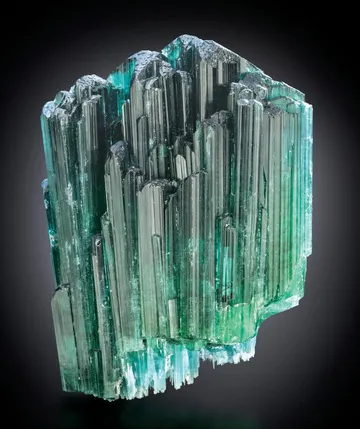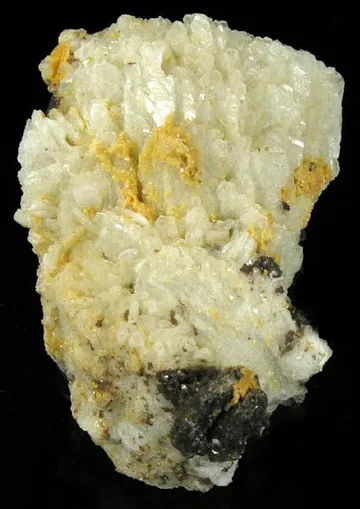
Goiás, Brazil — a key collector locality with zircon and kyanite crystals, emerald districts at Campos Verdes, and the Mara Rosa–Santa Terezinha belt.
Key facts
Goiás is not a single pocket locality in the narrow alpine-cleft sense; for collectors it is a state-scale name that ties together several of central Brazil’s great mineral stories. The state sits across a complicated Precambrian framework: the Goiás Magmatic Arc and Brasília Belt, older granite-greenstone terrains around Crixás and Pilar de Goiás, and younger alkaline-carbonatite complexes around Catalão and Ouvidor. That breadth explains why a Goiás label can mean very different things in a cabinet: stout reddish-brown zircon floaters from placer-derived or poorly localized older finds; thick, unusually gemmy blue to blue-green kyanite singles; emeralds from the Campos Verdes–Santa Terezinha district; niobium-phosphate-carbonatite species from Catalão; and ore-suite minerals from gold and copper-gold districts such as Crixás, Posse, Zacarias and Chapada.
For specimen collectors, the two most recognizable Goiás cabinet minerals are zircon and kyanite. The zircon is prized for textbook tetragonal form rather than matrix context: sharp dipyramidal to pseudo-octahedral crystals, often reddish brown to root-beer brown, commonly loose and in the best cases fully developed as floaters. The kyanite is quite unlike the common splintery mica-schist material seen from many metamorphic districts. Goiás pieces may be chunky, terminated, translucent and blue to bluish green, with an almost blocky thumbnail-to-small-miniature character that makes them stand out in systematic suites.
Regional View
Country View
The geological backbone of the collector story is the Mara Rosa–Santa Terezinha sector in northern Goiás. There, kyanite-rich rocks of the Serra das Araras form a resistant ridge of kyanitite, kyanite quartzite, muscovite-kyanite quartzite and related schists, developed along a major shear zone under amphibolite-facies conditions. Nearby Campos Verdes became one of Brazil’s best-known emerald districts after the 1981 rush, while the broader Chapada–Mara Rosa belt hosts gold, silver, barite and copper-gold mineralization. To the southeast, the Catalão alkaline-carbonatite complexes add another mineralogical province entirely, important for apatite, pyrochlore-group niobium ore, phosphate minerals and supergene alteration suites.

Photo: Wikimedia Commons
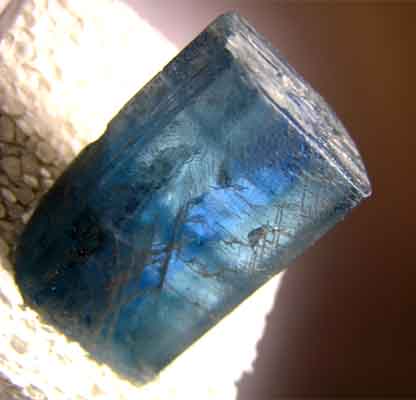
Photo: Wikimedia Commons
Search for specimens: View all specimens from Goiás, Brazil
Goiás is best treated as a collecting region with several deposit types rather than as a single mine. In the north and northwest of the state, the Goiás Magmatic Arc and adjacent granite-greenstone terrains host the mineral belts most relevant to collectible zircon, kyanite and emerald labels. The Mara Rosa and Santa Terezinha metavolcano-sedimentary sequences include pelitic to psammitic metasediments, basic to intermediate metavolcanic rocks, acid metaplutonic suites and orthogneisses, cut and rearranged by shear zones that controlled both metamorphic mineral growth and later mineralization. This same regional architecture explains the close geographic association, on maps and in the literature, of kyanite deposits, emerald workings and Au-Cu-Au prospects.
The kyanite deposit most often cited in Goiás mineral-resource literature is Serra das Araras, between Santa Terezinha de Goiás and Nova Iguaçu de Goiás. The ridge is a narrow, resistant belt roughly 16 km long and 400 m to 1.5 km wide, rising to about 570 m elevation. Its main rocks are kyanitite, muscovite kyanitite, muscovite-kyanite quartzite and kyanite quartzite, occurring as blocks and boulders along the ridge. In the richest kyanitite, kyanite can make up more than 90% of the rock, with quartz, muscovite and rutile as associated minerals; in kyanite quartzites, kyanite contents are commonly lower but still substantial. The genetic interpretation is not a simple “metamorphosed shale” story alone: the best studies relate the deposit to aluminum-rich rocks produced by earlier hydrothermal-magmatic alteration and then overprinted by amphibolite-facies metamorphism and deformation along the Serra das Araras shear zone. Industrially, this mattered because whole-rock Al2O3 values of the kyanitite were reported in the 40–60% range, with low Fe2O3, TiO2 and alkalis.
Mining at Serra das Araras was primarily an industrial kyanite story. The occurrence was explored during the 1980s and later listed as the largest official kyanite reserve in Brazil. CPRM/SGB resource summaries record Mineração Serra das Araras Ltda. at the Serra das Araras kyanite mine, with Goiás measured reserves reported in the low millions of tonnes and production falling sharply after the mid-1990s. The mine was described as paralyzed by the late 1990s in the state resource report and again as inactive in later sheet explanations. Collector-grade kyanite crystals from Goiás, however, are generally traded as individual crystals rather than as blocks of massive industrial ore; older labels may give only “Goiás, Brazil,” which is a common frustration for advanced locality collectors.
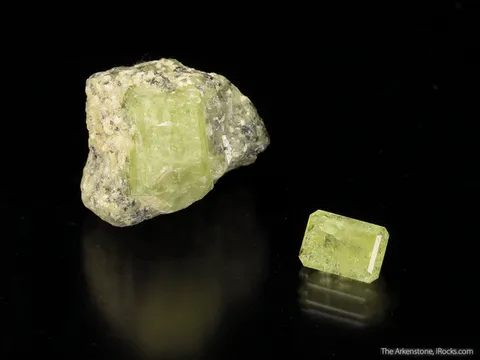
The zircon suite is more enigmatic. Older collector and gem literature records opaque zircon crystals from the Rio das Mortes valley in Goiás, sought by collectors for exceptional dimensions sometimes reaching several centimetres. Specimen-market and museum-image labels also record zircon from Goiás generally, from Rio do Peixe, and from Santa Terezinha de Goiás. The typical collector specimen is a loose, reddish-brown to dark red-brown crystal with a short prism and strong dipyramidal development, commonly complete enough to be called a floater. Because many old pieces were recovered without matrix and without precise mine names, the best provenance is an old label chain; the least satisfying labels simply say “Goiás” without river, municipality or find data.
The emerald district around Campos Verdes and Santa Terezinha de Goiás is the state’s best-known gemstone district. Emerald mineralization occurs in talc schist, biotite-carbonate-talc schist and related schists produced from ultramafic rocks and affected by Be-bearing granitic pegmatites and hydrothermal alteration. The early workings were known as Garimpo de Cima and Garimpo de Baixo, later Trecho Velho and Trecho Novo, and were worked by trenches, pits and tunnels after garimpeiros moved from eluvial material into the emerald-bearing schist. The district produced heavily iron-stained crystals near surface but also cleaner and more transparent gem material in situ. Modern reporting divides the district into several mined sections, including old and new workings, Netinho, Délio Braz and Kley; a 2022 gemological update recorded renewed production from a Lúvio Verde Mining joint venture south of previously mined sections.
Beyond the collector minerals, Goiás is a major mining state. Chapada, near Alto Horizonte, is a large open-pit copper-gold mine in the Mara Rosa arc, interpreted in modern work as a metamorphosed Neoproterozoic porphyry-type system with later shear-zone-hosted mineralization. Crixás is the classic greenstone-belt gold district of the state. Catalão and Ouvidor, by contrast, belong to an alkaline-carbonatite province important for niobium and phosphate production, with pyrochlore-group minerals, apatite and lateritic supergene assemblages rather than the metamorphic silicate suite of Santa Terezinha.
Collecting access today should be approached conservatively. Active mines and formal mining claims are not casual collecting ground, and the emerald district in particular has a long history of regulated garimpo areas, private shafts and commercial operators. Serra das Araras kyanite is described in the literature as an inactive industrial reserve, but inactivity is not permission; land ownership, mineral rights and environmental restrictions still apply. For most collectors, Goiás specimens are best acquired through established dealers, old collections and properly documented Brazilian sources rather than by field collecting.
Goiás zircon is valued above all for form: reddish-brown to dark cinnamon-brown crystals with sharp tetragonal dipyramids, short prisms, bright lustre and, in the best examples, complete floater development. Documented specimen sizes range from thumbnails around 2 cm to small miniatures and larger older examples; published and dealer-documented pieces include 23 mm Rio do Peixe floaters, 3.3 cm doubly terminated Santa Terezinha crystals, and 4–5 cm Goiás specimens considered large for the locality. Many are matrix-free, so associations are usually absent on cabinet pieces, though the broader geological context points to river-valley and older placer-derived collecting as well as poorly localized state-label material. The finest pieces are sharply edged, lustrous, undamaged and transparent in small windows; ordinary pieces are darker, contacted, chipped along the pyramidal edges or burdened by imprecise “Goiás” labels with no older provenance.
Goiás kyanite occupies a special niche because the collector crystals are commonly thick, blocky and sometimes gemmy, rather than the thin bladed aggregates typical of many metamorphic localities. Documented specimens include deep blue to bluish-green translucent crystals around 2.3–3.8 cm, some complete all around and some twinned or terminated, while the state’s best-studied geological occurrence at Serra das Araras is a large kyanitite and kyanite-quartzite body associated with quartz, muscovite and rutile in the Mara Rosa Magmatic Arc. The industrial rocks are blue, medium- to coarse-grained and locally massive, but the collector-grade pieces circulating under Goiás labels are judged on a different standard: thickness, termination, saturated colour, translucency, absence of edge bruising and confidence in the old locality label. A good Goiás kyanite should feel like a crystal, not just a shard of kyanite-rich rock.
Other minerals documented from Goiás reflect the state’s breadth. Emerald from the Campos Verdes–Santa Terezinha district is the best-known gem mineral, with chromite, pyrite, calcite, hematite, ilmenite and goethite recorded as inclusions or associates in the emerald suite. The Chapada mine has reported almandine, chalcopyrite, bornite, chalcocite, gahnite, galena, gedrite, magnetite, molybdenite, native gold, pyrite, quartz, rutile, sillimanite, sphalerite, staurolite and tourmaline in its metamorphosed Cu-Au environment. Catalão adds a carbonatite-laterite suite including apatite, pyrochlore-group niobium minerals, vermiculite, magnetite, ilmenite, anatase and phosphate minerals; goyazite, while not safely treated as a simple “Goiás type-locality mineral” on the available modern summaries, is historically named for Goiás and is recorded from the Catalão carbonatite environment.
The main collecting risk with Goiás specimens is locality precision. Many older zircon and kyanite labels stop at “Goiás, Brazil,” and because the best crystals are commonly matrix-free, there may be no geological context on the specimen itself. For zircon, names such as Rio das Mortes valley, Rio do Peixe, Monte Alegre de Goiás and Santa Terezinha de Goiás appear in the record, but old dealer labels are not always consistent. For kyanite, the geological kyanite reserves of Serra das Araras are well documented, while many fine collector crystals are still traded only under the state name. A specimen with a reliable old collection label is therefore worth more, mineralogically, than a cleaner but undocumented loose crystal.
No widely documented treatment problem is associated with Goiás zircon or kyanite specimens in the same way that oiling and filling are routine concerns for emerald. Zircon should not be confused with cut gem zircon treatments; collector crystals are normally valued as natural crystals, and the practical concern is mechanical condition. Look closely at the points and bevelled pyramid edges: zircon is hard but brittle, and small chips are common on old floaters. High lustre on all faces is desirable, but a single old contact on the back is not disqualifying if the display face is sharp and intact.
Kyanite from Goiás needs different handling. Its directional hardness and perfect cleavage make it much more vulnerable than its robust, blocky shape suggests. Edge bruises, cleaved bases, pressure cracks and dull abraded terminations sharply reduce desirability. Avoid ultrasonic cleaning and avoid any pressure across the long axis of the crystal. A soft brush, water only when necessary, and a padded perky box or individual case are safer than open tray storage.
For emeralds from the Campos Verdes–Santa Terezinha district, assume normal emerald caution unless a laboratory report states otherwise. Crystals may be naturally included, iron-stained, repaired, oiled or stabilized, and matrix specimens can be fragile where emerald sits in talcose schist. The district produced both gem rough and specimens; collector pieces with emerald crystals still on schist matrix are scarcer than loose commercial rough and should be evaluated for crystal completeness, natural attachment, colour zoning, and any resin or glue at the contact.
Market availability is uneven. Goiás zircon appears periodically from old collections and dealer inventories but is not a constant show commodity, especially in sharp 3 cm-plus floaters. Kyanite is also episodic; good thumbnails surface more often than large, undamaged crystals. Emerald from Campos Verdes is far more abundant in the gem trade than as display-quality matrix specimens. Catalão and Chapada species are usually represented in systematic or ore suites rather than as aesthetic cabinet minerals.
The most vivid Goiás mineral story begins not with a trained geologist but with a road machine. In March 1981, Diolino Gonçalves da Silva was grading the road between Santa Terezinha de Goiás and Martinópolis, near Fazenda São João, when green stones appeared in the soil. At first they were not recognized for what they were. Local accounts remember Chico Moita and João Mecânico trying to sell the stones as tourmalines before the truth spread: they were emeralds. Within a short time, about two hundred garimpeiros had arrived, including Alcebiades Paiva Martins, Davi da Hora, Domingos Barros, known as Domingão, and Antônio Gusmão. A settlement grew around the workings so quickly that it was first simply called “Garimpo.”
Gemological accounts add an almost cinematic detail to the same discovery. The green stones had reportedly been picked up by children and thrown at birds because the crystals found on the ground were stained by iron oxides and did not immediately look like valuable gems. In March 1981 a gem dealer from Governador Valadares identified them correctly, and the rush began in earnest. The first workings on the lateritic plateau became Garimpo de Cima, the “upper mine,” later Trecho Velho. In June 1981, emeralds were found to the north in a creek, opening Garimpo de Baixo, the “lower mine,” later Trecho Novo. What began as stained stones in road dirt rapidly became one of the deposits that consolidated Brazil’s standing as a major emerald producer.
The rush reshaped the map. The settlement formed by miners and traders became a municipality on December 30, 1987, by Goiás State Law no. 10401, and took the name Campos Verdes at the suggestion of Virmondes Vieira Machado, the first local physician and later the first mayor. The name was not subtle; it honored the emerald green that had transformed the place. The story is a reminder that some mineral localities are not merely points on a map. In Goiás, an emerald discovery created an urban identity, a mining economy and eventually a public-facing mineral-tourism culture.
Serra das Araras offers a quieter but equally striking geological image: a ridge up to 16 km long, built in part from rock so rich in kyanite that the mineral can exceed 90% of the mass. The ridge stands out because kyanite, quartz, muscovite and rutile resisted weathering better than much of the surrounding terrain. Field descriptions emphasize blocks and boulders scattered along the ridge, blue kyanitite with diablastically intergrown crystals, and kyanite stretched, bent and rotated by deformation. For a collector accustomed to seeing kyanite as a few blades in mica schist, Serra das Araras is a different order of occurrence: not a pocket, but a mountain-scale expression of aluminum-rich rock, fluid flow, shear and metamorphism.