

Jardinera No. 1 Mine is one of the great “small place, large consequence” localities of the Atacama: a modest copper working near Inca de Oro whose oxidized copper-molybdenum mineralization produced a new mineral species and a highly distinctive suite of collector specimens. Its reputation rests above all on szenicsite, Cu3MoO4(OH)4, the vivid green copper hydroxy molybdate named for Terry and Marissa Szenics, who found the first specimens in the early 1990s. The mine is also a classic source of powellite and cuprian powellite, including pale tan to green crystals, fluorescent vug linings, and prized pseudomorphs after molybdenite.
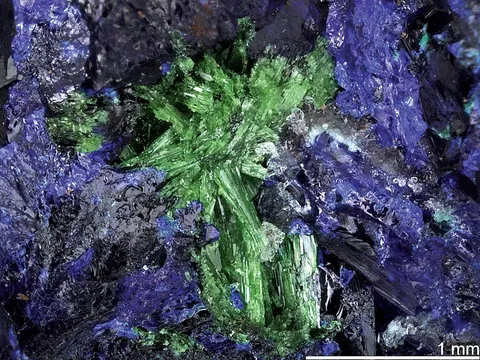
Mineralogically, Jardinera is unusual because molybdenum is not merely an accessory note in the copper mineralization: molybdenite, powellite, lindgrenite, and szenicsite form the signature paragenesis. The best specimens have the look of a high-desert chemical accident resolved into sculpture: adamantine, deep emerald-green szenicsite blades in booklike or jackstraw aggregates, sometimes perched with gemmy greenish powellite; pale to lime-green powellite sparkling in cavities; and blocky or platy powellite replacements preserving the habit of earlier molybdenite. The host is a hydrothermally altered granitic matrix in an oxidized copper-molybdenum setting, and the mineral assemblage is small but remarkably diagnostic.
Regional View
Country View
The szenicsite occurrence that made Jardinera famous was very limited. It was first recognized from material on an ore pile and then traced underground on the 60-meter level, where the productive zone was measured in meters rather than in a stope-scale run. That physical scarcity explains the character of the market: true Jardinera szenicsite is not merely a “rare species” label mineral, but a specimen from a finite early-1990s find that has never been repeated on comparable terms.

Photo: Wikimedia Commons

Photo: Wikimedia Commons
Search for specimens: View all specimens from Jardinera No. 1 Mine, Chile
Jardinera No. 1 Mine lies near Inca de Oro in the Diego de Almagro area of Chañaral Province, Atacama Region, northern Chile, in one of the driest and most mineralogically productive belts of the central Andes. The locality is generally described in the mineralogical literature as about 5 km east of Inca de Oro and roughly 80 km north of Copiapó. The collecting locality belongs to the Inca de Oro mining district, an area better known for copper and copper-gold workings than for specimen-producing molybdate chemistry.
The deposit is an oxidized copper-molybdenum occurrence in granite or hydrothermally altered granitic rock. Primary and hypogene minerals documented from the locality include molybdenite, chalcopyrite, bornite, chalcocite, pyrite, and galena, with quartz, baryte, calcite, albite, magnetite, hematite, kaolinite, and jarosite among the gangue and alteration minerals. The collector species formed in the oxidized zone, where molybdenite was altered to powellite and where copper-bearing oxidizing fluids generated szenicsite, lindgrenite, brochantite, chrysocolla, malachite, and related secondary minerals.
The classic szenicsite zone was tiny. Published accounts describe it as first discovered on a surface ore pile and later found in place on the 60-meter level. The productive occurrence was only about 1 x 1 x 2 meters in extent, and subsequent mining advanced in 4-meter slices to the 80-meter level without reproducing the find. The reported total recovery of szenicsite was on the order of only a few kilograms. That is the single fact that serious collectors should keep in mind: even though the species is conspicuous and showy when good, the original pocket was a very small event.
Within that zone, the ore was not a normal show of common copper carbonates and sulfates. Szenicsite occurred in cavities and fracture fillings with powellite, often in matrix rich in molybdenite or its alteration products. Powellite formed as small tetragonal crystals in vugs, as massive pale to greenish material, and as pseudomorphs after molybdenite. The enclosing rock can be porous and siliceous, with green-brown jasperoid-looking patches, quartz-lined cavities, and pockets in which powellite and szenicsite grew in intimate sequence.
The historical specimen discovery is tied to Terry and Marissa Szenics, mineral collectors and dealers based in Chile, who collected the green mineral in January 1993 and initially believed it to be lindgrenite. Through Aurora Mineral Corporation, material was submitted to the Harvard Mineralogical Museum, where X-ray work showed that it was not lindgrenite but a new copper molybdate. The species was approved by the IMA as szenicsite, and the definitive description corrected an early locality problem: some first labels and abstracts gave Tierra Amarilla rather than Jardinera No. 1, an intentional obfuscation that became an enduring label trap.
The modern mining landscape around Inca de Oro is active and access-controlled. Current corporate descriptions of the Delirio copper project list a Jardinera open pit among the Delirio, Barraza, Manto Cuba, Providencia, and Jardinera production or reserve areas, with crushing, leaching, ROM leach pads, SX-EW facilities, and a third-party ore purchasing station in the broader project infrastructure. That does not translate into collector access. For practical purposes, loose field collecting should be considered unavailable unless expressly authorized by the operator or property holder, and the significant szenicsite specimens in circulation derive from the early-1990s discovery and from later dispersals of that material through collectors and dealers.
Jardinera powellite is the indispensable companion species to szenicsite and in many specimens the mineralogical engine of the whole assemblage: it occurs as pale tan to yellowish, lime-green, apple-green, and greenish-gold material, commonly as small tetragonal crystals lining vugs, as massive or greasy-looking coatings on altered breccia, and as prized pseudomorphs after molybdenite. Published and collector-recorded examples range from millimetric terminated crystals in porous quartz to large cabinet pieces with fluorescent powellite-rich pockets, while pseudomorphs preserving molybdenite habit can reach several centimeters. Good pieces from Jardinera are judged by vivid green cuprian color, undamaged vug crystals, recognizable molybdenite replacement form, and association with szenicsite; ordinary pieces tend to be massive, contacted, or merely locality-representative pale powellite without sharp form.
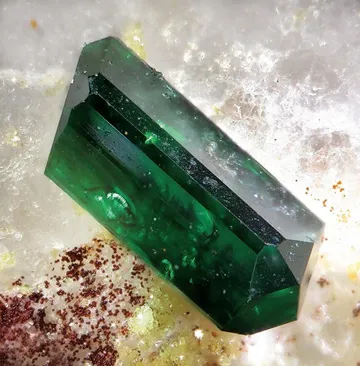
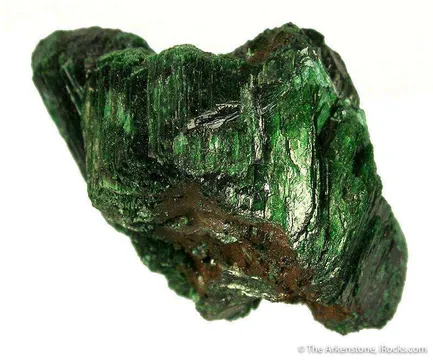
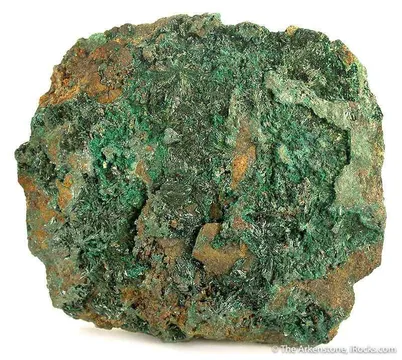
Szenicsite from Jardinera No. 1 is the type-locality material and the standard by which the species is judged: dark to electric green, transparent to translucent, adamantine to silky, and most characteristically developed as lamellar 100 blades elongated on [001], commonly in jackstraw aggregates or booklike radial fans with curved cleavage faces. Individual crystals are typically around a centimeter, with published crystal sizes to about 1 x 3 cm, and truly terminated crystals are notably rare. The finest specimens show three-dimensional, freestanding, lustrous blades with minimal contact damage, strong color, and direct association with powellite in cavities or fracture fillings of hydrothermally altered granitic matrix; lesser examples are compact scaly masses, flattened aggregates, or broken plates that still matter scientifically but lack the architectural presence of the best miniatures.
Other minerals documented from Jardinera No. 1 include albite, baryte, bornite, brochantite, calcite, cerianite-(Ce), chalcocite, chalcopyrite, chrysocolla, dioptase, galena, hematite, jarosite, kaolinite, lindgrenite, magnetite, malachite, molybdenite, native gold, pyrite, and quartz. Szenicsite is the locality’s type mineral and the principal rarity, but lindgrenite is important paragenetically because it marks the broader copper-molybdate halo around the szenicsite zone, while molybdenite and powellite record the molybdenum source and oxidation pathway that make the occurrence so distinctive.
The first authenticity issue with Jardinera specimens is locality labeling. Early material was intentionally labeled as coming from Tierra Amarilla to conceal the source, and that misinformation entered an early published abstract before the final Mineralogical Record description corrected the locality to Jardinera No. 1 near Inca de Oro. Old labels reading “Tierra Amarilla,” “Tia Maria,” or vague “Atacama” should not be dismissed automatically, but they demand careful comparison with the specimen: genuine Jardinera szenicsite should show the deep green bladed copper molybdate in the powellite-molybdenite association typical of the find.
No well-documented commercial fakes or treatments specific to Jardinera szenicsite appear to be established in the specimen literature, but misidentification is a real concern. Szenicsite was first mistaken for lindgrenite, and poor fragments can resemble other green secondary copper minerals at a glance. For high-value specimens, especially isolated green blades without clear provenance, analytical confirmation or a strong chain of labels is wise. The best provenance names attached to major pieces include early Szenics material, Harvard-related study material, and later well-known collections that handled the original find.
Condition is central to value. Szenicsite is brittle, with good cleavages on {100} and {010}; thin blades chip, shear, and fray easily. Many specimens show natural or mining-related contacts because the mineral occurred in narrow cavities and as intergrown plate aggregates. Beware of pieces that have been over-cleaned: the most attractive specimens often have delicate surface luster and fine scaly structure that can be dulled or broken by aggressive mechanical work.
Szenicsite itself is not a fluorescent display mineral, but Jardinera powellite often is. Pale powellite may show yellowish-white fluorescence under shortwave ultraviolet light, and cuprian powellite can show green to greenish-yellow responses depending on wavelength and copper content. Because fluorescence is a useful but variable clue, it should be recorded on specimen labels with the lamp wavelength used. Do not infer that a non-fluorescent green mineral is szenicsite; and do not infer that a fluorescent green vug lining is necessarily szenicsite.
Market availability is sharply divided. Powellite from Jardinera appears periodically, including cabinet-sized fluorescent pieces and cuprian green examples, and remains obtainable for locality, UV, and pseudomorph collectors. Szenicsite is much scarcer. Small reference pieces and matrix fragments turn up occasionally, but fine miniatures with distinct blades, strong luster, and visible powellite association are genuinely rare, and large, rich examples can command serious rare-species prices.
In January 1993, Terry and Marissa Szenics collected a beautiful green mineral at a small copper mine in northern Chile. It looked enough like lindgrenite to be treated as such at first, which was a reasonable field call in a copper-molybdenum oxidation zone. The crucial move was sending material through Aurora Mineral Corporation to the Harvard Mineralogical Museum. X-ray work there showed that the green blades were not lindgrenite at all. They were a new copper molybdate, soon to carry the Szenics name.
The discovery had the compressed drama of a classic mineralogical “one-pocket” event. Szenicsite was first found on an ore pile at the surface, then tracked back underground to the 60-meter level. The in-place occurrence was described as only about 1 x 1 x 2 meters. Mining continued downward in 4-meter slices to the 80-meter level, but repeated visits over the next three years failed to find another occurrence. The total quantity recovered was estimated at only 2 or 3 kilograms. For a species capable of making cabinet-worthy green specimens, that is an astonishingly small supply.
There is also a label story, and it matters. To conceal the source, early specimens were labeled Tierra Amarilla, a different mining area southeast of Copiapó. The incorrect locality found its way into an early abstract and was even distorted elsewhere as “Tia Maria.” The final 1997 description corrected the record, but the misdirection left a paper trail that still affects old labels. A collector holding an early “Tierra Amarilla” szenicsite is not necessarily holding the wrong specimen; they may be holding a piece of the concealment story itself.
A later collector anecdote shows how the material still hides in plain sight. Richard Gunter recorded a specimen bought at the Abbotsford Show on April 11, 2015 as “Powellite, Jardinera 1 Mine.” On close examination it proved to be far better: a porous quartz mass with cavities lined by deep green, highly lustrous platy szenicsite, some with fibrous terminations, plus powellite crystals and strong shortwave fluorescence. That is very Jardinera—one label mineral visible to the casual eye, and a rarer green molybdate waiting in the cavities.