Itinga, Brazil — a classic pegmatite locality yielding Li, Be, Nb, Cs minerals; prized elbaite, lepidolite rosettes, topaz, and historic type localities.
Key facts
Itinga sits in the Jequitinhonha Valley of northeastern Minas Gerais, on the productive Araçuaí–Itinga pegmatite belt of the Eastern Brazilian Pegmatite Province. For collectors, the name is less a single pit than a cluster of pegmatite localities: Urubu at Monte Belo, Teixerinha, the Jenipapo field, Taquaral, Ponte do Piauí, Poço d’Antas, Ilha, Jacaré, Arqueana, and smaller claims scattered through the Piauí and Jenipapo valleys. The district is classic LCT-pegmatite country, where Li, B, Be, P, F, Sn, Ta, Nb, and Cs were concentrated into zoned bodies capable of producing both cabinet-grade mineral specimens and scientifically important rare species.
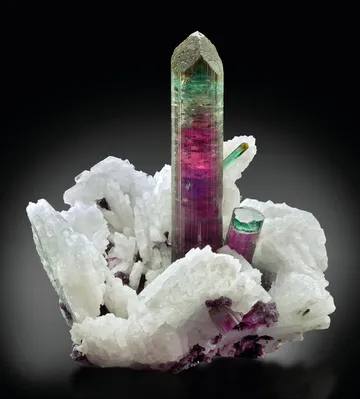
The collector image of Itinga is strongly colored: green to blue-green elbaite and fluor-elbaite, pink and lavender lepidolite rosettes, etched pale blue topaz, rose quartz from Taquaral, cleavelandite plates, phosphate associations with childrenite–eosphorite series minerals, zanazziite, moraesite, guimarãesite, ruifrancoite, and wilancookite. The best specimens have the “late-pocket” look that seasoned pegmatite collectors prize: glassy crystal faces interrupted by selective etching, mica books or lepidolite spheres still attached, quartz cores and replacements in tourmaline, and phosphate microminerals perched on quartz and feldspar rather than hidden in massive material.
Itinga also matters historically because it bridges two worlds of Brazilian pegmatites. On one side are the old garimpo and gem-tourmaline workings that fed the Araçuaí mineral trade; on the other are modern lithium operations, including the Cachoeira and Grota do Cirilo systems of the Araçuaí–Itinga region. The specimen mines and claims of Itinga are not merely decorative footnotes to an ore province: Urubu is one of the type localities for fluor-elbaite, Ponte do Piauí is tied to the description of guimarãesite and wilancookite, and the district has repeatedly supplied material important enough for museum collections, academic papers, and the high-end specimen trade.
Regional View
Country View
The geological setting is the Araçuaí orogen, where Cambrian S-type granites and their residual pegmatites invaded metasedimentary rocks of the Salinas Formation. Around Itinga, two pegmatite styles are especially important: non-zoned spodumene-rich bodies exploited as lithium ore, and complex zoned rare-element pegmatites that produced the collectible elbaite, lepidolite, topaz, albite, quartz, phosphates, cassiterite, tantalite, pollucite, and beryllium minerals. In hand specimen, that distinction often shows clearly: industrial spodumene pegmatites can be coarse and relatively plain, whereas the collectible pockets preserve open-space crystallization, replacement textures, vivid mica, etched topaz, and tourmaline with color zoning or quartz-filled cores.

Photo: Wikimedia Commons

Photo: Fabre Minerals
Search for specimens: View all specimens from Itinga, Brazil
Itinga is a municipality in the Jequitinhonha Valley of Minas Gerais, but in collector usage the locality name commonly embraces a broader pegmatite field between Araçuaí and Itinga, especially the Piauí and Jenipapo valleys and the Taquaral area. The important rocks are rare-element granitic pegmatites of the Eastern Brazilian Pegmatite Province, emplaced into metasedimentary host rocks of the Salinas Formation and related to late to post-orogenic Cambrian granitic magmatism of the Araçuaí orogen. The Ponte do Piauí geosite, near the Piauí River crossing between Araçuaí and Itinga, is described as a phosphorus-rich rare-metal pegmatite associated with S-type granitogenesis around 530–500 Ma, hosted by Ediacaran metasedimentary rocks of the Salinas Formation.
The Itinga field includes both ore and specimen pegmatites. The Cachoeira group represents the spodumene-rich, comparatively non-zoned population: bodies mined for lithium rather than for display minerals. These pegmatites are structurally controlled, commonly following NE-striking schistosity and fracture cleavage, and contain quartz, feldspar, mica, and spodumene as the economic lithium mineral. In contrast, the complex zoned pegmatites of Urubu, Teixerinha, Jenipapo, Taquaral, Ponte do Piauí, Poço d’Antas, and related claims are richer in the volatile and rare-element ingredients that make fine specimens possible: boron for tourmaline, fluorine for topaz and fluor-elbaite, phosphorus for the secondary phosphate suite, beryllium for beryllophosphates, and tantalum–niobium for microlite-group minerals, rankamaite, simpsonite, thoreaulite, cassiterite associations, and columbite-tantalite.
The Urubu pegmatite at Monte Belo is among the most important specimen and study localities in Itinga. It is a heterogeneous, albitized granitic pegmatite, described in the rankamaite study as lying near the junction of the Piauí and Jequitinhonha rivers. The body trends roughly east-northeast, dips gently north-northwest, and in its eastern part is divided into two lenses by a mica-schist intercalation. Its thickness has been described at about 10–15 m, with sharp, undulating contacts against dark-gray biotite schist with quartz beds. Collectors know Urubu for elbaite and fluor-elbaite, lepidolite, albite var. cleavelandite, quartz, petalite, pollucite, microlite-group minerals, rankamaite, simpsonite, thoreaulite, cassiterite, and the peculiar quartz-cored green tourmalines that are immediately recognizable.
Teixerinha is the Itinga locality most associated in the specimen trade with etched, pale blue topaz on or with lepidolite, cookeite, albite, and zanazziite. A small early-2000s production entered collections as attractive etched topaz crystals and topaz–lepidolite combinations, some of which show sharp faces on one side and dissolution sculpture on another. The best examples are not just fragments of blue topaz; they are sculptural crystals with visible pegmatite history, retaining mica or lepidolite and enough glassy surface to show transparency.
Taquaral and the Piauí Valley claims are especially important for phosphates and rose quartz. Poço d’Antas produced childrenite and childrenite–eosphorite series crystals with ruifrancoite on quartz, feldspar, albite, mica, and berlinite-bearing matrices; Ilha is known for rose quartz, eosphorite, zanazziite, and related phosphate associations; Ponte do Piauí supplied material central to the descriptions of guimarãesite and wilancookite. These are not bulk-ore occurrences in the collector sense: the desirable material is pocket and fracture mineralization, often small, delicate, and analytically significant.
Mining in the Araçuaí–Itinga district extends from old garimpo workings for gems and industrial minerals to mechanized lithium operations. The wider district had mining activity from the nineteenth century onward, with Araçuaí functioning historically as a commercial center for diamond and mineral activity. Later, spodumene mining became industrialized. Companhia Brasileira de Lítio operates the Cachoeira underground mine in the Araçuaí–Itinga area, with underground galleries, modern sublevel stoping, and production of spodumene concentrate for lithium chemicals. Sigma Lithium’s Grota do Cirilo project and other modern lithium projects have brought renewed attention to the same geological corridor, although those operations are not specimen-collecting localities in the traditional sense.
Collecting access today should be assumed restricted. Many Itinga occurrences are private claims, active or former garimpos, or modern mineral-rights areas; active lithium operations are industrial sites, not casual collecting ground. Older specimens on the market most often come through Brazilian dealers, Tucson and European show circulation, former private collections, or reference collections from known dealers. For serious collectors, precise mine or claim attribution matters: “Itinga” alone is useful regionally, but “Urubu mine,” “Teixerinha mine,” “Poço d’Antas claim,” “Ilha claim,” “Ponte do Piauí claim,” or “Jenipapo pegmatite field” carries much more mineralogical meaning.
Elbaite from Itinga is best known from Urubu, Teixerinha, Jenipapo, Arqueana, Ponte do Piauí, Jacaré, and other Taquaral-area pegmatites, and it ranges from small vivid crystals to miniature and cabinet specimens with strong locality character. Urubu crystals are particularly distinctive: green to yellowish green, blue-green, brownish green, or pinkish examples may show flat pedion terminations, etched or hollow bases, fibrous or massive white quartz exposed in the center, and matrices of lepidolite, albite var. cleavelandite, quartz, and muscovite. Some Urubu specimens appear as a tourmaline shell around a quartz core, a texture that separates them at sight from more conventional Brazilian elbaites. Teixerinha supplied gemmy emerald-green parallel-growth crystals, commonly small but lustrous and well terminated, while Taquaral and Piauí Valley material can be architectural, blue-green, or magenta-zoned. The best Itinga elbaites combine clean terminations, saturated color, visible internal zoning or unusual replacement texture, and original pegmatite matrix; ordinary pieces are darker, fractured, loose, or merely massive tourmaline without the pocket character that gives the district its appeal.
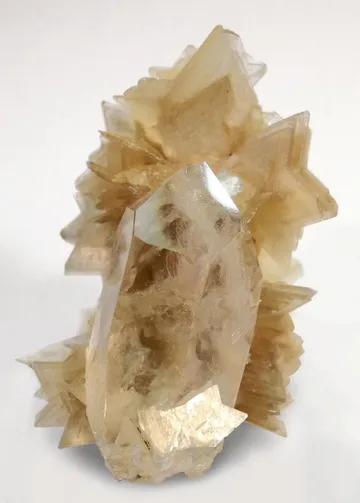
Topaz from Itinga is strongly tied to the Teixerinha mine, where pale blue to icy blue crystals occur with lepidolite, cookeite, albite, and zanazziite. The classic Teixerinha habit is an etched, glassy, blocky topaz crystal or crystal group in which smooth lustrous faces survive beside dissolution-textured surfaces, with pink to lavender lepidolite adding contrast. Documented specimens range from miniatures around 3 cm to cabinet pieces over 10 cm, and a Munich 2010 Brazilian exhibit specimen was described as roughly 5 cm tall. Unlike ordinary loose blue topaz parcels, the collector pieces from Teixerinha are valued for crystallographic form, transparency, etching, and matrix association; the most desirable examples show sharp edges, strong luster, attractive pale color, and original lepidolite or cookeite rather than being reduced to isolated abraded crystals.
Lepidolite from Itinga is a matrix-maker as much as a collectible species in its own right, appearing as lavender to pink, pearly books, rosettes, spheroidal aggregates, and mica-rich masses in the Urubu, Teixerinha, Jenipapo, Murundu, Poço d’Antas, and other evolved pegmatites. At Urubu, lepidolite accompanies green elbaite and quartz-cored tourmaline, sometimes as tan to lavender clusters only a few millimeters across and sometimes as showier matrix coverage. At Teixerinha it is the classic companion to etched blue topaz, giving those specimens their color contrast and locality signature. The best lepidolite specimens from Itinga are well-crystallized, pearly, lavender to pink, and aesthetically associated with tourmaline, topaz, albite, or quartz; massive, crumbly lithium mica is commoner and far less compelling unless it carries important associated species.
“Tourmaline” in Itinga collector labels can mean elbaite, fluor-elbaite, schorl, or unidentified tourmaline-supergroup material, so older labels deserve careful reading. Urubu and Ponte do Piauí are especially important because Urubu is one of the type localities for fluor-elbaite, represented by blue-green elongated prismatic crystals formed from late hydrothermal solutions in or near miarolitic cavities. Other Itinga tourmalines include black-looking crystals with rose quartz, apple-green or blue-green groups, magenta-zoned Taquaral pieces, and green crystals on lepidolite or cleavelandite. Strong pieces have good terminations, bright luster, clean color zoning, and a matrix that supports the locality attribution; average material is often dark, broken, or generically labeled “Minas Gerais tourmaline,” losing much of the Itinga-specific interest.
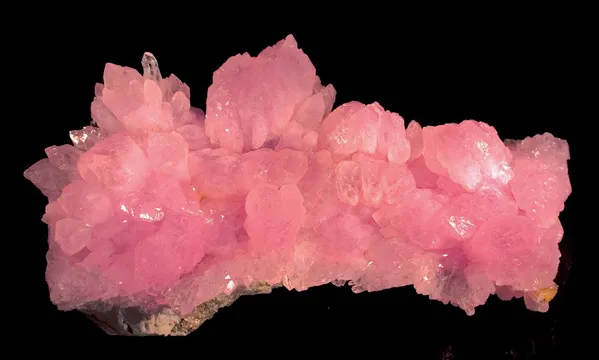
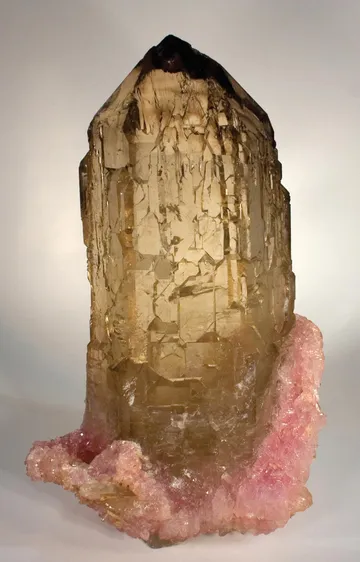
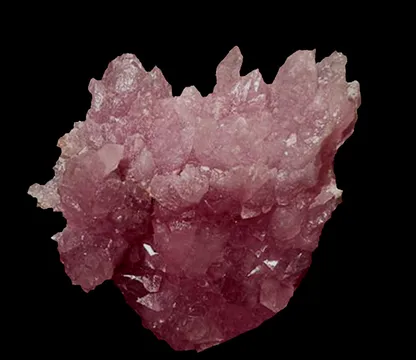
Quartz from Itinga is important both as a display mineral and as a textural witness to pegmatite evolution. Taquaral and the Ilha claim produced rose quartz specimens with deep pink crystals, including small aerial groups and second-generation gemmy pink terminations on earlier rose quartz. Urubu quartz is famous in a different way: white quartz can occupy the centers of green tourmaline crystals or form matrix beneath elbaite, lepidolite, and albite, producing specimens that look almost pseudomorphic or “windowed” into the pegmatite’s replacement history. In phosphate pockets, quartz is the platform for childrenite, eosphorite, zanazziite, ruifrancoite, and related species. The best quartz specimens from Itinga are either strongly colored rose quartz from Taquaral-area claims or matrix pieces that host high-quality associated minerals; plain massive quartz is abundant and has little collector importance unless the association is exceptional.
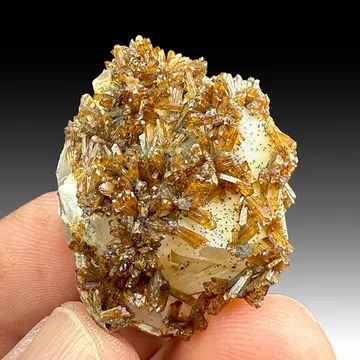
Childrenite from Itinga is chiefly a Piauí Valley and Poço d’Antas claim mineral, occurring as brown to yellow-brown, thin prismatic crystals on quartz, albite, feldspar, mica, and phosphate-rich matrix, commonly with ruifrancoite and roscherite-group minerals. Some analyzed Poço d’Antas specimens show childrenite–eosphorite series chemistry varying within the same crystal, with more Mn-rich central parts grading toward Fe-rich outer zones, which makes the locality especially interesting to micromount and analytical collectors. Crystals are typically small, from sub-millimeter groups to a few millimeters, but they can be sharp, transparent, lustrous, and doubly terminated. Good Itinga childrenite is identified or analyzed, isolated enough to see crystal form, and contrasted against pale quartz or albite; ordinary brown sprays without analysis can easily drift into the broader childrenite–eosphorite problem and should be bought with caution.
Albite from Itinga occurs in the cleavelandite habit prized in granitic pegmatites: white to pale, bladed, platy, sometimes transparent or laminar crystals forming matrix for elbaite, microlite-group minerals, muscovite, lepidolite, quartz, childrenite, and phosphate rarities. Urubu specimens can show two generations of cleavelandite, with smaller plates forming the base and larger thin plates rising through the matrix, and microlite-group crystals have been photographed on albite from the same mine. In the Taquaral and Piauí Valley phosphate pockets, albite is often less flamboyant but crucial as the support for childrenite, roscherite-group species, and beryllium phosphates. The best Itinga albite specimens are crisp, bladed, undamaged, and association-rich; as a stand-alone species it is secondary to the tourmaline, topaz, and phosphate suites, but as matrix it is one of the most reliable locality clues.
Beyond the major display species, Itinga is unusually rich in rarities. Urubu has documented fluor-elbaite, rankamaite, simpsonite, thoreaulite, microlite-group minerals, pollucite, petalite, spodumene, cassiterite, monazite-(Ce), xenotime-(Y), beryl, montebrasite, and lithium micas. Ponte do Piauí is the type locality for guimarãesite and wilancookite, with a phosphate assemblage that includes moraesite, eosphorite, zanazziite, saléeite, fluorapatite, childrenite, greifenstenite, ushkovite, and roscherite-group minerals. Poço d’Antas adds ruifrancoite-bearing associations, Ilha is notable for zanazziite, eosphorite, wardite, and rose quartz, and Jenipapo has produced kosnarite microminerals as well as elbaite and lepidolite. For a collector who values labels and analysis, Itinga is one of the Brazilian districts where a thumbnail or micromount can be more scientifically important than a much larger cabinet specimen.
Itinga material is generally authentic in broad regional terms, but mislabeling is a real concern. “Itinga,” “Araçuaí,” “Taquaral,” “Jequitinhonha Valley,” and “Minas Gerais” are often used loosely in the specimen trade, and older Brazilian labels may omit the mine entirely. For topaz, insist on Teixerinha when the specimen is an etched pale blue crystal with lepidolite, cookeite, or zanazziite; for quartz-cored green tourmaline, Urubu is the key name; for childrenite, ruifrancoite, and rare phosphate associations, Poço d’Antas, Ponte do Piauí, and Ilha are the labels that carry meaning. A generic “Itinga” label is acceptable for attractive pieces, but for rarity pricing the exact claim should matter.
No major, well-documented fake industry is associated specifically with Itinga, but several practical issues deserve attention. Tourmaline crystals from the district can be repaired, especially if gemmy, terminated, or color-zoned; check basal contacts, matrix joins, and any suspiciously clean break hidden by mica. Some Urubu elbaites have unusual quartz-filled or quartz-replaced centers, and these should not automatically be dismissed as assembled specimens; the texture is part of the locality’s legitimate character, but it also means the buyer should examine whether the tourmaline shell and quartz core are naturally continuous. Childrenite, eosphorite, ruifrancoite, zanazziite, and roscherite-group specimens should be treated as analytical material unless identification is backed by a reliable dealer, collection history, or laboratory work.
Blue topaz raises the usual Brazil-wide treatment question. Much commercial blue topaz is irradiated and heated, but Teixerinha specimen topaz is collected and valued as natural crystals on matrix, not as calibrated gem rough. Avoid paying a locality premium for loose, overly vivid blue topaz sold only as “Itinga” unless the provenance is convincing. The same caution applies to tourmaline color names: rubellite, verdelite, indicolite, elbaite, and fluor-elbaite are not interchangeable scientific identifications. Fluor-elbaite requires chemistry; “fluor-elbaite” on a label should be reserved for material with credible analytical or locality basis, especially from Urubu or Ponte do Piauí.
Condition standards should be strict for elbaite and topaz, because small bruises on terminations sharply affect value. Etching is natural and desirable when balanced by lustrous faces, but excessive dullness, crushed edges, or contact damage should be priced accordingly. Lepidolite can shed at the edges and cleavelandite plates bruise easily. Secondary phosphate specimens are often delicate and should be stored dry, boxed securely, and handled over a tray; autunite-bearing associations from Ponte do Piauí also deserve sensible radioactive-mineral handling and storage practices, especially avoiding unnecessary dust generation and prolonged close handling.
Market availability is uneven. Teixerinha topaz with lepidolite appears periodically but is not abundant. Urubu quartz-cored tourmaline is recognizable and sought after, particularly when the green shell, quartz core, and lepidolite/albite matrix are all present. Itinga lepidolite is more available, though fine rosettes or spheroidal groups with strong associations are better than common massive mica. Childrenite, ruifrancoite, guimarãesite, wilancookite, kosnarite, and related phosphate or beryllophosphate specimens are specialist material; they appear most often as micromounts or small reference pieces and should be bought for documentation as much as aesthetics.
The most revealing Itinga story is not a single spectacular pocket but the way a roadside pegmatite near the Piauí River became a mineralogical reference point. Ponte do Piauí lies close to the bridge over the Piauí River, reached from Araçuaí on the road toward Itinga, in the same dry, inselberg-studded country that has fed Brazilian gem commerce for generations. To a casual eye, it is another worked pegmatite in a district full of them. Under the microscope, it became the source of minerals new to science.
Guimarãesite was recognized there as a late fracture-filling mineral in a phosphate-rich granite pegmatite near the Piauí River. It was not a cabinet crystal in the usual sense: the material occurs in thin peripheral zones, in places only about 0.1 mm thick, around roscherite-group crystals. The mineral’s brown color with pale borders and vitreous luster are modest until one remembers what the specimen represents: a new Zn-dominant roscherite-group mineral named for Djalma Guimarães, one of Brazil’s important mineralogists. Its holotype went to the Museu de Geociências of the University of São Paulo under the registration DR591, turning a small, almost hidden fracture mineral into a permanent part of Brazilian type mineralogy.
Wilancookite adds another layer to the same locality. Luiz Menezes discovered the material in 2009, and the mineral was later named for William R. Cook Jr. and Anne Cook. Again, the drama is microscopic rather than theatrical: tiny dodecahedral crystals set on fibrous moraesite in phosphate nodules adjacent to the quartz core of the pegmatite. The mineral formed very late, after the moraesite fibers were already present, as part of a Be-rich secondary phosphate system produced by reactions involving montebrasite and beryl. Its type material was divided between the University of Liège and the Luxembourg Museum of Natural History, carrying an Itinga pegmatite into European institutional collections.
A different kind of collecting story belongs to the Urubu mine. Many pegmatite tourmalines can be identified only by color, but Urubu produced green elbaites whose interiors tell on themselves: white quartz cores, fibrous quartz centers, hollow etched bases, and tourmaline shells that look like the crystal has been opened to show its internal history. One noted group of specimens from around 2004 made collectors pay attention to this texture; later examples were repeatedly compared to that “quartz in the center” style. These are not the clean, gemmy pencils of Cruzeiro or the neon showpieces of Pederneira. Their appeal is stranger and more geological: a crystal that carries replacement, dissolution, and late-stage growth all in one small object.
Teixerinha’s topaz story is quieter but highly recognizable in the market. The small early-2000s production yielded etched blue topaz specimens that looked unlike the better-known topaz from Xanda. Instead of simple glassy prisms, Teixerinha pieces often show a split personality: smooth, lustrous, sharply bounded topaz faces on one side, and sculptural dissolution surfaces on another, with patches of lepidolite or cookeite left behind like a pegmatite fingerprint. One documented Fabre specimen from the 2006–2007 period measured 10.2 × 8.7 × 6.7 cm, large enough to make the association unmistakable and to establish Teixerinha as more than a footnote locality for pale blue topaz.