






A collector's guide to Ilha claim, Brazil: its geology, mining history and notable minerals, illustrated with the 142 specimens documented from this locality on EarthWonders.
Key facts
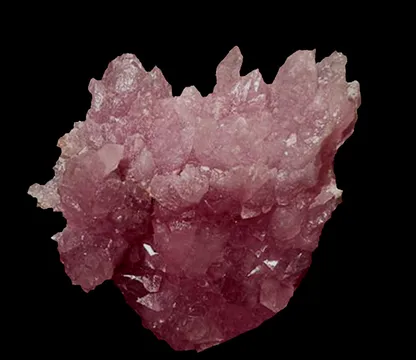
Ilha claim is the collector name for Lavra da Ilha, the “Island Mine,” a classic granitic pegmatite on a low island in the Jequitinhonha River near Taquaral, Itinga, Minas Gerais. Its fame rests on a rare and highly recognizable style of crystallized rose quartz: not massive cutting material, but delicate pink crystals growing in late-stage vugs close to the quartz core of a differentiated pegmatite. The best specimens are unmistakable—pale purplish-pink to rose-pink quartz crystals in rosettes, crowns, crusts, parallel aggregates, and stepped sprays, commonly set on earlier milky, clear, translucent, or smoky quartz and enlivened by warm brown eosphorite.
The geological setting matters as much as the color. Lavra da Ilha is a zoned pegmatite enclosed in quartzose mica schist, with muscovite and feldspar zones flanking a quartz core, sodic replacement bodies, and small geode-like cavities near the core. Those cavities produced the locality’s great collector assemblage: crystallized rose quartz with eosphorite, wardite, roscherite-group minerals, apatite, muscovite, albite, beryl, amblygonite, and other phosphates. Mineralogically, the locality is also important as the type locality for zanazziite, whiteite-(CaFeMg), and whiteite-(MnFeMg), making it far more than a pretty rose-quartz occurrence.
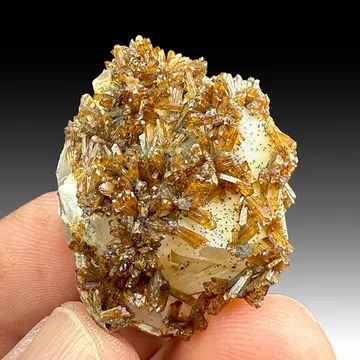
Historically, the 1969 discovery of Lavra da Ilha helped bring the Araçuaí–Itinga district to international attention for crystallized rose quartz. Its best pieces became benchmarks for the Brazilian style: small to cabinet specimens with lustrous, translucent pink quartz, crisp terminations, and a strong phosphate association. Eosphorite is the signature companion, typically as golden-brown to orange-brown prismatic or bladed crystals scattered over or rising from the quartz. Rare specimens add olive-green zanazziite, giving the pink-brown-green palette that seasoned collectors immediately associate with Ilha.
Regional View
Country View
Because the mine lay on an island exposed only during low-water season, the deposit had a peculiar rhythm: the workings could be cleared and mined when the Jequitinhonha dropped, then flooded and partly filled with sand again during the annual rise. That seasonal river setting gives Lavra da Ilha a physical identity unlike the better-known hillside and valley pegmatites of Minas Gerais.


Photo: Wikimedia Commons
Search for specimens: View all specimens from Ilha claim, Brazil
Ilha claim lies at Taquaral in the municipality of Itinga, Minas Gerais, on a small island in the Jequitinhonha River about 3 km north of Taquaral. Published locality data place it at approximately 16° 38' 42" S, 41° 51' 49" W. The island itself is about 500 m long, and the pegmatite is described as a subvertical body trending roughly northeast, partly obscured by alluvium and sand. The host rock is quartzose mica schist, a common wall-rock association in this part of the northeastern Minas Gerais pegmatite province.
The deposit is a zoned granitic pegmatite. Older descriptions give an irregular open working about 50 x 10 m and 15 m deep; later summaries describe an excavation approximately 70 x 10 m and more than 15 m deep, on a pegmatite trace perhaps 300 m long. The pegmatite is medium grained, with muscovite and feldspar on both sides of the quartz core. The collector minerals came especially from sodic replacement bodies and small vugs near the core, where late fluids deposited crystallized rose quartz on earlier quartz, feldspar, and mica.
Ilha’s mineralization is dominated, from a collector’s perspective, by the late quartz-phosphate stage. The earlier quartz may be milky, gray, translucent, clear, or smoky, and it commonly forms the structural base for later pink quartz growth. A thin chalcedony film has been reported between the older quartz and the rose-quartz generation. The rose quartz forms coatings, radial clusters, parallel aggregates, intergrown crystals, and crowns of doubly terminated individuals. Individual pink quartz crystals are commonly only a few millimeters to about 2 cm, though the aggregate specimens may be much larger; one photographed 1969 example was a 17 cm crown around a gray translucent quartz crystal.
The associated assemblage is what fixes many Ilha specimens in the collector’s eye. Pale green diamond-shaped muscovite, sphalerite, niobotantalite, cassiterite, milky beryl, albite, microcline, amblygonite, apatite, wardite, montgomeryite, rockbridgeite, vivianite, triphylite alteration products, eosphorite, and roscherite-group minerals have all been tied to the locality in the literature. Eosphorite is especially diagnostic because it is common in the best rose-quartz specimens from the mine, usually as brown elongated prisms or radial sprays. Zanazziite, once confused with roscherite at the locality, occurs as small olive-green to darker green crystals or aggregates on quartz and rose quartz.
The mine was discovered in 1969, and the first major collector impact belongs to the late 1960s and 1970s. Published accounts credit that discovery with making the Itinga–Araçuaí region internationally famous for crystallized rose quartz. Work was seasonal: during June to October, when the river was low, miners could clear sand and work the excavation; annual floods then inundated and refilled the pit. The deposit later became inactive, and published locality data now treat it as an inactive claim. Current collecting is therefore not a matter of casual public access; the realistic collector market consists overwhelmingly of old-production specimens, older dealer stock, estate material, and pieces recycled from established collections.
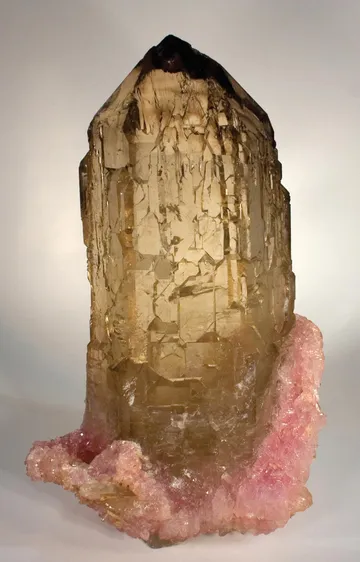
The finest pockets produced sculptural specimens rather than bulk rose quartz. The classic Ilha prize is a crown or halo of pink quartz around a larger earlier quartz crystal, preferably with complete terminations pointing outward and brown eosphorite set on the pink crystals. Good specimens may be small, but they need luster, intact tips, pleasing color, and the unmistakable pegmatite-phosphate association. Larger cabinet pieces with eosphorite, old provenance, or rare zanazziite are increasingly difficult to replace.
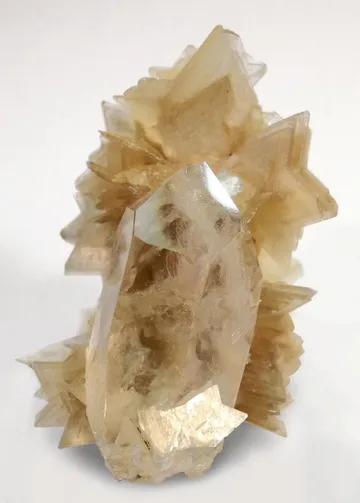
At Ilha claim, quartz is both the host stage and the show mineral: earlier milky, gray, clear, translucent, and smoky quartz forms the cores, points, and matrices on which the late rose-quartz generation grew, and the most recognizable pieces show pink crystals crowning or mantling decimeter-scale first-stage quartz. Published descriptions note automorphic or sheared quartz beneath the rose quartz and, commonly, a thin chalcedony film between the two quartz generations. Good quartz specimens from Ilha are not judged merely by size; collectors look for a sculptural core, visible contrast between the older quartz and the pink overgrowth, undamaged tips on both generations, and a clean association with eosphorite, muscovite, wardite, or zanazziite rather than a dull crust of broken pink quartz.
Ilha rose quartz is famous because it is crystallized, late-stage, and pocket-grown, occurring as regular coatings, rosettes, radial clusters, crowns, subparallel groups, and interpenetrating aggregates perched on earlier quartz, feldspar, or mica near the pegmatite core. Its color ranges from light purplish-pink to pale pinkish-white, with crystals reported from a few millimeters to about 2 cm, commonly translucent and locally quite transparent or opalescent, with occasional striations or growth figures. The most desirable specimens combine fresh pink color, bright luster, complete terminations, and three-dimensional architecture, especially crowns of doubly terminated pink crystals around white, gray, translucent, or smoky quartz; the locality’s eosphorite, wardite, apatite, muscovite, and rare zanazziite associations distinguish true Ilha material from other Brazilian crystallized rose-quartz occurrences.
Eosphorite is the signature phosphate on Ilha rose quartz, typically appearing as golden-brown to orange-brown, elongated prismatic or bladed crystals, lath-like individuals, and radial clusters on pink quartz or earlier quartz. It was important enough here to receive a dedicated 1990 study of zoned eosphorite from the Lavra da Ilha pegmatite, and collector examples commonly show sub-centimeter crystals, with better specimens carrying sharp crystals around 1 cm and occasional larger crystals reported. Fine Ilha eosphorite pieces gain their power from contrast: warm brown, translucent, lustrous phosphate crystals standing proud against pastel rose quartz, ideally undamaged and not lost in iron staining or broken quartz druse.
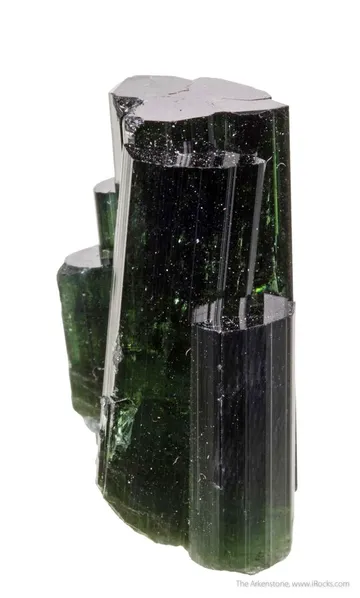
Beyond quartz, rose quartz, and eosphorite, Ilha claim is an important phosphate locality. It is the type locality for zanazziite, whiteite-(CaFeMg), and whiteite-(MnFeMg). Zanazziite occurs as small olive-green to dark green barrel-shaped, prismatic, bladed, or rounded aggregates, commonly on quartz or rose quartz with eosphorite. The whiteite species are much rarer collector minerals, occurring in the complex phosphate assemblage with eosphorite, zanazziite, wardite, albite, and quartz. Other documented minerals include wardite, roscherite or roscherite-group material, amblygonite, rockbridgeite, montgomeryite, fluorapatite or apatite, triphylite, vivianite, collinsite, muscovite, albite, microcline, beryl, sphalerite, cassiterite, niobotantalite, pyrite, manganese oxides, and tourmaline including indicolite reported as small acicular inclusions.
The chief authenticity issue with Ilha specimens is locality precision. Crystallized Brazilian rose quartz also came from Laranjeira, Alto da Pitora, Sapucaia, and several smaller pegmatites, and older labels may say only “Taquaral,” “Itinga,” “Minas Gerais,” or “Brazil.” Ilha pieces are most securely recognized when they show the classic phosphate association—especially eosphorite, and more rarely zanazziite, wardite, apatite, or roscherite-group minerals—on pink quartz over earlier milky, translucent, clear, or smoky quartz. Laranjeira material can also make crowns on quartz, but published comparisons emphasize that crystallized phosphate minerals are a key Ilha clue, whereas Laranjeira is better known for associated elbaite and lacks the same phosphate signature.
There is no reason to assume every old pink quartz from Taquaral is Ilha. Labels should be read carefully, particularly when specimens are sold simply as “rose quartz flowers,” “Brazilian rose quartz,” or “Taquaral rose quartz.” Conversely, some true Ilha specimens were historically simplified on labels, especially when passed through jewelry or decorative-mineral channels, because crystallized rose quartz itself was the selling point. Old provenance to Richard Kosnar, Paul Muse, Richard Hauck, Jaime Bird, Irv Brown, or other serious collections can add confidence, but the mineral association and habit still matter.
The most specific historical alteration problem is removal of eosphorite from rose-quartz specimens. At least some miners reportedly removed the brown phosphate because they thought it detracted from the pink quartz. For today’s collector, that means an otherwise fine rose-quartz cluster with small scars, pits, or oddly clean attachment points may once have carried eosphorite. Intact eosphorite associations are therefore not just attractive; they preserve part of the original paragenesis.
Condition is the major value divider. Ilha rose quartz is composed of small crystals and aggregates, so bruised terminations, rubbed edges, missing peripheral crystals, and cleaved contact zones are common. Eosphorite is softer and more fragile than quartz and often projects from exposed surfaces, making broken or abraded brown crystals frequent. Iron and manganese oxide staining can be natural and locality-correct, but heavy staining may obscure color and luster. Cleaning should be conservative: avoid aggressive chemical treatment on phosphate-rich pieces, avoid ultrasonic cleaning on eosphorite or zanazziite specimens, and do not soak composite phosphate specimens casually.
Color stability should be treated cautiously. General gemological work on Brazilian rose quartz notes that some rose quartz can fade after long exposure to light or sunlight and that heating can destroy pink color. Fine Ilha specimens should be displayed away from direct sun and strong heat, both to protect color and to reduce thermal stress in already fissured quartz. Fluorescence is not a major buying factor for Ilha material; form, color, association, and condition are far more important.
On the market, small crystallized rose-quartz specimens from Ilha still appear, but top pieces are old-stock or collection pieces and are not readily replaceable. Miniatures and thumbnails with sharp pink crystals remain obtainable; rose quartz with excellent eosphorite, large undamaged crowns, or confirmed zanazziite is scarcer. The best cabinet specimens have moved firmly into the classic-pegmatite category, prized by both quartz collectors and phosphate specialists.
The most memorable thing about Lavra da Ilha is that it was literally an island mine. Published accounts place the pegmatite on a 500 m island in the Jequitinhonha River, dry only at low water from June to October. The working season began not with a blast face, but with the labor of clearing sand out of a pit that the river had reclaimed. By the end of the season the river would rise again, flooding the excavation and filling it once more. This annual cycle shaped the entire collecting history of the deposit: a small pegmatite quarry, hidden in river sand, yielding some of the world’s most elegant crystallized rose quartz during the short months when the island allowed work.
The 1969 discovery changed the reputation of a whole district. Before Lavra da Ilha, crystallized rose quartz was known from places such as Sapucaia, but the Itinga–Araçuaí region was not yet the household name among quartz collectors that it would become. Ilha’s abundance of crystallized rose quartz—crowns, radial groups, small sparkling crusts, and doubly terminated pink crystals—gave museums and collectors enough material to recognize a new Brazilian classic. Some specimens were preserved as mineralogical examples; others were mounted in modern jewelry in their natural state, a reminder that the line between specimen and adornment was unusually thin for this locality.
One photographed specimen from the early discovery period captures the classic form: a 17 cm crown of crystallized rose quartz around a gray translucent quartz crystal, collected in 1969. That is the Ilha ideal in miniature architecture—older quartz as the core, later pink quartz as a halo, the whole object recording separate growth events inside the pegmatite. The best crowns are not just pink; they are directional, with crystals pointing outward as if the earlier quartz had bloomed.
Ilha also has a quieter mineralogical detective story. The olive-green phosphate now known as zanazziite was first treated as roscherite in early work from the deposit. Later structural and chemical study showed that the Lavra da Ilha material was magnesium-rich and distinct enough to be described as a new species. The mineral was named zanazziite in honor of Pier Francesco Zanazzi, whose structural work had helped clarify related phosphate minerals. In a locality famous to collectors for pink quartz, the scientific legacy turned out to include a type mineral of the roscherite group and two whiteite species as well.
.jpg)
_1.jpg)
