






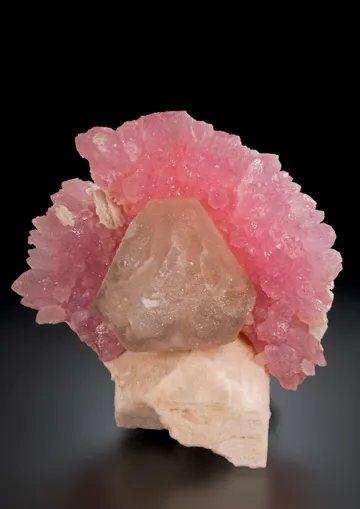
Rose Quartz, Ilha claim, Minas Gerais, Brazil: pink, translucent crystals in pegmatite pockets, often with eosphorite; a collectible locality for rose quartz.
Key facts
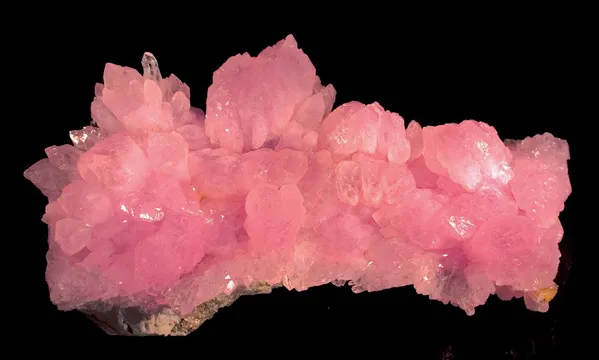
Ilha claim rose-quartz is one of the classic collector expressions of crystallized Brazilian rose quartz: not the familiar massive carving material, but small, lustrous, sharply crystallized pink quartz growing as crusts, rosettes, crowns, sprays, fences, and tight parallel aggregates on earlier quartz. The best pieces have a delicate but unmistakable pastel-to-purplish-pink color, enough translucency to glow under backlighting, and the kind of crystal definition that makes a quartz collector stop treating “rose quartz” as a lapidary material and start judging it as a fine cabinet species.

Photo: Wikimedia Commons
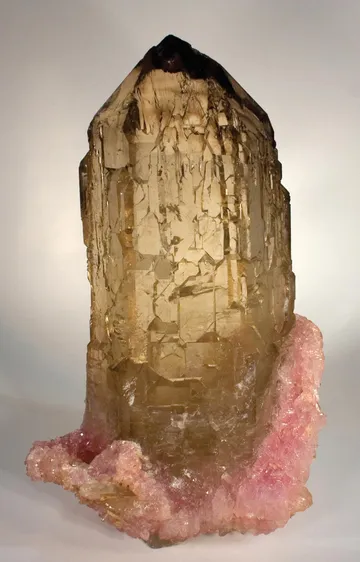
The locality is Lavra da Ilha, the “Island Mine,” a granitic pegmatite on a low island in the Jequitinhonha River near Taquaral, in the Itinga municipality of Minas Gerais. Its appeal is very much tied to that setting. The claim was not just another Brazilian pegmatite quarry; it was a seasonal river-island working where floods repeatedly filled the excavation with sand, and where the finest specimens came from late-stage vugs near the quartz core of a highly differentiated pegmatite. That late, pockety environment produced rose quartz perched on older milky, clear, translucent, or smoky quartz, often with distinctive phosphate minerals.

Photo: Wikimedia Commons
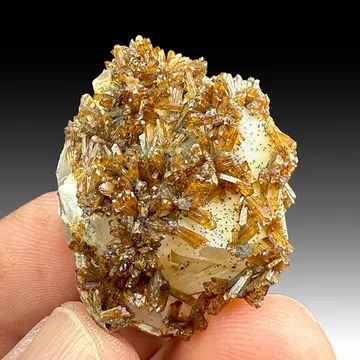
The “Ilha look” is recognizable: pink quartz crystals in sugary to glassy aggregates, commonly accompanied by brown-orange eosphorite and, on some specimens, olive-green zanazziite, wardite, apatite, muscovite, or earlier-generation quartz. Eosphorite is especially important to the eye and to the label. Its warm brown prisms or rosettes give contrast against the pink quartz, and its presence is one of the most useful locality clues for older Ilha material.

Photo: Wikimedia Commons
Historically, Ilha claim matters because its discovery in 1969 helped make the Araçuaí–Itinga region famous for crystallized rose quartz. The deposit is also mineralogically consequential beyond quartz: Lavra da Ilha is the type locality for zanazziite, whiteite-(CaFeMg), and whiteite-(MnFeMg), and it has supplied study material for several papers on complex phosphate assemblages in Brazilian pegmatites. For collectors, however, the great prize remains a complete, undamaged rose-quartz cluster with lively luster, natural pink color, and the classic phosphate association.
Search for specimens: View all rose-quartz specimens from Ilha claim, Minas Gerais, Brazil
Ilha claim, locally known as Lavra da Ilha, is an inactive granitic pegmatite claim on a small island in the Jequitinhonha River, about 3 km north of Taquaral, in the Itinga municipality of Minas Gerais. Mindat gives the locality coordinates as 16° 38' 42'' South, 41° 51' 49'' West, and records the claim as inactive. The claim sits within the broader Araçuaí–Itinga pegmatite district, one of the most productive Brazilian pegmatite provinces for lithium minerals, gem tourmaline, beryl, quartz, and phosphate species.
The deposit is a zoned pegmatite, partly covered by alluvium, striking roughly N 40° E and standing subvertical in quartzose mica schist. The pegmatite was described as perhaps 300 meters long, though some outcrops were reportedly lost beneath river sand. Its core is quartz, bordered by feldspathic zones with medium grain size and albitic replacement bodies. Those sodium-rich replacement zones and nearby geodes are the critical collector setting: the rose quartz belongs to a late stage of pegmatite evolution and formed in small open spaces near the core, on older quartz, feldspar, or mica.
Mining history at Ilha is inseparable from the river. Published accounts describe the island as about 500 meters long and dry enough for work only during low-water months, traditionally June to October. The main excavation was reported in one account as about 50 x 10 meters and 15 meters deep, and in a later locality summary as about 70 x 10 meters and more than 15 meters deep. Each annual flood could cover the workings with sand, so any return to production meant clearing the excavation before new work could begin. Small later production was obtained during low water after sand removal, but the main productive period for classic specimens was the 1960s–1970s, especially after the 1969 discovery.
The claim is not a casual collecting site. It is an inactive mineral claim on a river island, with land and mineral-rights access issues, seasonal water hazards, unstable old excavations, and the practical risks of pits that were repeatedly flooded and sand-filled. Serious collectors today normally encounter Ilha material through old collections, established dealers, auction records, and curated show stock rather than through field collecting.
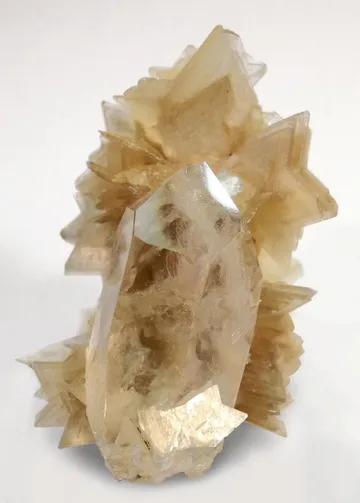
The notable finds are the crystallized rose-quartz groups themselves: crusts on quartz, radial clusters, parallel aggregates, intergrown sprays, and especially crowns of doubly terminated pink crystals around earlier white, translucent, clear, or smoky quartz. The locality’s phosphate suite is equally important. With the rose quartz, collectors and mineralogists have recorded diamond-shaped pale yellow-green muscovite, sphalerite, niobium-tantalum oxides, cassiterite, beryl, montebrasite or amblygonite-series material, eosphorite, zanazziite, rockbridgeite, montgomeryite, wardite, whiteite-group minerals, collinsite, apatite, vivianite, and other phosphate species derived largely from alteration of primary phosphate masses such as triphylite.
Ilha rose-quartz crystals are generally small, but they are often beautifully organized. Individual crystals commonly range from a few millimeters to about 2 cm, with one or two terminations. Some dealer-documented specimens show individual rose-quartz crystals larger than this, but the classic published range remains millimeter to 2 cm crystals arranged into visually stronger aggregates. The most desired groups gain size from architecture rather than from single-crystal scale: ridges, crowns, fans, rosettes, radial sprays, and crusts can make a miniature or small-cabinet specimen read as a much larger object.
Color ranges from nearly purplish pink through soft pastel pink to pale pinkish white. Good specimens have an even, natural pink tone with enough saturation to avoid looking merely milky, but Ilha color is often delicate rather than loud. The finest pieces combine color with translucency: pink crystals that glow at the edges, reveal internal clarity when backlit, and still keep a frosted or satiny surface where many tiny growth faces catch the light.
Crystal form is one of the locality’s strongest selling points. Ilha material can show doubly terminated individuals, tapered spires, crusts of small sparkling crystals, flattened to prismatic crystals in parallel growth, and rounded mounds made from dense crystal aggregates. Particularly characteristic are rose-quartz crystals perched on a previous generation of quartz, sometimes syntaxially overgrowing a milky, clear, or smoky quartz crystal. In the most sculptural examples, the pink crystals form a crown or halo around a central quartz core.
Luster varies from satiny and sugary on tight druses to bright, glassy, and sparkling on better-crystallized groups. The best old pieces have both: a field of scintillating small crystals, broken by larger, more legible quartz points. Growth figures and striated faces have been recorded, and some specimens show a thin chalcedony film between the earlier quartz and the rose-quartz generation.
Associated minerals are a major part of the Ilha identity. Golden-brown to orange-brown eosphorite is the association collectors most often want, especially when it forms sharp elongated prisms or rosettes on pink quartz. Zanazziite appears as rare olive-green to yellow-green botryoidal or spherulitic aggregates and has special importance because Lavra da Ilha is its type locality. Wardite, apatite, muscovite, microcline, albite, smoky quartz, and other phosphates may also be present. A rose-quartz specimen with eosphorite and zanazziite is not just prettier; it is more securely tied to the locality’s classic phosphate paragenesis.
Quality is judged by several factors at once: saturation of pink color, integrity of terminations, freedom from bruising on crystal tips, absence of distracting iron or manganese oxide staining, sculptural composition, contrast with the matrix, and the presence of attractive associated minerals. Complete floaters, crowns around quartz, and sharply crystallized sprays with little or no damage command the strongest interest. A small specimen with superb luster, complete terminations, and a clean eosphorite association can outrank a larger but dull, broken, or indistinct crust.
Ilha claim rose-quartz is available on the market, but much of the desirable material is old stock. Specimens appear in dealer inventories and auctions as 1960s–1970s material, as later old-collection pieces, and occasionally as less precisely dated specimens from the broader old production. Recent public listings show the spread clearly: modest toenails and miniatures can sell in the low hundreds of dollars, while fine small-cabinet examples with strong color, complete form, or important associations can be listed in the several-thousand-dollar range.
The biggest authenticity issue is not usually outright fabrication; it is locality precision. Crystallized rose quartz is known from several Brazilian localities, including other Minas Gerais pegmatites, and older labels may be vague, simplified, or wrong. Ilha material should be evaluated by style and association: small pink crystals on earlier quartz, common eosphorite, possible zanazziite, wardite or apatite, and the characteristic crown, crust, rosette, or parallel-growth habits. Eosphorite alone does not prove the locality, but eosphorite with the right rose-quartz habit and old Brazilian provenance is a strong supporting clue.
Another labeling issue is the distinction between “rose quartz” and the stricter mineralogical usage sometimes applied to euhedral pink quartz. In the specimen market, Ilha material is overwhelmingly bought, sold, and collected as crystallized rose quartz. A collector should care less about the semantic debate and more about whether the specimen is natural, correctly localized, undamaged, and visually characteristic of Lavra da Ilha.
Condition is critical. The crystals are small, crowded, and exposed, so edge bruises and missing tips can be easy to overlook in photographs. Examine the highest points of the cluster, the outer rim of any crown, and the contact line where rose quartz grew on older quartz. Many specimens have natural contacts or separation marks from the pocket wall; those are acceptable when they do not dominate the display face. Iron or manganese oxide dusting, pyrite oxidation, or clay residue can occur on some pieces. A little natural staining may be tolerable, but heavy brown coating can mute the pink color and reduce the specimen’s appeal.
No well-documented, locality-specific treatment scandal is associated with Ilha rose-quartz specimens in the sources reviewed for this guide. Still, ordinary caution applies. Avoid pieces with unnaturally uniform hot-pink color, suspicious dye concentration in fractures, glossy coatings, repaired crowns that do not align crystallographically, or vague “Minas Gerais rose quartz” labels upgraded to Ilha without supporting evidence. Because top Ilha specimens can be valuable, old labels, collection history, and credible dealer provenance matter.
For market buying, the best value is often in balanced miniatures: pink enough to read instantly, complete enough to survive magnification, and accompanied by eosphorite or zanazziite without becoming visually cluttered. Museum-grade pieces are those where the architecture is unmistakable—a complete rosette, a halo of rose quartz around an earlier quartz crystal, or a dramatic pink “fence” with all terminations intact.
The most memorable field image from Ilha is not a pocket scene but the mine itself: a pegmatite excavation on an island in the Jequitinhonha River, workable only when the water dropped. The island was described as roughly 500 meters long, with the rose-quartz working near the low-water reach of the river. In the dry months, miners could clear sand and open the quarry; when the river rose, the excavation filled again. A locality that produced some of the world’s most delicate pink quartz clusters was, for part of every year, simply surrendered back to water and sand.
The 1969 discovery changed the reputation of the Araçuaí–Itinga area. Before that, crystallized rose quartz had been known from places such as Sapucaia, but Lavra da Ilha made the Itinga region famous for abundant crystallized material. The specimens were not just massive pink quartz broken from a core; they were mineral specimens in the cabinet sense—small, composed, sparkling, and mounted by nature on earlier quartz. Some were preserved as mineralogical specimens; some were used in jewelry “in natura,” with their natural crystal form left visible rather than cut away.
The old production also entered American collecting through the hands of Richard “Rich” Kosnar. Auction records for old Ilha specimens describe Kosnar acquiring pieces personally at the claim in the 1970s, including a 1974 miniature of rose quartz that remained in his personal collection until after his death. Those Kosnar-provenance pieces are now doubly attractive: they are not merely old Ilha specimens, but part of the early American import history of a Brazilian locality that had only recently become famous.
A second kind of story is told by the associated minerals. To a quartz collector, the brown eosphorite needles on a pink quartz crust are beautiful accents. To a phosphate specialist, they point to a chemically restless pegmatite where primary phosphate minerals broke down and reassembled into a suite of hydrous secondary species. That is how Ilha became more than a rose-quartz locality. Its pockets supplied zanazziite, whiteite-group minerals, eosphorite, wardite, montgomeryite, vivianite, and related phosphates—some of them important enough to anchor formal mineral descriptions. In a good combination specimen, the pink quartz is the face of the locality, but the phosphates are its signature.


.jpg)