






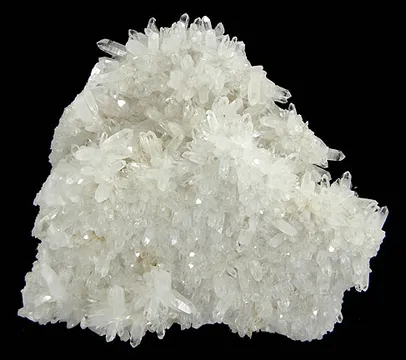
Idarado Mine, USA — San Juan locality famed for cabinet-grade calcite, quartz, sulfides, and rare telluride/fluorite in a massive historic vein system.
Key facts
The Idarado is not a single pretty name pinned to a single adit; it is a mountain-spanning mine system tying the Red Mountain and Telluride sides of the northwestern San Juan Mountains into one of Colorado’s great underground metal districts. Its workings lie along the northwest edge of the Silverton caldera system, where steep fissure veins and replacement bodies in the Telluride Conglomerate carried a classic San Juan suite: sphalerite, galena, chalcopyrite, pyrite, native gold, quartz, calcite, rhodonite, rhodochrosite, fluorite, epidote, adularia, and related manganese- and bismuth-bearing rarities. For the collector, Idarado matters because it produced both ore-grade history and cabinet-grade character: pale pink manganoan calcite sprays, milky to glassy quartz crystals, gold on white quartz with green chloritic selvages, brassy sulfide seams, and the occasional fluorite, hubnerite, or telluride surprise.
The mine’s scale gives its specimens a context few localities can match. The Treasury Tunnel portal on the Red Mountain side and the Mill Level entrance near Pandora, east of Telluride, were not separate worlds; they were connected underground by an enormous system of drifts, raises, crosscuts, ore passes, stopes, and older absorbed mines. Historic accounts describe more than 80 miles of interconnected workings, with principal vein names that read like a San Juan roll call: Black Bear, Montana-Argentine, Tomboy, Ajax-Smuggler, Liberty Bell, Pandora, Cross, Virginius, Barstow, and others. The best specimens carry that complexity visually. They are rarely sterile single-species objects. A good Idarado piece usually has a mineralogical sentence built into it: quartz first, sulfides tucked into seams and pockets, pink calcite as a late flourish, or gold flashing from white quartz with sulfide ghosts nearby.
Regional View
Country View
Geologically, Idarado sits in the intermediate-zone polymetallic vein environment of the San Juan volcanic field. The productive structures are steep, northwest-trending vein systems radial to the caldera margin, with important replacement ores developed where fissures entered porous, calcite-bearing beds of the Telluride Conglomerate. Beneath the main mine, drilling found skarn alteration in Paleozoic carbonate units: rhodonite-epidote, epidote-diopside, epidote-actinolite, garnet, magnetite, johannsenite, ilvaite, and related calc-silicate assemblages. For most collecting purposes, however, the memorable material is from the vein and replacement ore environment rather than from deep skarn: vugs lined with quartz, sulfides, fluorite, and late carbonate growths.
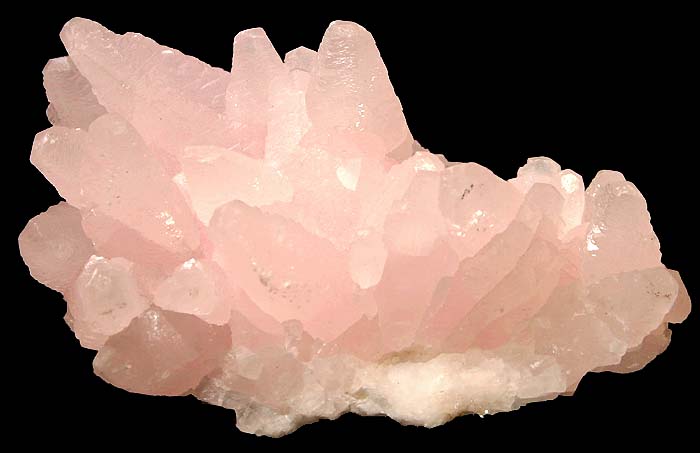
The mine’s manganoan calcites are among the locality’s most beloved collector pieces. They tend toward soft flesh-pink to blush-pink color rather than the saturated raspberry tones of some Colorado rhodochrosites; their appeal is in luster, geometry, and contrast on pale quartz. Fine examples show sharp modified scalenohedra or feathery sprays, often translucent on the edges and especially handsome when perched on white quartz or accented by small pyrite crystals.

Gold specimens from Idarado are scarcer and more specific in appearance: small, bright native gold leaves, grains, or plates standing out against white quartz, sometimes with chloritic green material, sphalerite, galena, or chalcopyrite. These are not the sprawling golds of a crystallized wire-gold camp; they are refined, vein-hosted San Juan gold specimens whose desirability rises sharply when the metal is clearly visible and the old mine-level provenance is preserved.

Quartz is the architecture of the locality. Historic mine descriptions put quartz at roughly 60 to 70 percent of the veins, and the specimens bear that out: crustified bands, milky plates, glassy crystals, drusy coatings, and occasional amethystine color all occur. Where quartz formed open-space vugs it could be beautifully crystallized, and where it served as matrix it made Idarado’s pink calcite and native gold visually legible.
Search for specimens: View all specimens from Idarado Mine, USA
The Idarado Mine is in the San Juan Mountains of southwestern Colorado, extending beneath the high ridge between Red Mountain Valley and the Telluride-Pandora side of the range. Locality labels are often split between Ouray County and San Miguel County, and both can be defensible depending on the specimen’s exact portal, vein, level, or older mine name. The principal modern locality is usually given as Idarado Mine, Ouray County, Colorado, USA, but many specimen labels add Telluride, Pandora, Red Mountain district, Treasury Tunnel, Black Bear vein, Argentine vein, Tomboy vein, or similar qualifiers. Collectors should preserve every old label rather than “cleaning up” the locality into a shorter but less informative form.
The ore deposit is a polymetallic vein and replacement system associated with mid-Tertiary San Juan magmatism and the structural margin of the Silverton caldera. Productive fissures strike roughly northwest and dip steeply, with important structures such as the Montana-Argentine, Black Bear, and Cross vein systems. The veins range from relatively well-defined tabular bodies to irregular zones of quartz and quartz-sulfide stringers, and historic descriptions note abundant gouge seams, blocky ground, and common vugs. Those vugs are the source environment collectors care about: quartz-lined cavities from a few inches across to room-like openings reported as much as tens of feet in one dimension.
The Black Bear and Argentine veins were typically 2 to 25 feet wide, most commonly about 5 to 7 feet wide. Quartz was the dominant gangue and varied dramatically from clear to white, gray, green, and amethystine, and from chalcedonic or bony textures to large zoned crystals. The main ore minerals were sphalerite, galena, chalcopyrite, pyrite, and native gold; gangue and accessory minerals included calcite, rhodonite, rhodochrosite, fluorite, epidote, chlorite, sericite, clay minerals, adularia, and specular hematite. The paragenesis is important for understanding specimens: early base-metal sulfides were followed by major quartz deposition and brecciation, then additional sulfides in quartz interstices, and finally late native gold. Calcite belongs to the very late part of the sequence and is in places among the youngest minerals.
Replacement ore is a major part of Idarado’s geological identity. Where the vein systems entered favorable, porous, calcite- or dolomite-bearing beds of the Telluride Conglomerate, sulfides replaced the rock adjacent to the fissures. This is why the mine is discussed not merely as a vein mine but as a vein-and-replacement system. Later drilling beneath the mine showed that most economic mineralization bottomed near the Tertiary unconformity in the Telluride Conglomerate, with a notable exception around the Cross-Argentine intersection where mineralization continued into older sedimentary rocks. Deeper carbonate units were metasomatized to marble and skarn, with manganiferous calc-silicate minerals and base-metal values related to manganese-rich zones.
Mining history at Idarado is a history of consolidation. Earlier mines on the Telluride and Red Mountain sides, including Black Bear, Tomboy, Barstow-Imogene, Smuggler-Union-related workings, and other properties, were gradually absorbed into a single large underground operation. Idarado Mining Company was formed in 1939 through a combination involving Telluride Black Bear Mines, San Juan Metals Corporation, Newmont Mining Corporation, and Barstow-Imogene interests. The old Treasury Tunnel, begun before 1900 and formerly known as the Hammond Tunnel, became a strategic access route from the Red Mountain side. In the early 1940s, Idarado extended it westward to reach the Black Bear vein and connect with older workings.
On the Telluride side, the Mill Level tunnel was driven by Telluride Mines between 1945 and 1948. Idarado purchased Telluride Mines in 1953 and fully merged the operation in 1956. The Red Mountain mill was then decommissioned, while the Pandora mill near Telluride was rebuilt and expanded. From that point, ore could be moved underground through the mine and delivered to the Pandora side for milling. The flotation mill made separate lead, copper, and zinc concentrates as well as a bullion product, and during its main postwar period the operation was a major producer of zinc, lead, copper, silver, and gold.
The mine’s production figures reflect both its industrial importance and its specimen potential. For the Idarado Mining Company period from 1946 to 1978, reported production was about 10.9 million tons averaging 0.07 ounces per ton gold, 1.91 ounces per ton silver, 2.33 percent lead, 0.71 percent copper, and 3.63 percent zinc. Earlier production from veins later incorporated into the Idarado property was also substantial and richer in gold. Idarado closed in 1978 as metal prices and operating costs turned against the mine, ending large-scale underground mining in the Telluride area.
Today the locality is not a casual collecting site. The mine and associated ground are private, reclaimed, and environmentally managed, with portals, dumps, tailings areas, and water-control systems forming part of a long-running post-mining landscape. Old mine workings are dangerous, and Idarado material on the market should be treated as historical production-era or old-collection material unless accompanied by clear, legitimate recent provenance. Serious collectors should not attempt entry or dump collecting without explicit permission from the landowner and compliance with all safety and legal requirements.
Documented specimen finds include the celebrated manganoan calcite from the mine, gold-bearing quartz from named levels such as the Tomboy vein, quartz crystal groups, fluorite vugs, hubnerite on crystallized quartz, and sulfide specimens carrying sphalerite, galena, chalcopyrite, and pyrite. The Argentine vein is especially familiar from calcite-with-pyrite and quartz material; the Black Bear vein is central to the mine’s ore history; the Dandy vein system is important in the mineralogical literature for galena and Pb-Bi-Ag-Cu sulfosalts; and old labels naming specific levels or veins can significantly improve a specimen’s scientific and market value.
Calcite is the signature display mineral from Idarado, especially the manganese-bearing pink material. The best pieces are lustrous soft-pink to flesh-pink modified scalenohedra, dogtooth crystals, and feathery sprays on white quartz, commonly with pyrite and occasionally fluorite; documented crystals reach several centimeters, with classic cabinet plates and smaller, sharper miniatures both known. Mine descriptions place calcite late in the paragenesis, associated with very late quartz and in part among the youngest minerals deposited, which explains why good specimens often look like a pink carbonate finish laid over earlier quartz-and-sulfide architecture. The finest Idarado calcites are not judged simply by color: translucency, undamaged terminations, three-dimensional growth, clean contrast on quartz, and a well-preserved old Telluride or Idarado label separate desirable pieces from ordinary pink calcite fragments.
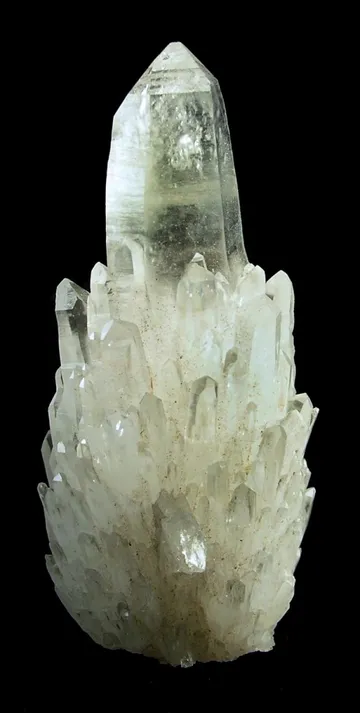
Quartz is the dominant vein mineral at Idarado and the matrix for much of the locality’s collectible material. Historic descriptions note clear, white, gray, green, and amethystine quartz, from fine-grained crustified bands to zoned crystals reported up to about 10 inches long and 5 inches in diameter; collector pieces range from milky plates and drusy-coated crystals to sharp cabinet-size crystals and vug linings with sphalerite, galena, chalcopyrite, pyrite, rhodochrosite, calcite, fluorite, hubnerite, or native gold. Good quartz from Idarado has more locality personality than simple whiteness: crustified banding, open-space crystal habit, contrasting sulfides, pink calcite overgrowths, or gold-bearing zones give it importance, while plain massive vein quartz without crystallization or association is common and much less collectible.
Gold from Idarado is a late-stage vein mineral and is most desirable when visible as bright native leaves, plates, grains, or small crystalline aggregates on white quartz, commonly with sphalerite, galena, chalcopyrite, chloritic material, or other sulfides nearby. The mine was a meaningful gold producer, but specimen gold is far scarcer than calcite or quartz; many pieces contain only millimeter-scale gold grains, while the most collectible examples show well-exposed yellow metal against pale quartz and retain exact provenance such as a vein or level. Electrum is also documented from the locality, and calaverite occurs as a rarer telluride counterpart, so gold-bearing Idarado specimens deserve careful examination before cleaning, trimming, or relabeling; a modest thumbnail with unmistakable native gold and old Idarado provenance can be more significant than a larger but visually ambiguous ore fragment.
Pyrite at Idarado is both an ore-mineral companion and a specimen accent. Mine descriptions record it as moderately abundant, occurring as disseminated small cubes in vein walls and as scattered granular masses or crystals within the veins; on specimens it is commonly seen with calcite, quartz, fluorite, sphalerite, chalcopyrite, galena, and rarer telluride or sulfosalt assemblages. It rarely carries the standalone perfection of a dedicated pyrite locality, but it is crucial to the Idarado look: tiny brassy cubes or sparkling crusts can sharpen a pale pink calcite plate, and pyrite-rich quartz-sulfide associations may point toward more interesting ore-stage paragenesis. The best collector pieces show bright, stable pyrite as a compositional feature rather than dull granular sulfide masses, and pyrite on calcite or fluorite from old Idarado collections is especially attractive.
Sphalerite was one of Idarado’s principal ore minerals and is most often encountered in collector pieces as lustrous dark brown to black crystals or crystalline masses with quartz, native gold, chalcopyrite, galena, pyrite, calcite, epidote, or pyroxmangite. Historic ore descriptions emphasize zinc-rich base-metal mineralization, with sphalerite forming grains and bands in the veins and replacement bodies rather than abundant large isolated display crystals. Good sphalerite specimens from Idarado are therefore association pieces: sharp, lustrous crystals with milky quartz or sulfide contrast, gold-bearing quartz with visible sphalerite, or specimens that document a named vein or level. Massive black sphalerite ore without crystal faces is commoner and less compelling, but well-crystallized sphalerite in a complete San Juan assemblage is a worthy locality specimen.
Beyond these five species, Idarado’s mineral list is unusually rich for collectors who like complex ore suites. Galena and chalcopyrite are major ore minerals; fluorite occurs in pale lavender cubes and octahedra in vugs, reportedly to about 1 inch; hubnerite from the San Miguel side formed ruby to dark-red crystals to about 6 mm on crystallized quartz; and rhodochrosite, rhodonite, pyroxmangite, epidote, adularia, hematite, magnetite, baryte, and anhydrite broaden the gangue assemblage. The locality is also notable for tellurides and Pb-Bi-Ag-Cu sulfosalts, including calaverite, petzite, aikinite, matildite, gustavite, eskimoite, friedrichite, heyrovskyite, lillianite, neyite, vikingite, stromeyerite, and tetrahedrite-group minerals. These rarities are generally not “pretty” in the simple cabinet-specimen sense, but they make Idarado an important analytical and reference locality, especially where old Dandy vein or Basin drift provenance accompanies the piece.
Idarado specimens are not usually faked in the way that some high-value gold localities are systematically counterfeited, but mislabeling is a real concern. The mine system absorbed and interconnected older workings across district and county boundaries, so labels may read Idarado, Treasury Tunnel, Black Bear, Tomboy, Pandora, Argentine, Telluride, Ouray, Red Mountain, or San Miguel County. Some of these labels are complementary rather than contradictory, but vague “Telluride, Colorado” labels should not automatically be upgraded to Idarado without supporting history. Conversely, an old label naming a specific vein, level, or collector is part of the specimen’s value and should stay with it.
Gold specimens require the most caution. Small visible gold in white quartz can be confused with chalcopyrite, pyrite, or brassy sulfides, and Idarado pieces may also carry electrum or telluride minerals. Avoid aggressive acid treatment of gold-quartz-sulfide specimens, because it can remove carbonate, damage sulfides, alter chloritic or clayey selvages, and destroy the textural evidence that makes the specimen credible. A loupe, stereo microscope, specific-gravity intuition, malleability testing only on inconspicuous grains if absolutely necessary, and, for better pieces, nondestructive analytical confirmation are preferable to guesswork.
Manganoan calcite is the most available classic Idarado specimen type, but good ones are still selective. Expect edge bruising, contacted crystals, cleaved tips, and old repairs on larger plates. The crystals can be delicate, and the pale pink color is easily lost in poor lighting or visually overwhelmed by iron staining. Some Idarado calcites fluoresce strongly orange to red-orange under ultraviolet light, consistent with manganese-activated calcite; fluorescence should be considered a bonus rather than proof of locality. Keep calcite away from acids, avoid ultrasonic cleaning, and remember that even mild chemical cleaning can change the appearance of associated pyrite, sulfides, and iron oxides.
Quartz specimens are generally sturdy, but Idarado quartz commonly has drusy coatings, sidecar crystals, healed surfaces, and sulfide inclusions that can be chipped or dulled by careless cleaning. Milky quartz alone is abundant and not necessarily valuable; crystallized quartz with documented association, good aesthetics, or old collection provenance is the material to pursue. Amethystine Idarado quartz is less common and should be judged conservatively, especially if the color is faint or localized.
Sulfide-rich specimens deserve stable storage. Pyrite, sphalerite, galena, chalcopyrite, and sulfosalts can oxidize under damp conditions, and old mine specimens with porous gangue or microfractures may shed small grains. Keep them dry, avoid foam that traps humidity, and do not wash sulfide ores and then store them before they are completely dry. Fine calaverite, petzite, and sulfosalt reference pieces should be handled as analytical specimens: small, labeled, protected, and never overcleaned.
Market availability is uneven. Pink manganoan calcite from Idarado appears regularly enough that collectors can be choosy. Quartz, calcite-pyrite, and mixed sulfide pieces appear periodically from old Colorado collections. Visible native gold, good hubnerite, attractive fluorite, and well-documented Dandy vein sulfosalt material are much scarcer. The best specimens carry old labels from respected Colorado collectors, mine employees, or historic dealers; such provenance can matter as much as size.
In Idarado’s working years, geography itself became part of the mine machinery. The Treasury portal on Red Mountain Pass sat around 10,600 feet, while the Mill Level tunnel at Pandora near Telluride opened far lower, around 9,060 feet. Between them was a mountain ridge, harsh weather, old workings, ore chutes, hoists, raises, and a hidden industrial corridor. Once the underground connections were fully configured, ore could be moved through the mountain rather than hauled over it, and a miner from the Ouray side could enter at Red Mountain, travel inward, descend through the mine, and end up working beside men who had entered from the Telluride side.
The commute became legendary. The two main portals were about five and a half miles apart underground and separated by roughly 1,600 feet of elevation. In the 1960s, chief engineer Dick Swerdfeger brought in four-wheeled mine bicycles so people could move more quickly through the rambling workings. With good timing at the hoists, he could ride in from the Mill Level tunnel and emerge at the Treasury portal about 40 minutes later. One remembered routine was almost absurdly domestic for such a place: ride through the mountain, change clothes in the dry room, spend the day in the office, and ride back to Telluride.
The mine even became an emergency highway. During one avalanche closure of Red Mountain Pass, a busload of stranded passengers was ferried underground all the way through to Telluride. It is the sort of story that could only happen at Idarado: a public road blocked by snow above, and below it a working industrial labyrinth spacious and organized enough to move people through the mountain.
The modern ghost of the mine is quieter but not dead. A later field account describes entering the Treasury Tunnel in spring after a cold San Juan storm had turned Red Mountain Pass to ice. Inside, the temperature and mood changed to “cold with a chance of dark.” The old tunnel, narrower and drier than the Mill Level side, still required maintenance crews, pumps, steel sets, rescue planning, and daily discipline. A safety warning from Newmont emergency-response coordinator Dorsey Manson captured the reality of old underground ground: “A human being is the softest thing inside a mine.” Outside the portal, a mine rescue trailer stood ready with rebreathers and a stretcher fitted with custom wheels for the tight tunnel geometry.
At Red Mountain, much of the built mine has vanished under fire, snow, collapse, cleanup, and reclamation. Historic offices, warehouse structures, boarding facilities, and mill buildings that once made the portal a busy industrial camp are gone or reduced to foundations. What remains is more austere: the Treasury portal, the iconic wooden trestle, reclaimed tailings, concrete stumps, old company houses across the highway, and a landscape where Trico Peak and the Red Mountains still dominate the scene more powerfully than any human structure.
On the Pandora side, the old gray mill has a different presence. It stands at the head of the Telluride valley like an industrial monument, close enough to town that it has never fully become invisible. A modern observer called it “the king of the valley,” an apt phrase for a building that outlived the ore trains, watched Telluride shift from mining town to ski town, and became both landmark and environmental responsibility. Today the work there is not blasting ore but managing water: collection boxes, infiltration ditches, lagoons, sampling regimes, and the long practical afterlife of a mine that once helped define the valley.


_IS_LOCATED._LARGE_SETTLING..._-_NARA_-_543738.jpg)
.jpg)