A collector's guide to Ouray Mining District, USA: its geology, mining history and notable minerals, illustrated with the 56 specimens documented from this locality on EarthWonders.
Key facts
Ouray is one of those Colorado names that means two things at once to collectors: a spectacular nineteenth-century mining camp set in the red cliffs of the San Juan Mountains, and a cluster of hard-won specimen localities whose best pieces are instantly recognizable. The district sits around the town of Ouray on the northwestern flank of the San Juans, where deep glacial and river canyons cut through Proterozoic basement, Paleozoic and Mesozoic sedimentary rocks, and later volcanic and intrusive rocks. The ore geology is not a single neat vein system, but a structurally controlled suite of replacement bodies, fissure veins, contact-metamorphic zones, pyritic gold-base-metal bodies, and silver-bearing lead-zinc deposits related to Laramide porphyritic granodiorite intrusions and older structural trends.
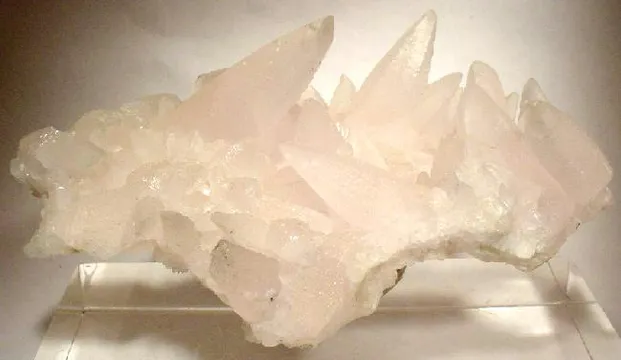
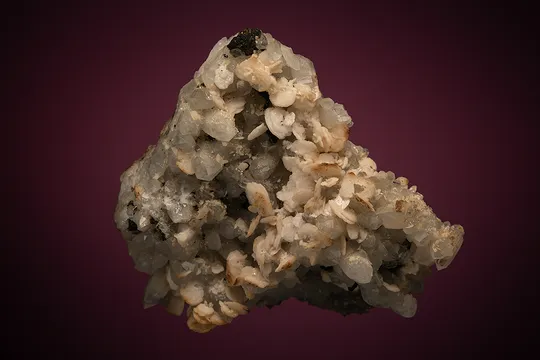
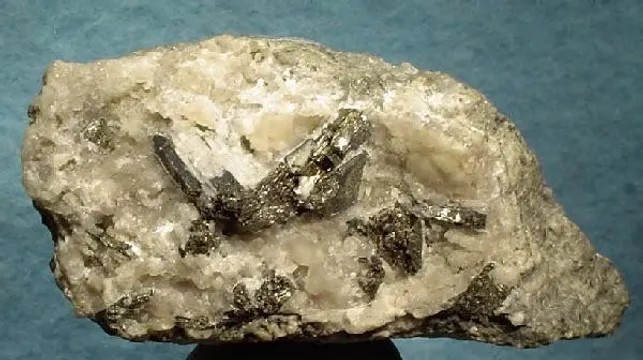
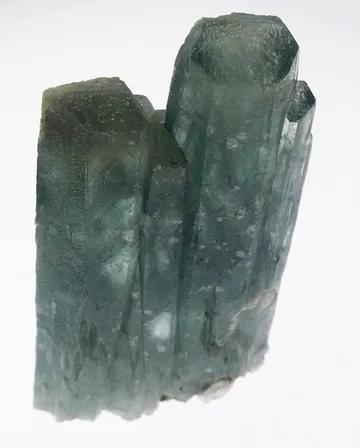
For collectors, the classic Ouray look is alpine-silver-camp quartz and manganese carbonate: milky to clear quartz plates, drusy quartz ribs, quartz epimorphs, pink to strawberry rhodochrosite rhombs, pyrite, sphalerite, galena, chalcopyrite, fluorite, calcite, barite, and occasional more exotic sulfosalts and tungsten minerals. The best specimens are not the heavy ore pieces that made the district famous economically, but the vug minerals that miners, leasers, and later specimen collectors saved from hard, wet, dangerous ground: rhodochrosite perched on sparkling quartz from the Grizzly Bear-Zanett system and Mountain Monarch/Michael Breen area; large quartz crystals and quartz casts from Leadville Limestone pockets; and smaller but choice assemblages of fluorite, sphalerite, barite, calcite, huebnerite, and sulfides from individual mines scattered around Bear Creek, Canyon Creek, the Amphitheater, Gold Hill, and the Upper Uncompahgre.
Regional View
Country View
Historically, Ouray belongs to the same rugged mineral belt as Silverton, Red Mountain, Sneffels, Telluride, and Camp Bird, but the town district has its own personality. The American Nettie, Bachelor, Mineral Farm, Pony Express, Grizzly Bear, Mountain Monarch, Michael Breen, Daniel Bonanza, Ohio, Portland, and related workings produced enough ore to anchor a mining economy, yet their specimen legacy is more selective and more local than the headline-grabbing Sweet Home rhodochrosites or the immense Camp Bird gold production. Good Ouray pieces tend to be cabinet-scale rather than huge museum monsters, with value concentrated in locality precision, undamaged crystals, old labels, and that unmistakable San Juan contrast of sugary white quartz and warm pink rhodochrosite.

Search for specimens: View all specimens from Ouray Mining District, USA
The Ouray Mining District is centered on the town of Ouray, at the junction of the Uncompahgre River and Canyon Creek, and collector usage commonly includes a wider group of mines and pockets around Bear Creek, the Amphitheater, Gold Hill, the Upper Uncompahgre, and nearby canyon walls. The narrower Uncompahgre portion of the district covers roughly fifteen square miles on the northwestern flank of the San Juan Mountains. USGS work by Wilbur S. Burbank and Robert G. Luedke places the principal ore deposits in Paleozoic and Mesozoic sedimentary rocks affected by Laramide porphyritic granodiorite intrusions, with ore emplacement governed by the intersection of a north-northwest Uncompahgre uplift axis and a northeast intrusive axis. That structural framework explains much of the district’s patchwork character: one mine may have replacement ore in limestone, another pyritic gold-bearing base-metal bodies, and another silver-lead-zinc mineralization in veins or favorable beds.
The chief economic metals were gold, silver, copper, lead, and zinc. The USGS estimated a gross value of roughly $14 to $15 million from the Uncompahgre district portion, while individual neighboring and overlapping San Juan operations, especially Camp Bird and Idarado, dominate broader Ouray County production statistics. In the town district proper, the American Nettie on Gold Hill, the Bachelor group north of Ouray, the Mineral Farm near Canyon Creek, and the Pony Express are among the historic names most often encountered in geological literature. Ore was controlled by intrusive contacts, shallow tensional fracture zones, favorable sedimentary horizons, and older structural lines. Contact-metamorphic and pyritic gold deposits are concentrated toward the central parts of the district, while silver-lead-zinc deposits occur more strongly in northern and southern sectors.
The sedimentary host rocks are crucial to the collector story. The Leadville Limestone and related carbonate units offered cavities, replacement sites, and reactive beds where quartz, calcite, rhodochrosite, barite, fluorite, and sulfides could develop in open space. The O.S. Pocket, a cut in Leadville Limestone at the south end of Ouray near U.S. 550, is the clearest example: collectors recovered large quartz casts, long labeled as quartz after barite but later interpreted as quartz after anhydrite. Other mines, such as the Ohio and Portland in and near the Amphitheater, produced distinctive quartz in solution cavities or carbonate-hosted pockets rather than as ordinary massive vein quartz.
Mining began in the 1870s, and several of the well-known claims were located while Ouray County itself was still taking shape. The Mineral Farm, one of the earliest properties near town, earned its memorable name because mineralized veins reportedly cropped out so plainly that ore could be extracted from the surface almost as though harvesting a crop. The Grizzly Bear claims were located in 1875 up Bear Creek, and the mine went on to become one of the district’s most important specimen localities for rhodochrosite. The Bachelor claim was filed in 1888 and became one of the best-known Ouray producers after a rich silver discovery in the mid-1890s. The American Nettie, sold in 1889 to the American Gold Mining Company, became one of the classic cliffside operations above town, a mine so dramatically situated that early color photochrom views still define the visual imagination of Ouray mining.
Specimen production has been intermittent and localized rather than continuous. At the Grizzly Bear, the twentieth-century John Zanett Tunnel was driven to intersect old workings and the Grizzly Bear vein system; during that work, collectors documented rhodochrosite pockets, quartz plates, fluorite, sphalerite, and other minerals. A major watercourse produced plates of white drusy quartz carrying etched rhodochrosite crystals, and another zone carried baby-pink rhodochrosite on chlorite-colored green quartz plates. At the Mountain Monarch/Michael Breen area south of Ouray, a 1982 specimen lease recovered several hundred rhodochrosite-on-quartz pieces, but only one major vug with larger specimens was found, and later cave-ins and snowslide damage made further serious collecting unlikely without major rehabilitation.
The district’s best quartz finds are equally pocket-bound. The O.S. Pocket produced unusually fine quartz epimorphs after anhydrite, some reaching around 15 cm and showing hollow, sparkling, cast-like forms. The Ohio Mine area yielded large milky, slightly barrel-shaped, doubly terminated quartz crystals in sprays, reportedly from solution-cavity settings in the Leadville Limestone. The Portland Mine produced clear quartz groups, quartz scepters, pale amethystine clusters, quartz casts, and associated sphalerite on calcite. These finds explain why “Ouray quartz” can mean very different things depending on label: simple milky vein quartz from dumps is common; sculptural, locality-specific quartz from named pockets is not.
Collecting access today requires care. Much of the historically productive ground is private, patented, claimed, caved, environmentally sensitive, or simply dangerous. The Ouray Ranger District has no designated casual collecting areas, and public-land collecting rules do not override existing claims, leases, private ownership, closures, or safety restrictions. Hand collecting in permissible areas is not the same as prospecting or commercial extraction, and mechanical equipment, significant disturbance, collecting on claims without permission, or entering old mine workings can create legal and safety problems. Serious collectors should treat Ouray as a provenance locality more than a casual digging destination: buy well-labeled old material, visit the Ouray County Historical Society Museum and archives, take sanctioned mine tours such as the Bachelor Syracuse, and never enter or dig at old workings without explicit permission and current land-status research.
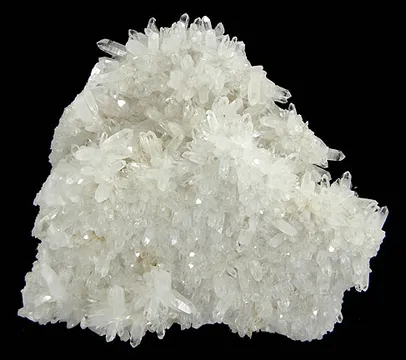
Quartz is the visual backbone of Ouray specimens: it forms clear to milky prisms, sparkling druses, scepters, large barrel-shaped crystals, pocket plates, and some of Colorado’s most distinctive quartz epimorphs. The O.S. Pocket, in Leadville Limestone near the south edge of Ouray, is famous for large sugary white quartz casts after anhydrite, formerly and often still seen on old labels as quartz after barite; the best examples are hollow, crisp, sculptural, and sometimes show rare “butterfly” twin morphology inherited from the original anhydrite. The Ohio Mine area produced milk-white, slightly barrel-shaped, doubly terminated sprays reportedly reaching about 12 inches, while the Portland yielded clear groups, white scepters, pale amethyst clusters, and quartz with lime-green sphalerite and pyrite on calcite. In the rhodochrosite localities, especially Grizzly Bear-Zanett and Mountain Monarch/Michael Breen, quartz is the stage on which the pink carbonate performs: fine pieces have sharp, lustrous quartz points or drusy ribs that set off rhodochrosite rhombs cleanly, whereas ordinary pieces are massive, iron-stained, bruised, or too densely coated to show crystal form.
Rhodochrosite from Ouray is a collector’s locality mineral rather than a bulk-color spectacle: the best specimens show pink, baby-pink, pastel-pink, rose-red, or strawberry-pink rhombohedra perched on quartz, with pyrite, sphalerite, chalcopyrite, fluorite, siderite, barite, calcite, and galena as possible associates depending on mine. The Grizzly Bear-Zanett system is the classic source, with documented rhombs from small crystals to exceptional multi-inch examples, including plates of white drusy quartz carrying etched rhodochrosite and pockets where iron staining partly masks the true color; fluorite and sphalerite assemblages from the same mine add to its desirability. Mountain Monarch and the closely associated Michael Breen workings produced the most familiar small-cabinet Ouray rhodochrosites of the early 1980s, typically sharp pink rhombs on clear to milky quartz druse, often with minor pyrite; documented examples include 7 to 9 mm rhombs, while symposium accounts record rhombs as large as about 2 inches on edge. Good Ouray rhodochrosite is judged by undamaged rhombohedral form, separation from the quartz matrix, attractive pink color despite staining, and a specific mine or pocket label; unlabeled “Ouray” rhodochrosite loses much of its meaning because Grizzly Bear, Zanett, Mountain Monarch, Michael Breen, Daniel Bonanza, Sunnyside, and Sweet Home material are too often blurred in the market.
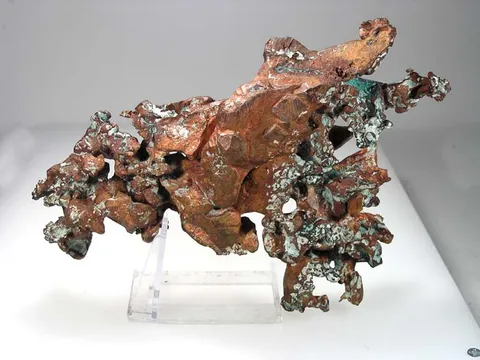
Beyond quartz and rhodochrosite, the district is rich in species that reward careful labeling. Grizzly Bear is documented for fluorite in lavender cubes and pale-green cuboctahedra, red to black sphalerite, small barite rosettes, calcite scalenohedra, chalcopyrite, chlorite, galena cubes, hematite, gemmy huebnerite, pyrite, rhodonite, siderite, tetrahedrite, and rare silver wires. Mineral Farm produced blocky cream-colored barite and fine quartz pseudomorphs after calcite, while Pony Express yielded brown calcite scalenohedra and white bladed barite. Portland is notable for quartz, sphalerite, calcite, galena, and pale amethystine quartz. Systematic collectors should also note the broader Ouray-Silverton context: ourayite, Ag3Pb4Bi5S13, was named for Ouray and has its type locality at the Old Lout Mine near Ouray in Poughkeepsie Gulch, while zunyite, another San Juan type-locality species, comes from the Zuni Mine on Anvil Mountain in the neighboring Silverton area.
The main authenticity issue with Ouray material is not laboratory treatment but locality accuracy. Rhodochrosite on quartz from Ouray County can be visually close to material from Sunnyside, American Tunnel, Sweet Home, and other Colorado localities, and vague labels such as “Ouray, Colorado” are less valuable than labels specifying Grizzly Bear, Zanett Tunnel, Mountain Monarch, Michael Breen, Daniel Bonanza, or another precise mine. Older Mountain Monarch material may be labeled “Mickey Breen” or “Michael Breen,” and specimen histories show that some early material marketed under the Breen name probably came from the Mountain Monarch workings. That does not necessarily make the specimens wrong in a broad district sense, but it does matter to advanced locality collectors.
The most specific documented mislabeling problem concerns O.S. Pocket quartz. Many specimens were long labeled as quartz after barite; later work identified them as quartz after anhydrite, and good modern labels should reflect that correction. Old labels should be preserved, not discarded, because they are part of the specimen’s history, but catalog records should note the updated interpretation.
Condition is a serious factor. Ouray rhodochrosite commonly sits on drusy quartz or in vugs where tiny rhombs are exposed on high points; edge bruising, cleaved rhomb corners, iron staining, quartz overgrowth, and contact damage are common. Etching can be natural and attractive, especially on Grizzly Bear rhodochrosite, but it can also make crystal faces look dull or rounded. Quartz groups from the O.S. Pocket and Ohio-type cavities should be checked for broken terminations, repaired cast walls, missing back plates, and chips hidden among sugary druse. Sulfide-rich specimens should be kept dry and stable; pyrite from San Juan ores is not automatically unstable, but mixed sulfide matrix and old mine-dump material can oxidize if stored in humid conditions.
Market availability is limited but real. Common Ouray dump quartz and sulfide ore is inexpensive, but fine, named-mine rhodochrosite-on-quartz appears only sporadically. Auction records and dealer listings show that small-cabinet Mountain Monarch and Grizzly Bear pieces still surface, especially from older Colorado collections, but the supply is thin because the important specimen pockets were finite and many productive workings are inaccessible, caved, private, or inactive. The best buys are specimens with old Colorado labels, exact mine attribution, and honest condition disclosure; the pieces to avoid are generic “Colorado rhodochrosite” or “Ouray quartz” offerings that lack a mine, pocket, or credible chain of custody.
The Grizzly Bear story begins with a location date that seems almost too early for the terrain. The original claims were located in 1875, up Bear Creek on the northwest slopes of Engineer Mountain, when access was still the fundamental problem of the San Juans. Between 1875 and 1910, the mine produced nearly $1,000,000 in ore values, yet it was always fighting distance, weather, and transportation. Around the turn of the century, investors poured money into road improvement, a boarding house, and hundreds of feet of tunnel work. The ore paid, but the crystals are what collectors remember.
A 1910 mine report by engineer Chester Ingersoll singled out details most mining engineers would have ignored. He described the Grizzly Bear vein as a “true fissure” with well-defined walls, 15 to 30 inches wide, traceable on the surface for several miles. Then, unusually, he paused on the gangue: quartz and rhodonite, the latter locally called “pink quartz,” accompanied by quartz crystals and “very beautiful crystals of rhodochrosite.” For a working engineer to spend words on rhodochrosite in an ore report is telling. It means the crystals were not a later collector fantasy; they were noticed while the mine was still a mine.
The modern collector chapter came with the John Zanett Tunnel. In 1978, Savage Mining Corporation, organized by four grandchildren of John Zanett, began driving a haulage tunnel named for him. After more than a dozen years and 8,500 feet of drifting, the tunnel connected with the old Grizzly Bear workings and was pushed farther into new ground along the vein system. It was not just an engineering project; it was a moving cross-section through a specimen locality. One zone showed fern-green quartz plates colored by chlorite inclusions, dusted with baby-pink rhodochrosite rhombohedra to half an inch. Farther in, a watercourse opened into plates as much as 12 inches across: white drusy quartz carrying etched rhodochrosite crystals to 2 inches on edge, some pale, some strawberry pink, many partly masked by iron staining.
The largest modern Grizzly Bear rhodochrosite described in the symposium literature has the sort of detail that sticks in a collector’s mind. Peter Klein, an operating partner in the mine, collected a rhombohedron almost 4 inches on edge from a large cavity in the Zanett haulage near the refuge station, 6,000 feet from the portal. The crystal was completely coated in fine white quartz druse. Before presenting it to Barbara Muntyan, one corner of the coating was removed to reveal the rhodochrosite beneath. That small act makes the specimen complicated by modern standards—altered, technically—but it also made it intelligible. Without that window, one of Ouray County’s greatest rhodochrosite crystals might have looked like a white quartz lump.
Mountain Monarch has a shorter, sharper specimen story. Around 1980, fine rhodochrosite rhombs on clear quartz began appearing with “Mickey Breen Mine” labels, the local nickname tied to the Michael Breen. Later accounts concluded that much of this production, including later material, probably came from the main adit of the Mountain Monarch Mine. In the summer of 1982, Harvey Gordon and others leased the Mountain Monarch specifically to recover rhodochrosite specimens, assisted by the Nordlander brothers of Ouray. They worked for months and recovered several hundred rhodochrosites on drusy quartz matrix. Only one major vug with a few larger pieces appeared. Then the opportunity essentially closed: a winter snowslide in 1983–1984 severely damaged buildings and equipment, and cave-ins blocked major haulages in both the Monarch and Breen workings. The supply collectors argue over today came out in a short, vivid pulse.
The O.S. Pocket is Ouray collecting folklore in miniature. The locality was a cut in Leadville Limestone near the 180-degree bend of U.S. 550 as it leaves the south end of town. The pocket produced large, pristine, hollow quartz casts—long sold as quartz after barite, later identified as quartz after anhydrite. The initials “O.S.” are said to come from the exclamation collectors made when they realized what the pocket contained. Robert Stoufer and Benjy Kuehling, both deeply associated with Ouray-area collecting, are tied to the locality’s recovery and documentation. The pocket was cleaned out in the early 1990s, which is why genuine O.S. pieces have the feel of a closed chapter: a small roadside geological accident that produced world-class casts, then ended.
The Bachelor Mine gives the district its bonanza narrative. The claim was filed in 1888 by J.T. Brown and brothers Charley and Alf Armstrong. A year later, Brown sold his share to George Hurlburt, and for six slow years the partners advanced only about 500 feet of adit while hunting for ore. In late 1894, Jesse Frank Sanders bought Alf Armstrong’s interest for $2,000, a formidable price for an unproven mine. Soon afterward, the mine hit rich silver ore. Shipments worth up to $400 per ton began moving down the mountain, and by 1895 the Bachelor was the largest producer in the Ouray area, with each partner reportedly clearing more than $10,000 a month. At the main portal, a little settlement of about 200 people grew up, named Ash from Armstrong, Sanders, and Hurlburt. It had a mill, school, post office, and even the Bachelor Band.
The Bachelor’s later Syracuse Tunnel is a reminder that mining districts have second acts. In the 1920s, investors from Syracuse, New York backed a lower access tunnel to drain and reach the old workings. Work began in December 1924, and in June 1927 the 5,000-foot tunnel intersected the mine shaft. The tunnel project found new silver veins and manganese ore, but its financial history whipsawed. Less than three years after completion, the mine sold at sheriff’s sale for $90,000; a March 1930 newspaper account reportedly called it “practically worthless.” Then, less than a year later, a rich silver vein changed the tone, and the same kind of newspaper commentary began calling it “the most promising ever located in that region.” In 1982, Carl F. Dismant began giving public tours through the Syracuse Tunnel by day while mining still took place at night.