






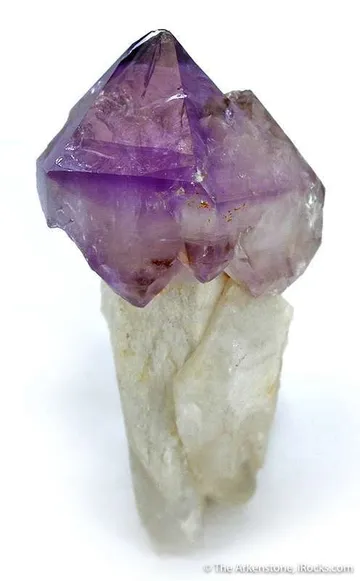
Hopkinton, USA — Diamond Hill yields amethyst scepters in milky quartz; finite production, well documented, and prized by major collections.
Key facts
For serious collectors, “Hopkinton” means the Diamond Hill occurrence at Ashaway Village in southwestern Rhode Island: a small, privately exposed quartz occurrence that produced one of the classic amethyst suites of the eastern United States. Its fame rests not on a mine, orebody, or large commercial working, but on a brief and unusually productive pocketed zone where clear quartz, porcelain-white milky quartz, and later violet amethyst recorded multiple generations of silica growth in and above quartzite of the Proterozoic Plainfield Formation.
The signature Hopkinton specimen is instantly recognizable: sharp, opaque white milky quartz crystals carrying transparent violet amethyst caps, commonly as scepters. The best pieces have the theatrical look of a purple crystal blooming out of a white stem, with a “mushroom” or cap-like overgrowth that is not merely perched on the quartz but crystallographically continuous with it. Fine groups show several amethyst caps on a plate of milky quartz; exceptional cabinet pieces combine rich purple color, gemmy transparency, clean scepter geometry, and enough white quartz matrix to make the contrast unmistakably Hopkinton.
Regional View
Country View
Although Rhode Island has a long history of small mineral localities, the Hopkinton find stands apart because the production was finite, well documented, and visually distinctive. The locality yielded hundreds of single scepters but comparatively few groups on matrix, and those matrix pieces are the specimens that now define the locality in advanced collections. Major examples have been recorded in institutional displays and collections, including the Smithsonian, the American Museum of Natural History, the Harvard Mineralogical Museum, and the Natural History Museum, London.

Photo: Wikimedia Commons / James St. John
Search for specimens: View all specimens from Hopkinton, USA
The collecting locality is Diamond Hill at Ashaway Village, in the town of Hopkinton, Washington County, Rhode Island. It lies in the southern New England Avalonian belt, where the regional bedrock includes quartzite, gneiss, schist, amphibolite, and calc-silicate units assigned in the area to the Plainfield Formation and related metamorphic rocks. The amethyst-bearing quartz occurrence is described as lying stratigraphically above a lithologically variable quartzite unit of the Proterozoic Plainfield Formation and beneath a thin cover of glacial till. The locality had no conspicuous quartz-vein outcrop at the surface; the important material was exposed only where temporary excavations cut down through the overburden.
This is best understood as a low-temperature quartz-crystal deposit rather than a metallic ore deposit. Earlier speculation considered an igneous source, but fluid-inclusion and oxygen-hydrogen isotope work led Rakovan and coauthors to interpret the quartz as precipitated from meteoric waters. The most useful collector’s model is a sequence of quartz growth in broken, pocketed quartz veins: early transparent quartz, then abundant milky quartz, then a later amethyst generation that grew as epitaxial overgrowths on the milky quartz. The quartz-bearing veins were described as broken-up bodies roughly 36 cm thick, with the productive zone in sandy clay to montmorillonitic material beneath glacial till.
The quartz paragenesis is the heart of the locality. Early clear quartz occurs as elongate, pencil-like euhedral crystals and as shorter prismatic crystals. Milky quartz is the dominant generation: white, opaque, prismatic crystals with clear cores and outer zones rich in fluid inclusions. The amethyst came later, usually as transparent to translucent violet scepter caps on one end of the milky quartz stems. On the finest pieces the amethyst is clean enough to show internal zoning and rich purple rhomb sectors, while the milky quartz matrix remains stark white and porcelain-like.
Hopkinton was not a commercial mine in the usual sense. The important discovery was made in spring 1981 on private property in Ashaway Village, and the locality was worked intermittently through small temporary pits, including deeper backhoe excavations in the early 1980s. John Rakovan and Sal Avella are the names most closely associated with the classic specimen production and documentation. Period accounts and later summaries indicate that the deposit was worked for roughly a decade and yielded on the order of 500 to 600 single scepter crystals and only a few dozen crystal groups; Mindat’s locality entry records 500 scepters and 25 matrix specimens, while another gallery summary cites 35 groups. The difference reflects how “matrix specimen” and “crystal group” were counted, but both figures make the essential point: individual scepters are scarce, and substantial matrix groups are genuinely rare.
Collecting access today should be treated as closed unless a collector has explicit permission from the landowner and mineral-rights holder. The productive exposures were temporary, and the absence of a permanent quarry face or public collecting area is part of why fresh Hopkinton material is rarely encountered. Modern specimens on the market overwhelmingly represent the 1980s production and later dispersals from older collections, not ongoing field recovery.
Hopkinton amethyst is famous for scepters and scepter caps on milky quartz, typically transparent to fairly transparent and ranging from faint violet to deep purple. The amethyst overgrowths are generally equant rather than long-prismatic, commonly forming a terminated cap with reentrant geometry where it meets the euhedral white stem; this gives many pieces the locality’s characteristic mushroom-like profile. Individual amethyst caps commonly fall in the centimeter range, with documented examples around 2.5 cm across on major plates, while notable individual scepters can be several centimeters tall or wide. The best pieces show clean, glassy purple amethyst with sector zoning, strong contrast against opaque porcelain-white milky quartz, complete terminations, and undamaged cap edges; ordinary pieces tend to be paler, less gemmy, incomplete, or detached from matrix.
Quartz at Hopkinton occurs in several visually distinct generations: early optically clear quartz, abundant white milky quartz, and violet amethyst as the final classic stage. Clear quartz may form pencil-like euhedral crystals with high length-to-width ratios, often in parallel growth, or shorter flattened prismatic crystals; the milky quartz forms the familiar opaque white stems and plates that support the amethyst. The milky quartz is particularly diagnostic because its whiteness comes from dense fluid inclusions, giving many stems a porcelain-like opacity, with smooth rhombohedral terminations but rougher prism faces covered by subordinate parallel growths. For collectors, fine quartz-only Hopkinton pieces are valued when they show sharp prismatic form, parallel growth, undamaged terminations, and the white opaque texture that ties them to the amethyst find; quartz with amethyst caps, however, remains the most desired expression of the locality.
Other minerals documented from Hopkinton are sparse compared with the quartz suite. At Diamond Hill, Mindat records hematite and montmorillonite in addition to quartz, amethyst, and milky quartz; montmorillonite is especially relevant because the productive zone was described as sandy clay, possibly montmorillonitic, where amethyst scepters were uncovered. At the broader town level, the Larsen Granite quarry adds ilmenite and microcline to Hopkinton’s recorded mineral list. No type-locality mineral is documented from the Hopkinton amethyst occurrence, and its significance is specimen-mineralogical rather than species-mineralogical: a compact, classic, well-studied quartz occurrence whose rarity comes from form, contrast, and paragenesis rather than a long list of rare species.
Hopkinton labels require attention. The best specimens should be labelled Diamond Hill, Ashaway Village, Hopkinton, Washington County, Rhode Island, USA; shorter labels such as “Hopkinton, Rhode Island” or “Ashaway, Rhode Island” are common but less precise. Confusion is possible with other eastern U.S. amethyst-scepter localities, especially Connecticut occurrences in or near the Plainfield Formation, and with other Rhode Island amethyst localities. True Hopkinton pieces usually have the combination of opaque white milky quartz stems, later transparent violet amethyst scepter caps, and a limited 1980s provenance.
No well-documented class of manufactured fakes is associated with Hopkinton, but repairs and restorations should always be considered on matrix groups and tall scepters. The natural habit itself creates vulnerable junctions: the amethyst cap sits on the end of a milky quartz stem, and old pieces may have damage at the cap rim, bruised terminations, or breaks where stems were separated from pocket clay or matrix. Detached scepters are much more available than fine plates, and a detached crystal with a vague “Rhode Island” label should be examined carefully before paying a Hopkinton premium.
Condition matters sharply at this locality. Purple amethyst edges show chips readily, and the white quartz is unforgiving: iron staining, clay in crevices, bruising, and broken subordinate growths are easy to spot. Some staining is natural and not necessarily a defect, but aggressive cleaning can leave a piece looking etched, chalky, or visually flattened. The most desirable pieces retain the crisp white-and-purple contrast without appearing over-cleaned.
Rarity is real. The deposit produced hundreds, not thousands, of collectible scepters, and substantial matrix groups are far scarcer than single crystals. As a result, good Hopkinton amethyst is seen irregularly on the market and is usually pursued by regional specialists, quartz collectors, and collectors of classic American localities. Small damaged scepters and modest thumbnail-to-miniature examples surface occasionally; sharp miniatures and cabinet matrix groups with multiple purple caps are the locality’s prize pieces.
The Hopkinton story begins not with a mine crew following an ore vein, but with a small private excavation in Ashaway Village. In the spring of 1981, amethyst scepter overgrowths on milky quartz were discovered on private property, beneath a cover of glacial till rather than in a proud exposed vein. Period accounts describe the first productive material coming from a zone of medium-grained sand mixed with clay, possibly montmorillonite. That is an unusually humble birthplace for specimens now regarded as Rhode Island classics: purple-capped quartz emerging from wet, clayey ground rather than from a glittering open pocket in hard rock.
The field photographs and later descriptions make the work feel immediate. Diamond Hill had no permanent collecting face; the veins had to be chased by temporary pits. One documented excavation reached roughly 15 feet deep and required a backhoe. At the bottom, collectors removed quartz in situ from the exposed zone. Another image records Sal Avella and John Rakovan in the excavation in 1983, the year most associated with the finest surviving examples. The productive veins were broken-up quartz bodies rather than clean, continuous cavities, which helps explain why so many specimens are singles and why complete matrix plates are uncommon.
The great Hopkinton plate became a locality icon: a triangular group of more than 100 milky quartz crystals measuring 12.7 x 25.5 x 30.5 cm, with 21 of the white crystals carrying amethyst overgrowths and 14 counted as major scepters. The largest scepter on that plate is recorded as 2.5 cm across. In specimen terms, that is the locality distilled into one object: not just a purple crystal, but a whole small field of white quartz stems, some capped by later amethyst, showing the paragenesis in three dimensions.
Another piece captures the locality’s peculiar beauty in miniature: a single 2.5 x 1.5 x 1.5 inch scepter of gemmy amethyst on an opaque porcelain-white milky quartz stem. The cap envelops the stem symmetrically where it meets the prism faces, producing the mushroom-like appearance that collectors now use as shorthand for Hopkinton. The habit is not accidental ornament; it is evidence of interrupted growth, renewed silica precipitation, and crystallographic continuity across a break in time.
The deposit’s scientific story is almost as satisfying as the specimens. The material was first suspected to be igneous in origin, a reasonable guess in a region of complex metamorphic and granitic rocks. Fluid-inclusion work and oxygen-hydrogen isotope analyses changed that view. The quartz was instead interpreted as having precipitated from meteoric waters. For collectors, that means these classic purple-and-white crystals are not simply “pretty amethyst”; they are a compact record of rain-derived fluids moving through a fractured quartzite setting, pausing, breaking, and beginning again.
William C. Metropolis, John Rakovan, and Sal Avella, “Amethyst Sceptered Quartz from Ashaway Village, Hopkinton, Rhode Island,” Rocks & Minerals, vol. 61, no. 5, 1986, pp. 247–250. DOI: 10.1080/00357529.1986.11762722. The first major published account of the locality, its discovery, and its distinctive sceptered amethyst.
John Rakovan, David B. Mitcheltree, Laurie D. Benton, and Sal Avella, “Amethyst on Milky Quartz from Hopkinton, Rhode Island,” The Mineralogical Record, vol. 26, no. 2, 1995, pp. 83–89. Listed in the digital issue contents at The Mineralogical Record. The definitive locality paper, including paragenesis, specimen descriptions, and the interpretation of the quartz generations.
John Sampson White and Robert B. Cook, “Amethyst Occurrences of the Eastern United States,” The Mineralogical Record, vol. 21, no. 3, 1990, pp. 203–213. Cited by Mindat for the Hopkinton amethyst occurrence and useful for placing Diamond Hill among eastern U.S. amethyst localities.
H. A. Gilg, S. Liebtrau, G. A. Staebler, and T. Wilson, editors, Amethyst: Uncommon Vintage, ExtraLapis English No. 16, Lithographie, 2012. Cited in the Mindat locality record for Diamond Hill amethyst.
John Rakovan, “Amethyst Scepters, Ashaway Village, Hopkinton, Rhode Island,” abstract/program entry, Flagg Mineral Foundation Symposium, 2023. Available as a symposium program PDF at Flagg Mineral Foundation. A concise modern summary of the locality’s importance, paragenesis, and meteoric-water origin.
Documented institutional specimens include Hopkinton amethyst and milky quartz plates or scepters in the National Museum of Natural History, Washington, D.C.; the American Museum of Natural History, New York; the Harvard Mineralogical Museum, Cambridge; and the Natural History Museum, London, as recorded in John Rakovan’s locality page and Mindat gallery captions.
Mindat: Diamond Hill, Ashaway, Hopkinton, Washington County, Rhode Island, USA — The core locality page, with coordinates, mineral list, references, and specimen-gallery access.
Mindat: Hopkinton, Washington County, Rhode Island, USA — Regional town-level entry summarizing Hopkinton’s recorded minerals and sublocalities.
John Rakovan: Sceptered Amethyst from Ashaway Village, Hopkinton, Rhode Island — A detailed locality page by one of the principal collectors and authors, with specimen photographs, geology, and paragenetic discussion.
ResearchGate abstract: “Amethyst Sceptered Quartz from Ashaway Village, Hopkinton, Rhode Island” — Abstract and bibliographic details for the 1986 Rocks & Minerals paper.
The Mineralogical Record digital issue, vol. 26 no. 2 — Issue listing for Rakovan, Mitcheltree, Benton, and Avella’s 1995 Hopkinton article.
Wikimedia Commons: Amethyst-milky quartz from Diamond Hill, Hopkinton — Open-license photograph of the classic purple-on-white Hopkinton habit.
Collector’s Edge: Quartz var. Amethyst, Hopkinton, Rhode Island — Dealer description illustrating current-market language, rarity, condition issues, and pricing context for a representative specimen.
USGS Bulletin 1295: Bedrock Geology of Rhode Island — Regional geologic background on Rhode Island bedrock units, including Plainfield Formation lithologies in the Ashaway-H Hopkinton area.
_3_(32109619163).jpg)