






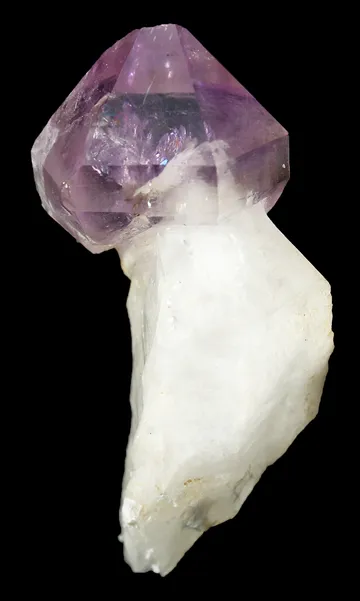
Ashaway, Rhode Island - rare locality for milky quartz capped by gemmy amethyst scepters from a hidden vein; prized for color contrast and growth history.
Key facts
Ashaway’s collector fame rests on one small, deceptively simple occurrence at Diamond Hill, in Ashaway Village, Hopkinton, Washington County, Rhode Island: a hidden quartz-vein system that produced milky quartz crystals capped and overgrown by gemmy amethyst. These are not ordinary New England quartz points. The classic pieces show opaque, porcelain-white milky quartz stems carrying sharply formed purple caps, many of them true scepters, with the amethyst developed as a later generation of quartz on earlier quartz. The best specimens have the theatrical contrast collectors love—cold white quartz against glassy violet amethyst—and the locality’s importance is out of all proportion to its size.
Geologically, the occurrence belongs to the metamorphic terrane of southwestern Rhode Island, in the Ashaway quadrangle near the Connecticut line. The quartz-bearing zone is associated with quartzites of the Plainfield Formation and sits on Diamond Hill, on the western limb of a north-south-trending synclinal structure cut by a major regional fault. The collectible quartz came not from an open quarry face or a commercial mine, but from broken quartz veins hidden beneath glacial till and clay, exposed only where temporary pits were dug. That explains both the locality’s rarity and its mystique: most fine specimens came from a limited number of excavations rather than from a long-lived collecting site.
Regional View
Country View
The Ashaway pieces are especially prized because they preserve a clear growth history in hand specimen. Early quartz grew as colorless to milky crystals, then later silica-bearing fluids returned and deposited amethyst on selected terminations and faces. On the finest plates, multiple milky quartz crystals carry purple caps like a miniature forest of scepters. Single crystals are much more common than matrix groups, and true plates with several intact scepters are among the most recognizable American amethyst specimens of the late twentieth century.

Photo: James St. John / Wikimedia Commons
Historically, Ashaway became famous after the spring 1981 discovery of amethyst scepters on milky quartz. Work by William C. Metropolis, John Rakovan, Sal Avella, David B. Mitcheltree, Laurie D. Benton and others turned what could have remained a local collecting oddity into a well-documented mineralogical occurrence. The result is one of Rhode Island’s signature specimen localities: small, intensely collected, scientifically interesting, and now essentially a classic on the secondary market.
Search for specimens: View all specimens from Ashaway, USA
The mineral locality meant by “Ashaway” in collector usage is Diamond Hill, Ashaway Village, Hopkinton, Washington County, Rhode Island. It is a hill locality rather than a formal mine, with the principal collecting coordinates recorded near 41° 25' 23" N, 71° 47' 9" W. The site lies south of Hopkinton in the southwestern corner of Rhode Island, close to the Connecticut border and within the broader Ashaway quadrangle mapped by the U.S. Geological Survey.
The deposit is best understood as a quartz-vein occurrence in metamorphic country rock, not a pegmatite and not an ore deposit. The collectible material occurred in broken quartz veins, each reported at roughly 36 cm thick, with no known natural surface exposure of the productive veins. The veins were accessible only where small temporary excavations cut through overburden. Diamond Hill itself is formed on the western limb of a north-south-trending syncline, with displacement along a major fault crossing southwestern Rhode Island. The quartz lies stratigraphically above a lithologically variable quartzite unit assigned in the locality literature to the Plainfield Formation, and the productive zone was covered by about 0.6 to 1.6 meters of glacial till.
The host setting is important because it separates Ashaway from the more familiar amethyst-in-vug, amethyst-geode, and pegmatitic quartz localities. Fluid-inclusion and stable-isotope work reported for the Hopkinton quartz indicates an epithermal meteoric origin: silica was precipitated from fluids ultimately derived from rainwater. That conclusion is central to the locality’s scientific interest. The deposit records multiple stages of quartz growth, including early colorless transparent quartz, later finely layered clear and milky quartz, and a final amethyst-bearing stage after a growth hiatus. The amethyst is therefore not simply “purple tips” on white quartz; it is a later overgrowth generation on earlier quartz crystals.
No commercial ore body or mining operator is associated with the famous collector production. The names tied to the specimens are those of the collectors and researchers, especially Sal Avella and John Rakovan, who are repeatedly associated with the classic field photographs and the most important documented specimens. Temporary pits, including a backhoe excavation deep enough for collectors to work at the bottom, exposed in situ quartz specimens in clay. The productive clay and broken-vein material protected some crystals but also meant that groups were fragile and could be separated during digging.
The best-known production estimate from the locality literature is approximately 500 to 600 single scepter crystals and about 35 crystal groups. That ratio still defines the market today. Singles are available with patience; groups on matrix, especially plates with multiple amethyst scepters on milky quartz, are far scarcer. Documented examples include a 35 x 20 cm plate described in the original Rocks & Minerals report, with about 50 milky quartz crystals to 5 cm high and 15 scepter caps, as well as later-described plates in major museum collections. A particularly celebrated triangular plate measured about 12.7 x 25.5 x 30.5 cm and carried more than 100 milky quartz crystals, 21 with amethyst overgrowths and 14 major scepters.
Collecting access today should be regarded as closed unless explicit landowner permission is obtained. The locality is on private ground and is not a public fee-digging site. Older references describe the occurrence as undisclosed private property, and recent market descriptions emphasize that specimens are no longer being found in any normal collecting sense. Modern Ashaway specimens reaching collectors generally come from old collections, dealer inventories, auction dispersals, or institutional deaccession and exchange pathways, not from casual field collecting.
Quartz from Ashaway is dominated by milky quartz crystals, commonly opaque white and porcelain-like, with prismatic forms that served as the substrates for later amethyst overgrowths; the locality’s good quartz specimens are therefore judged less by isolated clarity than by architecture—intact stems, sharp terminations, balanced parallel growths, and the degree to which the milky quartz carries or frames amethyst caps. Documented specimens range from small thumbnails and miniatures to cabinet plates, including individual milky crystals several centimeters long and exceptional plates tens of centimeters across. The most distinctive quartz pieces show epitaxial overgrowths down selected faces, reverse-scepter forms, or multiple milky crystals aligned in roughly parallel habit. Ordinary Ashaway quartz without purple overgrowth is mainly of locality interest; the finest examples are those where the white quartz matrix creates dramatic contrast and preserves the growth sequence that made Diamond Hill famous.
Ashaway amethyst is almost always valued as sceptered or cap-like overgrowth on milky quartz, with glassy violet to blush-purple terminations that may be strongly zoned—commonly richer in rhombohedral sectors and paler to nearly colorless in prism sectors. Individual amethyst caps are typically small, many around thumbnail scale, with reported scepter widths up to about 2.5 cm, yet their sharp form and contrast with the white stems give them much greater presence than their measurements suggest. The best Ashaway amethyst specimens are complete all around, gemmy, lustrous, and undamaged, either as elegant single scepters or, far more rarely, as matrix groups with several purple caps rising from milky quartz. What separates superior pieces from ordinary ones here is not just color saturation but undisturbed habit: a true scepter relationship, crisp faces, visible growth contrast, and a natural white quartz base rather than a detached loose cap.
Other documented minerals from the Diamond Hill locality are few. Mindat’s locality list records hematite and montmorillonite in addition to quartz varieties, with montmorillonite tied to the 1986 Rocks & Minerals description and hematite noted from a collection record. There are no recognized type-locality minerals from Ashaway in the standard locality references. The rarity here is not species diversity but a highly specific quartz paragenesis: colorless to milky quartz followed by amethyst overgrowths in a small, nearly exhausted vein occurrence.
Ashaway specimens are among the easiest Rhode Island minerals to recognize at a glance, yet they are also easy to misdescribe. The most common imprecision is locality wording: labels may read Ashaway, Ashaway Village, Diamond Hill, Hopkinton, or Washington County. These are not separate famous amethyst occurrences in normal collector usage; they refer to the Diamond Hill occurrence at Ashaway Village in Hopkinton. Confusion is possible with Diamond Hill, Cumberland, Rhode Island, which is a different Rhode Island locality, and with the much larger Diamond Hill Quartz Mine in South Carolina, a completely unrelated amethyst locality.
No well-documented locality-specific fake industry is known for Ashaway material, but the habit invites caution. Detached purple amethyst crystals can be glued onto milky quartz stems from the same or another locality to simulate a more valuable scepter. On authentic pieces, the overgrowth relationship should look crystallographically coherent: the amethyst cap should sit naturally on the earlier quartz, with compatible orientation, contact, and growth surfaces rather than a suspicious adhesive seam. Because many genuine specimens are small, gemmy, and complete, a loupe inspection of the junction is worthwhile.
Condition matters intensely. Many specimens were recovered from broken veins and clay, and single scepters are far more common than groups. Look for bruising on the amethyst termination, edge chips on rhombohedral faces, missing or rehealed contacts at the base, and repairs where a cap joins the milky stem. Minor dings are common enough that pristine examples bring a premium. Matrix plates should be checked for restored crystals, especially where several scepters rise from a white quartz base.
Color is usually modest to medium purple rather than the deep saturated hue associated with some Brazilian, Uruguayan, or Jackson’s Crossroads material. That is part of the Ashaway look. A pale but sharply formed, undamaged scepter on its original milky quartz stem can be more desirable than a darker detached crystal. As with all amethyst, long-term display in strong direct sunlight is unwise because violet color in quartz can fade with prolonged exposure.
Market availability is limited. The original production was small, the best pieces entered advanced private and institutional collections early, and matrix groups are rarely offered. Singles and small miniatures appear more often than cabinet pieces, but even these are now classic locality specimens rather than casual New England field finds. Provenance to older collections, Sal Avella, John Rakovan, or well-documented dealer and auction records adds confidence and desirability.
The Ashaway story begins quietly in the spring of 1981, not with a quarry blast or a mine discovery, but with a small hidden occurrence in Ashaway Village. The veins did not crop out. There was no glittering face of crystals visible to the passerby. The quartz lay under glacial till and clay, and the specimens became accessible only when small temporary pits opened a window into the buried vein system. That accident of exposure is why the locality has the feel of a rescued treasure: a small pocket of American amethyst that could easily have gone unnoticed.
By 1983 the find had become a serious collecting and research project. Field photographs from that year show Sal Avella and John Rakovan collecting scepter amethyst in an excavation, the sort of image that has become part of the locality’s lore. These were not casual surface finds. Specimens were removed from clay and broken quartz vein material, sometimes from pits deep enough that collectors were working at the bottom of a backhoe excavation. One documented scene records in situ quartz specimens being removed from an approximately 15-foot-deep hole. For a locality whose finished specimens often fit in the palm of a hand, the scale of effort behind them is easy to underestimate.
The numbers sharpen the drama. The published estimate—500 to 600 single scepters and about 35 groups—means that Ashaway was never abundant in the way great commercial amethyst districts are abundant. Most of what the locality would ever give collectors came out in a brief, intense period of work. Every matrix group represented a fortunate survival from a broken-vein environment where crystals could easily detach or be damaged. The great plates, therefore, are not merely larger examples; they are improbable survivors.
One of the most memorable described specimens is a 35 x 20 cm plate with about 50 milky quartz crystals, 15 of them bearing amethyst scepter caps. Another, a triangular plate roughly 12.7 x 25.5 x 30.5 cm, carried more than 100 milky quartz crystals, with 21 amethyst overgrowths and 14 major scepters. In a small Rhode Island occurrence, that is an astonishing concentration of form: dozens of white quartz stems, each recording early growth, with selected crystals crowned by later violet quartz.
The locality’s later field images add a second chapter. Photographs record collecting in a shallow excavation in 1995 and Sal Avella holding freshly dug scepter amethyst in 1998. Those dates matter because they show that Ashaway’s story did not end the moment the original discovery became known. Yet the classic status of the material rests on the same fact throughout: this was a small occurrence with finite production. By the time Ashaway specimens were appearing in major collections and publications, the supply was already being measured as a historical find rather than an ongoing source.
_3_(32109619163).jpg)