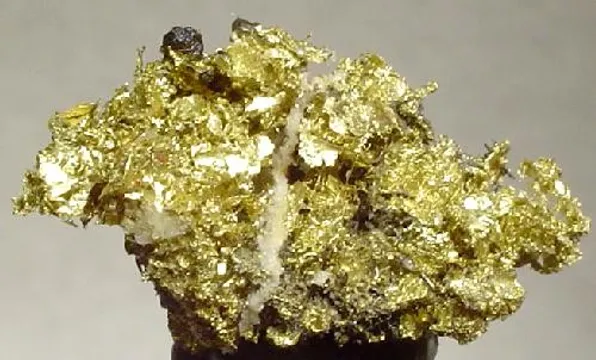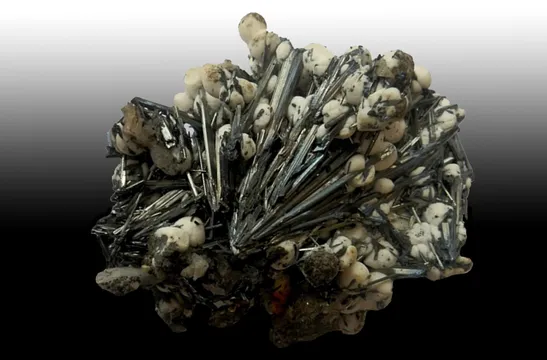
Herja Mine, Romania — Baia Mare district locality famous for stibnite sprays, black calcite, semseyite rosettes, and sulfosalt-rich vugs, a collector's classic.
Key facts
Herja is one of the great old European names in specimen mineralogy: a Baia Mare district polymetallic vein mine whose reputation rests on the improbable elegance of its low-temperature antimony assemblage. The deposit lies in Maramureș, in the Gutâi volcanic region of the Eastern Carpathians, where Neogene hydrothermal fluids cut a dense system of veins through volcanic and sedimentary rocks. To ore geologists Herja is a low-sulfidation epithermal base-metal system rich in Pb-Zn-Ag-Sb mineralization; to collectors it is the Romanian mine that made short, lustrous stibnite sprays, black and black-and-white calcite, semseyite rosettes, fizélyite, “plumosite,” tabular pyrrhotite, and sulfosalt-filled vugs into classics.
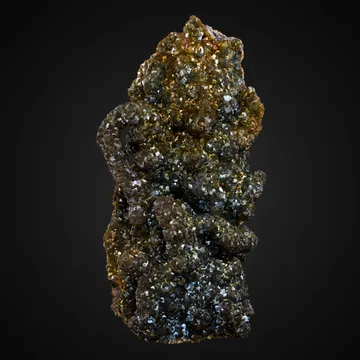
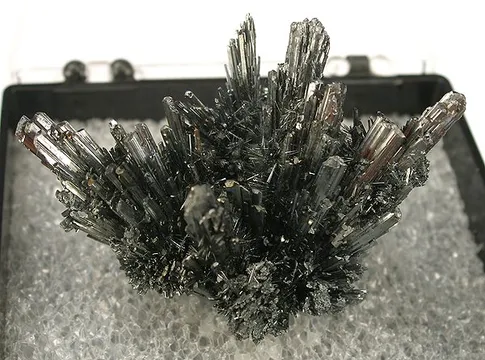
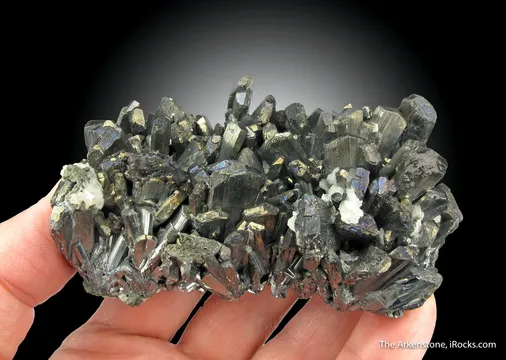
The best Herja specimens have a look that is hard to confuse with any modern production. Stibnite tends to occur not as the sword-length crystals of China but as dense sprays, rounded blooms, jackstraw fans, and compact gunmetal clusters on white to cream calcite, siderite, quartz, or baryte. Calcite may be pearly white, smoky gray, darkened by hairlike sulfosalt inclusions, or arranged as the locality’s famous spheroidal and bicolored aggregates. Sphalerite forms glossy black matrix and small crystals; semseyite makes metallic gray rosettes and tabular wheels; jamesonite and related Pb-Sb sulfosalts appear as silky felt, acicular mats, included fibers, and odd curved or ringlike forms. A fine Herja piece often balances sparkle, age, and strangeness: cream carbonate against black sulfides, bronze pyrrhotite against jet sphalerite, or a sulfosalt spray emerging from stalactitic calcite.
Regional View
Country View
The old-label geography matters. Herja is mineralogically treated as Herja Mine, Baia Mare, Maramureș County, but older European labels may read Chiuzbaia, Kisbánya, or Herzsabánya, reflecting historical access, Hungarian naming, and older political geography. That label complexity is part of the mine’s charm and also part of the collector’s work: Herja material is common enough to be traded, but the best old pieces are increasingly finite, because the mine is closed and the specimen-producing upper levels and vugs are no longer a living source.

Photo: Wikimedia Commons
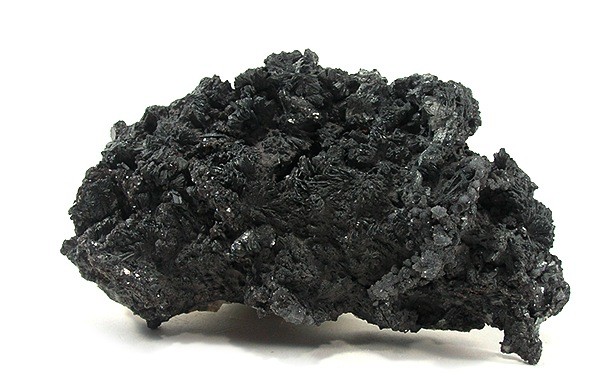
Photo: Wikimedia Commons
Search for specimens: View all specimens from Herja Mine, Romania
Herja is a low-sulfidation epithermal polymetallic vein deposit of the Baia Mare Neogene metallogenetic district. It is linked genetically to Pannonian-age magmatism and to subvolcanic pyroxene andesite, pyroxene-hornblende andesite, and porphyritic quartz microdiorite intrusions that supplied heat, metals, and hydrothermal fluids. The alteration assemblage described for the deposit includes propylitic, argillic, phyllic, and potassic alteration, and the mineralizing fluids evolved from dominantly magmatic water in earlier stages toward connate and meteoric components in the later stages.
Structurally, Herja is a vein system rather than a single simple lode. Published descriptions distinguish northern and southern vein groups arranged largely along ENE-WSW fractures. The southern group includes historically important named or numbered veins such as Șălan, Zincos, Ignațiu, Clementina, Boromei, and Mächtige, while other numbered veins and veinlets occur in altered sedimentary rocks of Pannonian, Sarmatian, and Eocene age. Romanian geological summaries describe the system as a dense network of roughly 260 veins and veinlets, with principal veins and many smaller branches; earlier technical descriptions counted more than 180 veins and noted widths ranging from centimeter-scale branches to veins approaching two meters.
The ore was worked chiefly for Pb-Zn-Ag-Sb mineralization, with minor gold. Its main massive ore minerals are sphalerite and galena, with pyrite, pyrrhotite, marcasite, subordinate chalcopyrite, Ag-bearing tetrahedrite/freibergite-group phases, and a remarkable late antimony-rich sulfosalt suite. The collector-grade vugs are especially important: they produced stibnite, jamesonite, berthierite, boulangerite, zinkenite, semseyite, tetrahedrite/freibergite, calcite, siderite, quartz, baryte, gypsum, and rarer Pb-Ag-Sb species. The classic specimen stage is late and comparatively cool, with stibnite and sulfosalts belonging to the closing part of the hydrothermal sequence.
Antimony was the most important product before 1928, a fact that fits Herja’s mineralogical personality: the mine’s fame is not merely as a galena-sphalerite producer but as one of Europe’s finest antimony-specimen deposits. Mining around Chiuzbaia and Baia Sprie has medieval roots, and the Herja area was worked through successive political and industrial regimes. The modern mine belonged to the Maramureș non-ferrous mining industry and, in the late twentieth century, to the REMIN sphere of operations. The decline began after the Romanian mining contraction of the 1990s, with staged layoffs and closure measures; by the 2006-2007 closure period, the mine had ceased to be a productive source.
Access today should be treated as closed-mine access, not a collecting locality. Underground workings are abandoned, old stopes and adits are unsafe, and post-mining environmental works and mine-water issues have been discussed publicly in Romania. Serious collectors should assume that legally and ethically available Herja specimens come from old collections, museum deaccessions where lawful, dealer stock, and pieces preserved from the mine’s working years—not from casual field collecting.
Several specific specimen-producing contexts recur in the literature and in collection records. The upper levels were especially productive for stibnite- and sulfosalt-bearing cavities. The Șălan, Clementina, and Ignațiu veins are tied to the famous carbonate spheres, including the black-and-white calcite “mineral balls” first recorded in 1958. The Clementina vein is also part of the local historical and speleological record around Chiuzbaia. “Plumosite”-filled pockets produced jamesonite-dominant felted sulfosalt material, sometimes with berthierite, boulangerite, zinkenite, tetrahedrite/freibergite, galena, sphalerite, and arsenopyrite. Older cabinet specimens also preserve pyrrhotite plates, marcasite pseudomorphs after pyrrhotite, calcite-siderite-pyrite combinations, and sulfosalt-rich plates from the early to mid-twentieth century.
Calcite is the visual signature of Herja as much as stibnite is its headline species: it occurs as cream to white rhombs and saddle-like curved crystals, stalactitic or botryoidal growths around stibnite needles, flattened rosettes, gray to black sulfosalt-included aggregates, and the celebrated loose or attached spheres from vugs in veins such as Șălan, Clementina, and Ignațiu. The most distinctive pieces are not ordinary white calcite but Herja-specific forms—black or bicolored calcite colored by acicular jamesonite, boulangerite, or berthierite inclusions, flattened floater rosettes with a sharp white/gray division, and spheroidal clusters that still show individual rhombohedral faces; good specimens are clean, balanced, and undamaged, with the dark inclusions enhancing the form rather than simply muddying the carbonate.
Stibnite from Herja is classic because of its sculptural European habit: short prismatic to acicular metallic crystals in radiating sprays, dense blooms, compact hedgehog clusters, and blades perched on or enclosed by calcite, siderite, quartz, dolomite, or baryte. Herja stibnite is typically dark lead-gray to gunmetal, often with a subdued but rich metallic luster, and the crystals are generally measured in centimeters rather than the spectacular elongated swords of some modern localities; the best pieces show sharp terminations, open three-dimensional arrangement, minimal bruising on the brittle tips, and strong contrast with pale calcite or colorless tabular baryte. Material with stalactitic calcite grown around stibnite cores, or with stibnite arranged as airy fans rather than massive splintery bundles, is especially desirable.
Herja sphalerite is primarily a matrix and ore-stage mineral, but a very important one: it forms lustrous black to dark red-brown crystals and massive bases for sulfosalt, semseyite, pyrrhotite, galena, and calcite specimens. Analytical work distinguished an earlier, Fe-rich deep red variety and a later darker variety associated with the sulfosalt paragenesis, the latter lower in Fe and enriched in Cd relative to the earlier sphalerite. Collectors favor pieces where the sphalerite is glossy, black, and crystalline enough to give depth to the display—particularly under semseyite rosettes, pyrrhotite plates, galena sections, or gray-black calcite—while massive dull ore without contrast is far less desirable.
Quartz is the common gangue mineral of Herja and was deposited through important parts of the hydrothermal sequence, with fluid-inclusion work on the district placing quartz crystallization in the higher-temperature part of the gangue history relative to late calcite and stibnite. Specimen quartz is usually white, colorless, gray, or locally yellowish to citrine-like, and it appears as drusy coatings, prismatic crystals, siliceous matrix, and supports for stibnite, siderite, sphalerite, galena, pyrite, and sulfosalts. The best Herja quartz specimens are those where quartz clarifies the paragenesis rather than dominating it: sharp, bright crystals carrying stibnite or sulfosalt sprays, or yellowish quartz associations with Romanian stibnite that retain credible Herja provenance.
Boulangerite at Herja is part of the Pb-Sb sulfosalt story and is most familiar to collectors as hairlike metallic inclusions in calcite or as acicular to fibrous material in the “plumosite” family of vug fillings, though modern microanalytical work shows that much material historically called plumosite is dominantly jamesonite rather than boulangerite. True boulangerite occurs with jamesonite, berthierite, zinkenite, galena, tetrahedrite/freibergite, arsenopyrite, sphalerite, and calcite, and it can darken calcite to smoky gray or black where fibers are densely disseminated. Good Herja boulangerite specimens are locality-character pieces: sharply zoned black-and-white calcite, silky gray included calcite, or verified sulfosalt associations where the identification is analytically supported or comes from a highly reliable old collection.
Siderite gives many Herja specimens their warm, old-world color: olive, honey-brown, yellow-green, or dark brown rhombs and druses occur with calcite, quartz, pyrite, sphalerite, galena, stibnite, semseyite, jamesonite, and black calcite. The locality is particularly noted for spheroidal siderite forms, small siderite balls on black calcite, and rare loose hollow siderite spheres with euhedral rhombs lining an internal cavity; dark pseudohexagonal siderite prisms have also been documented from Herja. Fine pieces show bright rhombohedral faces, attractive contrast against white calcite or black sulfides, and a shape that is recognizably Herja rather than ordinary carbonate gangue.
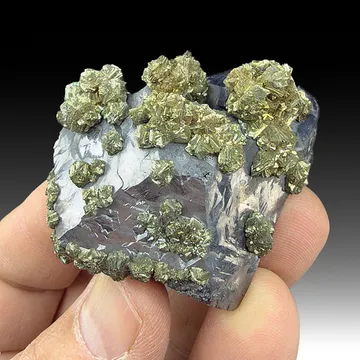
Semseyite from Herja is one of the mine’s great sulfosalt aesthetics, occurring as metallic gray to lightly iridescent tabular blades gathered into rosettes, wheels, fans, and sprays on sphalerite, galena, siderite, calcite, chalcopyrite, and associated Pb-Sb sulfosalts. Good rosettes are commonly centimeter-scale, with high-relief blades and a silvery metallic sheen; exceptional specimens show multiple undamaged wheels rising cleanly from black sphalerite or galena matrix. Ordinary pieces are dark, cramped, or rubbed, while the finest Herja semseyites have sculptural separation, crisp tabular edges, and enough matrix contrast to distinguish them from the many visually similar black sulfosalts in the district.
Jamesonite is central to Herja’s identity because the mine’s famous “plumosite” masses—loose felty mats and acicular sulfosalt aggregates in vugs—were shown to be dominantly jamesonite, commonly with Mn substitution toward the benavidesite component. At hand-specimen scale it appears as silky to metallic gray needles, felted sprays, inclusions in black calcite, curved or ringlike forms, and reaction rims or intergrowths with galena, tetrahedrite/freibergite, sphalerite, arsenopyrite, berthierite, boulangerite, and zinkenite. The best specimens are airy and legible rather than merely sooty: clean acicular masses, dramatic black calcite inclusions, or well-documented jamesonite-bearing calcite and siderite forms from the late vug stage.
Barite from Herja is most collectible as a companion mineral to stibnite, where colorless to pale tabular blades sit among dark metallic stibnite sprays or on carbonate gangue. It belongs to the late low-temperature assemblage with stibnite, calcite, gypsum, fluorite, realgar, orpiment, and cinnabar reported from the district’s closing mineralization stage. Good Herja barite pieces are transparent to translucent, sharply bladed, and undamaged, especially when the barite crystals are large enough to read visually against stibnite but not so dominant that they obscure the antimony spray.
Freibergite at Herja belongs to the Ag-rich tetrahedrite-group/fahlore suite and is important both scientifically and aesthetically because it is one of the silver-bearing phases in the polymetallic ore. Published microprobe work on Herja fahlore found tetrahedrite-group compositions with significant Ag, and collection records note sharp black modified tetrahedrons of silver-dominant freibergite from plumosite-filled pockets. Collector pieces are usually not large freibergite show specimens in the alpine sense; they are rich association specimens with black tetrahedral crystals, fizélyite, jamesonite, semseyite, galena, sphalerite, siderite, and calcite, where reliable identification and provenance matter more than crystal size alone.
Berthierite is one of the visually tricky Herja antimony minerals, occurring as dark metallic to steel-gray acicular, prismatic, fibrous, or bladed material in late sulfosalt-rich cavities with stibnite, jamesonite, boulangerite, zinkenite, arsenopyrite, tetrahedrite/freibergite, galena, sphalerite, quartz, calcite, and baryte. In Herja specimens it may be intergrown with or mistaken for other dark sulfosalts, especially where the material is matted or included in carbonate. Desirable pieces are those with coherent bladed aggregates, good metallic luster, and credible labels or analyses; ordinary “black needles” from Herja should be treated cautiously unless the association and morphology support berthierite.
Pyrrhotite from Herja is a classic old Romanian specialty, occurring as bronze to dark metallic tabular hexagonal plates, parallel-growth aggregates, and earlier ore-stage masses with sphalerite, galena, pyrite, and marcasite. The mine is particularly known for tabular pyrrhotite and for marcasite pseudomorphs after pyrrhotite, sometimes forming jackstraw layers on black sphalerite matrix. Fine specimens show bright bronze iridescence, crisp plate geometry, and stable-looking matrix; damaged or altered pieces can lose both luster and structural integrity, so uncrumbled old examples with strong form are much more collectible than dull pyrrhotite-rich ore.
Pyrite is an early and recurring sulfide at Herja, found in massive ore and as brassy crystalline nests or drusy accompaniments with calcite, siderite, galena, sphalerite, pyrrhotite, quartz, and marcasite. It is rarely the species that sells a Herja specimen by itself, but it can be crucial visually, adding bright metallic contrast beneath cream calcite or olive-brown siderite. The most attractive pieces show clean, fresh brassy pyrite as part of a balanced Herja association, while dull granular pyrite or pyrite in unstable sulfide matrix is much less desirable.
Galena is one of Herja’s principal ore minerals and appears both as massive lead-gray ore and as crystalline matrix for semseyite, chalcopyrite, sphalerite, pyrite, quartz, calcite, and late sulfosalts. Analytical work found Herja galena to be chemically fairly consistent across textural types, with trace Ag, Bi, Sb, and occasional Se, fitting the mine’s Pb-Zn-Ag-Sb character. Collector-grade galena from Herja is valued most when it is lustrous and well articulated or when it carries a better display mineral—semseyite wheels, siderite, calcite, quartz, or sulfosalt needles—rather than as heavy, massive ore without crystal form.
Baryte is the same mineral species commonly spelled barite in American usage, but Herja collectors often encounter the European spelling on old and dealer labels, especially for colorless tabular crystals associated with stibnite. The classic Herja habit is transparent to translucent bladed baryte perched on short, dark, metallic stibnite sprays, sometimes with calcite or dolomite gangue; crystals of a few centimeters are sufficient to make a highly aesthetic small cabinet piece when the stibnite and baryte are both sharp. The best examples have glassy blades, open spacing, and minimal chipping, because both the thin baryte plates and the stibnite tips are vulnerable.
Cronstedtite is a prized Herja rarity and one of the species for which the mine has supplied unusually fine specimens: black to dark green-black trigonal crystals, commonly with siderite, pyrite, quartz, and sulfide matrix. Herja cronstedtite has been important enough for crystal-structure work, including studies of triangular tabular crystals and polytype behavior. Good specimens are rare because many larger examples suffered from disintegration of the sulfide matrix, even though the cronstedtite itself appears comparatively stable; collectors should look for sharp, lustrous black crystals on intact matrix and should avoid pieces with active crumbling, powdering, or sulfide decay.
Beyond the species highlighted above, Herja is documented for a wide suite of ore, gangue, and sulfosalt minerals, including arsenopyrite, chalcopyrite, dolomite, fluorite, gypsum, marcasite, manganite, miargyrite, molybdenite, native gold/electrum, plagionite, pyrargyrite, realgar, rhodochrosite, stibiconite, valentinite, vivianite, zinkenite, and several reported or problematic rare sulfosalts. Its most important type-locality species is fizélyite, Ag5Pb14Sb21S48, named for Sándor Fizély; Herja specimens of fizélyite occur as black metallic curved blades, ropey intergrowths, or prismatic crystals with galena, sphalerite, freibergite, jamesonite, and semseyite, and they are among the most desirable systematic pieces from the mine. Parajamesonite is historically tied to Herja but remains a cautionary name: original descriptions and later reexaminations made it one of the classic “jamesonite problem” stories, and much material once labeled parajamesonite proved to be ordinary jamesonite.
Herja rewards connoisseurship. The locality is common enough that inexpensive stibnite, calcite, baryte, sphalerite, and sulfosalt pieces circulate, but truly excellent old cabinet specimens are no longer being replenished. Top pieces combine locality-specific habit, credible old labels, and intact condition: stibnite sprays on pale carbonate, black calcite with clear sulfosalt zoning, semseyite rosettes on black sphalerite or galena, fizélyite from old stock, tabular pyrrhotite, and cronstedtite on stable matrix.
The most important authenticity warning concerns black and gray calcite spheres. Published work on Herja calcite spheres documented fake centimeter-scale black or gray “calcite” balls shown at Romanian mineral fairs: X-ray data revealed synthetic aluminum oxide, with subordinate spinel balls, coated with jamesonite debris and needles glued to the surface. Genuine Herja calcite spheres should show convincing carbonate crystal growth, plausible inclusion texture, natural association, and ideally old provenance; a suspiciously smooth ball with glued metallic fuzz deserves skepticism.
Mislabelling is common but not always fraudulent. Herja specimens may be labelled Chiuzbaia, Kisbánya, Herzsabánya, Baia Mare, Baia Sprie, or Maramureș. Chiuzbaia/Kisbánya labels are normal for old Herja pieces, but Baia Sprie and Băiuț are separate mining areas that also produced stibnite and related minerals. Long, elegant stibnite prisms or radically different habits may be misassigned among Romanian localities; morphology, associations, and label history should all be weighed.
“Plumosite” is another trap. On old labels the term may refer descriptively to featherlike or felted Pb-Sb sulfosalt masses, not to a single mineral species. Modern work on Herja showed much plumosite to be jamesonite, while berthierite, boulangerite, and zinkenite may also occur in the broader assemblage. As a market rule, do not pay a premium for boulangerite, berthierite, jamesonite, or fizélyite names on visually ambiguous black fibers unless the specimen has reliable analytical backing, museum-level provenance, or a label chain from a specialist source.
Condition is often the deciding factor. Stibnite is soft and brittle; Herja sprays commonly show tip bruising, rubs, or broken blades. Baryte plates chip easily. Calcite cleaves and may be bruised on high points. Sulfosalt needles mat, shed, and catch dust. Pyrrhotite and marcasite-bearing matrices can oxidize or crumble, and Herja cronstedtite specimens are especially notorious for the matrix falling apart even when the cronstedtite crystals remain stable. Store sulfide-rich pieces dry, avoid rapid humidity cycling, keep pyrrhotite/marcasite away from damp environments, and isolate any specimen that begins producing sulfate bloom, acidic odor, or loose powder.
Fluorescence is not a major reason to buy Herja specimens, though some calcite-inclusion pieces have been noted with minor fluorescence under longwave and shortwave UV. Handling is more important than display lighting: stibnite and sulfosalt specimens should be lifted by the matrix, not by crystal sprays, and friable plumosite or cronstedtite pieces should be kept in boxes or on mounts that prevent abrasion.
The most famous Herja story begins in 1958, when miners encountered strange carbonate balls lying in the lower parts of geodes in several veins, including Șălan, Clementina, and Ignațiu. The mine people had a plain, memorable name for them: the “mineral balls from Herja.” At first they were treated as curiosities rather than as scientific treasures. Some were white, some black, and some split into dramatic black-and-white zones, the dark parts colored by clouds of acicular sulfosalts suspended and trapped during calcite growth. The best of them were unlike ordinary calcite specimens: they were little mineral planets, built of rhombohedral faces and internal zoning, some loose in cavities, some hollow or rattling with inclusions inside.
One of those Herja spheres became a Romanian national patrimony specimen at the County Museum of Mineralogy “Victor Gorduza” in Baia Mare. It was a bicolored calcite sphere, unevenly divided between white and black calcite, a single object that condensed the oddity of the mine into a handful-sized form. During the night of January 25-26, 2014, it was stolen from the museum’s secure place. The scientific paper that later discussed Herja’s bicolor calcite spheres recorded the theft bluntly: the specimen was still missing. For collectors, the story is a reminder that a mineral specimen can move from mine curiosity to national patrimony—and then to absence.
Another Herja story sits almost at knee height. Near Chiuzbaia, speleological and heritage work documented the so-called Dwarf Mine, a small old working associated with the Clementina vein area. Its square profile was only about 0.9 to 1.3 meters high and roughly 0.50 meter wide, a tunnel that forces the modern visitor to imagine mining as crouched labor rather than grand industrial descent. The team examining the area in March 2009 included D. Iștvan, T. Minghiraș, I. Bereș, A. Mureșan, R. C. Mureșan, O. Chinta, and I. Pop; the mapping was carried out by T. Minghiraș and I. Bereș. The investigators could not document the exact beginning of exploitation there, but on the evidence available they considered a seventeenth-century start plausible. The little gallery preserves, in miniature, the long continuity between early mining at Chiuzbaia and the later specimen fame of Herja.
The mine’s ending was much less romantic. The major decline began in 1997, when a Romanian government ordinance signaled that mining at Herja and elsewhere in Maramureș would be reduced gradually toward closure. Workers were dismissed in stages, depending on retirement age and individual choices, with compensatory payments, unemployment support, and retraining offered as the social machinery of shutdown. Former workers protested in front of the Prefecture and unions tried to stop the process, but the closure went forward. By January 2007 fewer than 150 employees remained. The last farewell was a miner’s formula—“Noroc bun!”—and then the lock went on. Some miners went to the Jiu Valley, some left for Hungary, and Florin Pop, remembered as one of the mine’s best engineers, went as far as Chile.
There is also a quieter specimen-market story in Herja’s labels. A specimen may pass through a European collection as Kisbánya, appear in a dealer tray as Chiuzbaia, be entered in a database as Herja Mine, Baia Mare, and be verbally remembered by a miner as coming from a particular vein number. The mineral did not move; the map around it did. Herja collecting is full of these small translations—Hungarian, Romanian, Germanized, museum, mine, dealer—and the best labels are often those that preserve the ambiguity rather than erase it.