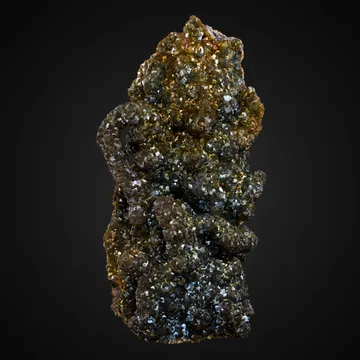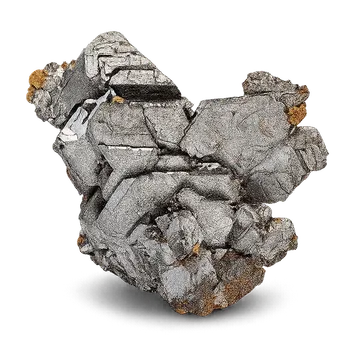
Galena from Herja Mine, Romania — metallic cuboctahedra with famed paragenesis (calcite, sphalerite, siderite) and rich sulfosalts, prized by collectors.
Key facts
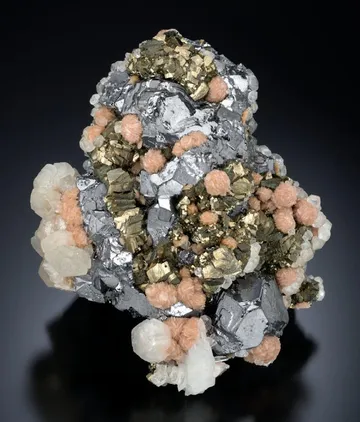
Galena from the Herja Mine is not the blunt, anonymous lead ore one often sees from base-metal veins. The best Herja pieces have a distinct Romanian character: bright metallic-gray cuboctahedrons and modified octahedra, commonly described by collectors as having a slightly “melted” or rounded look, set into lively matrices of quartz, calcite, siderite, sphalerite, chalcopyrite, pyrite, pyrrhotite, and lead-antimony sulfosalts. The crystals can be sharp and architectural, but the locality’s special appeal is often the whole paragenesis—the way silver-gray galena contrasts with ivory calcite rosettes, honey-brown siderite, brassy chalcopyrite, black sphalerite, and steel-gray semseyite or jamesonite.

Photo: Mineral Auctions
Herja belongs to the Baia Mare Neogene ore district of the Gutâi Mountains in northwestern Romania, a classic Eastern Carpathian hydrothermal province. The deposit is a Pb-Zn-Ag-Sb system with subordinate Au, developed as a large conjugate vein network. Earlier literature treated Herja as a Pb-Zn “mesothermal” deposit in the old Lindgren sense; more recent work places it in a low-sulfidation epithermal setting related to Neogene post-collisional volcanism and structurally guided hydrothermal flow.
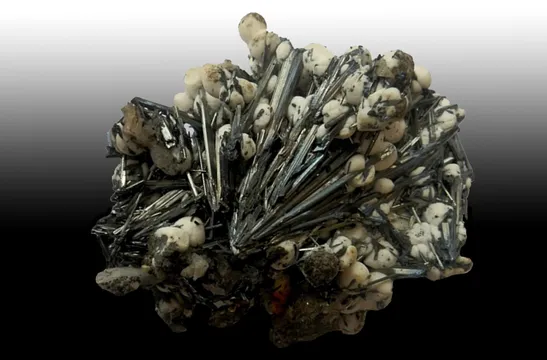
For galena collectors, Herja is important for three overlapping reasons. First, it produced massive galena ore of real economic significance, especially in named vein systems such as Șălan. Second, it produced attractive crystallized galena combinations, not just ore chunks. Third, galena sits in one of Europe’s richer sulfosalt environments: Herja is celebrated for stibnite, semseyite, fizélyite, jamesonite, boulangerite, berthierite, and other Pb-Sb-Ag minerals, so a good galena specimen may also be a compact record of a complex ore-forming system.

Photo: Mineral Auctions
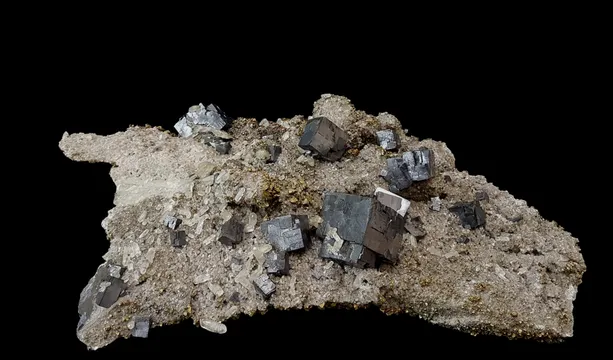
The finest Herja galenas are cabinet and small-cabinet combinations: lustrous cuboctahedral galena crystals on black sphalerite, on sparkling quartz, with tan siderite rhombs or rosettes, or partly veiled by flattened calcite. Less common but especially desirable are pieces where galena crystals are large enough to dominate the specimen yet still carry the unmistakable Herja accessories. Auction examples document sharp galena cuboctahedrons to 4.5 cm on a 14.8 cm cabinet specimen, and classic plates where calcite rosettes sweep across a matrix of splendent metallic galena.
Search for specimens: View all galena specimens from Herja Mine, Romania
The Herja Mine is in the Baia Mare area of Maramureș County, Romania, in the Eastern Carpathians. Mindat places the locality at 47° 41' 41" N, 23° 38' 39" E, with nearby settlements including Chiuzbaia, Tăuții de Sus, Baia Sprie, Firiza, and Baia Mare. The locality has a persistent labeling wrinkle: geographically the mine belongs to Baia Mare, but older specimen labels often give Chiuzbaia, or the Hungarian Kisbánya, and Herja itself may appear as Herzsa on older European labels.
Geologically, Herja is a polymetallic vein deposit producing Pb, Zn, Ag, Sb, S, and minor Au. Published work describes more than 250 vein structures, of which 67 were regarded as principal veins; some were mined for nearly 1000 m along strike and more than 500 m down dip. The general vein trend is ENE-WSW, and the ore system is tied to Neogene post-collisional volcanism, hydrothermal alteration, and structural preparation that allowed mineralizing fluids to move through open spaces.
The deposit’s metal suite explains the collector suite. Galena, sphalerite, and pyrite are joined by quartz, calcite, siderite, chalcopyrite, pyrrhotite, marcasite, stibnite, jamesonite, boulangerite, semseyite, fizélyite, plagionite, fülöppite, and other sulfosalts. Herja was especially noted in the literature for massive galena ore in the Șălan vein, sphalerite-rich ore in the Zincos vein, and very high silver grades—reported up to 4 kg/t Ag—in the upper parts of many veins. Gold was present but scarce compared with the base-metal and silver-antimony character of the system.
Mining in the broader Baia Mare district is centuries old, but the specimen-producing Herja familiar to modern collectors belongs above all to the 20th-century industrial period. The mine’s high-quality crystallized stibnite, semseyite, galena, sphalerite, siderite, and calcite entered European collections through mine production and local collecting networks. Published accounts note that the mine has been closed since 2006, and Romanian mining sources describe the suspension of nonferrous and precious-metal extraction and processing in the Baia Mare region at the end of 2006.
Collecting access should be treated as closed industrial mine access, not as an open field locality. The underground workings are historic, inactive, and potentially dangerous; old adits, stopes, water, unstable ground, and mine drainage are not collector hazards to take casually. Most specimens now come from old mine production, old Romanian or European collections, museum material, and dealer circulation rather than from legitimate fresh collecting.
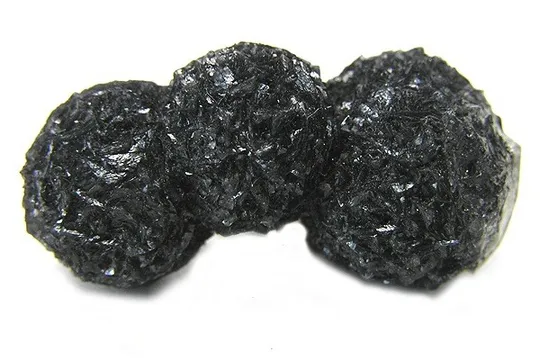
Notable finds at Herja go beyond galena alone. The mine produced some of the world’s finest stibnite specimens and famous semseyite rosettes, as well as peculiar carbonate spheres—white, black, and bicolor calcite, plus hollow or loose siderite spheres—formed in jamesonite-rich geodes. Those carbonate oddities are not galena specimens in the narrow sense, but they matter to galena collectors because they come from the same late open-space hydrothermal environment that also produced the locality’s complex galena-sulfosalt-carbonate combinations.
Herja galena is typically gray to bright metallic lead-gray, with no fluorescence. The most distinctive crystallized habit is a modified cuboctahedral to octahedral form; Mindat specifically records “melted” octahedra with cube modifications to 2 cm. Dealer-documented specimens show broader size variation: small-cabinet combinations may carry galena cuboctahedrons to 1.7 cm, while larger cabinet pieces have been described with dominant galena cuboctahedrons to 4.5 cm. Massive galena is also common, and in many specimens the crystalline faces emerge from, or sit on, a massive galena-rich base.
The crystal surfaces are one of the keys to recognizing attractive Herja material. Fine crystals can be lustrous, silvery, and crisp, but many have slightly rounded, stepped, skeletal, or “melted” surfaces rather than the razor-flat cubic style of some Mississippi Valley-type galenas. This surface character is attractive when it reads as natural growth texture; it is less attractive when the crystal is dull, bruised, or heavily cleaved.
Associations are central to quality. Siderite is one of the most characteristic accessories, appearing as tan to brown rhombs, rosettes, disks, spheres, or coatings. Quartz may occur as clear to white points or larger crystals, sometimes partly coated by siderite. Calcite can be white to ivory, flattened, curved, rosette-like, or lenticular; on some Herja combinations it contrasts dramatically with the metallic galena. Black sphalerite forms granular or crystallized matrix, and chalcopyrite adds brassy sphenoids or small metallic crystals. Pyrite, pyrrhotite, marcasite, semseyite, jamesonite, boulangerite, berthierite, and stibnite are important collectors’ companions and can raise a specimen’s locality interest substantially.
The best Herja galena specimens combine several virtues at once: large enough galena crystals to be visually dominant; bright metallic luster; complete or nearly complete modified octahedral/cuboctahedral forms; a matrix that is mineralogically rich but not visually chaotic; and strong color contrast from calcite, siderite, quartz, sphalerite, or chalcopyrite. A specimen with ordinary massive galena and sparse carbonate is far less desirable than a balanced Herja combination with sharp galena crystals and classic accessories.
Size categories vary widely. Miniatures and small-cabinet pieces often show the best balance of crystal definition and matrix composition. Cabinet pieces are known and can be spectacular, but condition becomes more difficult: galena is dense, cleaves easily, and large plates are more likely to show bruised edges, contacted crystals, or old trimming damage. Large, rich, well-composed Herja galena combinations are therefore much scarcer than the locality’s general abundance of galena might suggest.
The most common authenticity issue is not fake galena, but imprecise or inherited labeling. Herja specimens may be labeled Herja, Chiuzbaia, Kisbánya, Herzsa, Baia Mare, or Maramureș, and older labels may use Hungarian or Germanized forms. “Chiuzbaia” on an old label is not automatically wrong; it is a common historical specimen-label convention for Herja material. Conversely, “Romania” or “Baia Mare” alone is too broad for a serious galena locality label, since the district includes several important mines and deposits with overlapping species.
There are no widely documented, locality-specific fake galena crystals from Herja comparable to the well-known fake black and gray calcite spheres reported from Romanian mineral shows. However, the documented carbonate-sphere fakery is still relevant to collectors because it shows that Herja’s famous paragenesis has been copied: synthetic aluminum oxide or spinel balls were reportedly covered with jamesonite debris and needles to imitate Herja black or bicolor calcite spheres. Any Herja piece marketed as a rare loose black/white calcite sphere, especially if it is too perfect, should be approached with analytical caution. Galena combinations are less likely to be outright fabricated, but glued-on accessory crystals, repaired galena faces, or relabeled Baia Mare district material should be considered possible in the general market.
Condition is a major value factor. Galena has perfect cubic cleavage and a high density, so crystals bruise, cleave, and edge-chip easily. On Herja specimens, look for flattened bright spots, sharp fresh cleavage breaks inconsistent with the natural surface, crushed edges on protruding cuboctahedrons, and detached or missing carbonate accessories. Calcite rosettes, quartz points, and siderite sprays can be more delicate than the galena itself; a good Herja combination should be evaluated as a whole specimen, not only by the galena crystals.
Some Herja galena specimens are massive ore pieces with only minor crystal faces. These can be scientifically legitimate but are not in the same collector tier as crystallized combinations. Massive galena with semseyite, jamesonite, or unusual siderite may still be desirable to sulfosalt collectors, especially if the accessory species is well crystallized and identified, but the value proposition is different.
Market availability is best described as intermittent old-stock availability. The mine is closed, yet Herja material still appears through European collections, estate dispersals, and auction archives. Recent auction records show cabinet-sized galena combinations with quartz, chalcopyrite, siderite, and semseyite still circulating, including a 14.8 cm ex Kurt Hefendehl specimen that sold in 2024 for $262. Older auction listings document high-quality cabinet galena-calcite-siderite pieces and small-cabinet galena-siderite-sphalerite-quartz combinations from named collections. Fine specimens are not unattainable, but the best ones—large, bright, undamaged galena with classic Herja matrix—are much less common than ordinary Herja sulfide pieces.
The most memorable Herja stories are not about galena crystals being lifted from a pocket one by one, but about the strange open spaces of the ore veins—the kind of cavities that also produced the galena-carbonate-sulfosalt combinations collectors prize.
In 1958, miners encountered something so odd that it entered Herja lore under a simple underground name: “the mineral balls from Herja.” They were white, black, and black-and-white calcite spheres lying in the lower parts of geodes in veins such as Șălan, Clementina, and Ignațiu. Alexandru Dunca, a standardizer working at the mine, later remembered geodes where balls of different sizes could be seen: some black, some black and white, not always divided evenly. The miners were surprised enough that, in his words, they “used to play with them.” For a mine known to engineers for lead, zinc, silver, and antimony, these loose hydrothermal spheres must have looked almost unserious—marbles in a sulfide vein.
Victor Gorduza, the founder of the Mineralogical Collection in Baia Mare and later head of the County Museum of Mineralogy, gave the more geological memory. The balls were not lying clean in museum-ready form. They sat in a mass of plumosite filling the geodes and had to be cleaned out. The black part of the bicolor balls was always below. That observation became crucial to later genetic interpretation: the black color was not paint-like zoning at random, but the result of needle-like sulfosalts—especially jamesonite—settling into the lower part of hydrothermal fluid in open cavities. White calcite grew where the fluid was cleaner; black calcite grew where the fluid was loaded with suspended metallic needles.
One of the finest of these bicolor calcite spheres, about half black and half white, became a Romanian national patrimony mineral specimen in the County Museum of Mineralogy “Victor Gorduza” in Baia Mare. During the night of January 25–26, 2014, it was stolen from its secure place. The published account states that it was still missing when the 2019 study appeared. For collectors, that missing sphere is a sharp reminder that Herja’s greatest objects are not merely attractive minerals; some are cultural artifacts of Romanian mining history.
The afterlife of the “mineral balls” also produced a cautionary tale. Until 2005, Herja bicolor carbonate spheres were still seen at mineral shows in Romania, but then they disappeared from the public market. Later X-ray diffraction work showed that fake centimeter-sized black or gray spheres were being exhibited: synthetic aluminum oxide, with subordinate spinel balls, covered by jamesonite debris and needles glued onto the surface. The irony is painful and very Herja-specific—the same feathery jamesonite that made the real black calcite possible became the camouflage used on imitations.
The mine itself has now become a fading archive. The 2019 carbonate-sphere study emphasized that Herja had been closed since 2006 and that former staff were rapidly disappearing without leaving written records. Much of what we know about the most unusual finds comes from oral testimony by geologists, miners, and museum people who saw the material underground or handled it shortly after extraction. In that sense, every old Herja galena combination with calcite, siderite, jamesonite, semseyite, or sphalerite is part specimen and part witness: a fragment of a mine whose best stories were often carried in miners’ memories before they ever reached the literature.