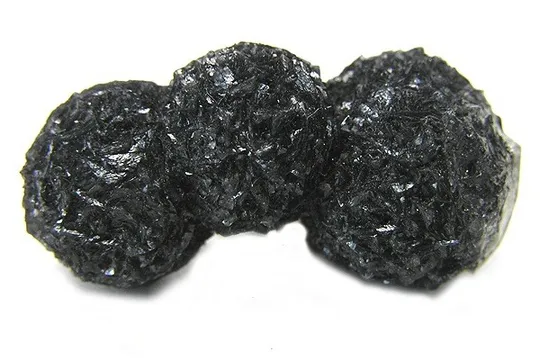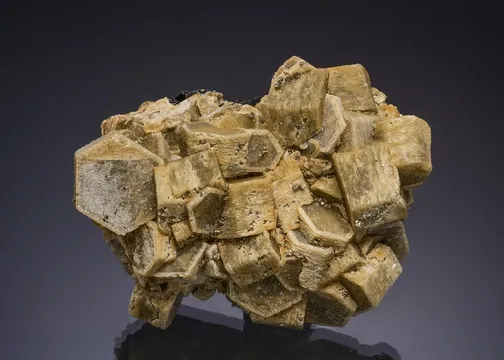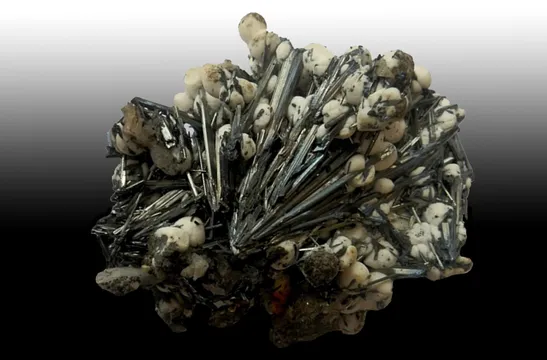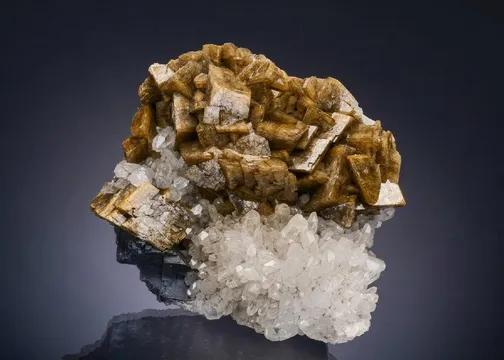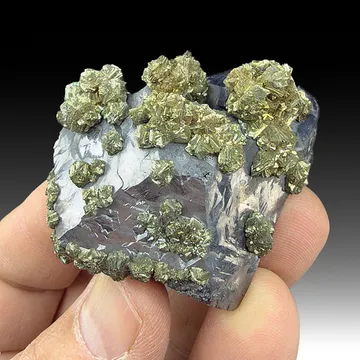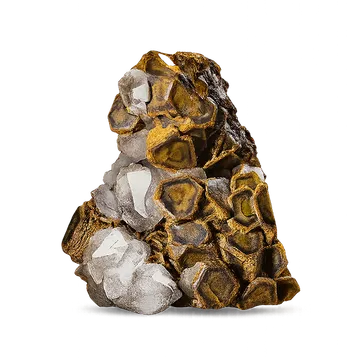
Herja Mine, Romania — renowned for siderite in late carbonate growth, sulfosalt-rich vugs, and striking black calcite spheres, a top locality for collectors.
Key facts
Herja is one of those European vein localities where siderite is not merely a brown carbonate accessory, but part of the identity of the mine. The best Herja pieces have a distinctly old-world look: olive to honey-brown siderite rhombs and druses set against white or gray calcite, quartz, black sphalerite, galena, pyrite, stibnite, and the famous lead-antimony sulfosalt assemblage of the Baia Mare district. In cabinet specimens, the siderite often acts as the warm mineralogical bridge between bright carbonates and dark metallic minerals; in the more unusual pieces it forms balls, spheroidal aggregates, egg-like masses, hollow spheres, and pseudomorphic-looking forms that are immediately recognizable as Herja material.

Photo: Wikimedia Commons / Rob Lavinsky, iRocks.com
Geologically, Herja belongs to the Neogene Baia Mare metallogenetic district of the Gutâi Mountains in northwestern Romania. The deposit is a Pb-Zn-Ag-Sb vein system with minor Au, developed in relation to Pannonian subvolcanic intrusions and the broader post-collisional volcanic activity of the Eastern Carpathians. Earlier literature often treated Herja as a mesothermal Pb-Zn deposit, but later studies placed it among low-sulfidation epithermal systems. For collectors, that genetic shift matters less than the texture it produced: open cavities, late carbonate growth, and extraordinary sulfosalt-bearing vugs where siderite, calcite, jamesonite, berthierite, boulangerite, semseyite, stibnite, galena, sphalerite, quartz, pyrite, pyrrhotite, and marcasite can occur in close association.
What makes Herja siderite especially distinctive is its relationship to the mine’s carbonate spheres and “plumosite” assemblage. Herja is famous for black and black-and-white calcite spheres colored by dense inclusions of needle-like jamesonite and related sulfosalts. Siderite occurs with these spheres as late coatings, minute rhombohedra, fissure fillings, attached small spheres, and in rare loose hollow siderite forms. A documented hollow siderite sphere from the Babeș-Bolyai University Mineralogy Museum is 3.1 cm in diameter, with walls 3–6 mm thick and a roughly 2 cm inner void lined by euhedral siderite rhombohedra 1–2.5 mm long. Another studied Herja siderite morphology consists of loose pseudohexagonal prisms up to 10 mm, black to dark brown, with rugged surfaces and microscopic mosaic-like structures; X-ray diffraction confirmed them as siderite.
Historically, Herja is a classic Maramureș mine. It was known under Hungarian names such as Kisbánya and Herzsabánya, and old labels may give Chiuzbaia or Kisbánya even though the mine is geographically assigned to Baia Mare. The mine produced antimony, lead, zinc, silver, sulfur, and minor gold-bearing ores, and it supplied collectors with some of the world’s most admired stibnite and sulfosalt specimens. Siderite from Herja rides on that same pedigree: not usually the flashiest species in the case, but often the mineral that gives a Herja specimen its locality character.
Collectors look for three broad styles. The first is aesthetic siderite in association: lustrous brown or olive rhombs on quartz, calcite, sphalerite, galena, pyrite, semseyite, or sulfosalt sprays. The second is spheroidal or “sphärosiderite” material—balls, egg-like masses, and rounded aggregates that are far more locality-specific than ordinary rhombic siderite. The third is rarity material from the jamesonite-rich paragenesis: pseudohexagonal dark crystals, hollow spheres, and siderite deposited late over black calcite or jamesonite-bearing carbonates.
Search for specimens: View all siderite specimens from Herja Mine, Romania
Herja Mine lies in Maramureș County, northwestern Romania, in the Baia Mare area of the Gutâi Mountains. Mindat gives the locality as Herja Mine, Baia Mare, Maramureș County, Romania, with coordinates near 47° 41' 41'' N, 23° 38' 39'' E. The locality is also encountered on older mineral labels as Herja, Herzsa, Kisbánya, Chiuzbaia, or Kisbánya near Baia Mare. That labeling history is important: many older Herja specimens are not wrong in a historical sense, but “Chiuzbaia” on a dealer label can obscure the modern administrative locality.
The deposit is a complex hydrothermal vein system. Published work describes two principal vein groups developed along ENE-WSW fractures. The southern group includes veins such as Șălan, Zincos, Ignațiu, Clementina, Boromei, and Mächtige, enclosed by porphyritic quartz microdiorite. The northern group is hosted by altered sedimentary rocks of Pannonian, Sarmatian, and Eocene age. Cook and Damian reported more than 180 veins known at the time, while later work described more than 250 vein structures at the deposit scale and 67 “principal” veins, some mined for nearly 1000 m along strike and more than 500 m down dip.
Herja’s ores are polymetallic. Zinc, lead, silver, antimony, sulfur, and minor gold were produced, with massive galena ore in the Șălan vein, sphalerite-rich ore in the Zincos vein, and high-grade silver ore reported in the upper parts of many veins. One published account gives silver values up to 4 kg/t Ag in the upper portions of almost all veins, with the Clementina vein noted for high silver grades from surface levels around 600 m above sea level down to the +425 mining level. Gold was scarce by comparison, with reported spotty grades up to 5 g/t in the upper part of the Șălan vein.
The mineral sequence is the reason Herja is so loved by collectors. Earlier stages deposited pyrite, pyrrhotite, sphalerite, and galena, followed by lower-temperature stibnite and Pb-Sb sulfosalts. Later cavity assemblages included quartz, calcite, siderite, and abundant fibrous sulfosalts. Cook and Damian emphasized that the stibnite and sulfosalt-bearing vugs were especially abundant in the upper levels, many of which were already largely mined out by the late twentieth century.
The mine has medieval roots and was worked for centuries. Antimony was the most important mining product before 1928, but the twentieth century made Herja famous among mineral collectors for stibnite, black sphalerite, sulfosalts, carbonate spheres, and unusual siderite. The mine is closed; a 2019 mineralogical study notes that Herja had been closed since 2006, which makes modern collecting dependent on old mine production, former miners’ material, museum holdings, and the secondary market rather than fresh underground access.
Notable finds include the carbonate spheres first discovered in 1958 in geodes from veins such as Șălan, Clementina, and Ignațiu. These “mineral balls from Herja,” as miners called them, were black, white, or black-and-white calcite spheres, commonly tied to jamesonite-rich environments and sometimes overgrown or veined by late siderite. Herja also produced loose siderite spheres, hollow siderite shells, and unusual pseudohexagonal dark siderite crystals in jamesonite felted masses—forms that make this locality much more than a routine siderite occurrence.
Herja siderite is FeCO3, but visually it spans a surprisingly wide field. Mindat summarizes the locality habit as pseudohexagonal crystals, balls, and rhombs, and that compact description is unusually accurate. Standard Herja specimens show siderite as small to medium rhombohedra, drusy coatings, rosettes, granular masses, and late crusts. More distinctive pieces show spheroidal “sphärosiderite,” loose egg-like aggregates, hollow spheres, and pseudohexagonal dark crystals.
Color is one of the better locality clues. Herja siderite may be tan, honey-brown, olive-brown, yellow-green, grayish, dark brown, or nearly black in the unusual jamesonite-associated pseudohexagonal crystals. In association pieces, small olive or golden-brown rhombs can sit on white to gray calcite, quartz, galena, sphalerite, or sulfosalt sprays. Some specimens show the siderite as an earthy or granular coating, while the best pieces have sharper rhombs with enough luster and relief to read clearly against the matrix.
The most scientifically distinctive Herja siderite forms are tied to late carbonate growth in open spaces. In one studied specimen, black calcite attached spheres up to 2.5 cm in diameter are covered by an approximately 1 mm continuous siderite layer, with additional millimeter to submillimeter euhedral flattened rhombohedra and siderite fillings in fissures cutting the black calcite. In another specimen, an incomplete hollow siderite sphere 3.1 cm across has a 2 cm internal void and a wall 3–6 mm thick, with 1–2.5 mm siderite rhombohedra lining the interior. These are not generic siderite habits; they are part of Herja’s strange late-stage carbonate-sulfosalt story.
A second standout morphology occurs in loose jamesonite felted masses. Ghiurcă and Pop described black to dark brown pseudohexagonal prisms up to 10 mm across, with rugged surfaces and microscopic mosaic-like structures, confirmed as siderite by powder X-ray diffraction. They presented this morphology as a novelty for Herja and possibly for Romania and the wider Carpathian region. For a collector, that means dark, loose, pseudohexagonal “siderite” from Herja should not be dismissed as an automatic misidentification—but it should be treated as a specialist habit requiring good provenance and, ideally, analytical support.
Associations are a major part of the appeal. The most frequent visual companions include calcite, sphalerite, quartz, galena, pyrite, pyrrhotite, stibnite, marcasite, semseyite, dolomite, chalcopyrite, jamesonite, boulangerite, berthierite, plumosite, gypsum or selenite, covellite, fizélyite, zinkenite, fluorite, baryte, and rhodochrosite. In display specimens, the strongest combinations usually pair siderite with one of three visual contrasts: white or gray calcite, black sphalerite or galena, or hair-like jamesonite/boulangerite/berthierite.
Size ranges vary by habit. Small rhombohedra are commonly millimetric, especially where siderite forms late coatings on calcite spheres or in fissures. The documented hollow siderite sphere is 3.1 cm across; loose calcite and carbonate spheres from the district generally range from under 1 cm to 7 cm, with many in the 1.5–5 cm range, and Herja siderite spheres and coatings belong to that same collector-scale world. Dealer and auction specimens show Herja siderite associations from thumbnails and miniatures to substantial cabinet pieces; large sculptural examples are much less common and carry a premium when undamaged.
Quality is judged differently for different styles. For ordinary rhombic siderite, seek sharpness, luster, warm color, and contrast with quartz, calcite, galena, sphalerite, pyrite, semseyite, or sulfosalts. For spheroidal material, look for intact rounded form, visible crystal texture, lack of bruising, and clear locality documentation. For hollow or pseudohexagonal forms, rarity and provenance matter as much as beauty. The most desirable Herja siderites have both: a recognizable Herja association and an unmistakably unusual siderite habit.
Herja is closed, so virtually all worthwhile siderite specimens are old-production, ex-collection, former dealer stock, or pieces that entered commerce during the mine’s late active decades. Modern market availability is uneven: small calcite-siderite-quartz combinations and mixed sulfide-carbonate pieces appear periodically at modest prices, while large, sculptural, well-provenanced Herja siderites—especially spheroidal, iridescent, pseudomorphic-looking, or sulfosalt-rich examples—are much scarcer and can move into serious cabinet-specimen territory.
Labels deserve careful reading. Older specimens may be labeled Chiuzbaia, Kisbánya, Herzsabánya, Baia Mare, Maramureș, or simply “Herja, Romania.” That is not automatically a warning sign; it reflects the mine’s historical and geographic labeling conventions. Conversely, a vague “Romania siderite” label is not enough to assign Herja unless the specimen has the right association, old collection history, or a reliable dealer/museum trail.
The main documented authenticity problem from Herja concerns carbonate spheres rather than ordinary siderite rhombs. A 2019 study reported fake centimeter-sized black or gray “calcite spheres” exhibited at Romanian mineral shows: XRD showed synthetic aluminum oxide with subordinate spinel balls, with jamesonite debris and needles glued to the surface. Because authentic Herja carbonate spheres may carry late siderite coatings, minute siderite crystals, or siderite-like brown crusts, collectors should be alert to suspiciously perfect black spheres, glued-looking fibrous coatings, overly uniform artificial cores, or surfaces that lack natural crystal continuity.
Condition issues are typical of the Herja paragenesis but important. Siderite rhombs can be bruised at edges, dulled by oxidation, or partially coated with later iron oxides. Spheroidal aggregates and hollow forms are especially vulnerable to cracks, broken walls, and rubbed high points. Associations with stibnite, jamesonite, boulangerite, berthierite, and semseyite add further fragility: acicular sulfosalts can be bent, shed, or matted by poor packing, and stibnite sprays from Herja are notoriously delicate. Inspect for repairs where siderite spheres join matrix, and examine whether calcite overgrowths are naturally interlocked or simply glued onto a broken surface.
There is also a mineral-identification caution. Herja’s black or gray fibrous “plumosite” has historically been confused with boulangerite, jamesonite, berthierite, and related Pb-Sb sulfosalts. Modern work indicates that much Herja plumosite is jamesonite, but not every fibrous metallic inclusion on a Herja label is correctly named. On combination specimens, this affects value: “siderite with jamesonite,” “siderite with boulangerite,” and “siderite with berthierite” can look similar to non-specialists. For high-value pieces, analytical confirmation or strong specialist provenance is worth the trouble.
The best Herja story begins underground in 1958, in the lower parts of geodes in veins such as Șălan, Clementina, and Ignațiu. Miners encountered loose black, white, and black-and-white carbonate spheres sitting in the geodes—objects so strange that they were known locally as “the mineral balls from Herja.” At first they were treated more as curiosities than as scientific treasures. Alexandru Dunca, who worked at the mine as a standardizer, remembered geodes where balls of different sizes could be seen: some black, some black and white, and not all divided into equal color fields. The miners were surprised enough by the find that, in his recollection, they “used to play with them.”
Victor Gorduza, later a central figure in the Baia Mare mineral museum, gave a more geological memory of the same phenomenon. He described white and black balls lying in a mass of plumosite that filled the geodes. They had to be cleaned before they could be collected. Most strikingly, he observed that the black part of the bicolor calcite balls was always below. That simple underground observation later became a key clue in the genetic model: the black portions were packed with heavy needle-like jamesonite or related sulfosalts, gravitationally concentrated in the lower part of the fluid-filled cavity, while cleaner carbonate grew above.
The Herja spheres eventually crossed from mine curiosity into national patrimony. One particularly fine bicolor calcite sphere, approximately half black and half white, was held by the County Museum of Mineralogy “Victor Gorduza” in Baia Mare and indexed as a Romanian national patrimony mineral specimen. During the night of January 25–26, 2014, it was stolen from its secure place. The scientific paper published five years later still recorded it as missing. For collectors, that theft is a reminder that Herja’s carbonate spheres—often partly linked with late siderite deposition—are not just oddities but culturally recognized mineral treasures.
Herja also produced a quieter but equally memorable siderite story: the hollow sphere. A specimen in the Babeș-Bolyai University Mineralogy Museum, labeled RCol/2/C, is an incomplete siderite sphere 3.1 cm across. Its walls are not paper-thin; they range from 3 to 6 mm, enclosing an inner void of about 2 cm. Inside, small euhedral siderite rhombohedra 1–2.5 mm long grew on the inner wall. The sample file places it in a jamesonite-rich environment from the Herja mine. It is the sort of object that explains why Herja siderite deserves special attention: not simply brown crystals on matrix, but a mineralogical shell grown in an open hydrothermal cavity.
Another unusual episode belongs to the dark pseudohexagonal crystals found in loose jamesonite felted masses. Under the microscope these black to dark brown crystals showed rugged surfaces and a mosaic-like structure; powder X-ray diffraction established that they were siderite. Ghiurcă and Pop treated the morphology as new for Herja and possibly for Romania and the Carpathian region. In a district famous for metallic sulfosalts and stibnite, siderite managed to produce one of the locality’s stranger surprises.
Ghiurcă, V., and Pop, D. “A novel morphological type of siderite in the jamesonite paragenesis from Herja (Maramures County, Romania).” Studia UBB Geologia 51, no. 1 (2006): 23–27. DOI: 10.5038/1937-8602.51.1.3.
The key paper for Herja siderite itself, documenting black to dark-brown pseudohexagonal siderite prisms up to 10 mm in jamesonite felted masses, confirmed by XRPD.
Mârza, I., Tămaș, C.G., Tetean, R., Andreica, A., Denuț, I., and Kovács, R. “Epithermal Bicolor Black and White Calcite Spheres from Herja Ore Deposit, Baia Mare Neogene Ore District, Romania—Genetic Considerations.” Minerals 9, no. 6 (2019): 352. DOI: 10.3390/min9060352.
Essential for Herja carbonate spheres, late siderite deposition, hollow siderite spheres, counterfeit sphere warnings, and the 1958 discovery accounts from former mine personnel.
Damian, Gheorghe. “The genesis of the base metal ore deposit from Herja.” Studia UBB Geologia 48, no. 1 (2003): 85–100. DOI: 10.5038/1937-8602.48.1.8.
A primary geological treatment of the Herja deposit, classifying it as a low-sulfidation epithermal system and discussing alteration, fluid evolution, and the role of Pannonian intrusions.
Cook, N.J., and Damian, G.S. “New data on ‘plumosite’ and other sulphosalt minerals from the Herja hydrothermal vein deposit, Baia Mare district, Rumania.” Geologica Carpathica 48, no. 6 (1997): 387–399.
The foundational modern microanalytical paper on Herja sulfosalts, plumosite, jamesonite, and the vug assemblages in which siderite occurs.
Lang, Barbu. “The base metals-gold hydrothermal ore deposits of Baia Mare, Romania.” Economic Geology 74, no. 6 (1979): 1336–1351. DOI: 10.2113/gsecongeo.74.6.1336.
A district-scale economic geology paper for understanding Herja in the broader Baia Mare metallogenic context.
Mindat locality entry: Herja Mine, Baia Mare, Maramureș County, Romania.
The most useful collector-facing locality database entry, with coordinates, alternative names, mineral list, label notes, and references.
Mindat occurrence entry: Siderite from Herja Mine, Baia Mare, Maramureș County, Romania.
A focused occurrence page for Herja siderite, listing formula, locality habit, associated minerals, photo data, and references.
Wikimedia Commons: Calcite-Jamesonite-Siderite-26431.jpg, photo by Rob Lavinsky, iRocks.com.
A freely licensed Herja specimen image showing gray calcite with jamesonite and olive-colored siderite crystals from the mine.
Herja Mine locality page on Mindat — Best single locality reference for Herja’s coordinates, alternative names, mineral list, and collector-label context.
Siderite from Herja Mine on Mindat — Focused occurrence page for Herja siderite, including listed habits and associated minerals.
Ghiurcă and Pop, 2006, Studia UBB Geologia — The dedicated paper on Herja’s unusual pseudohexagonal siderite in jamesonite paragenesis.
Mârza et al., 2019, Minerals — The most detailed modern account of Herja carbonate spheres, including siderite hollow spheres, late siderite overgrowths, fakes, and field recollections.
Damian, 2003, Studia UBB Geologia — Geological and genetic framework for the Herja base-metal deposit.
Cook and Damian, 1997, Geologica Carpathica PDF — Detailed microanalytical treatment of Herja plumosite and Pb-Sb sulfosalts, essential for understanding many siderite associations.
Wikimedia Commons Herja calcite-jamesonite-siderite image — Free-use specimen photograph with locality and attribution details.
Baia Sprie tourism page on “mine flowers” — Regional context for Maramureș “mine flower” collecting culture and the Baia Mare Mineralogy Museum.