Heißer Stein Mine, Germany — Wölsendorf fluorite locality famed for sharp cubic crystals, strong zoning, and scarce collectible specimens.
Key facts
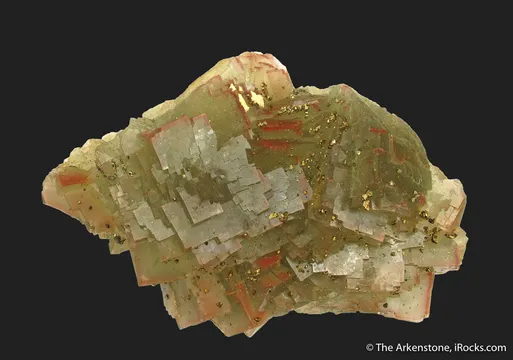
Heißer Stein is one of the compact but highly collectible fluorite producers of the Wölsendorf fluorite mining district in the Upper Palatinate of Bavaria. Its appeal is not volume but character: a short, deep, historically brief working that produced a small number of specimens with the unmistakable Wölsendorf palette—fluorite in violet, yellow-green to pistachio, gooseberry-beige and honey tones, commonly set off by smoky quartz, amethyst, red hematite-included quartz known to collectors as Eisenkiesel, and lustrous brown baryte. Within the Nabburg–Wölsendorf fluorite-barite vein province, the mine belongs to the granitic, fault-controlled hydrothermal vein system developed along the western edge of the Bohemian Massif, close to the structural influence of the Great Bavarian Quartz Lode, the Pfahl. For collectors, Heißer Stein matters because its best specimens compress that regional geology into cabinet scale: sharp cubic fluorite with strong internal zoning, sparkling red quartz skins, brown baryte blades, and the darker smoky-to-amethyst quartz that has long made the mine a named Wölsendorf classic rather than just another locality label.
Regional View
Country View
The mine’s collecting reputation is amplified by scarcity. Heißer Stein worked a comparatively limited orebody, and its period of modern production was short, from 1957 to 1972. Contemporary locality notes from Stulln stress that fewer specimens entered collections because the mine had lower output and an early shutdown, yet the pieces that did survive are counted among the better Wölsendorf specimens. That combination—recognized quality, modest production, and the finite nature of the old underground finds—is why a good Heißer Stein label still carries weight among European fluorite collectors.
Search for specimens: View all specimens from Heißer Stein Mine, Germany
Heißer Stein lies about 1 km north of Stulln in the Schwandorf District of Bavaria, in the former Nabburg–Stulln–Wölsendorf–Schwarzach fluorspar field. Mindat places the inactive mine at 49.43050 N, 12.13531 E, and the older German locality form is Grube Heißer Stein, Stulln, Landkreis Schwandorf, Oberpfalz, Bayern, Deutschland. In district terms it is part of the Wölsendorf fluorite mining district, a narrow belt of fluorite-barite-quartz vein mineralization historically worked for CaF2 and known to collectors for unusually varied fluorite colors, uranium minerals, baryte, and quartz.
Geologically, the mine belongs to a hydrothermal F-Ba vein system at the western edge of the Bohemian Massif, where late- and post-Variscan structures guided mineralizing fluids through granites, gneisses, mylonitic zones, and locally adjacent sedimentary cover. The broader Nabburg–Wölsendorf deposits line up near the continuation of the Pfahl, the great NW-SE Bavarian quartz and shear-zone structure. Geological mapping of the Nabburger fluorspar field records Pfahlschiefer-like mylonite zones in the area of the Erika, Erna, Heißer Stein, and Hermine mines; specifically at Heißer Stein, granite is recorded south of the main fracture beneath about 30 to 60 m of Tertiary cover. The same work notes that the regional crystal basement lies at roughly 300 to 330 m above sea level in this covered area, and that the mineralized structures may pass beneath younger cover rather than appearing as simple surface outcrops.
The orebody at Heißer Stein was small by district standards. Local Stulln mining notes record an earlier Baumgärtnerschacht working on the occurrence, followed in 1957 by the Heißer Stein mine proper. The later mine reached 210 m depth. Its main vein could be followed for only about 100 m along strike and was economic to about 180 m depth. These numbers matter to collectors: they explain why Heißer Stein is not abundant compared with larger Wölsendorf names such as Marienschacht, Johannesschacht, Erna, or Hermine. A short payable strike length and early closure meant fewer pockets, fewer saved specimens, and fewer well-preserved collection pieces.
The mine’s mineralization is a classic Wölsendorf assemblage centered on fluorite with quartz and baryte. The most distinctive collector pieces show fluorite associated with Eisenkiesel, amethyst, smoky quartz, and glossy brown baryte. Dealer-documented examples also record calcite on Heißer Stein fluorite, including sharp, light wine-green fluorite cubes with stepped creamy calcite scalenohedra and reddish ferruginous quartz. Another documented cabinet specimen, ex Fritz Haller and acquired in 1970, measured 10 x 6 x 3 cm and showed intensely violet fluorite with darker edges, fine tabular baryte on upper faces, and red Eisenkiesel. These are not random embellishments; they are the visual signature of the mine.
The broader mining history of the district reaches much farther back than the Heißer Stein shaft. Silver-bearing galena was worked in the Wölsendorf area in early centuries, while industrial fluorspar mining began in the late nineteenth century and grew through the first half of the twentieth. In Stulln’s local account, Georg Bauer acquired mining rights at nearby Wölsendorf in 1884; production began with three miners and primitive equipment, then expanded after installation of steam power for hoisting and pumping. By 1900 output had risen to 1,000 tonnes, and after Bauer’s death in 1912 his son Hans Bauer took over operations with 45 employees. Heißer Stein itself belongs to the later, postwar industrial phase, when district fluorspar was still economically important for metallurgy and chemical uses.
The mine was in operation from 1957 to 1972. Its headframe was still standing at the western edge of the small wood south of the Lissenthan–Nabburg road at the beginning of 1977; it was later transferred to the Bergbau- und Industriemuseum in Theuern. The wider Wölsendorf fluorspar industry declined as ore quality decreased and imported fluorspar became cheaper; the final underground trip at the Hermine mine, the district’s last working, took place on May 27, 1987.
Collecting access today should be treated as effectively historical rather than recreational. The mine is inactive, the district contains old underground workings and remediated dumps, and local field guidance for the Wölsendorf area warns visitors not to leave forest paths because the ground is undermined in places and old workings may collapse. There is no public visitor mine in the district today. For collectors, the practical source of Heißer Stein specimens is the secondary market: old Bavarian collections, European dealers, and occasional estate material, not casual field collecting.
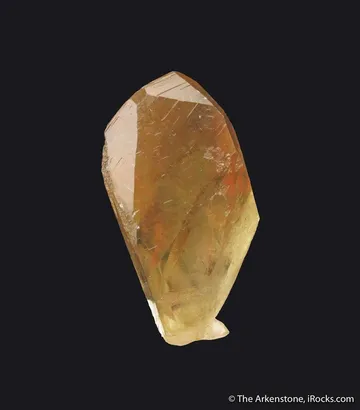
Fluorite from Heißer Stein is best known as sharp cubic material in violet, honey-yellow, greenish to pistachio, gooseberry-beige, and locally darker Wölsendorf tones, often with strong translucency and internal zoning; the finest pieces are small-cabinet to cabinet specimens with lustrous, undamaged cubes and crisp color architecture rather than massive ore fragments. The classic associations are red hematite-included quartz or Eisenkiesel, smoky quartz grading toward amethyst, brown glossy baryte, and less commonly calcite, and the best examples show a lively contrast between geometric fluorite cubes and sparkling red quartz or tabular baryte. Documented market pieces include a 7.6 x 5.4 x 3.5 cm fluorite-calcite specimen with light wine-green cubes and reddish ferruginous quartz, a 7.2 x 6.2 x 2.6 cm pistachio-green phantom fluorite, and a larger 90 x 97 x 57 mm fluorite with Eisenkiesel in which gooseberry-to-beige fluorite formed the bulk of the specimen; ordinary pieces lack this combination of transparency, sharp edges, color zoning, and characteristic Heißer Stein matrix minerals.
Quartz at Heißer Stein is important less as isolated clear crystals than as the mine’s great aesthetic partner to fluorite: smoky quartz, amethyst, and Eisenkiesel occur as coatings, drusy fields, and small crystals on or beside fluorite, baryte, and vein matrix. The red Eisenkiesel is hematite-included quartz and is particularly prized where it forms glittering, reddish, doubly terminated or bipyramidal crystals along fluorite cube edges or across upper surfaces; smoky quartz that passes into amethyst is also specifically recorded from the mine. The strongest Heißer Stein quartz specimens are those in which the quartz does not obscure the fluorite but frames it—red sparkle against violet or green fluorite, or smoky-to-amethyst crystals giving depth and locality character—while plainer quartzose vein pieces without fluorite, baryte, or color contrast are much less desirable.
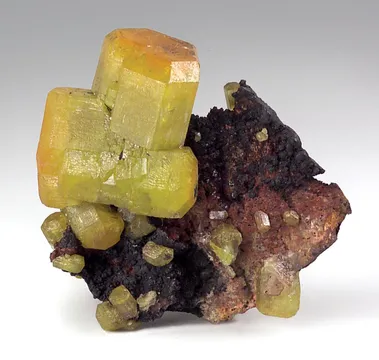
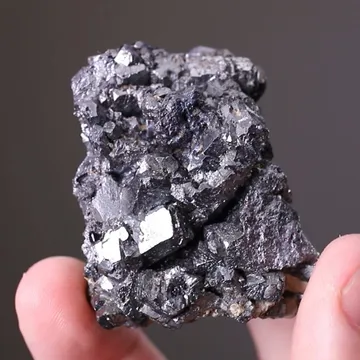
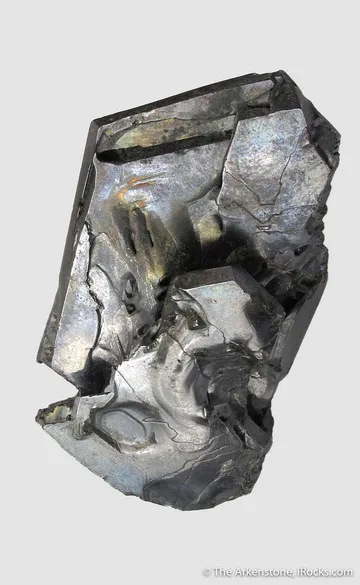
Other minerals documented from Heißer Stein include baryte, autunite, torbernite, uraninite including pitchblende, uranocircite, and safflorite. Baryte is especially important aesthetically, because the mine’s brown, lustrous baryte is part of the classic Heißer Stein look when it sits with violet fluorite and red Eisenkiesel. The uranium minerals place the locality firmly within the famous radioactive-mineral side of the Wölsendorf district, although the mine is not known as a type locality in the standard locality records consulted; the nearby district as a whole is historically celebrated for uranium species and radioactive fluorite, particularly the dark Wölsendorf “Stinkspat” tradition. For collectors, radioactive secondary phosphates from Heißer Stein should be treated as mineralogical rarities rather than common display material.
Heißer Stein labels deserve careful reading. Specimens may be labelled broadly as Wölsendorf, Stulln, Nabburg, or Wölsendorf fluorite mining district, and older German labels may use Grube Heißer Stein or the unaccented Heisser Stein. Because the mine is only one member of a dense district of closely spaced shafts and veins, broad Wölsendorf specimens should not automatically be upgraded to Heißer Stein unless the label chain is convincing. Conversely, genuine Heißer Stein pieces may appear under older district labels, especially if they came from Bavarian collections assembled before locality precision became standard in the specimen trade.
No well-documented, locality-specific fakery or treatment tradition is evident for Heißer Stein specimens. The main authenticity issue is mislocality, not artificial enhancement. The visual overlap with other Wölsendorf fluorites is real: violet fluorite with quartz, baryte-fluorite combinations, and uranium-associated pieces occur elsewhere in the district. Strong Heißer Stein candidates are those matching the known suite—fluorite with Eisenkiesel, smoky-to-amethyst quartz, brown baryte, and the Stulln-area label history—especially if they trace to old European collections.
Condition is a major value driver. Wölsendorf fluorite can show bruised cube edges, cleavage nicks, and contact faces from tight vein growth; these issues are especially visible on transparent greenish, beige, or honey material. Eisenkiesel coatings add sparkle but also create a rough surface that can conceal small chips or contacts. Baryte blades and calcite, where present, are more vulnerable than fluorite and should be checked under low-angle light for edge damage. A fine Heißer Stein specimen should have clean cube definition, lively luster, strong internal color, and matrix minerals that enhance rather than obscure the fluorite.
Fluorescence is relevant but not the central collecting criterion. Wölsendorf fluorite includes fluorescent material, and some documented market pieces from the district and Heißer Stein-related offerings note fluorescence or “daylight fluorescence,” but the mine’s top collector identity is based more on color zoning, Eisenkiesel association, baryte contrast, and provenance. Specimens containing autunite, torbernite, uranocircite, or pitchblende require normal radioactive-mineral precautions: avoid inhaling dust, do not grind or trim casually, wash hands after handling, store away from prolonged close contact, and keep secondary uranium minerals dry and stable.
Market availability is intermittent. Small pieces and thumbnails appear occasionally, but intact cabinet-quality Heißer Stein specimens are genuinely scarce. Recent documented examples range from modest auction material around the tens-of-euros level for small-cabinet fluorite-calcite combinations to sold dealer specimens in the low hundreds for pistachio-green phantom fluorite and much higher prices for large, sharp fluorite with classic Eisenkiesel association. The premium is paid for three things: secure Heißer Stein provenance, undamaged sharp fluorite, and the full locality paragenesis of fluorite with red quartz, amethyst or smoky quartz, and baryte.
The Heißer Stein story is unusually compact, which is part of its charm. About 1 km north of Stulln, an older working called the Baumgärtnerschacht had already tested the occurrence before the modern Heißer Stein mine was driven in 1957. The later mine went deep—down to 210 m—but the payable body was short. The main vein could be followed for only about 100 m along strike, and ore worth mining persisted to about 180 m depth. In a district where the great mine names can blur into one another, those numbers give Heißer Stein an unusually sharp silhouette: a deep but limited working that produced fewer specimens, then closed in 1972.
The mine left behind one very tangible artifact. At the beginning of 1977, several years after closure, the headframe of Heißer Stein still stood at the western edge of the wood south of the Lissenthan-to-Nabburg road. Later it was moved to the Bergbau- und Industriemuseum in Theuern. For anyone who has handled a fine Heißer Stein fluorite, that displaced headframe is a useful image: a small wooden-and-steel landmark of a mine whose best crystals also moved away from the forest, into collections, cabinets, and eventually the specimen market.
A particularly vivid collector trail comes from an old cabinet specimen sold in Munich: a 10 x 6 x 3 cm fluorite, baryte, and Eisenkiesel piece from the Fritz Haller collection, acquired in 1970 while the mine was still active. The description is pure Heißer Stein—intensely violet fluorite, darker edges in transmitted light, fine tabular baryte over the upper faces, and red Eisenkiesel giving the specimen its color contrast. It is the sort of piece that explains why Stulln’s own historical note can say that fewer specimens lie in collections, yet those that do “count among the best in the district.”
The wider Stulln mining story gives the Heißer Stein specimens their human setting. Georg Bauer acquired mining rights at nearby Wölsendorf in 1884, and the first operation was almost startlingly small: three miners bringing rock to daylight with primitive means. Steam power for the hoist and pump followed, and by 1900 production had reached 1,000 tonnes. After Bauer’s death in 1912, Hans Bauer took over the mines with 45 employees. By the postwar decades, when Heißer Stein was operating, this had become an industrial fluorspar landscape rather than a prospector’s curiosity, complete with shafts, processing, transport, and the later economic pressure of cheaper imported fluorite.
There is also a darker line in the district history. Stulln’s local history records that in 1942, during the Second World War, 200 prisoners from Flossenbürg worked in Stulln’s fluorspar operations alongside local labor. The Heißer Stein shaft itself belongs to the later 1957–1972 period, but its landscape is part of that same mining community, and a serious locality guide should not polish the human history into a simple romance of pretty crystals.
After the mines closed, memory did not stop underground. Stulln records that after the last trip at Hermine on May 27, 1987, former miners continued the Christmas-time Mettenschicht tradition, entering the adit to remember the region’s mining past. Today, old workings are secured, paths are posted, and the mineral collections in Stulln and Schwarzenfeld carry much of the district’s public memory. Heißer Stein survives in that memory in two forms: a headframe preserved at Theuern, and the scarce fluorite specimens whose color, baryte, amethyst, and red Eisenkiesel still speak for a small, short-lived mine.