Cäcilia Mine, Germany — classic fluorite locality famed for greenish to honey-yellow pseudoscalenohedral fluorite, zoning, and Wölsendorf specimens.
Key facts
Cäcilia Mine sits at Freiung, near Stulln in the Upper Palatinate of Bavaria, on the western side of the Nabburg–Wölsendorf fluorite district—one of Europe’s classic hydrothermal F-Ba vein camps. To collectors, Cäcilia matters for two different reasons at once. Industrially, it was once a giant: in the early 1950s it was described locally as the largest fluorspar mine in the world, with production on the order of 120 tonnes of spar per day. Mineralogically, it is one of the great names for German fluorite morphology, especially the extraordinary “pseudoscalenohedral” or 731 fluorite crystals from the 1961–1963 period on the 210 m level, forms so odd that they can fool the eye into seeing calcite rather than fluorite.
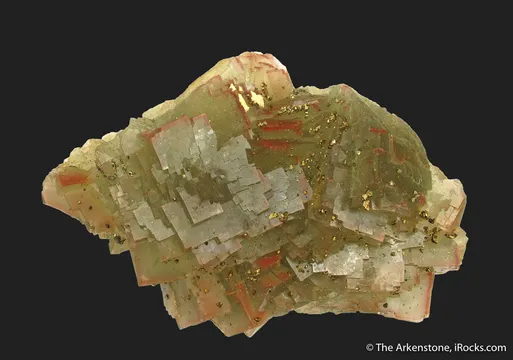
The setting is the fault-controlled western margin of the Bohemian Massif, where the Great Bavarian Quartz Lode, the Pfahl, and related NW-SE structures guided post-Variscan hydrothermal fluids through granitic and gneissic basement and overlying foreland sediments. In the Cäcilia vein system the classic gangue sequence is fluorite, baryte, quartz, calcite and dolomite, with sulfides such as pyrite, marcasite, chalcopyrite, sphalerite and galena appearing as accessory ore minerals. The best specimens are not simply “German fluorite”; they have a particular Wölsendorf look—greenish to honey-yellow cubes, white to colorless zones, reddish hematitic quartz or cinnabar inclusions, creamy bladed baryte, and in the finest examples a geometric sharpness or bizarre elongation that gives them an unmistakably old-European personality.
Regional View
Country View
Cäcilia specimens reward close looking. Ordinary pieces may be massive or blocky green fluorspar with some baryte or quartz, but the better cabinet pieces show zoning, transparency, sharp cube faces, delicate quartz crusts, dolomite rhombs, pyrite or chalcopyrite accents, and the rare elongated forms that made the mine a crystallographic reference point. The old mine was also part of a network of workings: Cäcilia connected underground with neighboring Hermine, Erika and Hanns workings by exploration and ventilation headings, and its surface plant processed material from more than one source. That processing history makes old labels especially important, because “Cäcilia” can refer either to specimens mined from the Cäcilia workings proper or, less rigorously, to material handled at the Cäcilia plant from nearby mines in the same district.

Photo:
Search for specimens: View all specimens from Cäcilia Mine, Germany
Cäcilia Mine was a hydrothermal fluorspar-baryte vein mine in the Nabburg–Wölsendorf district, a belt of F-Ba-Pb-Zn-Cu-U mineralization developed along fault systems at the western edge of the Bohemian Massif. The broader district occupies a structurally favorable zone where NW-SE and subsidiary fractures cut basement rocks and, locally, the sedimentary cover. Fluorite and baryte formed as open-space vein fillings, breccia cements, banded ore, cockade textures and drusy crusts. In the Cäcilia vein specifically, the best-documented paragenetic sequence begins with hornstone-like quartz, followed by an early violet and green fluorite generation that made up more than half of the vein filling in places, bladed baryte and minor calcite, then colorless fluorite, quartz crusts including red eisenkiesel, calcite, additional baryte, zoned cubic fluorite and younger baryte. Late descending alteration produced further baryte generations, iron hydroxides, marcasite and crosscutting quartz veinlets.
The mine lay about 2.5 km northwest of Stulln, at the western margin of the Wölsendorf fluorspar field. Modern locality usage places it at Freiung, Stulln, Schwandorf District, Upper Palatinate, Bavaria. It was not an isolated small adit but a substantial industrial mine. In 1933, the small Reichhart and Hochscheidt workings were consolidated into the Cäcilia mine, and a new double-compartment shaft was sunk. By 1943 that shaft had reached 150 m; the 180 m level was later connected upward from below. Below the main shaft system, the mine was extended through a blind shaft to the 290 m level and then by underhand working to the 320 m level, making it one of the deepest operations in the local district. The 180 m level included a pump chamber, and a sump drift lay seven metres below in the shaft bottom area.
Cäcilia’s ore bodies were classic Wölsendorf veins: thick enough in places for profitable fluorspar extraction, yet variable along strike, with swelling, pinching, brecciation and changing proportions of fluorite, baryte and quartz. The mine is especially associated with light green acid-grade fluorspar; one historical analysis of selected green acid spar from Cäcilia reported 95% CaF2. The broader district commonly yielded veins containing 60–80% fluorite, with baryte and quartz as major gangue partners. Cäcilia’s mineralization is somewhat less famous for radioactive “stink spar” than the central Wölsendorf mines, but the district context is important: uranium-bearing zones, pitchblende and secondary uranium minerals occur in the wider field, and radiation damage is part of the explanation for the darkest Wölsendorf fluorites.
Mining history at Cäcilia is unusually well documented in surviving industrial memory. In the 1950s the mine’s reported 120-tonne daily output made it one of the world’s great fluorspar operations. A fluorspar processing plant was added in the early 1940s, and in 1962 a flotation plant was built on the Cäcilia site. The operator historically associated with Cäcilia was the Flußspatwerk Schwarzenfeld, formerly Kallmünzer, later connected with the Saline Ludwigshalle and Kali-Chemie/Solvay corporate line. Under Paul Kottwitz, who became managing director in 1954, the Cäcilia site functioned not only as a mine but also as an important processing center for fluorspar from neighboring workings and, later, purchased and imported material.
The mine’s productive life ended before the rest of the district finally faded. Cäcilia ceased extraction in 1973 because the deposit was exhausted. Its ventilation shafts were filled in 1975, but the production shaft and southern man-riding compartment were kept open until 1987 as a water-management shaft serving the neighboring Hermine mine down to the 180 m level. After Hermine closed, the typical wooden headframe was demolished and the shaft was sealed. Some surface buildings survived into the late 20th and early 21st centuries: the processing tower, office and engine-house structures, workshop and garage ranges, ore bunker remnants, and the surrounding industrial yard. By the 2000s and 2010s, much of the complex had been demolished or stood derelict.
Collecting today should be treated as historical rather than active. The mine workings are closed, the shafts sealed, and the remaining ground is not a casual public collecting site. Any surface access would require landowner permission and local safety awareness; underground access is out of the question. Serious specimens now come almost entirely from old collections, dealer stock, museum holdings, and occasional estate dispersals. The finest Cäcilia pieces are therefore not just mineral specimens but documents of a vanished underground environment: pieces from the 210 m level, specimens with old German or American collection labels, and examples traceable to well-known collectors carry added importance.
The most celebrated find was the early-1960s pocket or group of pockets that produced the strange 731 fluorites on the 210 m level. These transparent to yellow-orange or whitish fluorites are complexly twinned and elongated, often with cinnabar filaments and pyrite or marcasite on associated baryte. They were later discussed in crystallographic and collector literature because they resemble scalenohedral calcite crystals despite being fluorite. Other notable Cäcilia specimens include zoned greenish-yellow cubes with quartz coatings, fluorite with dolomite rhombs, fluorite with chalcopyrite or sphalerite, and bladed baryte specimens showing pinkish to creamy plates on iron-stained matrix.
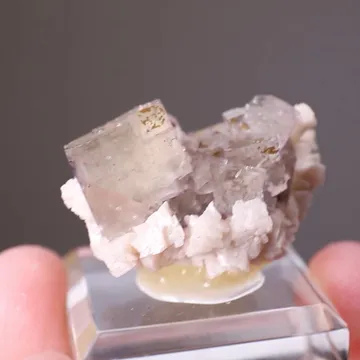
Fluorite from Cäcilia Mine ranges from massive light green fluorspar to sharp cubic crystals and, most famously, the rare elongated “pseudoscalenohedral” 731 forms found around 1961–1963 on the 210 m level. Typical collectible pieces show pale green, yellow-green, honey-yellow, white or colorless zones, with brownish or reddish internal coloration caused by inclusions and staining rather than simple body color alone; the finest pieces have transparent edges, geometric zoning, clean lustrous faces, and lively associations with bladed baryte, red quartz or eisenkiesel, dolomite, pyrite, chalcopyrite, sphalerite or cinnabar. Cabinet-size fluorites from Cäcilia are known, but the truly exceptional material is judged less by size alone than by identity: undamaged crystals with sharp cubes, documented old labels, or convincing 731 morphology are far more desirable than ordinary green massive spar.
Other minerals documented specifically from Cäcilia include baryte, quartz including the red hematitic variety eisenkiesel, dolomite, hematite, pyrite, chalcopyrite, cinnabar, sphalerite, galena, bornite and covellite. Baryte is the most important companion mineral for specimen collectors, occurring as bladed white to pinkish aggregates and as coatings on fluorite; quartz appears as drusy crusts, red iron-rich coatings and matrix; dolomite may occur as rhombohedral crystals scattered over quartz, baryte or fluorite. Cinnabar is significant not as large display crystals, but as red inclusions and filaments in fluorite from the classic pockets. The broader Wölsendorf district has type-locality and uranium-mineral importance, but Cäcilia’s own fame rests chiefly on fluorite morphology and on its well-documented F-Ba vein paragenesis rather than on a named type mineral from the mine itself.
Cäcilia specimens require careful label reading. Because the mine site had a processing plant and handled fluorspar from nearby workings, labels reading simply “Cäcilia,” “Wölsendorf,” “Stulln,” “Nabburg,” “Freiung,” or “Cäcilia plant” may not all mean the same thing. Pieces with distinctive associations—bladed baryte, red quartz, dolomite, cinnabar inclusions, and especially old labels mentioning the 210 m level—are more persuasive than vague district labels. Specimens should also be distinguished from similar Wölsendorf material from Erika, Marienschacht, Johannesschacht, Hermine, Roland and Reichhartschacht, all of which can produce superficially comparable fluorite-baryte-quartz assemblages.
The major condition issue is fluorite fragility. Cäcilia fluorites are reported to be unusually sensitive to strong light and heat; some specimens have faded after exposure to intense light, and very fine cracking has been noted from modest warming. Avoid bright display lights, windowsills, hot cases and thermal shock. The highly prized transparent yellow-orange and white forms should be handled only by the matrix or base, never by projecting crystals. Cleavage bruises, edge rubs and repaired crystals are common problems in old Wölsendorf fluorite generally, and the elongated 731 crystals are especially vulnerable.
No widespread, locality-specific fake industry is documented for Cäcilia in the sources consulted, but mislabeling is a real collecting hazard. Generic Wölsendorf fluorites, etched cubes, or distorted crystals from other mines may be optimistically sold as Cäcilia “scalenohedral” fluorite. True pseudoscalenohedral Cäcilia material should show convincing crystal morphology, appropriate matrix or association, and preferably provenance. A merely corroded or elongated fluorite is not enough. Some Cäcilia fluorites and associated carbonates have been reported with minor fluorescence under longwave and shortwave UV, but fluorescence should be treated as a supporting observation rather than an identification criterion.
Market availability is sporadic. Small and mid-grade Cäcilia fluorites appear periodically in European dealer stock, online auctions and old-collection dispersals. Fine fluorite with dolomite, quartz, baryte or sulfides is significantly scarcer. The classic 731 material is genuinely rare: much of the best-known material passed through a small number of old collections, including American collections assembled when the mine was still active or recently closed. Today, documented examples with strong morphology and no obvious damage command a premium well above ordinary district fluorite.
In the 1950s, Cäcilia was not a romantic little mine tucked into the Bavarian woods; it was an industrial fluorspar engine. At 120 tonnes of spar per day, the mine stood in local memory as the largest fluorspar mine in the world. The surface plant had a wooden headframe of the type once characteristic of the district, an ore bunker, a processing tower, workshops, garages, engine-house and changing-room buildings. Beneath that practical architecture lay a mine pushed down through levels at 150 m, 180 m, 290 m and finally 320 m, connected by investigation and ventilation headings to neighboring mines. The result was a hidden underground city of fluorite veins, pumps, sumps and crosscuts below the quiet ground northwest of Stulln.
The most collectible episode came not from tonnage but from a pocket. Between 1961 and 1963, on the 210 m level, miners encountered fluorite crystals unlike the ordinary cubes for which the district was already famous. These crystals stretched into strange, complex, elongated forms, their faces indexed as 731, close to the tetrakishexahedral family but so visually misleading that collectors still call them “scalenohedral” fluorites. Some are yellow-orange and transparent; some are white to pale; many carry cinnabar filaments inside, with pyrite or marcasite nearby on baryte. At first glance they look almost wrong—like calcite from a carbonate pocket that wandered into a fluorspar vein.
Decades later, collectors still talk about that find with the special tone reserved for one-pocket classics. Thomas Moore, writing about Kay Robertson’s collection, noted that finding another comparable Cäcilia specimen on the open market would be highly unlikely because Kay had obtained, as far as was known, “almost all of the good ones.” One of her larger pieces measured 9.6 cm across and carried a focal-point crystal projecting near the middle. The story has the flavor of the best mid-century collecting: an obscure European mine, a crystallographic oddity, a collector with the eye to keep the right pieces, and a later generation realizing that the small lot had become essentially irreplaceable.
Cäcilia’s closing had its own afterlife. Production ended in 1973, the ventilation shafts were filled in 1975, but the main shaft did not vanish immediately. It remained open until 1987 to serve as a water-holding and water-management shaft for the neighboring Hermine mine. Only after Hermine’s closure was the wooden headframe demolished and the shaft sealed. Photographs from the late 1980s show a landscape in transition: the ore bunker and loading plant still legible, the processing tower still standing, the headframe gone or going, and at one point a small circus overwintering on the old mine yard—a surreal coda to what had once been the world’s great fluorspar producer.