






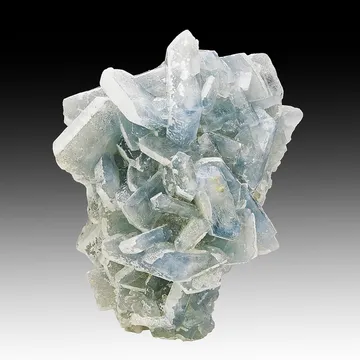
Hanson Quarry, USA - famed Midwestern locality for glassy celestine crystals in Devonian limestone, with calcite and rare strontianite; prized by collectors.
Key facts
Hanson Quarry at Sylvania, Lucas County, Ohio, is one of the great Midwestern carbonate-quarry localities: an active limestone operation on the southeastern margin of the Michigan Basin whose collector reputation rests on elegant strontium mineralization in Devonian rock. The locality is best known in mineral collections as Hanson Aggregates Midwest Inc. Sylvania “West” Quarry, but older labels may read Sandusky Cement Co. Quarry, Medusa Portland Cement Co. “South” Quarry, Medusa South-South Quarry, France Stone Co. “West” Quarry, or simply the Sylvania quarry. Those label variants are not trivial; they record the way quarrying migrated through a compact but geologically important block of ground west of Centennial Road and between Sylvania Avenue and Brint Road.
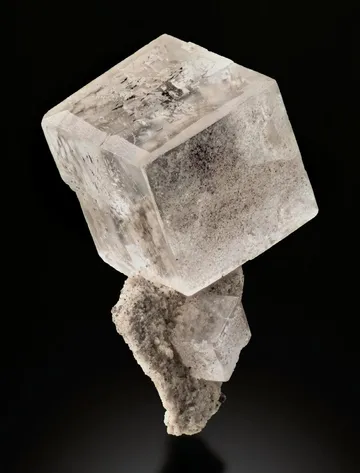
For collectors, Hanson matters above all for celestine. The best pieces are not the common chalky nodules or pale cavity linings seen at many Midwestern limestone quarries, but stout, glassy, pale blue to bluish gray crystals in vugs and solution openings, often with the heft and watery translucency that immediately distinguish SrSO4 from most carbonate look-alikes. Fine specimens show sharp tabular to blocky-prismatic crystals, sometimes as freestanding “floater” groups and sometimes perched on drab Devonian limestone matrix. Calcite is the important companion species: yellowish, translucent, lustrous rhombohedral to scalenohedral groups that can add both contrast and context to the celestine. Strontianite, recorded from the locality, completes the small but meaningful strontium assemblage.
The host rocks are part of the Middle Devonian succession so famous at Sylvania: Dundee Limestone, Detroit River Group rocks, and the overlying fossiliferous Silica Formation. The Silica Formation is the source of the locality’s parallel fame among paleontologists, with brachiopods, bryozoans, corals, crinoids, and trilobites recovered from the shale-limestone sequence. The mineral specimens, however, belong to a different collecting eye: they are products of open-space filling in carbonate rock, where strontium-bearing fluids used fractures, joints, and vugs as crystal chambers.
Regional View
Country View
The quarry’s position is also part of its collecting character. Sylvania lies in northwestern Ohio, close to the Ohio-Michigan line, in a belt of aggregate and cement-rock quarries that have repeatedly exposed Devonian and Silurian carbonate units. Many of those quarries produce celestine, calcite, fluorite, pyrite, marcasite, dolomite, or baryte, but Hanson’s West Quarry is a more focused locality in the mineralogical record: the verified list is short, and the best specimens are judged on the quality of the celestine-calcite association rather than on species diversity.


Search for specimens: View all specimens from Hanson Quarry, USA
Hanson Quarry is the Sylvania “West” Quarry at Silica, Sylvania Township, Lucas County, Ohio, currently known in commercial aggregate listings as the Sylvania Quarry at 4100 Centennial Road. The modern corporate name is Heidelberg Materials, formerly Hanson Aggregates; older mineral and fossil literature commonly uses Hanson Aggregates Midwest Inc., France Stone Co. West Quarry, Medusa South Quarry, or Sandusky Cement Co. Quarry. In collector usage, “Hanson Quarry, Sylvania, Ohio” normally refers to this West Quarry complex rather than to the nearby Sylvania East Quarry, France Stone North Quarry, Centennial Quarry, or other quarries around the Silica district.
The quarry is a carbonate industrial-mineral operation, not an ore mine. Its economic rock is limestone used for aggregate and related construction products, but the collectible minerals occur as open-space fillings in cavities and fractures within Devonian carbonate rocks. The verified mineral list for the West Quarry is notably concise: calcite, celestine, and strontianite. Celestine and strontianite mark the strontium-rich character of the fluids, while calcite reflects the host-rock chemistry and late-stage carbonate precipitation. The best specimens come from vugs rather than massive seams: individual cavities could line or partly fill with celestine, then receive calcite overgrowths or associated groups.
The bedrock section exposed in the Sylvania quarry area includes Middle Devonian formations on the southeastern flank of the Michigan Basin and near the structural influence of the Cincinnati-Findlay arch system. Quarry and field-guide sources describe Dundee Limestone, rocks assigned to the Devonian Detroit River Group, the richly fossiliferous Silica Formation, and the Ten Mile Creek Dolomite in the broader Sylvania exposures. The Silica Formation is an interbedded shale and limestone unit; it is famous for marine invertebrates and has been repeatedly treated in paleontological literature. For mineral collectors, the important point is that the limestone below and within this sequence provides the rigid, fractured, solution-prone carbonate host in which celestine-bearing pockets developed.
The mining history is a little tangled because several adjacent and evolving quarries have been worked in close proximity. The West Quarry ground traces back to the Sandusky Cement Company in the 1920s. It was later operated by the Medusa Cement Company, whose South Quarry and South-South Quarry names appear in older geological and paleontological work. In the late 1950s, France Stone Company opened the West Quarry by making a passage beneath Centennial Road, principally to quarry Dundee Limestone. Later, France Stone acquired the Medusa operation, and Hanson Aggregates acquired France Stone in the 1990s. Modern Heidelberg Materials listings retain the Sylvania Quarry as an active limestone operation, while collector labels preserve the whole succession of names.
The ore-body language of metal mining does not fit Hanson well. There is no vein system exploited as ore, no mine level, and no formal lode. The mineralization is better understood as local low-temperature diagenetic to hydrothermal open-space crystallization in a quarry bench environment: vugs, joints, solution cavities, and fracture openings in Devonian carbonate rock. Celestine crystals may occur singly, as blocky compound crystals, or as clusters partly lining cavities. Calcite may occupy the same openings as pale yellow curved rhombohedra or lustrous scalenohedra. Strontianite is much rarer in the specimen record and is best treated cautiously unless well labeled or tested.
Access today should be regarded as closed except through formal permission or organized arrangements. Hanson/Sylvania is an active industrial quarry, with blasting, heavy equipment, highwalls, and restricted working areas. Public fossil collecting in the Sylvania area is directed to Fossil Park, where shale from the nearby quarry operations has historically been supplied for safe, supervised hand collecting. That public venue is excellent for Devonian fossils, but it is not a substitute for mineral collecting in the active quarry benches, and collectors should not expect celestine pockets to be available there.
The specimen-producing history is best documented through quarry-field-trip reports, dealer records, museum-style photo documentation, and the Mindat locality record. A Friends of Mineralogy Midwest Chapter field symposium in September 2005 reported especially productive collecting at Hanson Aggregates Midwest’s Sylvania Quarry, with sky-blue and white to colorless bladed to tabular celestine and pockets containing pale yellow curved calcite rhombohedra in groups several centimeters across. Later market specimens from the Harris Precht and Robert Nowakowski collections show that significant cabinet-size celestine pieces survived into major Midwestern collections: examples include 9–17 cm specimens, crystals several centimeters across, loose floater clusters, and stout translucent compound crystals weighing more than a kilogram.
Celestine is the signature mineral of Hanson Quarry and the reason serious mineral collectors know the Sylvania West Quarry as more than a fossil locality. Documented specimens show colorless, white, pale blue, bluish gray, and sky-blue crystals, commonly bladed to tabular and locally thick, blocky, compound, or prismatic in aspect; the best pieces have glassy luster, translucency to local gemminess, crisp terminations, and enough open limestone matrix to show the vug origin without overwhelming the crystal group. Field reports from the quarry describe celestine pockets with pale yellow curved calcite rhombohedra in groups several centimeters across, while dealer-documented pieces include cabinet specimens around 10–17 cm overall and individual crystals to about 6.5 cm. Ordinary Hanson celestine can be pale, bruised, cleaved, or embedded in rough carbonate, but good specimens combine a distinct blue tone, three-dimensional architecture, minimal cleaving, and an undamaged display face.
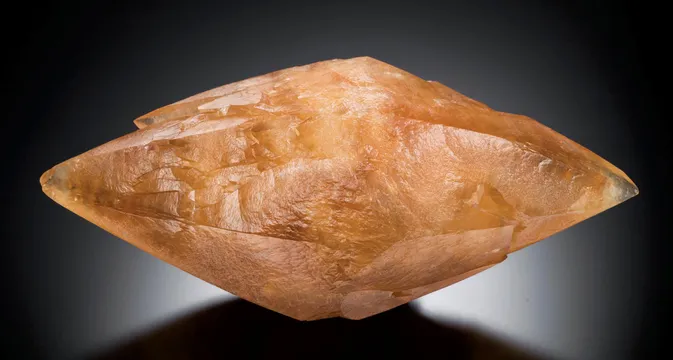
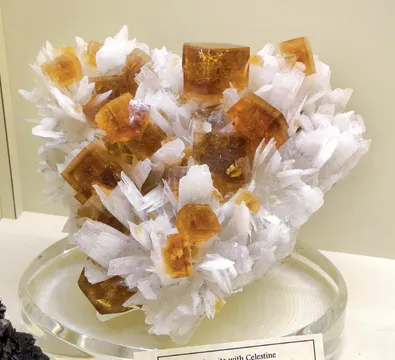
Calcite from Hanson Quarry is collectible chiefly as the elegant companion and contrast mineral to celestine, though some pieces stand on their own as attractive Ohio carbonate specimens. The best documented habits are pale yellow to yellowish translucent, lustrous scalenohedral clusters and curved rhombohedral groups, with individual groups reported in the several-centimeter range and cabinet specimens around 9–11 cm overall in recent dealer records. It occurs in the same vug-and-fracture environment as the celestine, and the most desirable pieces preserve the spatial relationship between the two species: blue or colorless SrSO4 blades with honey-yellow calcite rhombs, or sharp calcite floater groups that clearly come from the Hanson vug system. Damage along cleavages and bruised crystal tips are common condition problems, so sharp luster, intact terminations, and a clean, unrepaired association with celestine make the difference between a merely local calcite and a collection-grade Hanson specimen.
Strontianite is the important rarity documented from Hanson Quarry. It is recorded for the Sylvania West Quarry but is much less commonly encountered than celestine or calcite, and it should be treated as a locality rarity rather than a routine find. The verified mineral list for the locality is only three species—calcite, celestine, and strontianite—so claims of fluorite, baryte, pyrite, marcasite, or sphalerite on labels should be checked carefully against the exact quarry name; several nearby Sylvania and northwestern Ohio quarries do carry those minerals, but the Hanson West Quarry record is narrower. No mineral type locality is documented for Hanson Quarry itself in the verified mineral records consulted; the site’s “type” importance is stratigraphic and paleontological, tied to the Silica Formation district, not to a named mineral species.
The chief authenticity issue with Hanson specimens is locality precision, not widespread fakery. Old labels may legitimately read Medusa South Quarry, Medusa South-South Quarry, Sandusky Cement Co. Quarry, France Stone West Quarry, Benchmark Materials-France Stone Company Sylvania Quarry, Hanson Aggregates Midwest Sylvania Quarry, Sylvania West Quarry, or Hanson Quarry. All can refer to the same West Quarry complex or to closely related historical quarrying phases, but the Sylvania district contains multiple adjacent pits, and mineral lists differ between them. A specimen labeled only “Sylvania, Ohio” or “Medusa Quarry” deserves careful interpretation before being upgraded to Hanson West Quarry.
Confusion is especially likely with other Midwestern celestine localities. Ohio specimens from Clay Center, Lime City, Maumee, Portage, Genoa, and other quarry districts may look broadly similar, and celestine from Hanson Quarry in Salem, Indiana, is a completely different locality that can be misread on abbreviated labels. Hanson Quarry, Sylvania, Ohio, celestine tends to be recognized by its pale blue to bluish gray tabular-blocky crystals in Devonian limestone vugs, sometimes with yellowish calcite; however, habit alone is never proof. Provenance from a known Midwestern collection, an old label naming France Stone West or Medusa South, or a documented dealer/museum history adds real value.
No well-documented locality-specific treatments or manufactured fakes were found for Hanson celestine or calcite. That said, the minerals themselves demand normal scrutiny. Celestine has perfect to good cleavage and is brittle; large Hanson crystals often show cleaved corners, contacted backs, pressure bruising, or internal stress fractures from blasting and quarry extraction. Calcite bruises and cleaves even more readily, and lustrous yellowish scalenohedra can lose display quality from minor edge chatter. Repairs are plausible on larger cabinet specimens, particularly where heavy celestine crystals were attached to carbonate matrix, so inspect suspected joints under magnification and ultraviolet or strong side lighting.
Handling should be gentle. Celestine is noticeably heavy for its size, so tall or off-balance crystals need stable bases and secure cabinet mounts. Avoid acid cleaning unless you fully understand what you are doing: calcite is part of the desired assemblage and will be attacked by acids, while iron-stained carbonate matrix may respond unpredictably. Water rinsing and soft mechanical cleaning are safer for most specimens. Store large celestine pieces away from vibration and from harder specimens that can chip the edges.
Market availability is intermittent but real. Hanson Quarry celestine appears in old Midwestern collections, specialized Ohio suites, and modern dealer offerings, while calcite-only pieces are less frequently emphasized unless especially aesthetic. Ordinary small celestine specimens are obtainable, but large, lustrous, undamaged, three-dimensional examples with rich blue color or fine calcite association are scarce and are the pieces most likely to command serious collector prices.
One of the most vivid episodes in the modern history of the Sylvania quarry is not a single pocket but a public compromise. In May 1998, Hanson Aggregates Midwest offered a 10-acre tract containing the famous fossil-bearing Silica Formation to the City of Sylvania under a 99-year lease. The plan solved several problems at once: the parcel lay away from long-term reserve access, it could serve as a buffer around the active quarry, it had suffered illegal dumping, and supervised public use could reduce trespassing and safety problems. The result was Fossil Park, opened in 2001 through cooperation among Hanson, the City of Sylvania, and The Olander Park System. For collectors, that story explains why Sylvania became one of the rare places where an active industrial quarry district also supports legal public collecting—though for fossils, not for quarry-bench celestine pockets.
The September 2005 Friends of Mineralogy Midwest Chapter field symposium gives a glimpse of what serious organized access could produce. Twenty-six members and guests attended the two-day excursion, and the Hanson Aggregates Midwest Sylvania Quarry provided the best collecting of the trip. The report’s mineral details are exactly the sort collectors remember: sky-blue and white to colorless celestine, bladed to tabular in habit, and pockets filled with pale yellow curved calcite rhombohedra in groups several centimeters across. The same symposium program included John Medici speaking on celestine collecting in northwestern Ohio and southeastern Michigan, and Joe Vasichko discussing fluorescent and phosphorescent minerals of the region. In a few sentences, that field note captures the culture of the locality: private quarry access, regional expertise, celestine as the prize, and the Sylvania quarry as a stop that could outperform better-known collecting sites on a good weekend.
The older quarry story is equally revealing. In the 1920s, the Sandusky Cement Company’s workings south of Brint Road exposed the beds that would become central to the Silica Formation literature. Later, Medusa developed its South and South-South quarries, while France Stone drove a passage beneath Centennial Road in the late 1950s to reach the Dundee Limestone west of the road. For a time, the France Stone West Quarry and the Medusa South workings were separated by a wall of Anderson Limestone; after ownership changes and continued quarrying, that wall disappeared. This is why a cabinet specimen can carry an old label that seems inconsistent with a modern map yet still belong to the same quarry lineage. The stone business reshaped the place faster than mineral labels could standardize it.
_1.jpg)
_3_(48367161751).jpg)
_2.jpg)