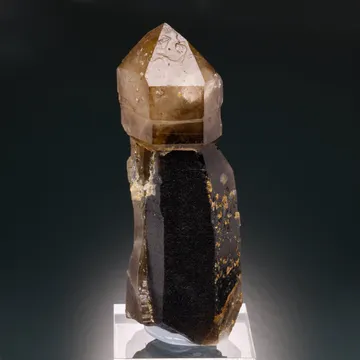
Hallelujah Junction — Nevada/California quartz locality known for scepter growth, smoky quartz with amethyst and citrine accents, prized architectural specimen…
Key facts
“Hallelujah Junction” is the collector’s name for the quartz-producing pocket systems on Petersen Mountain, north of Reno, where the Nevada–California line cuts through a rugged high-desert range. The name is imprecise in the old rockhound way: Hallelujah Junction itself is the highway locality down in Lassen County, California, while the most celebrated specimen-producing ground is on Petersen Mountain, especially in Washoe County, Nevada. On labels the place may appear as Hallelujah Junction, Petersen Mountain, Peterson Mountain, Crystal Tips, Foster Hallman claim, Royal Scepter Mine, or Petersen Mountain Quartz Mines; the best modern references use Petersen Mountain as the geographic anchor.
Collectors care about Hallelujah Junction because it is one of the great American quartz localities for scepter growth. The deposit is not an ore mine in the usual sense, but a specimen-mining district of milky quartz veins, pockets, breccias, and cavities in granodioritic terrain. From those cavities came the locality’s unmistakable look: smoky quartz stalks with broader caps, amethyst-rich heads, smoky-amethyst combinations, rare citrine-yellow zones, ametrine-like color transitions, internal phantoms, skeletal faces, doubly terminated floaters, and quartz plates that look far more architectural than the simple “point” most non-collectors imagine when they hear the word quartz.
Regional View
Country View
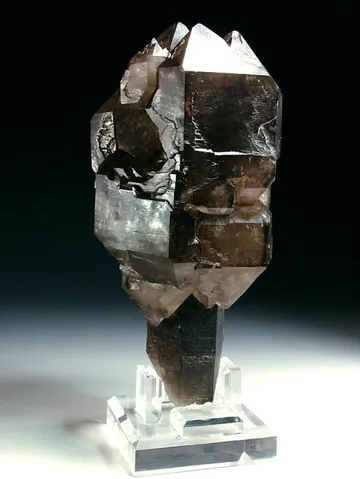
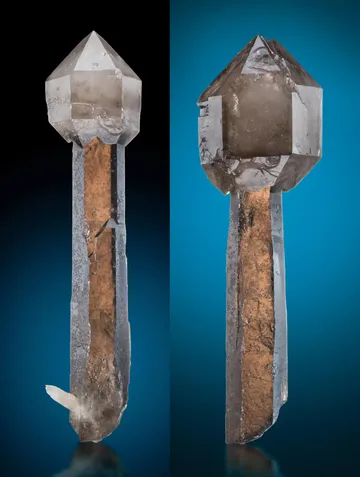
The finest Hallelujah Junction pieces are judged as sculpture as much as mineral specimens. A classic example has a dark smoky, sometimes nearly black stem supporting a glassier smoky, colorless, milky, yellowish, or amethystine cap. In better pieces the color is internal, zoned, and crystallographically controlled, so that backlighting reveals a second life inside the specimen: purple at the head, tea-brown in the stalk, milky ghosts following earlier crystal outlines, or a pale citrine flame perched on darker smoky quartz. The locality became known to collectors through decades of private claim work and fee digs, especially the claims associated with Foster Hallman, Jon Johnson, and later partner-operated ground; its status was confirmed in the modern literature by a major 2022 Mineralogical Record article devoted to the Hallelujah Junction scepter quartz deposit.

Photo: Wikimedia Commons

Photo: Wikimedia Commons
Search for specimens: View all specimens from Hallelujah Junction, USA
The specimen locality is centered on Petersen Mountain in the Hallelujah Junction area of Washoe County, Nevada, with related collecting history and older labels also referring to the adjacent California side. Mindat notes that the mountain itself, not the highway junction, is the proper collecting framework, and that “Peterson Mountain” is a common misspelling or label variant. The collector’s usage nevertheless stuck, because Hallelujah Junction was the convenient road reference for diggers approaching the mountain.
Geologically, the prized specimens come from a quartz-vein pocket system in granodiorite. Thick milky quartz veins cut the host rock, and where openings remained, silica-rich fluids deposited later generations of quartz into cavities. Repeated deposition is the key to the locality’s style: an early quartz crystal could act as a stalk, a later generation could build a broader head, and still later growth or changing conditions could add smoky color, amethyst, milky zones, skeletal faces, or healed bases. The surrounding regional geology is more complex than the specimen mine alone, with Mesozoic granodiorite, Miocene Hartford Hill Rhyolite units, Pliocene sedimentary rocks, and Basin and Range faulting shaping the Hallelujah Junction–Red Rock Canyon area. For collectors, however, the crucial field fact is simpler: the good crystals are pocket specimens from quartz veins and brecciated zones, not metalliferous ore specimens.
The productive ground has long been divided among claims and named workings. Labels may cite Petersen Mountain Quartz Mines, Crystal Tips No. 1 pit, Crystal Tips No. 2 pit, Royal Scepter Mine, Foster Hallman claim, Jon Johnson’s claim, or later Hallelujah Partners ground. The old Crystal Tips/Hallelujah material is especially important in collector history, because Foster Hallman’s name appears on many specimens and in many field accounts. The Nevada Division of Minerals’ older locality information for “Peterson Peak, AKA Hallelujah Junction” identified Crystal Tips Mines and Hallelujah Mining and Exploration Company contacts, and noted smoky and amethyst quartz crystals, scepters, phantoms, multiple claims, and fee or permission-based collecting. The 2025 Nevada active mine directory still listed Petersen Mountain in Washoe County with Hallelujah Partners as operator, indicating that the ground remained part of Nevada’s current mine-reporting landscape.
The mining history is episodic specimen mining rather than steady industrial production. Quartz was recognized on the mountain by collectors by the 1940s. By the early 1980s, Jon Johnson and Foster Hallman had staked official claims in the area, with later accounts placing Hallman on the northern side and Johnson on the southern side. Production then depended on pockets: some days yielded only broken rough, small smoky points, or modest clusters; a good pocket could change the season with scepters, amethyst crystals, and large cabinet pieces. A 2006 Tucson display by Krystal Tips Mining, a widely discussed record-breaking Petersen Mountain quartz specimen reported by Mineralogical Record in 2009, and the 2022 Mineralogical Record locality article all mark stages in the locality’s modern rise.
The collecting environment is serious high-desert field country. Access has been described from the Reno area toward U.S. 395 and California Route 70, then up rough roads such as Greasy Hill Road. The top of Petersen Mountain is exposed, windy, hot in summer, prone to thunderstorms, and short on shade. Wet conditions can make steep access roads hazardous, and even dry roads call for appropriate vehicles and preparation. Most importantly, the principal quartz-producing areas are covered by private mining claims. Collecting should be treated as permission-only; some operators have offered paid digs or club access, but arrangements change, and no collector should assume that old public reports still describe current access.
The most memorable pockets range from small quartz-lined cavities only a few inches across to breccia-related openings large enough to be worked carefully after mechanical exposure. Modern field accounts describe an excavator opening ground until alteration, vein structure, or a glimpse of pocket material signals a stop; then hand tools, patience, and gentle extraction take over. The pocket fill may contain loose crystals, attached scepters, amethyst and smoky fragments, fist-sized amethyst pieces, citrine-bearing combinations, mud, mica-rich debris, and broken crystals that require careful reconstruction or cleaning. The best finds are those that emerge complete, with undamaged caps and natural terminations; large scepters are often vulnerable to breakage at the stem or cap because of the geometry that makes them desirable.
Quartz from Hallelujah Junction is best understood as a family of multi-stage pocket crystals rather than a single look: colorless to milky quartz, smoky quartz, amethyst, citrine-like yellow quartz, ametrine-like combinations, skeletal crystals, phantoms, plates, doubly terminated floaters, and above all scepters. The ordinary pieces are loose points or contacted crystals a few centimeters long; the memorable pieces show a strong architectural contrast between a narrower stalk and a broader cap, or combine smoky, purple, milky, and pale yellow zones in one coherent crystal. Documented specimens range from miniature and small-cabinet crystals to major cabinet pieces, with published and photographed examples around 30 cm and more, and older records noting large amethyst scepters from the Petersen Mountain/Hallelujah Junction area. Good Hallelujah Junction quartz is sharp, lustrous, naturally terminated, internally interesting, and well balanced; a dark smoky stem with a clean, transparent, milky, amethyst, or citrine-like cap is far more desirable than a bruised, opaque, poorly centered scepter whose only virtue is the locality name.
Smoky quartz is the signature Hallelujah Junction material, especially in scepter form. The color ranges from pale tea and root-beer brown to deep charcoal or nearly morion-like black, and it is often most effective when contrasted with a paler cap, amethyst tip, milky overgrowth, or citrine-yellow zone. Many specimens have frosted or etched faces, skeletal windows, healed bases, or natural contact areas from tight pocket growth; these features should be read carefully because they can be growth history rather than damage. The Foster Hallman claim, Crystal Tips workings, Royal Scepter Mine, and Petersen Mountain Quartz Mines all figure in the smoky-quartz label history, and photographed specimens include dark-stemmed scepters, smoky-amethyst floaters, and large smoky crystals with later milky scepter growth. The best smoky quartz from here has a decisive silhouette: a straight dark stalk, a well-positioned cap, clean rhombohedral terminations, good luster, and enough translucency that the smoky color glows rather than merely blacks out.
Amethyst from Hallelujah Junction is most prized when it appears as part of the locality’s scepter architecture: purple caps on smoky stalks, purple zones within smoky heads, doubly terminated smoky-amethyst floaters, or crystal groups with purple cores and smoky margins. The color is typically blush-purple to richer violet rather than the uniform dark purple of some basalt-geode localities, and its appeal lies in zoning, transparency, and association with scepter growth. Crystal Tips No. 1 and No. 2, Royal Scepter Mine, and the broader Petersen Mountain quartz workings all have documented amethyst-bearing material, and the locality is also represented in the Smithsonian’s National Gem Collection by a 172.23 ct cut amethyst from Hallelujah Junction, Nevada. Good amethyst specimens from the locality show color where it matters visually—at the head, termination, or internal phantom—combined with sharp form, visible internal architecture, and honest condition; pale purple alone is common enough, but a clean smoky-amethyst scepter with a balanced cap is a serious collector’s piece.
Other documented minerals and varieties from the Petersen Mountain/Hallelujah Junction records are modest in specimen importance but useful for understanding labels and associations. Mindat records chlorite-group minerals, muscovite, pyrite, piemontite, meta-autunite, and an epidote occurrence in the broader Petersen Mountain area, while Crystal Tips No. 2 is specifically tied to muscovite, pyrite, chlorite-group minerals, amethyst, ametrine, citrine, and smoky quartz. The nearby California Hallelujah Junction/Buckhorn uranium records add autunite, uranophane, gummite, hematite, limonite, montmorillonite, quartz, and placer gold to the broader regional mineral picture, but these should not be confused with the classic Petersen Mountain scepter-quartz pockets. The locality’s collector identity remains overwhelmingly quartz; the rarities are usually habits, color combinations, pockets, and growth forms rather than a broad suite of rare species.
The first collecting issue is locality precision. A label reading “Hallelujah Junction” may be historically legitimate but geographically vague. Better labels name Petersen Mountain and, when known, the claim or working: Foster Hallman claim, Crystal Tips No. 1, Crystal Tips No. 2, Royal Scepter Mine, Petersen Mountain Quartz Mines, or a specific pocket name such as Glass Ceiling Pocket or 5:00 Shadow Pocket. “Peterson Mountain” appears frequently on older labels and dealer descriptions; it is best treated as a common misspelling of Petersen Mountain rather than a separate locality.
The second issue is repair. Large Hallelujah Junction scepters are mechanically vulnerable. The narrow stem below a heavy cap is a natural break point, and pocket collapse or excavation can separate stems, heads, and side crystals. Repaired examples can still be attractive and collectible, but repair should be disclosed. Examine the junction between stem and cap, cloudy white zones, contact areas, and the underside of caps under strong light. A clean, unrepaired, doubly terminated floater or intact scepter deserves a premium over a similar-looking restored piece.
Condition standards should be strict but realistic. Common issues include bruised tips, chipped rhombohedral edges, snapped stems, broken backs, contact marks from adjacent crystals, iron staining, clay in recesses, etched surfaces, and incomplete pocket-wall attachments. Natural rehealing, skeletal faces, growth interference, and contacted areas are not automatically defects; fresh bruising and glue lines are. The best pieces display well from more than one angle and do not rely on a mount to hide major incompleteness.
Color treatment is not the main scandal of the locality, but quartz is a mineral group in which irradiation, heating, and over-cleaning are always worth considering. Hallelujah Junction naturally produces smoky quartz, amethyst, citrine-like yellow zones, and mixed-color crystals, so unusual color is not suspicious by itself. What matters is provenance, internal zoning, surface condition, and whether the color fits the growth architecture. Be cautious with poorly documented “citrine” that is uniformly orange or with unusually even black smoky color lacking the zoning and pocket character typical of Petersen Mountain material.
Market availability is tiered. Loose smoky points, modest clusters, and small scepters appear with some regularity from old collections, field-collector stock, online dealers, and recent production. Attractive miniatures and small-cabinet scepters remain obtainable, though good ones are not cheap. Fine cabinet pieces—large, unrepaired, sharply terminated, with strong smoky-amethyst or smoky-citrine contrast—are genuinely competitive. Public dealer and auction records show small and modest examples selling in the low hundreds, while major scepters with strong form and condition can reach much higher prices. Buy the specimen, not merely the name: a damaged dark point from Hallelujah Junction is far less important than a smaller, complete, well-zoned scepter with a reliable label.
Petersen Mountain has produced not only quartz but a durable field-collecting folklore. In a modern Rock & Gem account, geologist Ian Merkel, after years of visiting the locality, described it in the kind of language field people rarely spend casually: “There’s nowhere like it on earth.” Ryan Anderson, one of the partners on the southern claim block, called the place “very magical.” Those phrases are easy to understand when set against the physical scene: a high, exposed desert mountain, sagebrush and bitterbrush, hard roads, heat, wind, and then—suddenly—a pocket wall glittering with scepters.
The modern dig is a tense partnership between heavy equipment and human judgment. Merkel described watching the machine closely for subtle signs around the veins: alteration zones, breccia, and the small cues that tell a digger the next bucket could destroy or reveal a pocket. When he sees something, the machine stops almost instantly. From that point forward, the work changes character completely. The excavator has done its part; the pocket belongs to hands, eyes, patience, and sometimes chopsticks. Merkel’s warning that screwdrivers in pockets make him nervous is memorable because every collector can imagine the sound of metal scraping across a face that took geologic time to grow.
Pocket size is part of the drama. A cavity may be only a few inches across, or it may open into a breccia zone many feet wide. Inside, the material can vary from loose points and fragments to plates, amethyst, smoky caps, fist-sized crystals, and scepters jutting from the walls. Anderson’s favorite moment was the unearthing of a scepter—“It’s a treasure”—and the word is exact. A good pocket at Hallelujah Junction is not simply a hole with crystals; it is a small sealed room where multiple generations of quartz survived until the digger arrived.
Foster Hallman belongs to the older, rougher chapter of the locality’s story. He was a Reno firefighter, mineral collector, claim holder, and one of the names most tightly bound to Hallelujah Junction specimens. Field accounts remember him as physically large, direct, and deeply associated with the Crystal Tips/Hallelujah ground. In one story retold by Scott’s Rock & Gem, old digging companions remembered Foster returning across the sagebrush after an unexpectedly long absence, wearing only boots and carrying a case of beer. Foster laughed at the story and did not deny it. It is absurd, human, and somehow perfectly matched to the informal desert-claim culture out of which many now-prized cabinet specimens emerged.
That same field story preserves the claim economics of an earlier period. Visitors could keep most finds, but anything valued over $100 went to Foster. That rule made every pocket a little moral negotiation. On one frustrating day, the writer and his friend Blake worked the wall with hand tools while Foster held back the backhoe. Nothing came. They stayed after Foster left, still scratching into the ground in the dark, hoping the mountain might give them something.
At three in the morning, five or six unauthorized night visitors came over the rim of the pit and began working the same area. The writer watched one of them reach into a pocket he believed he had already checked and pull out a large doubly terminated elestial. Years later he decided the man must have already had the crystal and staged the moment; believing otherwise meant accepting that he had missed a “drop dead big old smoky” in his own pocket. The scene is pure field collecting: fatigue, suspicion, darkness, trespassers, and the unbearable thought that the specimen of the night was sitting an arm’s length away all along.
The best scene in that account comes later. Early one morning the backhoe exposed a promising opening, and hand work began. The writer pulled a ten-inch smoky from the pocket mouth; under the rules, Foster kept it. A half hour later came a ten-by-ten-inch plate of smokies with a fat scepter centered on it; Foster kept that too. Through the afternoon the pocket yielded thumb-sized points and another large scepter, perhaps six inches, which also went to the claim owner.
Then a boy of about nine or ten fell down the hill, bleeding and in shock, and Foster took him down the mountain to the hospital. After the emergency, the writer returned to the pocket in the fading light. It seemed empty. He scooped at the dirt in the bottom anyway, almost absently, and a crystal face appeared. Beneath the loosened mud was a large turkey-head scepter with a second scepter bridging into its base, big enough to fill his hand. After watching the day’s best pieces go away, this one stayed with him. The story ends not with triumph alone but with the mixed feeling familiar to anyone who has collected on another person’s claim: gratitude, guilt, luck, and the strange sense that the mountain finally chose a moment to give.
A newer chapter is the “Epic Pocket” story from Ian Merkel’s Elemental Endeavors account. Merkel wrote that working with Paul Geffner, Joe George, Rick Kennedy, and the Hallelujah Junction crew had been one of the great honors of his field-collecting life, and that he and Joe George dug the Epic Pocket together. That pocket contained several world-class scepters, including one that went on the cover of the 2022 Mineralogical Record Hallelujah Junction issue and later entered display at the MIM Mineralogical Museum in Beirut. Merkel’s own summary is disarmingly direct: if he died the next day, he would have experienced what every mineral field collector sets out to do.