Crystal Tips No. 1 pit, USA, Petersen Mountain quartz locality renowned for amethyst, smoky quartz, and scepter quartz in sculptural pockets and overgrowths.
Key facts
Crystal Tips No. 1 pit is one of the named Petersen Mountain quartz workings behind the collector shorthand “Hallelujah Junction,” a locality whose best specimens rank among the most recognizable American scepter quartzes. The pit lies on the Nevada side of Petersen Mountain in Washoe County, close to the California line, where quartz-bearing pockets occur in fractured granodioritic ground. It is not an ore locality in the usual metallic-mining sense; its importance is the production of specimen quartz from open cavities, seams, and widened vein zones.
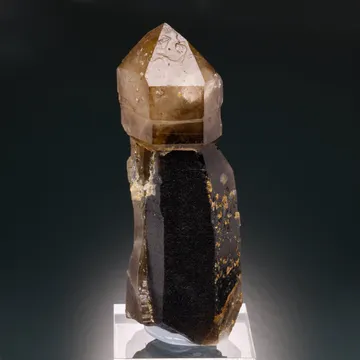
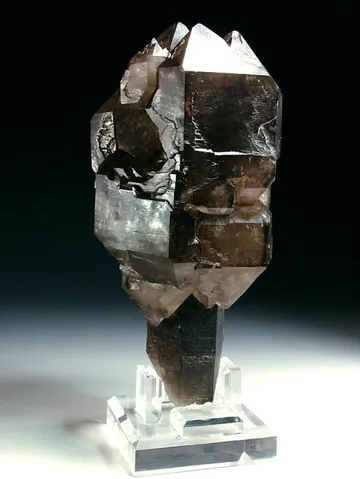
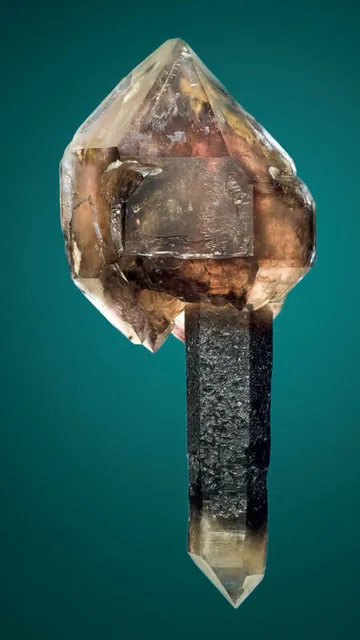
The pit’s fame rests on quartz in sculptural, multi-generation forms: smoky quartz stalks, amethyst caps, pale to reddish-brown phantom zoning, and scepter crystals whose later overgrowths preserve the growth history of the pocket. Mindat records only quartz as a valid mineral species at Crystal Tips No. 1, but it records that species in the varieties collectors care about here: amethyst, smoky quartz, and scepter quartz. The scepter occurrence is rated as especially significant, and that is exactly how the best pieces present themselves: not merely as loose points, but as built objects, with one crystal generation visibly overgrown by another.
Historically, Crystal Tips No. 1 belongs to the small, personality-rich world of late twentieth- and early twenty-first-century Western specimen mining. The operation appears in federal mine-safety records as a surface amethyst mine owned and operated by Jon L. Johnson, doing business as Hallelujah Mines, and worked intermittently rather than as a full-time industrial quarry. A 1999 field-collection reference cited for the locality records amethyst from Crystal Tips #1 measuring 15 x 10 cm. That is a serious size for American amethyst quartz, and it helps explain why specimens from this claim group have long traveled under labels such as Crystal Tips, Krystal Tips, Hallelujah Mine, Petersen Mountain, and Hallelujah Junction.
The finest Crystal Tips No. 1 pieces have a distinctive look. Expect sharp, glassy quartz forms with smoky brown, reddish-brown, pale lavender, and pinkish-purple zoning; occasional doubly terminated development; and the prized scepter habit in which a broader cap rides on, or partly envelops, an earlier stalk. Ordinary pieces may be simple smoky or amethystine points with contact marks or broken bases. Good pieces have architectural form, undamaged terminations, internal phantoms, strong contrast between stalk and head, and enough transparency that color zoning can be read through the crystal rather than merely seen on the surface.
Regional View
Country View
Crystal Tips No. 1 should also be understood as part of a very compact cluster of related Petersen Mountain workings. Crystal Tips No. 2 lies essentially next door, and the broader Petersen Mountain Quartz Mines and Royal Scepter Mine records document the same general style of quartz mineralization. This proximity is useful to collectors, but it is also the source of label confusion. A specimen labeled simply “Hallelujah Junction” may be completely legitimate, but a specimen labeled specifically “Crystal Tips No. 1 pit” carries a narrower claim-level meaning and should be treated with more precision.
Search for specimens: View all specimens from Crystal Tips No. 1 pit, USA
Crystal Tips No. 1 pit is a surface quartz-specimen working on Petersen Mountain, in the Hallelujah Junction area of Washoe County, Nevada. The Mindat locality record places it at about 39.88028, -119.99806 and identifies it as a pit. The old collector spelling “Peterson Mountain” is common on labels and in dealer descriptions, but “Petersen Mountain” is the locality spelling used in the formal Mindat hierarchy. “Hallelujah Junction” itself is the nearby California highway reference point that collectors adopted as the convenient name for the whole quartz-producing area.
The deposit is best described as a quartz-pocket system in granodioritic rock. Regional descriptions of Petersen Mountain emphasize fractured granite to granodiorite cut by quartz veins and pocket-bearing brecciated zones. In the specimen pits, collectors are not following a metal ore shoot; they are following quartz structures. Productive ground is suggested by milky vein quartz, broken and recemented zones, alteration selvages, open cavities, and widened seams where silica-rich fluids had space to deposit crystals. Repeated opening and mineral deposition are the key to the scepters: an earlier quartz crystal grows, conditions change, and a later quartz generation overgrows the tip, side, or termination region in the same crystallographic orientation.
Crystal Tips No. 1 was described by MSHA in 2000 as a surface amethyst mine. At that time it was owned and operated by Jon L. Johnson, DBA Hallelujah Mines, with total employment of two persons and intermittent operation amounting to about one month per year. Amethyst was extracted from a single bench in the pit. Overburden was removed, the mineral was extracted with a backhoe and track loader, and the material was hand-sorted; there were no plant or milling facilities, and the product was taken to rock shows for sale or trade. A federal citation following the 2000 fatal accident stated that the mine had been working since 1986, giving a firm documentary anchor for the operation’s modern production history.
The broader Petersen Mountain claim history is inseparable from Jon Johnson and Foster Hallman. Published field accounts and modern magazine coverage describe Johnson and Hallman staking claims in the area by the early 1980s, with Hallman associated especially with the northern ground and Johnson with the southern part of the claim block. Crystal Tips No. 1 belongs to that southern Hallelujah/Crystal Tips side of the story. Later accounts also describe partnership mining, paid digging, and continued specimen-oriented work using excavators to expose pockets before hand tools take over.
Access today must be treated as private-claim access, not casual public collecting. The productive Petersen Mountain quartz ground is covered by claims, and removing specimens from a staked claim without permission is not acceptable. Paid digs have been offered at times in the broader Hallelujah Junction claim area, often described as limited seasonal opportunities, but arrangements change with ownership, claim status, weather, road conditions, and active mining plans. The access road commonly referenced by field collectors is steep and can become a serious problem when wet; high-clearance four-wheel drive is not a luxury there.
The pockets at Crystal Tips No. 1 and adjacent Petersen Mountain workings can vary enormously. Some are small seams producing loose smoky or amethystine points. Others open into larger cavities with quartz projecting from the walls, breccia fragments, pocket clay, and scattered floaters. Modern descriptions from the broader locality mention pockets ranging from hand-sized openings to cavities many feet across, and collectors consistently emphasize that the last few centimeters of extraction are done with care: a screwdriver or steel pry tool used too aggressively can scar a face, snap a scepter head, or turn a cabinet piece into fragments.
Notable documented finds from Crystal Tips No. 1 include field-collected amethyst to 15 x 10 cm and pale pinkish-purple to reddish-brown scepter quartz with phantom zoning. Market records for specimens labeled Crystal Tips or Krystal Tips show smoky and smoky-amethyst scepters roughly 8 to 11 cm across or tall, including flattened light-smoky bases supporting gemmy scepter caps, doubly terminated smoky crystals on milky quartz matrix, and multicap scepters with dark smoky zones at the base and purple amethyst toward the termination. The best examples have the visual clarity of staged growth: stalk, cap, phantom, and color zone all readable at once.
Quartz from Crystal Tips No. 1 is the whole story of the locality: SiO2 expressed as colorless to milky quartz, smoky quartz, amethyst, and above all scepter quartz. Specimens range from small loose points and broken pocket crystals to cabinet-size scepters and field-collected amethyst masses; the documented 15 x 10 cm amethyst reference and 64 x 37 x 26 mm scepter photo record give useful scale for the pit. The typical Crystal Tips No. 1 quartz aesthetic is multi-stage rather than simple—older stalks, later overgrowths, phantom color zoning, reddish-brown smoky tones, and pale pinkish-purple to amethyst caps. Good pieces are sharply terminated, lustrous, and naturally complete through the scepter head; ordinary pieces are more likely to be contacted, bruised at the cap, or represented by incomplete bases from the pocket wall.
Smoky quartz from Crystal Tips No. 1 occurs as brown to reddish-brown crystals, commonly in scepter form and commonly associated with amethyst zoning in the same specimen. Mindat photo data for the pit associate smoky quartz with quartz, scepter quartz, and amethyst, matching the collector-market material labeled Crystal Tips or Krystal Tips: flattened smoky bases, darker smoky stalks, pale smoky or amethystine caps, doubly terminated crystals, and occasional multiple scepter heads. Strong pieces show transparent to translucent smoky interiors, high glassy luster, intact points, and a clean contrast between darker stem and lighter or purple cap. The most desirable smoky examples are not merely dark; they have form, zoning, and an undamaged scepter architecture that identifies them immediately as Petersen Mountain material.
Amethyst from Crystal Tips No. 1 is usually best appreciated as part of a mixed quartz growth history rather than as isolated Brazilian-style purple crystals. The locality is specifically noted for fine amethyst and smoky quartz scepters, and the recorded 15 x 10 cm field-collected amethyst from Crystal Tips #1 shows that the pit produced substantial amethyst material. Crystal Tips amethyst tends toward pale lavender, pinkish-purple, or purple zoning in caps, phantoms, and overgrowths, often riding on smoky quartz stalks or mingled with reddish-brown smoky color. Superior pieces show visible purple in transmitted light, crisp natural terminations, and convincing scepter or phantom structure; weaker examples may be only faintly tinted or too bruised at the termination to carry the locality’s best visual signature.
The published mineral list for Crystal Tips No. 1 is deliberately simple: quartz is the only valid species recorded, with amethyst, smoky quartz, and scepter quartz as its documented varieties. No type-locality mineral is tied to Crystal Tips No. 1 in the verified locality records. Nearby and closely related Petersen Mountain records broaden the specimen context with citrine, ametrine, muscovite, chlorite-group minerals, pyrite, epidote-group material, piemontite, and meta-autunite in the wider area or adjacent pits, but those should not be casually transferred onto a Crystal Tips No. 1 label unless the specimen’s own provenance supports it.
The first collector issue is locality precision. Crystal Tips No. 1, Crystal Tips No. 2, Krystal Tips Mine, Hallelujah Mine, Foster Hallman claim, Royal Scepter Mine, Petersen Mountain Quartz Mines, Petersen Mountain, Peterson Mountain, and Hallelujah Junction all appear in the labeling ecosystem of this district. Some labels are broad but honest; others may be imprecise. For a serious locality collection, a specimen with an old claim-level Crystal Tips No. 1 or Hallelujah Mines provenance is preferable to a generic “Hallelujah Junction” label, especially if the piece is unusually fine.
The second issue is repair. This locality produces scepters, and scepters are structurally vulnerable. The visual prize is often a heavy head on a narrower stalk, exactly the form most likely to break during pocket movement, excavation, cleaning, transport, or an old fall from a display shelf. Repaired Petersen Mountain scepters are known in the market, and auction descriptions sometimes stress “no repairs” because that status matters. A repair is not automatically disqualifying if disclosed, but it changes value substantially. Inspect the junction between stalk and cap, any adjoining crystals, and the base of a scepter head under magnification and strong side light.
Condition standards should be strict. A missing or bruised cap termination is far more serious than a broken attachment point at the base. Minor pocket contacts, etched areas, clay staining, and natural frosting can be acceptable, especially on smoky stalks, but polished-looking terminations, resin-filled fractures, glossy glue seams, or unnatural color concentration along cracks should raise questions. Matrix examples and scepter clusters should be checked where crystals meet milky quartz matrix, because that is where restoration can hide.
Color treatment is not documented as a Crystal Tips No. 1 scandal, but quartz color always deserves common-sense scrutiny. Petersen Mountain naturally produces smoky, amethyst, pale yellow to citrine-like, and mixed-color quartz in the broader deposit, so color alone is not evidence of treatment. Still, uniformly black smoky quartz with no internal zoning, suspiciously even yellow on a poorly provenanced piece, or purple that does not match the growth structure should be treated cautiously. Natural Crystal Tips material is often more interesting than uniform: phantoms, smoky rims, amethyst caps, reddish-brown zones, and uneven saturation are part of its charm.
Fluorescence is not a major buying point for the Crystal Tips No. 1 quartz suite. Handling is more important. These are hard minerals, but a hard mineral can still chip; quartz points and scepter cap edges will bruise if rattled together. Clean pocket clay gently, avoid aggressive acids unless you know exactly what coatings are present and what you are trying to remove, and never use steel tools inside a promising pocket surface or on a finished specimen face.
Rarity is tiered. Small smoky points and modest scepters from the broader Hallelujah Junction area remain obtainable. Good Crystal Tips-labeled scepters are scarcer, particularly with undamaged caps and old provenance. Large, transparent, sharply zoned, unrepaired smoky-amethyst scepters are genuinely difficult to replace. Doubly terminated floaters, multigeneration pieces with strong phantom zoning, and matrix examples with fine placement are the pieces that separate a locality suite from a tray of attractive but ordinary smoky quartz.
Market availability remains active enough that collectors can be selective. Older collection pieces appear in auctions, and recent Petersen Mountain production continues to circulate through dealers and field-collecting networks. Prices span a wide range: modest loose crystals may be accessible, small-cabinet scepters can trade in the low to mid hundreds depending on quality, and exceptional large scepters with strong form and no repair can rise dramatically. Buy the crystal, not the name alone; the difference between a bruised smoky point and a first-rate Crystal Tips scepter is enormous.
The modern story of Crystal Tips No. 1 begins not with a corporate mine office but with a rugged mountain claim culture. MSHA’s 2000 report describes a two-person, intermittent surface amethyst mine where the quartz was extracted by backhoe and track loader, hand-sorted, and carried to rock shows for sale or trade. That single paragraph is one of the clearest windows into the operation: a specimen mine small enough to have no mill, no plant, and no regular schedule, but productive enough to send amethyst and scepters into the collector market.
The mountain has always demanded more than casual enthusiasm. Field accounts of the broader Petersen Mountain workings describe a high, exposed claim area reached by a steep road that can turn nearly impassable in wet weather. Summer heat, wind, thunderstorms, sagebrush, and mechanical excavation all sit in the same scene as gemmy amethyst caps and smoky scepters. The work rhythm is familiar to anyone who has mined pockets with machinery nearby: the excavator removes overburden and fractured rock, a watcher reads the vein signs, and when a pocket appears everything stops. From that moment, the job changes from mining to surgery.
One of the best modern descriptions comes through geologist Ian Merkel’s remarks in Rock & Gem. He had been visiting the locality for 16 years and described the signs as subtle: alteration zones projecting outside the veins, hints in the breccia, small changes that tell an experienced digger the machine is close to something. The pocket might be only three inches across, or it might open to fifteen feet. Ryan Anderson, part of the southern claim partnership, gave the collector’s version of the same moment: unearthing a scepter is “a treasure.” That is precisely the feeling the specimens preserve. A fine Crystal Tips scepter is not just quartz; it is the instant a hidden cavity became visible.
The old field culture around Foster Hallman’s side of Petersen Mountain has become almost folklore. Scott’s Rock & Gem published a memorable account of collecting on “Peterson Mountain,” using the old spelling, and remembered Hallman as a Reno fireman who had mined the locality for decades. The stories are rough-edged, comic, and unmistakably Western: long absences down the mountain, after-dark digging, claim rules, backhoe work, pocket clay, and the painful arithmetic of who got to keep the best crystal. One collector recalled a rule under which anything valued over $100 belonged to Foster, a condition that could turn every fine smoky scepter into a moment of mixed joy and resignation.
That same field account gives one of the locality’s most vivid pocket scenes. After a discouraging start, the backhoe finally opened a good cavity. A ten-inch smoky crystal came out first. Then, after more careful work, a plate roughly ten by ten inches emerged, carrying smokies and a fat scepter. The day produced thumb-sized points and another large scepter, and then shifted abruptly when a young boy fell down the hill and had to be taken for medical help. Later, in fading light, the collector returned to what seemed an emptied pocket and scraped almost idly in the bottom. A face appeared in the dirt: a large “turkey-head” scepter with another scepter bridging into its base. It is exactly the sort of find that keeps people returning to difficult quartz localities long after easier hobbies have suggested themselves.
Crystal Tips No. 1 also has a tragic chapter. On May 9, 2000, John D. Lucchesi, Sr., a 51-year-old dozer operator with 30 years of mining experience, was clearing large boulders from above the pit when the John Deere 850C dozer lost traction on a steep slope and rolled down the hillside. MSHA’s report says he was found on the slope about 440 feet from where the machine came to rest. The agency concluded that the mining method used for removing overburden was unsafe and that seatbelt maintenance and use contributed to the severity of the accident. For collectors, the report is a sober reminder that even a “gem” or “amethyst” mine can involve heavy equipment, steep ground, and irreversible consequences.
The stories surrounding Crystal Tips and Petersen Mountain are part of the specimens’ appeal, but they should not be romanticized into carelessness. The mountain has produced delicate lavender caps, smoky phantoms, dark stems, and some of the great American scepter quartzes. It has also produced broken crystals, repaired stems, hard roads, difficult pockets, and real danger. A fine Crystal Tips No. 1 specimen carries both halves of that history: the elegance of repeated quartz growth and the human effort required to bring it out whole.
Mindat locality record: Crystal Tips No. 1 pit, Petersen Mountain, Hallelujah Junction area, Washoe County, Nevada, USA — Primary locality record for the pit, with coordinates, hierarchy, mineral list, and references for quartz, amethyst, smoky quartz, and scepter quartz.
Mindat occurrence record: Amethyst from Crystal Tips No. 1 pit — Occurrence record documenting quartz var. amethyst at the pit and citing J. Schlegel’s 1999 field-collected amethyst reference.
Mindat occurrence record: Smoky Quartz from Crystal Tips No. 1 pit — Occurrence record documenting smoky quartz and photo-based associations with quartz, scepter quartz, and amethyst.
Mindat occurrence record: Sceptre Quartz from Crystal Tips No. 1 pit — Occurrence record for the pit’s most important habit variety, rated excellent or very significant on Mindat.
J. Schlegel, 1999, report to the Mineralogical Society of Southern California, “Field Collected Quartz, v. Amethyst measuring 15 x 10 cm; Crystal Tips #1, Hallelujah Mine, Petersen Mountain, Washoe County, Nevada; May 31st,” cited in the Mindat locality and occurrence records — Important claim-level reference for sizable field-collected amethyst from Crystal Tips No. 1.
Stephen B. Castor and Gregory C. Ferdock, Minerals of Nevada, Nevada Bureau of Mines and Geology Special Publication 31, 2004 — Standard Nevada mineral reference cited by Mindat for Petersen Mountain quartz localities and their varieties.
Ian Merkel, Paul Geffner, Joe George, and Rick Kennedy, “The Hallelujah Junction scepter quartz deposit, Petersen Mountain, Nevada,” The Mineralogical Record, Vol. 53, No. 2, March–April 2022, pp. 205–239 — Major modern collector publication on the Petersen Mountain/Hallelujah Junction scepter quartz deposit.
Mindat reference page for The Mineralogical Record Vol. 53, No. 2, “Hallelujah Junction!” — Bibliographic record listing the Hallelujah Junction scepter quartz article and issue details.
Mine Safety and Health Administration, Report of Investigation, Fatal Machinery Accident, May 9, 2000, Crystal Tips No. 1, Jon L. Johnson DBA Hallelujah, Reno, Washoe County, Nevada, ID No. 26-02417 — Federal report documenting ownership, mining method, intermittent production, and the 2000 fatal dozer accident at Crystal Tips No. 1.
Smithsonian National Museum of Natural History, Quartz var. amethyst, NMNH G11640 — A 172.23 ct Hallelujah Junction amethyst gem in the National Gem Collection, useful for the broader gem significance of the district.
Mindat: Crystal Tips No. 1 pit — Best single reference for the exact pit locality, mineral list, coordinates, and formal hierarchy.
Mindat: Locality maps for Crystal Tips No. 1 pit — Coordinate and mapping page for the pit; use only as a reference and not as permission to visit.
Mindat: Petersen Mountain locality — Broader locality context for Petersen Mountain, the “Peterson Mountain” misnomer, and associated quartz occurrences.
Rock & Gem Magazine: “Hallelujah Junction Mine: Quartz is King” — Readable modern field-oriented overview of the Petersen Mountain quartz claims, access conditions, pocket digging, and scepter collecting.
The Quartz Page: Smoky Quartz — Detailed mineralogical and locality discussion of smoky quartz, including Petersen Mountain/Hallelujah Junction habits and pocket setting.
The Quartz Page: Amethyst — Includes a Petersen Mountain amethyst scepter example and useful discussion of amethyst growth and color.
Mineralogical Record: Hallelujah Junction! Vol. 53, No. 2 — Back-issue page for the major 2022 article on the Hallelujah Junction scepter quartz deposit.
MSHA fatal accident report: Crystal Tips No. 1 — Essential primary document for the mine’s 2000 operating details and safety history.
Scott’s Rock & Gem: “An Odd Place To Dig – A Story” — Personal field narrative from Petersen Mountain with vivid recollections of Foster Hallman-era collecting.
Mineral Auctions: DT Smoky Quartz crystals, Crystal Tips Mine — Useful market record for a Crystal Tips-labeled smoky quartz specimen, including dimensions, condition notes, and auction result.
Minfind: Quartz var. smoky and amethyst from Krystal Tips Mine — Dealer-archive record illustrating the smoky-amethyst scepter style and 2015 production attributed to Krystal Tips.
Smithsonian: Quartz var. amethyst, NMNH G11640 — Smithsonian object page for the 172.23 ct Hallelujah Junction amethyst gem.