Quartz from Hallelujah Junction, USA - smoky scepters with caps, phantoms, and color zoning from granodiorite pockets; a sculptural, collector-favorite localit…
Key facts
“Hallelujah Junction” is the collector’s name for a group of quartz crystal occurrences on Petersen Mountain, north of Reno, straddling the California–Nevada line but best documented in Washoe County, Nevada. The name is slightly misleading in the useful old rockhound way: Hallelujah Junction itself is the highway junction down in California, while the celebrated quartz comes from pockets higher on Petersen Mountain. Collectors use the name because it is memorable, and because the crystals have become distinctive enough that “Hallelujah” now means a recognizable style of American quartz.

Photo: Wikimedia Commons
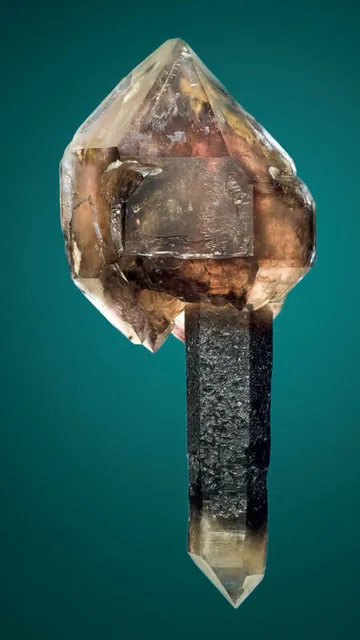
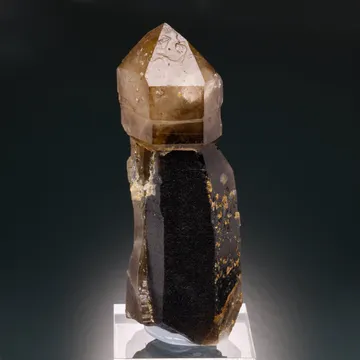
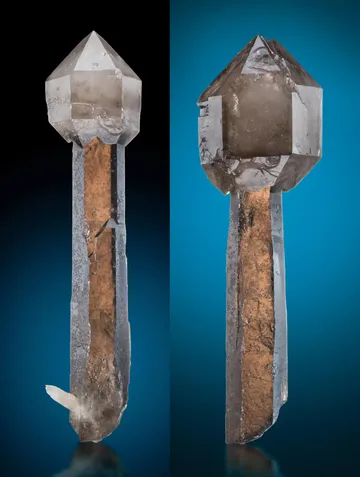
The classic specimen is a smoky quartz scepter: a dark, often nearly morion-colored stalk rising into a swollen, brighter cap that may be smoky, pale golden, amethystine, milky, or zoned in several of those tones at once. The best pieces have architectural presence. They are not merely pointed crystals; they look built in stages, with one generation of quartz overgrowing another. Some have glassy caps on darker stems, some show phantoms and internal veils, and some broaden into “turkey head” scepters or doubly terminated floaters. Local collectors also use the nickname “candles” for smoky crystals capped by yellowish citrine-like tips.
The setting is a granitic-pocket quartz locality developed in and around granodiorite. The pocket system has produced smoky quartz, amethyst, citrine, ametrine, colorless quartz, and scepter forms, along with mica, chlorite-group minerals, and pyrite in some pockets. The mineralogical interest lies in repeated growth events: first a quartz core or stalk, then later silica-rich fluids depositing overgrowths, caps, phantoms, and color zoning. The locality’s appeal is therefore both sculptural and geological; the better specimens preserve a visible sequence of pocket growth.

Photo: Wikimedia Commons
Historically, the locality sits at the intersection of field collecting, small-scale specimen mining, and the modern market for high-grade American quartz. The pockets were known to collectors by the mid-20th century, but the locality’s reputation grew strongly after claims were staked and mined by figures including Foster Hallman and Jon Johnson. In recent years, Petersen Mountain material has remained visible through private-claim production, paid digs, dealer offerings, and major magazine coverage. Serious collectors look for natural form first: an undamaged scepter head, a clean contrast between stalk and cap, doubly terminated development, transparent or gemmy areas, attractive smoky-to-amethyst or smoky-to-citrine zoning, and minimal repair.
Search for specimens: View all quartz specimens from Hallelujah Junction, USA
The Hallelujah Junction quartz occurrences are centered on Petersen Mountain, roughly north of Reno, in the Hallelujah Junction area of Washoe County, Nevada, with related collecting also reported from the California side of the line. Mindat treats Petersen Mountain as the proper locality framework and notes that “Peterson Mountain” is a common misnomer; “Hallelujah Junction” persists because it was the easy meeting point and highway reference for diggers headed up the mountain.
The deposit is best understood as a quartz-pocket system in granodioritic terrain rather than as an ore mine. The productive zones are pockets, seams, and cavities that may range from tiny openings to large vugs. At the Crystal Tips pits and related Petersen Mountain Quartz Mines, the documented mineral suite is dominated by quartz and its varieties: amethyst, smoky quartz, citrine, ametrine, and scepter quartz. Crystal Tips No. 2 adds muscovite, pyrite, and chlorite-group minerals to the immediately documented pocket assemblage. Broader Petersen Mountain records include additional species such as piemontite, epidote, and meta-autunite, but the collectible fame of the locality rests overwhelmingly on quartz.
Mining history is largely specimen-mining history. The quartz was recognized by collectors at least by the 1940s. By the early 1980s, Jon Johnson and Foster Hallman had staked official claims in the area, with Hallman associated with the northern ground and Johnson with the southern ground. The named localities and claims that collectors encounter in labels include Petersen Mountain Quartz Mines, Crystal Tips No. 1 pit, Crystal Tips No. 2 pit, Royal Scepter Mine, the Foster Hallman claim, and later partner-operated claim blocks. The 2024 Nevada Active Mines Directory lists “Petersen Mountain” in Washoe County with operator Hallelujah Partners, showing that the locality remains part of Nevada’s active mine-reporting landscape.
Access is a serious matter. These are not open public collecting grounds in the casual sense. Multiple private mining claims cover the important quartz-producing areas, and collecting on an active or staked claim requires permission from the claim or mineral-rights holder. Paid digs have been offered at times, commonly described as seasonal opportunities, but they are controlled access, not a standing invitation. The road situation reinforces the point: the route up Greasy Hill Road can be steep, winding, and poor when wet, and high-clearance four-wheel drive is strongly recommended by those who know the area.
Production has been episodic rather than continuous industrial mining. Work has ranged from hand digging and backhoe-assisted pocket opening to modern claim operations using heavier equipment to remove overburden and expose new pocket-bearing ground. Notable finds include large smoky and amethyst scepters, amethyst/citrine combinations, enhydros, doubly terminated floaters, and uncommon matrix plates. Published and museum records document field-collected amethyst to 15 x 10 cm, crystals reported to 35 cm from the Foster Hallman claims, and a 29.7 cm quartz scepter featured on the cover of the March–April 2022 issue of The Mineralogical Record.
The defining habit is the scepter. In the ideal Hallelujah Junction example, a dark smoky quartz stalk supports a broader cap that may be lighter smoky, nearly colorless, milky, amethystine, or pale yellow to citrine-like. The transition from stalk to head can be abrupt and crisp, giving the crystal a ceremonial, almost manufactured symmetry, or it can be complex and skeletal, with stepped faces, etched surfaces, sidecar crystals, and secondary overgrowths.
Color zoning is one of the locality’s great pleasures. Smoky stems may grade into clearer, golden, or purple caps; some crystals show amethyst and smoky areas in the same head; and some display internal phantoms that follow earlier crystal outlines. In the best pieces, these color zones are not random stains but crystallographic architecture preserved in the quartz. Backlighting often reveals much more color than is obvious in ordinary room light, especially in pieces with dark stalks and translucent caps.
Crystal forms range from small loose points and thumb-sized pocket crystals to small-cabinet and cabinet scepters. Dealer and museum records show common collector-size specimens from about 5 to 13 cm, while notable crystals and plates can be much larger. Documented examples include 7.4 cm and 9.5 cm Wikimedia specimens, 9 cm commercial scepters, 13 cm cabinet crystals, 15 x 10 cm amethyst, and larger exceptional pieces reaching several tens of centimeters. Matrix specimens are scarcer than single crystals; many pockets yield loose crystals or crystals separated from fragile decomposed granitic material.
Doubly terminated crystals and floaters are especially desirable. Some scepters are recrystallized on the bottom or have no obvious point of attachment, giving them a complete 360-degree form. Others show secondary crystals perched on the scepter head or attached along the stalk. “Elestial” or skeletal textures, chisel-like terminations, etched faces, frosted surfaces, and internal veils are all seen in the locality’s material, and they are part of its personality rather than automatic defects.
Associated minerals are usually subordinate, but they matter for identification and aesthetics. Muscovite and chlorite-group inclusions or coatings can create snowy, mossy, or phantom-like effects inside smoky quartz. Pyrite is documented from Crystal Tips No. 2. The broader Petersen Mountain area also has mineralogical records for piemontite and other species, but in specimen terms the associations most often discussed with the quartz are mica, chlorite, pyrite, and other quartz varieties.
Quality is judged by form, completeness, and contrast. A first-rate Hallelujah Junction quartz should have a sharp, natural termination; an intact scepter head; good luster; attractive zoning; and no major undisclosed repair. A dark smoky stalk with a clear, golden, amethyst, or milky cap is a classic look. Damage to the cap is more serious than damage at the base, because the scepter head is the visual focus. Complete floaters, dramatic bicolor examples, amethyst/smoky combinations, and large unrepaired scepters are the most sought-after.
No well-documented, locality-specific fake industry for Hallelujah Junction quartz emerged in the sources reviewed, but collectors should still examine pieces with the same skepticism applied to any valuable quartz. The most important issue is not outright fabrication; it is repair. Large scepters from this locality are often fragile in the stem-to-head relationship, and pocket movement, extraction, transport, and cleaning can break crystals into sections. Repaired and even lightly restored examples circulate in the market, sometimes perfectly acceptable if disclosed, but they should be priced and described accordingly.
The specific warning signs are familiar: glue lines at the base of the scepter head, a repaired join where the stalk meets an adjacent crystal, resin filling in missing areas, unnatural gloss in a fracture, or a termination that appears polished rather than naturally lustrous and striated. Several auction descriptions for Hallelujah Junction pieces explicitly emphasize “unrepaired” status because repairs are common enough that an intact cabinet scepter carries a premium.
Condition issues are also predictable from the habit. Fat scepter heads are prone to bruising on points and prism edges. Dark smoky stalks may show natural etching, frosting, and contact marks that are not necessarily damage. Many pieces have broken or incomplete bases where they were attached to a pocket wall. Loose crystals may be excellent, but matrix examples are less common and should be checked carefully for restoration where crystal meets host.
Color treatment is not a documented locality scandal, but smoky quartz in general can be artificially irradiated and amethyst can be heat-altered to produce yellow tones. Hallelujah Junction naturally produces smoky quartz, amethyst, citrine-like yellow zones, and mixed-color crystals, so the mere presence of dark smoky or yellowish color is not suspicious. What matters is provenance, internal zoning, and surface integrity. Uniform, overly black color with no natural zoning, especially on a weakly documented specimen, deserves closer questioning.
Rarity is tiered. Small smoky points and modest scepters are obtainable. Good cabinet-size scepters with sharp, clean caps are scarcer. Large, unrepaired, highly aesthetic scepters with strong smoky/amethyst or smoky/citrine contrast are much harder to replace. Doubly terminated floaters, fine matrix plates, and large amethyst-rich scepters sit at the high end of the locality.
Current market availability remains active because the locality has seen relatively recent production and because older collections continue to release specimens. Recent public auction and dealer records show small to cabinet pieces selling across a broad range: modest examples around low hundreds of dollars, better cabinet scepters in the mid hundreds, and top unrepaired large examples commanding far more when form, size, and condition align. A collector should buy the specimen, not just the locality name: the difference between a bruised loose point and a world-class Hallelujah scepter is enormous.
Petersen Mountain has always had a claim-camp flavor: dust, wind, machines, long looks at pocket walls, and the sudden change in mood when a hollow opens. The modern paid-dig version still follows an old rhythm. Heavy equipment peels back decomposed granitic overburden until a vein or alteration zone gives a sign. Then the machine stops. The work changes instantly from force to delicacy. Diggers move from buckets and backhoes to hand tools, probing mud, seams, and loose plates of rock for the unmistakable shine of quartz.
Ryan Anderson described the lure plainly: the scepter pocket is the dream. A pocket may be no more than a three-inch opening, or it may open into a cavity many feet across. When a productive pocket appears, the scene can look like a miniature cave full of crystal growth. But the best diggers are cautious. Ian Merkel’s warning about screwdrivers in pockets is the kind of sentence every field collector should remember: rough scraping can turn a fine scepter into a bag of fragments. Chopsticks, gentle prying, and patient mud removal often do better work than force.
The mountain itself shapes the experience. The top of Petersen Mountain is high, exposed, and short on shade. Summer heat is real; wind is a constant companion; thunderstorms can turn the work from exciting to urgent in minutes. The access road can be treacherous when wet. The reward is that peculiar high-desert theater: sagebrush and bitterbrush, long views toward valley bottoms and lakes, a dig face scraped fresh by machinery, and then the intimate glow of a crystal face appearing in pocket mud.
One of the better modern collecting accounts describes a day that began with frustration and ended with exactly the kind of improbable find that keeps diggers returning. After hours of work in a productive pocket, several fine pieces had already come out: a 10-inch smoky crystal from the mouth of the pocket, then a 10 x 10 inch plate of smokies with a fat central scepter, and later another large scepter. The pocket appeared finished. The claim owner had taken the major pieces under the collecting agreement. The digger went back anyway, scooping at the dirt in the bottom of the now-empty cavity.
At dusk, a crystal face appeared where there should have been nothing left. The cavity floor had a crack partly filled over centuries by mud and decomposed granite, and a large fallen crystal had lain hidden in it. What came out was a large “turkey headed” scepter with a second smaller scepter bridging into it at the base. The account describes it as filling the collector’s hand and feeling like the mountain had finally handed over its prize. That is classic Hallelujah Junction: not just finding quartz, but finding a later growth history wrapped in pocket mud at the last possible moment.
Foster Hallman remains central to the folklore. He was a Reno fireman and longtime miner of the Petersen Mountain claims, remembered by collectors as an outsized personality as well as a source of great smoky-amethyst scepters. One field story paints him almost mythologically: in the early days, before easy vehicle access, he had gone down toward Hallelujah Junction for beer and returned across the sage wearing only boots and carrying the case. The quoted image from the witness is unforgettable: a “giant cherub” coming back over the mountain. Whether one treats the story as camp comedy or local legend, it belongs to the claim culture that produced the crystals.
The mountain also had its wild side. In another account, paying diggers worked late after a poor day, camping under the stars above the distant highway. Around 3 a.m., five or six trespassers came over the rim into the pit and began scavenging. One reached into a pocket the day’s diggers were certain had already been checked and produced a large doubly terminated elestial. The narrator later convinced himself the crystal had probably been palmed in advance, a kind of “Lucky Digger ceremony,” because otherwise he would have to accept that a good crystal had been missed in plain reach. Every serious field collector understands the anxiety behind that joke.
The Rock & Gem account brings the same drama into more recent, organized digging. Bryan Major of The Crystal Collector recalled that once claim crews scraped the walls with an excavator, visitors had to be ready for a heavy day. His group found fist-sized amethysts, amethyst/citrine combinations, several scepters, and an amethyst with a moving water bubble. That last detail is exactly the kind of small marvel that makes a field locality outlive its production statistics: not just “quartz was found,” but a water bubble sealed inside an amethyst from a high desert pocket.
Ian Merkel, Paul Geffner, Joe George, and Rick Kennedy, “The Hallelujah Junction scepter quartz deposit, Petersen Mountain, Nevada,” The Mineralogical Record, Vol. 53, No. 2, March–April 2022, pp. 205–239 — The major modern collector publication on the locality; the issue is titled “Hallelujah Junction!” and features a 29.7 cm quartz scepter from the deposit on the cover.
Stephen B. Castor and Gregory C. Ferdock, Minerals of Nevada, Nevada Bureau of Mines and Geology Special Publication 31, 2004 — Cited by Mindat for Petersen Mountain Quartz Mines and its quartz varieties, including amethyst, citrine, and smoky quartz.
Rocks and Minerals, 2007, Vol. 82, pp. 415–418, as cited for Crystal Tips No. 2 pit — Mindat’s reference for Crystal Tips No. 2 species including quartz, amethyst, ametrine, citrine, smoky quartz, muscovite, pyrite, and chlorite-group minerals.
J. Schlegel, 1999, report to the Mineralogical Society of Southern California, as cited by Mindat for Crystal Tips No. 1 pit — Field-collected quartz var. amethyst measuring 15 x 10 cm is recorded from Crystal Tips #1, Hallelujah Mine, Petersen Mountain, Washoe County, Nevada, May 31.
Smithsonian National Museum of Natural History, Quartz var. amethyst, NMNH G11640 — A 172.23 ct Hallelujah Junction amethyst gem, credited to Greg Polley, described by the Smithsonian as the first from this locality for the National Gem Collection.
Mindat occurrence record: Quartz from Foster Hallman claims — Records crystals to 35 cm and habits including smoky and amethyst-tipped scepters, “dumbbells,” and doubly terminated crystals.
Mindat locality: Petersen Mountain Quartz Mines — Core locality record for the group of quartz mines on the northern end of Petersen Mountain, with coordinates, species list, and reference framework.
Mindat locality: Royal Scepter Mine — Locality record for Royal Scepter Mine, documenting quartz, amethyst, scepter quartz, and smoky quartz from the Petersen Mountain / Hallelujah Junction area.
Mindat locality: Crystal Tips No. 1 pit — Locality record noting fine amethyst and smoky quartz scepter production and documenting the Crystal Tips No. 1 mineral list.
Mindat locality: Crystal Tips No. 2 pit — Locality record documenting ametrine, citrine, smoky quartz, amethyst, muscovite, pyrite, and chlorite-group minerals from the Crystal Tips No. 2 pit.
Rock & Gem Magazine — “Hallelujah Junction Mine: Quartz is King” — The best accessible narrative overview of the modern locality, with interviews, access notes, pocket-mining details, and field flavor.
The Mineralogical Record — Vol. 53, No. 2, 2022, “Hallelujah Junction!” — Essential print reference for serious collectors of Petersen Mountain scepter quartz.
Mindat — Petersen Mountain locality page — Broad locality framework explaining the Petersen Mountain / Hallelujah Junction naming issue and listing the documented mineral suite.
Mindat — Petersen Mountain Quartz Mines — Focused locality record for the quartz mines, with coordinates, mineral list, and references.
Mindat — Crystal Tips No. 1 pit — Useful for Crystal Tips #1 labels and the documented amethyst, smoky quartz, and scepter quartz records.
Mindat — Crystal Tips No. 2 pit — Useful for Crystal Tips #2 labels and associated minerals such as muscovite, pyrite, and chlorite-group minerals.
Mindat — Royal Scepter Mine — Useful for Royal Scepter Mine labels and photo references.
Smithsonian NMNH — Hallelujah Junction amethyst, NMNH G11640 — Museum record for a 172.23 ct amethyst gem from Hallelujah Junction.
Wikimedia Commons — Petersen Mountain Quartz Mines category — Freely licensed photographs of classic Petersen Mountain scepter quartz specimens.
Scott’s Rock & Gem — “An Odd Place To Dig – A Story” — Colorful firsthand field recollections from Petersen Mountain, including Foster Hallman-era collecting stories.
American Gemstones — Hallelujah Junction — Short gem-oriented overview explaining why the highway-junction name became attached to the nearby quartz deposits.
Nevada Active Mines Directory for 2024 — State listing that includes Petersen Mountain in Washoe County under Hallelujah Partners.
Minfind — Hallelujah Junction quartz scepter market example — Recent dealer listing showing size, price, and description for a smoky quartz scepter from Petersen Mountain.
Mineral Auctions — Hallelujah Junction smoky quartz scepter, unrepaired floater — Auction record useful for market context, condition language, and the premium placed on unrepaired scepters.