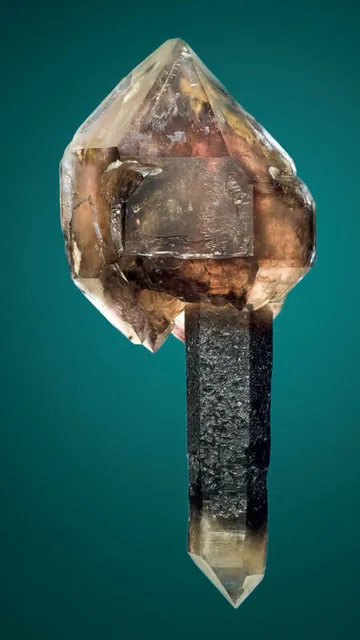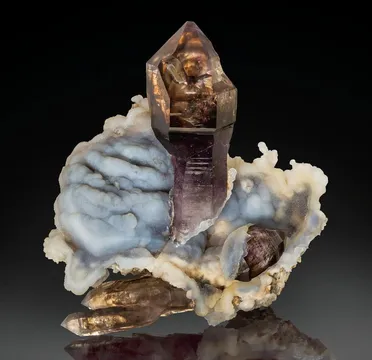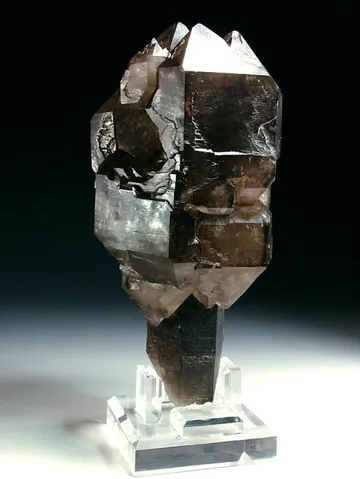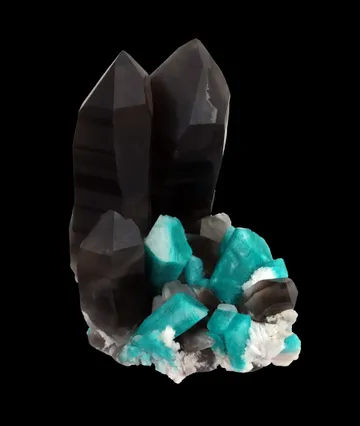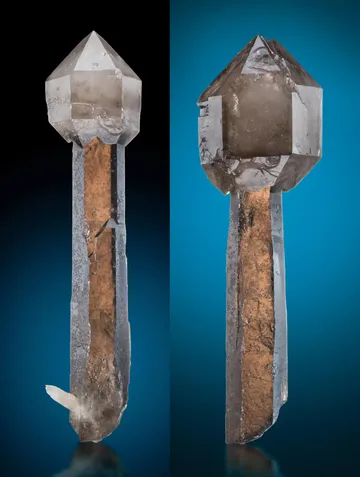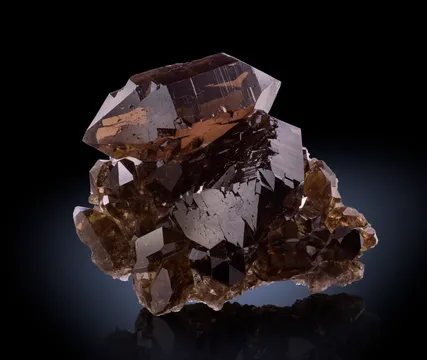
Smoky Quartz - Hallelujah Junction, USA: dramatic scepter crystals, sharp terminations, internal zoning, multi-stage growth from Petersen Mountain.
Key facts
Hallelujah Junction smoky-quartz is one of the great American quartz styles: dramatic, architectural, and instantly recognizable. The classic specimen is a scepter—usually a darker smoky stem carrying a broader, often clearer or lighter smoky cap—but the locality also yields doubly terminated floaters, skeletal and elestial growth, smoky-amethyst combinations, phantoms, and rare citrine-bearing pieces. Good crystals have the sculptural presence collectors want from a cabinet quartz: a strong silhouette, clean prism faces, sharp rhombohedral terminations, internal zoning, and enough transparency that the smoky color seems to float inside the crystal rather than sit on the surface.

Photo: Wikimedia Commons
The name “Hallelujah Junction” is collector shorthand rather than a precise mine name. The quartz occurrences are on Petersen Mountain, a north-south summit on the California-Nevada line north of Reno; the road junction that gave the collecting area its famous name lies several miles away in California. Labels may read Hallelujah Junction, Petersen Mountain, Peterson Mountain, Crystal Tips, Foster Hallman claim, Royal Scepter Mine, or Petersen Mountain Quartz Mines, and all can refer to material from the same broader crystal-producing system.
Geologically, the specimens come from pockets and cavities in milky quartz veins cutting granodiorite. The crystals grew from silica-rich fluids in a system that saw repeated deposition events: one phase could produce a stalk, another could overgrow it as a cap, and later shifts in chemistry, temperature, space, and irradiation could leave zones of smoky brown, purple amethyst, honey-yellow citrine, or milky-white internal clouds. That multi-stage growth is the heart of the locality’s appeal. Hallelujah Junction specimens look less like simple points and more like little geological histories standing upright.

Photo: Wikimedia Commons
Historically, Petersen Mountain entered collector lore through decades of claim work and fee digs, especially the claims associated with Foster Hallman and Jon Johnson. The area was already recognized for quartz by the mid-twentieth century, formal claims were being staked by the early 1980s, and by the 2000s the locality had become a fixture in western U.S. field-collecting stories and show displays. The 2022 Mineralogical Record article on the Hallelujah Junction scepter quartz deposit confirmed what collectors had long known: this is not just another smoky quartz locality, but a major American source for large, fine scepter quartz.
Search for specimens: View all smoky-quartz specimens from Hallelujah Junction, USA
The Hallelujah Junction quartz locality is best understood as a cluster of quartz-producing claims and pits on Petersen Mountain in Washoe County, Nevada, with related collecting and labeling history on the adjacent California side. Mindat’s locality hierarchy places the better-known Nevada occurrences under Petersen Mountain in the Hallelujah Junction area, including the Petersen Mountain Quartz Mines, Crystal Tips No. 1 pit, Crystal Tips No. 2 pit, and Royal Scepter Mine. The spelling “Peterson Mountain” is common on old labels and dealer descriptions, but “Petersen Mountain” is the form used in the Mindat locality name.
The deposit type is a quartz-vein pocket system in granodiorite. Collectors encounter the specimens as crystals lining open spaces in quartz veins and brecciated zones, not as ore minerals from a conventional metal mine. Milky quartz veins, fractured wall rock, alteration selvages, and pockets are the essential field clues. Some pockets are only a few inches across; others have been described by miners as large enough to work into carefully after mechanical exposure. The finest pockets can contain scepters projecting from walls, detached crystals in vug mud, plates of smaller smoky crystals, amethyst crystals, and composite smoky-amethyst-citrine pieces.
The mountain itself is high, exposed, and unforgiving. Access has been described from the Reno area northward toward California State Route 395 and then onto rough roads such as Greasy Hill Road. Dry conditions can still demand high-clearance four-wheel drive, and wet conditions can make the road hazardous. The claim area has little shade, strong wind, summer heat, and thunderstorm risk. This is not casual roadside collecting country.
Collecting access is controlled by claims and permission. The mountain has long been covered by multiple claims; some collecting has been allowed through fee digs, club trips, or direct permission, but collecting on an active claim without permission is not acceptable and may be illegal. Modern reports also mention paid mining opportunities in a limited late-spring window, especially around mid-May to mid-June, but access arrangements change and should be confirmed directly with the current claim operators before any trip is planned.
Mining history is tied strongly to named collectors and claim holders. The quartz occurrences were recognized at least as early as the 1940s. By the early 1980s, Jon Johnson and Foster Hallman had staked claims in the area, with Hallman associated with the northern side and Johnson with the southern side in later accounts. Foster Hallman, a Reno firefighter and longtime mineral collector, became inseparable from the Crystal Tips/Hallelujah story; many older cabinet and small-cabinet smoky scepters in collections trace to his claim or to field trips he hosted.
Production has been episodic rather than continuous industrial mining. The best specimens appear when crews intersect the right pockets, and the locality’s output can vary from loose thumb-sized smoky points to superb scepters and plates. Significant finds continued into the 2000s, with a 2006 Tucson display by Krystal Tips Mining noted in Mindat photo records, a widely discussed large Petersen Mountain quartz specimen reported in Mineralogical Record’s 2009 “What’s New” coverage, and later production important enough to anchor a 35-page locality article in the March-April 2022 Mineralogical Record.
The signature form is the smoky quartz scepter. A typical Hallelujah Junction scepter has a darker smoky, sometimes nearly black lower stem and a broader cap that may be lighter smoky, clear, citrine-toned, amethystine, or internally clouded with milky quartz. The best examples are sharply hexagonal, lustrous, and transparent to translucent, with a strong size contrast between stalk and cap. The locality also produces “turkey-head” scepters—large caps with short or missing stems—plus multi-cap scepters, penetrated crystals, doubly terminated floaters, skeletal growth, elestial faces, and complex asymmetric overgrowths.
Color is one of the great pleasures of the locality. Smoky tones range from pale tea and root-beer brown to deep charcoal and morion-like black. Some specimens show smoky stems with purple amethyst caps; others grade into yellowish or citrine-like tips. Local collectors have called some citrine-capped smoky crystals “candles” because the yellow top resembles a flame on a darker stem. Bicolored and tricolored crystals are especially desirable when the zoning is natural, sharply expressed, and visible in transmitted light.
Size ranges from thumbnail and miniature points to major cabinet specimens. Common collectible pieces are single crystals or small clusters a few centimeters long. Small-cabinet scepters around 7 to 10 cm are regularly seen in dealer and auction records. Larger cabinet pieces in the 11 to 15 cm range are much more serious, especially if unrepaired and displayable from multiple angles. Exceptional scepters and plates can be substantially larger, and the 2022 Mineralogical Record cover specimen was a 29.7 cm quartz scepter from the deposit.
The associated mineral suite is simple but telling. The essential species is quartz, expressed as smoky quartz, amethyst, citrine, ametrine, colorless quartz, and milky quartz. Mindat records for the Crystal Tips No. 2 pit also list muscovite, pyrite, and chlorite-group minerals; Rock & Gem’s locality account likewise notes pyrite, mica, and chlorite as contributors to the appearance of some crystal groups and scepters. Muscovite inclusions or coatings, chloritic material, iron staining, and milky internal clouds can either add character or reduce desirability depending on how they affect transparency and composition.
Collectors judge Hallelujah Junction smoky-quartz by architecture first. A strong scepter habit, a straight undamaged stem, a well-centered cap, sharp termination, and clean display face matter more than mere darkness. Transparency and internal zoning are major value factors. A crystal with a dark stem and a luminous smoky-to-clear or smoky-to-amethyst cap can be more desirable than a uniformly black point. Doubly terminated floaters, unrepaired large crystals, and pieces with a natural base or matrix of smaller quartz crystals command special attention.
Condition is especially important because many crystals were recovered from tight pockets, vug mud, decomposed granodiorite, or collapsed pocket debris. Natural rehealing, recrystallized bases, contact areas, and growth interference are common and should be distinguished from fresh mining damage. Some irregular terminations are growth features, not damage, but bruised edges, chipped tips, and broken stems are also common. Large scepters may have been found in multiple pieces and reassembled; that is not automatically disqualifying, but it should be disclosed and reflected in price.
The first authenticity issue is locality precision. Hallelujah Junction labels can be geographically loose. Some specimens are labeled Nevada, some California, some Petersen Mountain, some Peterson Mountain, and some simply Hallelujah Junction. For serious collections, a label naming the claim or pit—Foster Hallman claim, Crystal Tips No. 1 or No. 2, Royal Scepter Mine, Petersen Mountain Quartz Mines—is preferable to the broad “Hallelujah Junction” tag alone. Older labels may still be perfectly legitimate, but they should be read as historical collector usage rather than exact mapping.
The second issue is repair. Large Hallelujah Junction scepters are often naturally stressed by pocket collapse, excavation, and tight growth conditions. Dealer descriptions and collector accounts repeatedly note that larger crystals may be found broken and glued back together. An unrepaired, doubly terminated floater or intact large scepter is therefore notably better than an otherwise comparable repaired example. Always check the junction between stem and cap, the underside of the cap, and any milky or opaque zones where glue lines can hide.
Treatment is less central here than in some quartz markets. Natural smoky quartz, amethyst, citrine, and smoky-amethyst combinations are all documented from the locality. Because quartz can be irradiated or heated elsewhere in the trade, unusually uniform color, suspiciously vivid yellow, or poorly documented “citrine” should be treated cautiously, especially if offered without provenance. Still, the better-known Hallelujah Junction concern is not a documented wave of fake crystals but the ordinary collector problems of mislabeling, undisclosed repair, over-cleaning, and confusing natural growth features with damage.
Common condition issues include chipped terminations, bruised prism edges, snapped stems, missing backs on display-side specimens, pocket-contact areas, iron staining, and clay-filled crevices. Many pieces have one excellent display face and an incomplete or contacted reverse. This can be acceptable in a representative specimen, but fine examples should be evaluated in the round: termination, luster, transparency, cap symmetry, stem completeness, base integrity, and whether the specimen stands naturally or requires a mount.
Rarity is tiered. Loose smoky points and modest clusters are obtainable. Attractive miniatures and small-cabinet scepters appear with some regularity from old collections, field-collector stock, and online dealers. Fine, undamaged, aesthetic scepters are much scarcer. Large unrepaired floaters, plates with multiple smoky crystals, highly transparent smoky-amethyst scepters, and major cabinet pieces with strong provenance are genuinely competitive specimens.
Recent market evidence shows a wide spread. Small-cabinet scepters and repaired or modest pieces can sell in the low hundreds. Better unrepaired cabinet scepters can bring several hundred dollars. Major, robust, aesthetic scepters from public mineral auctions can reach into the thousands; a 13.6 cm smoky quartz scepter from the Petersen Mountain/Hallelujah Junction area sold at Heritage in January 2026 for $4,000. For collectors, the sweet spot remains a sharply crystallized, well-labeled miniature or small cabinet scepter with honest condition and a strong silhouette.
Petersen Mountain has produced more than fine smoky quartz; it has produced its own folklore. In one modern Rock & Gem account, geologist Ian Merkel described the locality in terms no cautious field man usually spends lightly: “There’s nowhere like it on earth.” Ryan Anderson, one of the partners on the southern claim block, called the place “very magical,” and the phrase fits the strange combination of desert hardship and sudden crystal abundance. The mountain can be windblown, hot, nearly treeless, and hard to reach. Then a vein opens, and the pit can change from ordinary granodiorite and milky quartz to a room of scepters.
Anderson’s own entry into the place began like many western field-collecting stories: a young person hears about a spot from somebody who has been there, goes to look, finds a few things in the dumps, and never quite returns to ordinary life. He has said that the first finds “ignited a passion” he did not know he had. That is Petersen Mountain’s trap. The work is hard enough to repel casual visitors but generous enough, when it wants to be, to keep serious diggers coming back.
The modern dig is a partnership between eye and machine. Merkel described watching the excavator closely, reading subtle alteration signs projecting beyond quartz veins, and stopping the bucket the instant something looked promising. Once a pocket shows, the mood changes completely. Heavy equipment gives way to hand tools, patience, and nerves. Merkel’s warning about people scraping pockets with screwdrivers is memorable because every collector can picture the damage: one careless metal stroke across a crystal face that waited geologic time for daylight.
The pocket sizes are part of the mountain’s drama. One opening might be only three inches across. Another might run fifteen feet. Inside, there may be loose points, amethyst, smoky caps, quartz plates, or scepters jutting from several directions. Anderson called the unearthing of a scepter his favorite part because “it’s a treasure.” That is not romantic exaggeration; in a good pocket, the collector is literally removing fragile, lustrous objects from a hidden chamber before collapse, weather, or the next blow of the machine can destroy them.
A different, rougher picture comes from a field story published by Scott’s Rock & Gem. The storyteller remembered Foster Hallman as a giant of a man, a Reno fireman who mined Petersen Mountain for “fabulous smoky amethyst scepters” and museum-style quartz for decades. One of the old-timer tales involved Foster walking back from Hallelujah Junction with beer after an unexpectedly long absence. According to Pete, one of Foster’s friends from the early digging days, Foster eventually appeared about half a mile off in the sagebrush, wearing only boots and carrying a case of beer. Foster laughed at the memory and did not deny it. The story is ridiculous, but it captures a real element of the old Hallelujah scene: remote, informal, sunbaked, and populated by characters as memorable as the crystals.
The same field account gives one of the best descriptions of the claim’s old collecting terms. Visitors could keep most of what they found, but anything valued over $100 went to Foster. That rule created a constant little tension over what, exactly, a smoky scepter was worth. On one frustrating day, the writer and his friend Blake worked the wall with picks and screwdrivers while Foster held back on the backhoe. Nothing came. They kept scratching into the dark after Foster left, hoping perhaps the mountain might finally give them something they could keep.
At three in the morning, the quiet pit changed. Five or six nighttime intruders came over the rim, loud and wild, and began rummaging through the same ground. The writer watched one man reach into a pocket he was certain he had already checked by daylight. Out came a large doubly terminated elestial. That moment has all the cruelty of field collecting: a crystal appears exactly where you had looked, in the hands of someone who should not have been there. Years later, the writer decided the man must already have had the crystal in hand and was performing a kind of lucky-digger theater. It was easier to believe that than to believe he had missed a “drop dead big old smoky” in his own pocket.
The best Petersen Mountain story in that account comes later, after a hard day finally turned glorious. Early in the morning, the backhoe tore out rock and exposed a good-sized opening. The dig shifted to careful hand work. The writer pulled a ten-inch smoky from the mouth of the pocket. Under the rules, Foster kept it. After another half hour, an extraordinary ten-by-ten-inch plate of smokies came free, with a fat scepter centered on it. Foster kept that too. Through the afternoon the pocket yielded thumb-sized points and another large scepter, perhaps six inches, which also passed through the writer’s hands to the claim owner.
Then came an emergency. A boy of about nine or ten fell down the hill, bleeding and in shock. Foster took him down the mountain to the hospital. After the commotion, the writer returned to the pocket. It seemed empty. He scooped at the dirt in the bottom almost absentmindedly, still smelling the peculiar pocket mud that Hallelujah diggers know so well. In the last dusk light, a crystal face appeared. Beneath the loosened dirt was a large turkey-head scepter with a second scepter bridging into its base, a piece big enough to fill his hand. After watching the day’s best pieces go to Foster, the collector kept this one. He still wrote about the guilt years later, but also about the feeling that the mountain itself had finally handed him a crystal.
That mixture—hard rules, rough roads, strange company, vug mud, sudden beauty, and a little superstition—is part of why Hallelujah Junction specimens carry more romance than many quartz localities. A good scepter from here is not merely a smoky quartz crystal. It is a record of repeated mineral growth and of a very particular American field-collecting culture: desert claims, old labels, fee digs, excavators halted in a heartbeat, and collectors staring into a pocket hoping the next face in the mud is the one.