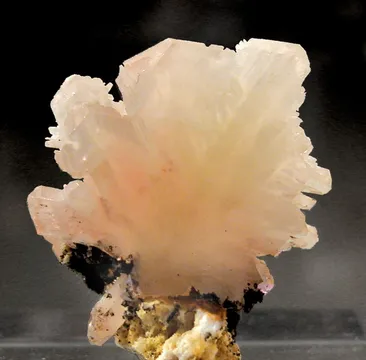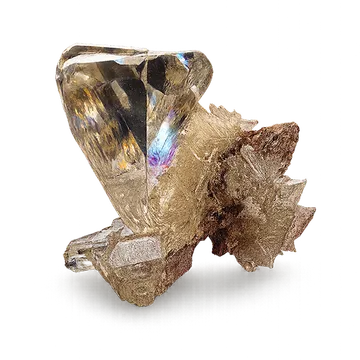
Cerussite from Daoping Mine, China - yellow to straw-yellow crystals with pale green coatings, prized for luster, color, and its pyromorphite associations.
Key facts
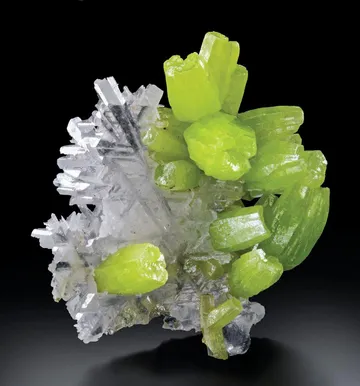
Cerussite from the Daoping Mine is the quieter prize from a locality that collectors usually approach through its dazzling apple-green pyromorphite. The mine’s reputation was made by pyromorphite, but the best Daoping cerussites have their own unmistakable personality: glassy yellow to straw-yellow crystals, pale greenish coatings or inclusions, delicate reticulated “snowflake” twins, and airy combinations with bright pyromorphite on gossan or carbonate matrix. When a Daoping cerussite is good, it has the old lead-zone look collectors love—sharp PbCO3 crystals perched on an oxidized matrix, with enough color and association to identify the locality across a room.

Photo: Rob Lavinsky, iRocks.com via Wikimedia Commons
The geological setting explains the associations. Daoping is a hydrothermal lead-zinc deposit hosted by Devonian Wuzhishan Formation limestone, sandstone, and shale, locally cut by granite and lamprophyre dykes. In the oxidized parts of the Pb-Zn system, primary galena and sphalerite supplied lead and zinc to a suite of secondary minerals: pyromorphite, cerussite, malachite, descloizite, dundasite, willemite, calcite, quartz, and iron oxides. Cerussite sits naturally in that story as a lead carbonate made in the weathered zone; its best crystals are essentially the carbonate counterpart to Daoping’s famous lead phosphate.

Photo: Rob Lavinsky, iRocks.com via Wikimedia Commons
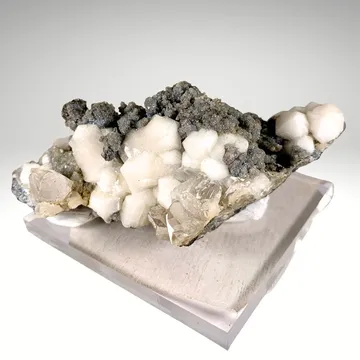
For collectors, the most sought-after Daoping cerussites fall into several overlapping styles. The yellow material long sold as “chrome cerussite” is especially attractive when the crystals are lustrous, translucent, and undamaged, but the “chrome” label should be understood as an old trade habit rather than a proven chemical guarantee. Combination specimens are often more distinctive: cerussite with wet-looking green pyromorphite, cerussite crusts serving as matrix for pyromorphite sprays, and fragile reticulated twins rising from oxidized matrix. The best pieces are small but complete; top value comes from luster, color, crystal isolation, lack of bruising, and convincing old-pocket provenance.
Search for specimens: View all cerussite specimens from Daoping Mine, China
The Daoping Mine is in Gongcheng County, Guilin Prefecture, Guangxi Zhuang Autonomous Region, southern China, at about 25°02'53" N, 110°37'35" E. Older labels may say Tangping or Tang Ping; that name appears repeatedly in the specimen trade, but current locality treatment regards Tangping as a misnomer or variant attached to the Daoping-Yangshuo mining area.
The deposit is a hydrothermal Pb-Zn system. The ore is hosted in Devonian Wuzhishan Formation limestone, sandstone, and shale, and the sedimentary sequence is locally intruded by granites and lamprophyre dykes. The mineralized zone straddles the Gongcheng-Yangshuo county boundary and has been worked from both sides of the mountain: the Daoping workings on the Gongcheng side and the Yangshuo workings on the Yangshuo side. Since 2003 the two mines have been connected underground, which is why post-2003 specimens may be difficult to separate cleanly between “Daoping” and “Yangshuo” in the strict mining sense.
Industrial mining for lead and zinc was organized in the late 1950s. By the time the locality became famous to specimen collectors, the mines were already mature ore operations with numerous tunnels, dated but intensive working methods, manual labor, and ore transport by rope-way from higher adits down toward the main road. Specimen mining developed as local miners realized that the green pyromorphite previously discarded as gangue had significant collector value. Cerussite was not the headline species, but it occurred in the same oxidized lead-zone environment and entered the market as yellow crystals, colorless twins, crusts, and combinations with pyromorphite.
Collectors generally encounter Daoping cerussite through dealers and old collection dispersals rather than as field-collected material. The important specimen-producing episodes were small and episodic: early-2000s combination material, the small 2005–2007 yellow “chrome cerussite” find, a very small 2007 find of reticulated cerussite with pyromorphite, and a 2011 pocket of subtly colored lustrous cerussites that appeared in China and at the Munich show. Modern labels should be read with care because the Daoping and Yangshuo workings are connected underground and because some associated blue “plumbogummite” material historically sold as Daoping/Yangshuo has since been reassigned by specialists to the separate Laohuan area.
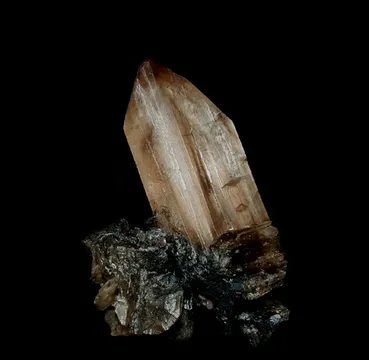
Daoping cerussite occurs as PbCO3 crystals in several collector-recognized habits. The yellow to straw-yellow crystals are typically glassy, translucent, blocky to tabular, and often cyclically twinned. Many examples are miniature to small-cabinet matrix pieces with crystals around 0.4 to 1.0 cm; better crystals reach about 1.5 to 1.7 cm, and a few dealer-documented examples report crystals around 1.9 to 2.0 cm, large for the locality. The color ranges from water-clear and white through creamy yellow, pastel yellow, straw yellow, and greenish yellow. Some “green cerussite” pieces owe their seafoam appearance to malachite or other copper-bearing surface material rather than to the cerussite structure itself.
The most elegant morphology is reticulated cerussite: delicate, interlaced “snowflake” or boxwork twins, usually colorless to white and perched on gossan, quartz, cerussite crust, or pyromorphite. These pieces are much less common than ordinary Daoping pyromorphite and are valued for the architectural form of the twin as much as for crystal size. The 2007 material is especially memorable: very fine, reticulated cerussite accented by apple-green pyromorphite prisms, typically in small miniature sizes.
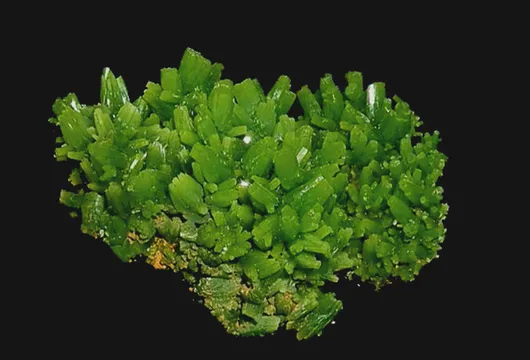
Combination pieces are central to Daoping’s appeal. Pyromorphite, Pb5(PO4)3Cl, appears as lustrous yellow-green to bright apple-green prisms, sometimes wet-looking and sometimes hoppered or skeletal. On many specimens pyromorphite grows on, beside, or over cerussite, producing a contrast of bright green prisms against pale lead-carbonate matrix. Malachite, Cu2(CO3)(OH)2, may produce green coatings or inclusions; calcite, CaCO3, quartz, SiO2, galena, PbS, sphalerite, ZnS, hematite, limonite, dundasite, descloizite, dolomite, gypsum, willemite, and recently verified hawleyite, CdS, are part of the broader Daoping suite.
Quality factors are unusually strict because cerussite is heavy, brittle, and unforgiving. The best Daoping pieces have sharp crystal edges, high vitreous to adamantine luster, visible translucency, clean terminations, and no distracting bruises on exposed crystal tips. Yellow material is most desirable when the color is even but not muddy; green-accented material is best when the copper mineral adds contrast without obscuring the cerussite form. For reticulated twins, completeness is everything: a partly broken lattice may still be interesting, but a fully exposed, intact “snowflake” is in a different collecting class.
The main authenticity issue with Daoping cerussite is not a flood of manufactured fakes; it is label accuracy and terminology. Daoping and Yangshuo are connected underground, and many later specimens are best understood as coming from a combined Daoping-Yangshuo Pb-Zn system rather than from a single isolated adit. Older labels reading “Tang Ping” should be interpreted cautiously but are not automatically wrong in a specimen-trade sense; they usually point to the same broader Gongcheng/Yangshuo lead-zinc district.
The “chrome cerussite” label also deserves caution. The term is widely used in dealer archives for Daoping’s yellow cerussite, but yellow cerussite is not a separate species, and the cause of yellow coloration in so-called chrome cerussite is not always chromium. For Daoping material, the most disciplined approach is to describe the observable specimen—yellow cerussite, greenish cerussite, cerussite with malachite, cerussite with pyromorphite—rather than paying a premium solely for an unverified trace-element claim.
Blue plumbogummite associations need special scrutiny. Older Daoping and Yangshuo labels attached to plumbogummite-bearing Chinese specimens have been substantially revised in the literature and on Mindat, with many such specimens now attributed to the Laohuan locality rather than Daoping. A Daoping cerussite with a blue powdery accent may be visually appealing, but the blue mineral and its locality should not be accepted uncritically without strong provenance or analytical support.
Condition is the decisive practical issue. Daoping cerussites are often perched on exposed matrix, and the crystals chip easily along edges and terminations. Reticulated twins are especially vulnerable; look for missing lattice arms, glued repairs, and fresh-looking breaks at the points where the twin rises from matrix. On yellow matrix pieces, check whether the brightest crystals are complete or merely the few survivors on a damaged plate. On pyromorphite-cerussite combinations, inspect both species: pyromorphite terminations bruise, while cerussite edges chip and can lose luster where handled.
Market availability is intermittent. Ordinary Daoping pyromorphite remains much easier to find than good Daoping cerussite. Dealer and auction records show a wide spread: modest cerussite examples and old-collection pieces can trade in the low hundreds or below, while fine yellow or unusually complete cabinet examples from the small 2005–2007 and 2011 finds can command substantially higher prices. The collector sweet spot is an intact miniature with strong Daoping character: yellow translucent crystals, green pyromorphite association, or a complete reticulated twin.
The Daoping story begins with confusion as much as with discovery. When the first sensational Guangxi pyromorphites reached Western collectors around 1999 and 2000, locality names shifted in the marketplace: Guilin, Yangshuo, Baise, Daoping, Tang Ping. One early account blamed the usual mixture of secrecy, translation, and supply-chain self-protection—“paranoid disinformation-giving” was the memorable phrase. By the Denver Show of 2000, a working consensus had formed around an old lead mine in the mountains near Guilin and Yangshuo, with two main adits driven from opposite sides of the mountain and the name Daoping attached to the now-famous production.
Rock Currier later summarized the operational geography in unusually concrete terms. In June 1999, pyromorphite specimens were collected from tunnels 1335 and 1370 in the Yangshuo Mine, the numbers referring to elevations in meters. In January and February 2000, new material appeared in three Daoping tunnels: 2398, 3250, and 3199. In those tunnel numbers, the first digit indicated the mining area and the last three digits the elevation, giving 1398, 1250, and 1199 meters. That detail matters to collectors because it helps explain why specimens from the two sides of the mountain can look related yet carry different labels.
One of the early Yangshuo pockets was not a cavernous fantasy but a tight, specific object: about 60 x 70 cm in cross-section. It produced four large pieces around 20 x 20 x 20 cm and many smaller specimens, with yellow pyromorphite crystals reported to 2.5 cm in diameter and up to 4 cm long. After May 2000, no significant pockets were found in that tunnel. The picture is not of a limitless mine pouring out collector pieces, but of small oxidized fractures and pockets that were rapidly emptied once miners understood their value.
The Daoping side operated on a larger industrial scale. Currier described roughly 300 workers at the time, annual lead and zinc metal production in the range of 3,000 to 7,000 tons, and more than 100 tunnels worked over the life of the operation, about 70 of them still active then. Many high mountain tunnels were not reachable by road. Workers walked to them, and ore moved down by rope-way. Against that backdrop, specimen mining was a narrow and opportunistic side economy: in February 2000 the Daoping administration signed contracts with miners including Zhou and Jiang so they could mine pyromorphite specimens.
The shift in value was dramatic. Old miners in the district reportedly knew the green lead phosphate, but it had been thrown away until a specimen was taken to the Geological Survey in Changsha and identified as pyromorphite. Dealers understood the implications immediately, and, as Currier put it, “the rush was on.” Cerussite rode into collections in the wake of that rush—less abundant, less famous, and often more fragile, but now recognized as one of the locality’s most interesting secondary lead minerals.