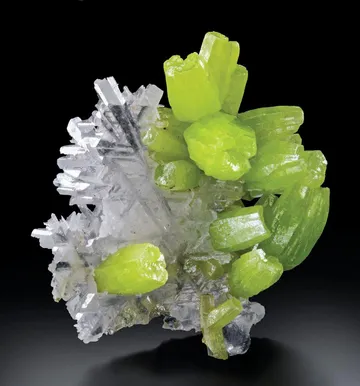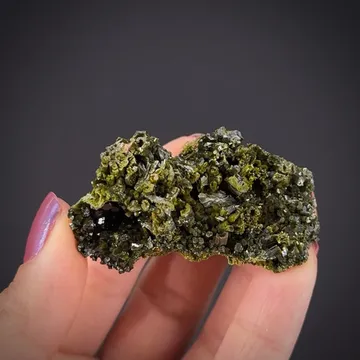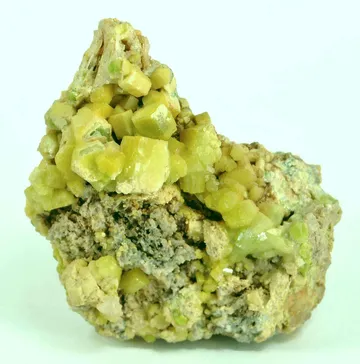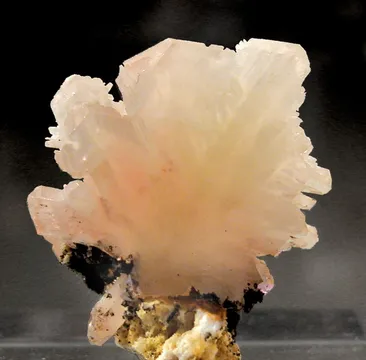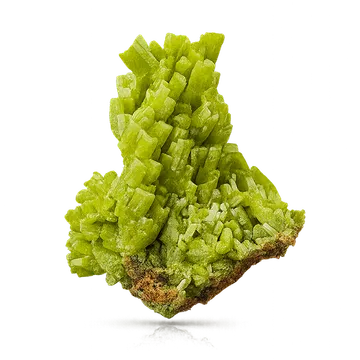
Pyromorphite from Daoping Mine, China: vivid lime-green prisms, hopper terminations, and architectural clusters; a modern, sought-after source for collectors.
Key facts
Daoping pyromorphite changed the modern collector’s idea of what Chinese lead-zone minerals could be. When the Guangxi material began reaching the international market in 1999 and especially 2000, it arrived not as a few isolated curiosities but as a genuine world-class occurrence: vivid grass-green to lime-green pyromorphite, Pb5(PO4)3Cl, in lustrous hexagonal prisms, hoppered clusters, skeletal sprays, and dense “gardens” of crystals with a saturated color that collectors still recognize across a room.

Photo: JJ Harrison, Wikimedia Commons
The best pieces are immediately distinguished by the combination of color, luster, translucency at the edges, and sculptural growth. Some specimens are compact crusts of short hexagonal barrels; others are loose, all-around groups with crystals standing in parallel ranks or divergent sprays. Many show deep hollow terminations, giving the crystals a terraced or “hopper” look, and the most admired miniatures can seem almost architectural: apple-green towers, crests, and radial clusters growing from a very thin matrix or as complete floaters.
Geologically, Daoping is part of a hydrothermal lead-zinc system in the Guilin region of Guangxi. The deposit is hosted mainly by Devonian limestone, sandstone, and shale of the Wuzhishan Formation, locally intruded by granitic rocks and lamprophyre dykes. The pyromorphite formed in the oxidized zone of the lead-zinc orebody, where primary galena and associated sulfides supplied lead and late supergene fluids supplied phosphate and chlorine under near-surface conditions. The result was one of the most productive modern pyromorphite specimen sources in the world.

Photo: Rob Lavinsky, iRocks.com, Wikimedia Commons
Collectors prize Daoping material for several different “looks.” The classic form is bright green, short-prismatic pyromorphite with pinacoid terminations and hollow crystal ends. Another desirable style consists of longer, more acicular to prismatic crystals in airy divergent sprays. Less common but very appealing are yellow-green to yellowish crystals, translucent crystals on white baryte, and specimens with cerussite, quartz, galena, or iron-oxide contrast. At the highest level, Daoping pieces compete directly with the great classic pyromorphites of Les Farges, Bad Ems, Bunker Hill, and Broken Hill—but with a distinct late-20th- to early-21st-century Chinese identity.
Search for specimens: View all pyromorphite specimens from Daoping Mine, China
The Daoping Mine is in Gongcheng County, Guilin, Guangxi Zhuang Autonomous Region, China, in the Haiyang Mountain area. The name “Tangping” appears on older labels, but modern locality work treats it as a misnomer rather than a preferred mine name. A second locality name, Yangshuo, is inseparable from the collector history: the same lead-zinc mineralized mountain is worked from both the Gongcheng side and the Yangshuo side, and the Daoping and Yangshuo workings have been connected underground since 2003. For specimens mined after that connection, the distinction between “Daoping” and “Yangshuo” can be more historical and commercial than geological.
The deposit is a hydrothermal lead-zinc system hosted by Devonian sedimentary rocks—limestone, sandstone, and shale—with local granites and lamprophyre dykes. Pyromorphite occurs in the oxidation zone of the orebody, especially in fractures, pockets, and cavities where the lead supplied by galena weathering was remobilized and fixed as the very insoluble lead chlorophosphate. Associated minerals recorded from Daoping include cerussite, quartz, galena, sphalerite, calcite, dolomite, gypsum, hematite, limonite, malachite, descloizite, willemite, and baryte.
Mining in the district is older than the modern collector boom, but organized exploitation of the Daoping-Yangshuo lead-zinc deposit began in the late 1950s. The industrial mine operated for lead and zinc, not originally for specimens. Early miners knew the green lead mineral but discarded it until dealers recognized its value. Once the specimen market responded, contractors and miners began targeting pyromorphite pockets in the oxidized levels, especially during 1999 and 2000.
The most important specimen production came from named tunnels and elevations in the Daoping-Yangshuo system. Early commercial lots in 1999 came from Yangshuo tunnels 1335 and 1370. In early 2000, Daoping tunnels including 2398, 3250, and 3199 produced pyromorphite in a range of green and yellow tones and in multiple crystal habits. Tunnel 3250 is especially remembered for some of the finest Chinese pyromorphites, including dark green crystals up to about 1 cm across and nearly 3 cm long, with specimens reaching cabinet size.
Collecting access should be regarded as controlled industrial mine access, not casual field collecting. The locality is an active or historically active mining district with underground workings, steep mountain terrain, and ore-production infrastructure. Fine specimens reached collectors through miners, contractors, and dealers rather than through ordinary visitor collecting. Modern buyers should expect most available pieces to be old-stock material from the great early-2000s production, later limited finds, or specimens recycled from collections.
Daoping pyromorphite is best known for bright green hexagonal crystals with pinacoid terminations, often showing hopper growth or skeletal development. The strongest pieces have a saturated grass-green, apple-green, or lime-green color with enough translucency to light up at thin edges and broken-free terminations. The surface luster varies from bright vitreous to slightly greasy or waxy; on excellent examples the luster gives the crystals a wet, fresh look without appearing artificially enhanced.
Crystal habits are unusually varied. Short, stout hexagonal prisms are the classic habit, commonly gathered in crusts, mounds, and radiating clusters. Many crystals are hollow at the ends, with stepped internal faces that create a terraced appearance. Some specimens show doubly terminated crystals, pinacoidal caps, parallel growths, and slight curvature of prism faces and edges. Others depart from the standard barrel habit and form acicular sprays, “crest” structures, flattened crystal groups, fanlike aggregates, or plant-like miniature clusters of elongated bright green prisms.
Typical collector specimens range from thumbnails around 2 cm across to miniatures and small cabinets in the 4–10 cm range. Loose matrixless groups of hoppered crystals are common enough to define the locality’s thumbnail aesthetic. Good small-cabinet pieces with continuous coverage, strong color, and little damage are much scarcer. Large matrix specimens exist, and a few very large display pieces have been documented, but the market strength of Daoping lies especially in miniatures and small cabinets with exceptional crystal definition.
Crystal size varies by pocket and habit. Many attractive specimens have crystals in the 3–10 mm range. Better examples commonly show individual crystals around 1 cm long, and notable pieces have crystals reaching 2–3 cm. Historical reports from early Yangshuo-side pockets mention yellow pyromorphite crystals as much as 2.5 cm in diameter and up to 4 cm long, though that material was generally described as lower quality than the best green Daoping production.
Color is a major quality factor. The benchmark Daoping color is vivid, uniform green: not muddy, not dull olive, and not merely pale yellow-green. Darker green material from Daoping is often preferred over the lighter, more yellowish Yangshuo-attributed style, though the underground connection and mixed marketing history mean that a rigid separation is often impossible. Yellowish specimens can still be excellent when the crystals are sharp, bright, translucent, and aesthetic, but they are judged differently from the classic neon-green pieces.
Associated minerals matter to advanced collectors. Quartz is a common matrix or cavity mineral, and cerussite is one of the most important lead-zone associates. Specimens of cerussite with pyromorphite inclusions or pyromorphite-related color are part of the broader Daoping suite. Baryte matrix is less common and especially attractive when white baryte contrasts with sharp translucent green pyromorphite. Galena ore on the same specimen is rare and desirable because it ties the secondary phosphate directly back to the primary lead sulfide system.
Condition is central. Daoping crystals may be sharp but brittle, and hoppered terminations expose many delicate edges. Tiny chips on basal terminations and crystal rims are common, particularly on loose groups. Matrix specimens can be fragile where pyromorphite rests on soft, porous, oxidized rock. The best pieces show undamaged crystal tips, clean hollow terminations, strong three-dimensional form, and no distracting bruising along the display crest.
The principal authenticity issue with Daoping pyromorphite is not dyeing or laboratory growth; it is locality attribution. The Daoping and Yangshuo mines exploit the same connected lead-zinc system, and specimens from both sides were widely traded during the first market boom. Older labels may say Daoping, Yangshuo, Tang Ping, Tangping, or simply “Guilin, Guangxi.” For many specimens, especially those lacking original mine-run documentation, the most honest label may be “Daoping-Yangshuo mine complex, Guangxi, China,” while pieces with strong old Daoping provenance can retain the Daoping Mine label.
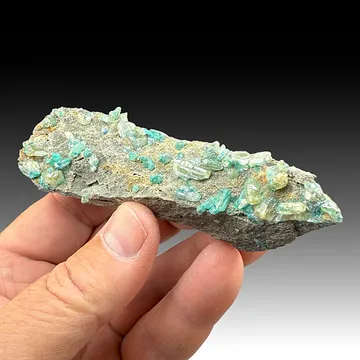
The second major labeling problem involves blue plumbogummite on or after pyromorphite. For years, blue botryoidal plumbogummite pseudomorphs and coatings from Guangxi were often sold as Daoping or Yangshuo. Later locality work tied the famous plumbogummite source to the Laohuan area, nearly 40 km away from the Daoping-Yangshuo pyromorphite mines. A specimen labeled “Daoping plumbogummite on pyromorphite” should therefore be treated cautiously unless there is analytical and locality documentation strong enough to overcome the well-known misattribution.
Condition problems are predictable. Loose hoppered groups should be examined under magnification for edge chips, broken basal terminations, and repaired contacts. Matrix pieces should be checked for crumbling oxidized rock, added glue on the underside, and old mounting residues. Stabilization of soft matrix with diluted white glue has been discussed by collectors, and such treatment may be practical if restricted to the back or base, but it should be disclosed when visible or significant.
Rarity is uneven. Ordinary small green Daoping pyromorphites remain available because the early production was large, and thumbnails or small miniatures still appear regularly in dealer inventories and collection dispersals. The finest early-2000s material—undamaged, saturated green, lustrous, hoppered, translucent, and sculptural—is no longer abundant. Large cabinet specimens, complete floaters, baryte-associated pieces, and specimens with very large crystals are much more difficult to replace.
Market availability favors patient collectors. Affordable thumbnails can still be found, but premium Daoping pieces increasingly trade as classics rather than as recent Chinese novelties. A strong miniature with vivid color and clean hoppered crystals is preferable to a larger but dull, chipped, or poorly arranged plate. When buying, prioritize original labels, old dealer provenance, accurate mine-complex naming, and honest condition notes over dramatic color descriptions alone.
The Daoping story began as a familiar mining-district reversal: the material that would later make collectors stop in the aisles had once been waste. In Rock Currier’s account, the old miners knew the green mineral in the district but threw it away until its value to collectors became clear. A specimen was taken to the Geological Survey in Changsha and identified as pyromorphite. Dealers saw the material, understood what it could mean on the international market, and, as Currier put it, “the rush was on.”
The first important commercial material was not a neat single-mine discovery. In June 1999, pyromorphite was collected from Yangshuo tunnels 1335 and 1370, the numbers referring to tunnel elevations in meters. After those first lots sold successfully, miners began looking for more. In January and February 2000, pyromorphite was also found in Daoping tunnels 2398, 3250, and 3199. These tunnel numbers were not arbitrary labels to collectors on paper; they marked different elevations and working areas in the mountain, and they produced distinct runs of color, habit, and quality.
One early Yangshuo pocket in tunnels 1370 and 1335 produced a considerable quantity of lower-quality yellow pyromorphite between June 1999 and April 2000. The largest crystals were reported at 2.5 cm in diameter and up to 4 cm long. The pocket itself measured about 60 × 70 cm in cross section, and four large pieces around 20 × 20 × 20 cm were recovered along with many smaller specimens. After May 2000, that source did not continue to deliver significant pockets.
Daoping tunnel 2398 produced a different kind of run. Specimen production there began in March 2000, and in April a contractor named Mr. Jiang signed with the mining administration to dig specifically for pyromorphite specimens. The productive fractures were narrow—up to about 5 cm wide—and the crystals were generally small, with crystal lengths not exceeding 1.5 cm. The color was commonly dark green. The pockets followed the strike of the fracture zone, appearing continuously enough that by November 2000 the total production from that tunnel was estimated at 400 to 500 kilograms of specimens.
Tunnel 3250 became the legendary one. Currier’s notes identify it as the tunnel that may have produced the best and most valuable Chinese pyromorphites to that date. On June 17, 2000, miners found a large pocket with dark green crystals up to about 1 cm in diameter. From June 18 to 21, they opened many small pockets along an open fracture zone, recovering crystals up to about 1 cm across and nearly 3 cm long, with specimens as large as 30 × 40 cm. The contractor, Mr. Zhou, produced about 70 boxes of material—several thousand specimens weighing more than a ton.
Tunnel 3199 produced quantity on another scale. Between February and April 2000, more than 10,000 pieces of yellowish pyromorphite were reported. The crystals were all under 1 cm, while individual specimens ranged from less than 2 cm across to about 30 × 30 cm. Pocket sizes ranged from about 20 × 30 cm to a maximum of 100 × 100 × 300 cm. After February, only several small pockets with green hair-like and yellow pyromorphite were found.
The mine setting behind those numbers was rugged and industrial, not romantic hand-collecting in a roadside quarry. Gongcheng lies about 120 km southeast of Guilin, with additional travel by steep, winding roads to the mining district. The mountain workings were numerous: more than 100 tunnels were reported at Daoping, with roughly 70 active at the time of Currier’s notes, and many were not accessible by road. Workers walked to the tunnels, and ore was moved down to the main road by ropeway.
The human scale was just as striking. Daoping employed hundreds of workers over decades and produced lead and zinc metal by conventional, labor-intensive methods. Yangshuo was smaller but still a substantial operation. Once pyromorphite specimens proved valuable, the specimen economy layered itself onto an existing industrial mine: contractors signed agreements, miners followed narrow oxidized fractures, dealers met material in cities such as Changsha and Guilin, and what had been discarded green lead mineral became one of the defining mineral “explosions” of 2000.