Xiefang Mine, China: fluorite deposit with green-to-purple fluorite, baryte, quartz, calcite, and pyrite; notable for large veins and striking museum specimens.
Key facts
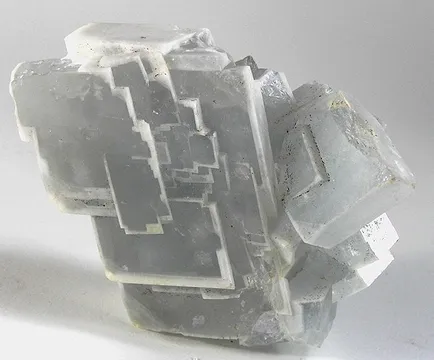
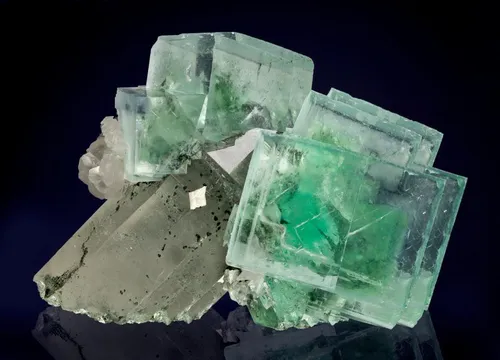
Xiefang Mine, near Ruijin in Ganzhou Prefecture, southern Jiangxi Province, is one of the modern Chinese fluorite localities that crossed over from ore geology into the front rank of specimen collecting. Its importance rests on a large volcanic-hydrothermal fluorite vein system: not a small pocket locality, but a significant fluorite deposit developed along a long vein zone in the fluorite-rich metallogenic terrain of South China. For collectors, the mine is best known for green to purple fluorite, golden to orange baryte, quartz, calcite, and pyrite in combinations that can be startlingly architectural—transparent green cubes and modified octahedra, frosted or drusy purple overgrowths, white sparkling quartz, and later baryte blades or tabular crystals that light up against darker fluorite.
Regional View
Country View
The best Xiefang specimens have a look that is now quite recognizable. Earlier material often shows green fluorite—sometimes as octahedral or highly modified octahedral crystals—set in white quartz, with successive fluorite generations in green, purple, and colorless zones. Later show material, especially the 2022–2025 barite/baryte finds, brought gemmy yellow-orange tabular baryte on botryoidal or crystallized purple fluorite, a color pairing that is very different from the classic green-fluorite-on-quartz plates. The mine’s stature is also helped by sheer scale: one giant fluorite-with-quartz specimen from Xiefang, weighing about 1,510 kg and approximately 1.7 meters across, entered the Yale Peabody Museum’s public display and became one of the most conspicuous modern Chinese mineral specimens in an American museum gallery.

Photo: Wikimedia Commons

Photo: Wikimedia Commons
Search for specimens: View all specimens from Xiefang Mine, China
Xiefang Mine is recorded at Ruijin Co., Ganzhou, Jiangxi, China, at about 25.65000 N, 115.79167 E. Mindat characterizes it as a volcanic-hydrothermal fluorite deposit with a 10 km-long vein system, and that description fits the specimen evidence: repeated open-space growth, multiple generations of fluorite, quartz druse and plates, baryte deposition, and minor sulfides. In the broader regional literature, southern Jiangxi is treated as an important fluorite province within South China, where fluorite ore bodies are commonly controlled by faults and hosted around contacts between granitic rocks and Cretaceous volcanic-sedimentary or clastic formations. Xiefang is cited among the major fluorite operations of southern Jiangxi, together with deposits such as Nankeng, Longping, and Junmenling.
The geological model is a low-temperature hydrothermal one. Fluorite veins in this region are commonly structurally controlled, and published discussions of Xiefang-type deposits describe fluorite veins cutting early Yanshanian biotite granite and extending into Cretaceous strata. For collectors, that matters because the specimen pockets are not pegmatitic cavities or carbonate-replacement vugs; they are vein cavities in a fluorite-quartz-baryte system. The best plates preserve sequential mineralization: first fluorite masses and crystals, then quartz or drusy coatings, then additional fluorite generations, and in some later finds baryte seated on fluorite.
The mine and surrounding Xiefang fluorite district have been worked for fluorite ore, not merely sampled for specimens. Ganzhou planning documents list the Ruijin Xiefang fluorite mining area as a municipal-level key mining area, with recorded retained CaF2 resources and planned annual production. Chinese corporate and administrative records also show active fluorite enterprises in Xiefang town and nearby villages, including companies involved in fluorite mining, processing, or mine expansion projects. These records are best read as evidence of an active industrial fluorite district rather than as a simple collector-access roadmap; specimen labels usually reduce the producing area to “Xiefang Mine,” while the ore district contains named villages, mining-right areas, processing operations, and individual claims.
Specimen production appears in several distinct waves. By 2010, green fluorite and fluorite-on-quartz specimens from Xiefang were already photographed and circulating internationally. A major museum-scale fluorite-with-quartz piece was publicized with the Yale Peabody Museum’s David Friend Hall opening in 2016 and in subsequent museum literature. The 2022–2023 period produced notably bright apple-green fluorite cubes partly coated with lustrous golden baryte on quartz. By 2025, dealers were again reporting new golden baryte on purple to violet fluorite, commonly in cabinet-size pieces, with smaller examples increasingly available after years in which the material was seen mainly as larger plates.
Collecting access today should be assumed to be closed or highly restricted unless arranged through mine management and local authorities. Xiefang is an industrial fluorite-producing area with permits, production, processing, and safety oversight; it is not a casual field-collecting site. Serious collectors obtain Xiefang material through established Chinese and international dealers, auction houses, older collections, and museum deaccession or exchange channels rather than by visiting the mine.
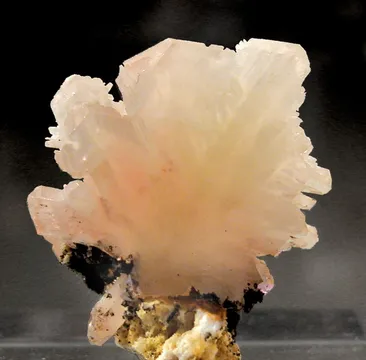
Xiefang barite is the same BaSO4 species often spelled baryte in British and mineralogical usage, and the collector material that has made the locality famous is golden to yellow-orange, highly lustrous, and commonly tabular to blocky on fluorite; recent examples range from thumbnails and miniatures around 4.5 cm to cabinet specimens well over 15 cm, with individual crystals described up to several centimeters across, while older and contemporary finds include barite over purple, violet, or green fluorite and, less commonly, on quartz-rich matrix. The best pieces have sharp, glassy, undamaged golden crystals isolated across a contrasting fluorite surface—especially purple botryoidal or crystallized fluorite—whereas ordinary pieces tend to be crowded, edge-bruised, oily, or visually flat because the barite blends into a similarly pale matrix.
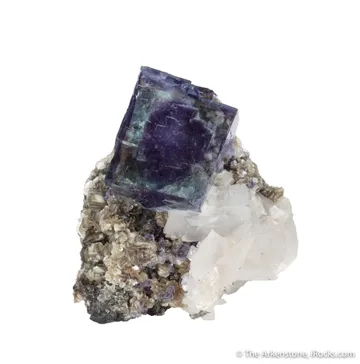
Xiefang fluorite is the mine’s foundation species and occurs in several habits and color generations: green cubes and modified octahedra, frosted deep-green octahedral forms, purple drusy coatings, colorless epitactic corner growths, botryoidal purple masses beneath baryte, and apple-green transparent cubes from the 2022–2023 material. Size spans from small cabinet plates to enormous museum pieces, with one Yale Peabody specimen weighing roughly 1,510 kg, but the finest cabinet specimens are judged less by weight than by clarity, color zoning, sharp modifications, and association—green fluorite against white quartz, purple fluorite under golden baryte, or multigenerational crystals where green cores, purple overgrowths, and colorless corners can all be read in one specimen.
Under the baryte spelling, Xiefang material is especially recognizable as lustrous yellow-orange tabular crystals on purple to violet fluorite, a style that appeared repeatedly at shows and in dealer updates during the early-to-mid 2020s; reported specimens include compact 4.5–10 cm pieces priced and sold as approachable miniatures as well as large heavy cabinet plates. Good baryte from Xiefang is bright, glassy, richly colored, and well separated from the fluorite surface, often with a single prominent “aerial” crystal or an elegant cluster rising from the matrix; lesser examples may be large but monotonous, crowded, damaged along the exposed edges, or artificially improved in appearance with oil.
Quartz at Xiefang is primarily a matrix and companion mineral rather than the main commercial species, but it is essential to the classic look of the locality: snowy druses, thin sparkling plates, and milky white quartz masses cradle or frame translucent green fluorite, and some specimens show quartz pseudomorphs after calcite on green fluorite. The best quartz-bearing Xiefang pieces use quartz as contrast—fine, bright, undamaged white crystals that sharpen the color of green fluorite or balance golden baryte—while ordinary pieces have dull sugary quartz, massive white matrix, or broken quartz edges that distract from the fluorite.
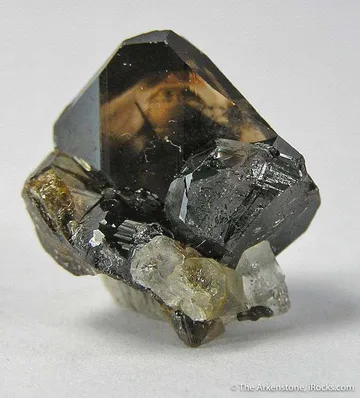
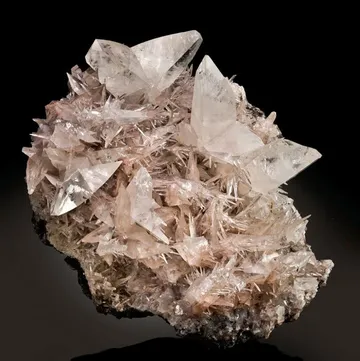
Other minerals documented from Xiefang include calcite, pyrite, galena, chalcopyrite, opal, muscovite including sericite, chlorite-group minerals, feldspar-group minerals, and a questionable aragonite occurrence. No type-locality mineral is documented for Xiefang in the sources checked. The minor sulfides are important mainly as paragenetic indicators and aesthetic accents: pyrite can appear with fluorite and quartz, galena and chalcopyrite are part of the ore-mineral assemblage, and calcite is recorded both as a vein mineral and as the likely precursor for quartz pseudomorphs on some older green-fluorite specimens.
Xiefang specimens deserve a careful condition check. The barite/baryte is exposed, brittle, and dense; even good specimens commonly show small chips, peripheral bruising, or missing crystal tips. Dealer notes on recent material explicitly warn that many examples are imperfect and that specimens of this type are often oiled to disguise bruising or surface problems. When buying, examine the piece under strong oblique light, look at the edges of tabular baryte crystals, and ask whether the specimen has been oiled, coated, repaired, or stabilized.
Mislabelling is also a real issue. Xiefang in Jiangxi can be confused with other Chinese fluorite localities, especially when labels are shortened to “China fluorite” or when names with similar romanization enter the chain of custody. The classic Xiefang look—green fluorite with quartz, or golden baryte on purple or green fluorite—is helpful, but not definitive; China has many productive fluorite deposits, and superficially similar specimens may come from Xianghualing, Yaogangxian, Shangbao, De’an, Xia Yang, or other mines. Strong provenance, old labels, mine-specific dealer records, and matching known Xiefang paragenesis matter.
Fluorescence can add value and diagnostic interest. Recent golden baryte on purple fluorite has been described with fluorite fluorescence under longwave ultraviolet and also under shortwave ultraviolet; EarthWonders-listed material likewise notes fluorescence in fluorite-rich matrix. Do not rely on fluorescence alone for locality authentication, but it is worth checking because it can reveal hidden fluorite layers and growth generations. Handle under UV with standard eye protection, avoid unnecessary shortwave exposure, and remember that the heavy baryte matrix makes large specimens more vulnerable to vibration and shock than their size suggests.
Rarity varies by style. Small to medium Xiefang fluorite and fluorite-quartz specimens are obtainable, and recent baryte-on-fluorite finds have made the locality more visible on the market. Fine pieces, however—undamaged golden baryte on vividly purple fluorite, sharply zoned green fluorite cubes, or older multigenerational fluorite on sparkling quartz—are much scarcer. Museum-scale Xiefang fluorite is effectively institutional material, while aesthetic cabinet pieces remain actively traded but increasingly selected hard by dealers and collectors.
The Xiefang story that most collectors now recognize is the giant. In the David Friend Hall at the Yale Peabody Museum, the mine is represented not by a delicate thumbnail but by a monumental green fluorite with quartz specimen from Jiangxi. German-language coverage of the Yale display records it as about 1.7 meters wide and 1,510 kg, catalogued as YPM MIN.100652; EarthWonders’ publication record gives the English shorthand as a 3,328-pound, 5-foot fluorite specimen. Either way, it is a piece that changes the scale on which most collectors imagine a fluorite specimen. What is normally a hand-held mineral—cubes, octahedra, a plate of quartz—becomes furniture, architecture, and landscape.
A smaller but very human collector story comes from the 2025 baryte-on-fluorite material. Khyber Mineral Company’s dealer notes describe the familiar frustration of pursuing perfection from a large modern find: after inspecting “many hundreds” of earlier Xiefang pieces with tiny, sub-1.5 cm barites on green fluorite, the dealer waited for a perfect one and ended up with only a single miniature. When a later group of larger baryte-on-fluorite specimens came through, the strategy changed. The new pieces were still not perfect—virtually none were—but the best were chosen for luster, color, and relative freedom from damage, with an explicit warning that many comparable pieces are heavily oiled to hide flaws.
That candid market detail is part of the modern Xiefang identity. These specimens are not old European classics that were collected slowly over a century; they are contemporary Chinese mine products moving quickly from active ore operations through local handlers, Chinese dealers, Western dealers, show rooms, auctions, and online updates. One year the material appears as large statement pieces too big for many cabinets. Another year, a Spanish dealer can offer nine miniatures in the 4.5–10 cm range, suddenly making the same color combination available to collectors who do not have space for a heavy cabinet plate. The locality is still being defined in real time.