A collector's guide to Piaotang Mine, China: its geology, mining history and notable minerals, illustrated with the 46 specimens documented from this locality on EarthWonders.
Key facts
Piaotang is one of the great names of the Dayu tungsten district of southern Jiangxi: a granite-related W-Sn polymetallic vein system set in the eastern Nanling Range, a belt that has furnished China with an extraordinary share of its tungsten. For collectors, its importance is twofold. Economically and geologically, Piaotang is a textbook quartz-vein and veinlet tungsten-tin deposit rooted in a hidden Jurassic granite cupola, with wolframite and cassiterite as the defining ore minerals. Aesthetically, it is a source of refined Chinese cabinet specimens—especially fluorite on quartz, quartz with sulfides, chalcopyrite-pyrite-quartz plates, euclase with quartz, and occasional native bismuth—that can be mistaken at a glance for material from the better-known Yaogangxian field but has its own personality.
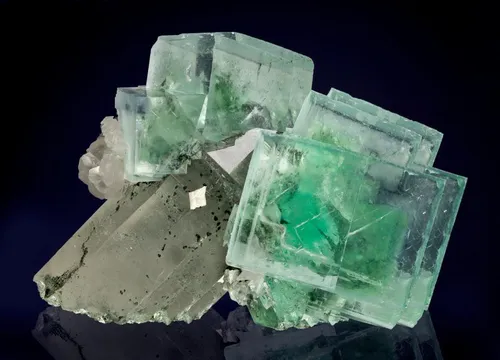
The best Piaotang specimens are not merely “Chinese fluorite” in a broad market sense. They tend to show a particular combination of pale green, colorless, lavender, or purple-zoned fluorite with quartz, mica, feldspar, calcite, scheelite, wolframite, or chalcopyrite. Good pieces balance sharp geometry with airy, open composition: terraced cubes, cuboctahedral or octahedral-looking growth forms, purple edge zoning or phantom zones, and glassy quartz crystals that lift the fluorite above the matrix rather than burying it. The mine’s sulfide specimens have a different mood—brassy chalcopyrite, reflective pyrite, bismuthinite or native bismuth, and quartz from the intermediate to late polymetallic stages of the vein system.
Regional View
Country View
Piaotang also matters because it is more than a specimen locality: it is one of the classic localities behind the “five-floor” zonation model used in Chinese exploration for vein-type tungsten deposits. From the top downward, the quartz system grades from threadlike veinlets into progressively thicker and better-connected veins, then into the thicker wolframite-quartz veins nearer the granite contact. That architecture is not just an academic diagram; it explains why a mine that can look unassuming in a specimen cabinet is such an instructive ore system in the literature, and why its pockets include fluorite-quartz combinations, sulfide-rich assemblages, beryl-topaz-wolframite-cassiterite associations, and late carbonate-fluorite overprints in the same broad deposit.
Search for specimens: View all specimens from Piaotang Mine, China
The Piaotang Mine is in the Xihuashan ore field, Dayu County, Ganzhou, Jiangxi Province, China, in the southern Jiangxi section of the Nanling metallogenic belt. It lies northeast of the famous Xihuashan tungsten mine and belongs to the same broad W-Sn polymetallic district, but it is not simply a duplicate of Xihuashan. Xihuashan is classically described as an endocontact, larger-vein system in and around a granite stock; Piaotang is an exocontact system hosted largely by Cambrian metasedimentary rocks above and around a buried granite cupola.
The exposed country rocks at Piaotang are chiefly Middle to Upper Cambrian low-grade metamorphic sandstone, slate, phyllite, and related hornfelsed rocks, with the ore system genetically tied to a concealed Early Yanshanian granite. The buried Piaotang granite has been described as comprising biotite granite, two-mica granite, and muscovite granite, with the muscovite granite especially close to the W-Sn mineralization. Geochronological work places the granite and the cassiterite-bearing mineralization at about 160 Ma, effectively synchronous on the scale of the analytical uncertainties. An older quartz diorite is exposed nearby, but modern dating and geochemical interpretation point to the hidden Jurassic granite, not the older exposed diorite, as the principal magmatic driver of the tungsten-tin system.
Piaotang is a quartz-vein and quartz-veinlet W-Sn polymetallic deposit. Wolframite and cassiterite are the defining ore minerals, accompanied by molybdenite, bismuthinite, chalcopyrite, sphalerite, galena, pyrite, pyrrhotite, scheelite, fluorite, quartz, muscovite, topaz, beryl, helvine, calcite, chlorite, tourmaline, feldspar, and other gangue or accessory phases. Published descriptions emphasize a vertical morphological zonation in which the thin upper veinlets thicken downward. The upper thread-vein zone consists of numerous very narrow veinlets; lower levels include veinlet and mixed veinlet-thin-vein zones; still lower, thicker wolframite-quartz veins occur nearer the granite contact. One detailed account of the deposit describes a mineralized zone trending northeast for more than 1.3 km and extending for more than 500 m vertically, with the economically stronger parts generally in the intermediate zones rather than in the barren thread veins at the top or the sparse deep veins below.
Paragenetically, Piaotang records a long magmatic-hydrothermal history. Early alteration and contact metamorphism affected the metasedimentary rocks; carbonate-bearing horizons locally developed calc-silicate replacement. The ore stages then progressed from oxide-silicate assemblages dominated by wolframite, cassiterite, beryl, topaz, and quartz, through sulfide-bearing stages with molybdenite, chalcopyrite, sphalerite, galena, bismuthinite, pyrite, and pyrrhotite, and finally into later quartz-fluorite-carbonate-chlorite-sericite assemblages. For the collector, that progression is the key to understanding the cabinet pieces: quartz is the constant structural medium, fluorite is largely a late and visually important gangue mineral, chalcopyrite belongs to the polymetallic sulfide pulse, and bismuth minerals and euclase mark rarer branches of the mineralizing system.
The mine’s recorded history reaches back to the early twentieth century. Piaotang was discovered around 1918, and small-scale extraction of alluvial and primary tungsten mineralization began shortly afterward, often cited as 1919. Systematic industrial exploration came much later, mainly from 1958 to 1966, when drilling confirmed the hidden granitic body and the major wolframite-quartz vein system. Industrial mining began in 1971, with published accounts citing early annual production on the order of 700 tonnes of WO3. By the 1980s the mine was being developed more intensively, including mill construction and planning for tungsten and tin as principal products with molybdenum, bismuth, copper, lead, zinc, beryllium, niobium, tantalum, and other byproducts.
Modern Piaotang is an industrial tungsten-tin operation, not a casual collecting locality. Recent Chinese public documents identify Jiangxi Piaotang Tungsten Co., Ltd. as the operating entity, with mining and beneficiation of tungsten, molybdenum, tin, bismuth, copper, lead, and zinc within its registered business scope. Access should therefore be treated as restricted industrial access; specimens reaching collectors generally pass through Chinese mineral dealers, mine contacts, old collections, auction dispersals, and established international dealers rather than from legal public collecting.
Specimen production appears to have been episodic. The late 2000s and early 2010s are repeatedly associated in the collecting literature and dealer records with euclase and fluorite-quartz material, while later auction and dealer offerings show continued circulation of older-stock fluorite, quartz, chalcopyrite, pyrite, and bismuth-bearing pieces. One especially useful locality detail is the No. 359 vein, cited for fluorite with chalcopyrite on quartz; another recent Mindat-described specimen refers to the Muziyuan mining area within the Piaotang Mine for fluorite-quartz-feldspar-muscovite material. These are not broad tourist labels but pocket-scale clues, and they matter because Piaotang specimens are often confused with other Dayu or Hunan material when labels are shortened or lost.
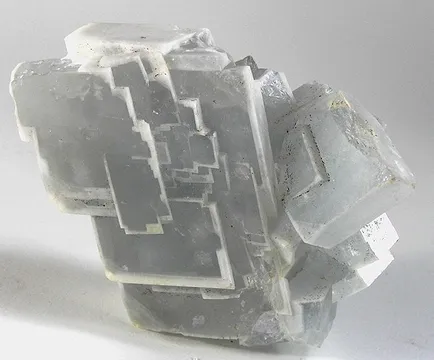
Fluorite is the collector face of Piaotang: typically pale green, colorless, lavender, purple, or distinctly zoned, occurring on quartz with muscovite, feldspar, calcite, scheelite, wolframite, chalcopyrite, and other vein minerals. The most desirable specimens show sharp cubic to stepped-cubic growth, cuboctahedral or octahedral-looking forms, transparent interiors, and purple zones concentrated on edges, corners, cores, or irregular “splashed” internal patterns rather than uniform color. Reported examples include small-cabinet to cabinet pieces, fluorite crystals around 2.4–3 cm on edge, large plates approaching 18 cm across, and rare large multi-mineral aggregates. Good Piaotang fluorite is separated from ordinary material by transparency, luster, crisp zoning, undamaged edges, and a composition in which the fluorite rises cleanly from white quartz or mica rather than sitting as a bruised isolated cube.
Quartz at Piaotang is both ore-stage architecture and specimen aesthetics: it forms the wolframite-cassiterite quartz veins, the milky drusy crusts that support fluorite, and the colorless prismatic crystals associated with chalcopyrite, pyrite, euclase, calcite, scheelite, and muscovite. The finest collector pieces are not necessarily the largest quartz masses but those in which quartz provides sculptural lift—milky terminated crusts under green or zoned fluorite, clear prismatic crystals framing sulfides, or gemmy individual quartz crystals acting as the visual spine of a multi-species cabinet specimen. Because Piaotang is a veinlet-to-vein system, quartz may range from tight massive vein material to open-pocket crystals; the most collectible examples are clean, lustrous, undamaged, and clearly associated with the locality’s more diagnostic minerals rather than anonymous white vein quartz.
Chalcopyrite belongs to Piaotang’s polymetallic sulfide stages and appears on specimens as brassy blocky crystals, glittering crystalline layers, or chalcopyrite-rich matrix beneath quartz, fluorite, pyrite, and bismuth minerals. Strong examples show bright brass-yellow color, submetallic to metallic luster, subtle iridescent blue-purple-red overtones, and a sharp contrast against colorless prismatic quartz or reflective pyrite cubes. A documented cabinet specimen measuring 18 x 15 x 13 cm was described as largely covered with robust blocky chalcopyrite crystals with quartz and pyrite, while No. 359 vein material includes chalcopyrite crystals to about 9 mm between fluorite and milky quartz. The best pieces are those with fresh luster and clear crystal definition; dull massive chalcopyrite, although geologically correct, lacks the display quality collectors seek from this locality.
Beyond fluorite, quartz, and chalcopyrite, Piaotang is documented for a broad W-Sn polymetallic assemblage including wolframite group minerals, ferberite, cassiterite, scheelite, molybdenite, bismuthinite, native bismuth in notable collector specimens, pyrite, pyrrhotite, sphalerite, galena, chalcocite, arsenopyrite, stannite, beryl, topaz, helvine, euclase, triplite, calcite, muscovite, sericite, pyrophyllite, chlorite-group minerals, feldspar, K-feldspar, tourmaline-group minerals, biotite, and zircon. No widely recognized mineral species appears to have Piaotang as its formal mineral type locality; the mine’s “type” importance is instead geological, as a classic locality for the five-floor zonation model of vein-type tungsten deposits. Among collector rarities, euclase from the Dayu/Piaotang area and native bismuth with chalcopyrite are especially significant, and both require careful labeling because their exact source within the broader Dayu workings and prospect pits has been debated.
The main Piaotang authenticity issue is locality discipline, not a well-documented plague of manufactured fakes. Piaotang fluorite-quartz specimens are frequently confused with Yaogangxian material because the species suite and visual language overlap: zoned fluorite on quartz, mica, sulfides, and occasional scheelite or carbonate. A specimen with a vague “China fluorite” or even “Yaogangxian” label may deserve a second look if it has the pale green to colorless fluorite, purple zoning, milky quartz, and mica-rich matrix typical of Piaotang; conversely, attractive Piaotang-style material should not be upgraded to Yaogangxian merely because that name is better known.
A second label trap is geographical: Dayu, Jiangxi, has been confused in print with Daye, Hubei. The difference is not a minor spelling issue; Dayu and Daye are hundreds of kilometers apart and represent very different mineral districts. Labels reading “Piaotang Mine, Daye” should be treated as suspect and corrected only with supporting provenance. Euclase is even more delicate. Some euclase specimens long publicized as from the Piaotang Mine have been reported by Berthold Ottens and later mineral-market commentary as coming from small prospect pits and outcrops in the Dayuling Mountains rather than from the underground Piaotang mine itself. For euclase, a conservative label such as “Dayu ore field” or “Dayuling Mountains near Piaotang” may be more honest if the chain of custody is weak.
Condition varies sharply by species. Fluorite commonly suffers from bruised edges, contacted backs, and cleaved corners; because the best crystals are transparent and zoned, even small chips are conspicuous. Stepped or terraced fluorite growth can hide minor abrasions, so examine edges under angled light. Quartz points on fluorite specimens are often numerous and delicate; expect minor peripheral nicks on large plates, but avoid pieces where the central quartz or fluorite has been heavily repaired. Chalcopyrite and bismuth-bearing specimens should be checked for rubbing, oxidation, and old handling marks, as fresh metallic luster is central to their appeal. Native bismuth from Piaotang can be analytically confirmed in better-documented specimens and should not be bought casually from a vague label because bismuth-rich material is uncommon and valuable.
Fluorite from Piaotang may fluoresce purple to violet, but fluorescence should be treated as a supporting character rather than proof of locality. Do not rely on UV response to distinguish Piaotang from Yaogangxian or other Chinese fluorite sources. The most convincing locality evidence is a combination of old collection provenance, mine or vein labels such as No. 359 vein when credible, associated minerals consistent with Piaotang, and comparison with well-documented specimens.
Market availability is intermittent. Small fluorite-quartz specimens appear periodically, but high-end pieces with transparent zoned fluorite, undamaged quartz, and elegant composition are much scarcer than generic Chinese fluorites. Chalcopyrite and bismuth-rich cabinet specimens are rarer still and can sell strongly when they have size, luster, and provenance. Euclase from the Dayu/Piaotang area is attractive and still underappreciated by some collectors, but the label question means careful buyers should pay for the specimen and its documentation, not merely for the most famous possible mine name.
In 2007 and 2008, Piaotang briefly stepped into the mineral-world spotlight through an almost comic single-letter mistake. Mineralogical Record market reporting had announced striking Chinese euclase specimens as coming from the Piaotang Mine in the Daye district of Hubei Province. Then Jürgen Tron corrected the record: the mine name was right, but the district was not Daye—it was Dayu, in Jiangxi. The correction mattered because Dayu and Daye are roughly 500 km apart. In a field where a single misplaced letter can move a specimen from one metallogenic province to another, the episode became a useful cautionary tale: “Piaotang” is not enough; the full label must read Dayu County, Ganzhou, Jiangxi.
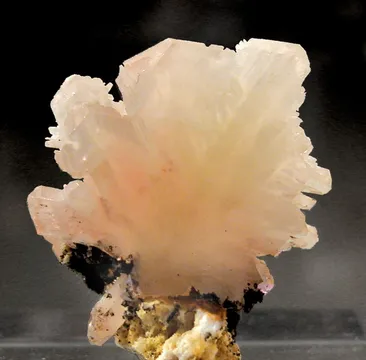
The euclase story grew more complicated in 2011. Online market notes described Jin-Ming Mineral Company showing three euclase specimens attributed to the Piaotang mine, Dayu ore field, Dayuling Mountains. One was a loose thumbnail-size yellow crystal; two matrix specimens measured 3 cm and 6.5 cm and carried shiny euclase crystals in yellow, colorless, and yellow-white zoned forms, with tiny quartz and pyrite. That would have been notable enough, because most euclase seen from the area was colorless. But the report added a crucial caution from Berthold Ottens: the euclase crystals were said to come not from the underground Piaotang mine itself, but from small prospect pits and outcrops in the Dayuling Mountains. It is the kind of provenance wrinkle collectors remember because it is both specific and inconvenient. The specimens are real; the broader Dayu association is real; the exact mine label may be too tidy.
Another revealing Piaotang thread runs through the collection of Steve Smale, the Fields Medal-winning mathematician and serious collector who lived and worked in Hong Kong and built an important Chinese mineral collection through dealer networks in southern China. A 2013 Mineralogical Record supplement illustrates a 12.5 cm fluorite with quartz from Piaotang, found in 2008 and in the Smale collection. The note places Piaotang in the world of the new Chinese specimen market: material moving from mine sources to Chinese dealers, from dealers to collectors in Hong Kong, Shenzhen, Changsha, Tucson, Munich, and beyond. That one 12.5 cm specimen is more than a pretty fluorite-quartz combination; it is a timestamp for the period when Piaotang material entered advanced Western collections with better locality awareness.