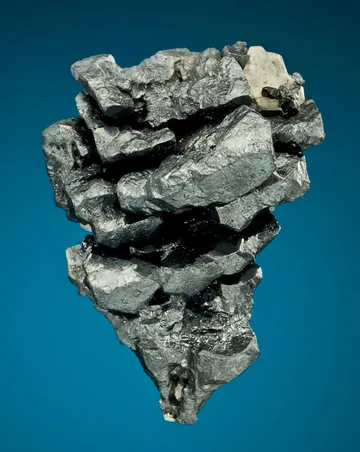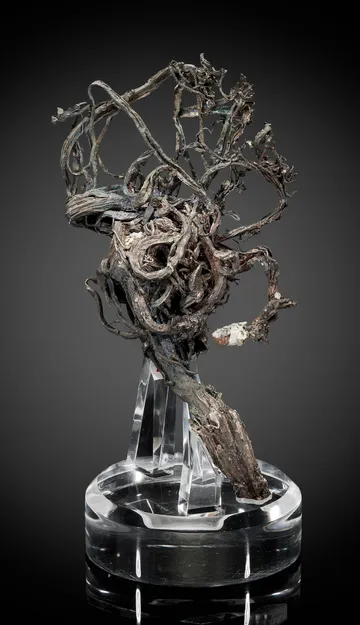
Freiberg Mining District, Germany — native silver with arborescent, wiry forms in calcite or sulfide matrices; prized for provenance and historic mines.
Key facts
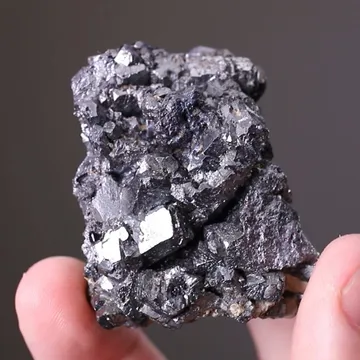
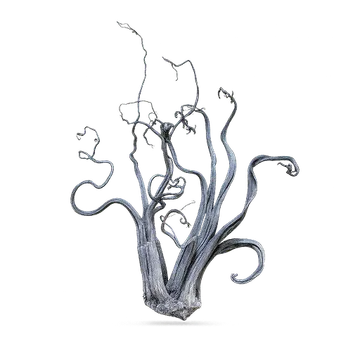
Freiberg silver is one of the great European archetypes of native silver: not merely a metal-bearing ore, but a sculptural mineral specimen with historical gravity. The finest pieces show wiry, ropy, curled, arborescent, and dendritic aggregates of Ag, often rising from calcite or dark silver-sulfide matrix. Fresh breaks can flash bright white to pale rose-silver, while old surfaces commonly carry a grey, smoky, brownish, or nearly black patina from tarnish and thin silver-sulfide alteration. Good specimens have the look collectors want from a classic mining district: irregular metallic growth, evidence of age, and a believable matrix association rather than a sterile bundle of isolated wires.

Photo: Wikimedia Commons
The district’s appeal rests on two overlapping histories. Geologically, Freiberg is a polymetallic epithermal Ag-Pb-Zn vein district in the eastern Erzgebirge, with ore hosted in a large system of veins carrying galena, sphalerite, pyrite, arsenopyrite, acanthite, ruby-silver minerals, fahlores, and a remarkable suite of silver sulfosalts. Historically, it is one of the foundational silver-mining regions of Europe. The discovery of silver near Christiansdorf in the 12th century gave rise to Freiberg’s identity as a “Silver City,” supported Saxon mining law, metallurgy, minting, and eventually the Freiberg Mining Academy, one of the most influential institutions in the history of mineralogy and economic geology.
For collectors, Freiberg native silver is prized most when it combines form, provenance, and mineralogical context. A small tangled miniature with dark acanthite and calcite can be more desirable than a larger anonymous mass if it carries an old German label or a well-documented mine attribution such as Himmelsfürst, Himmelfahrt, Reiche Zeche, or a Brand-Erbisdorf locality. The most coveted examples are matrix specimens with curling silver wires still visibly rooted in the ore, because they preserve the geological setting rather than presenting the silver as a detached metallic ornament.
Search for specimens:
The Freiberg Mining District lies in Mittelsachsen, Saxony, on the northern flank of the Erzgebirge. In collector usage, “Freiberg” on an old label often refers to the broader mining district rather than a specimen collected within the present town limits. That distinction matters: important specimens may come from individual mines and subdistricts around Freiberg and Brand-Erbisdorf, especially the Himmelsfürst and Himmelfahrt mine groups.
The ore field is a classic vein district rather than a single mine. Modern studies divide the principal polymetallic veins into three broad types: quartz-bearing polymetallic sulfide veins, carbonate-bearing polymetallic sulfide veins, and barite-fluorite-sulfide veins. The two main mineralizing episodes recognized in recent isotope work are a Lower Permian stage for the quartz- and carbonate-bearing polymetallic sulfide veins, and a younger Cretaceous stage for the barite-fluorite-sulfide veins. In practical specimen terms, native silver belongs to a complicated Ag-Pb-Zn-Cu-As-Sb-S mineral system in which silver may appear as the native element but is more commonly locked in acanthite, pyrargyrite, miargyrite, polybasite, freibergite-group fahlore, and related sulfosalts.
Mining began after the famous 12th-century discovery of silver ore near Christiansdorf, traditionally dated to 1168. The resulting “Berggeschrey,” or mining rush, brought miners, craftsmen, merchants, and metallurgists into what became one of Europe’s defining silver towns. Freiberg’s wealth supported a mint, mining administration, legal codes, and ultimately a mining academy founded in 1765. The academic tradition matters to mineral collectors because Freiberg was not only a producer of ore; it was a place where minerals were described, classified, taught, archived, and collected.
The district is immense underground. The modern visitor mine literature describes more than 1,000 ore lodes, a mining area beneath the city of roughly 30 square kilometers, and a total underground route system on the order of 2,000 kilometers. Historic production is commonly summarized at about 8,000 metric tons of silver. The Reiche Zeche visitor mine descends by cage to about 150 meters, while tours in the Freiberg silver mine system present workings from the 14th to 20th centuries. These tours are for education and heritage; they should not be confused with collecting access.
For collecting purposes, Freiberg is essentially a historical source. The mines that produced the classic native silver specimens are closed, and access to old workings, protected heritage areas, and dumps is controlled. Field collecting should never be assumed without explicit permission from landowners and local authorities. The collector market is therefore dominated by old collections, museum deaccessions, long-held dealer stock, and occasional specimens that appear when classic European collections are dispersed.
Notable documented specimen localities include Himmelsfürst Mine at Brand-Erbisdorf and Himmelfahrt Mine at Freiberg. Himmelsfürst is particularly important for wire and curl silver in the collector literature, and the large Freiberg silver curl displayed by terra mineralia has made that style instantly recognizable: silver rising like twisted metallic hair from the ore. The district also produced or is associated with an exceptional list of silver minerals beyond native silver, including acanthite, pyrargyrite, proustite, miargyrite, polybasite, stephanite, freieslebenite, argyrodite, and freibergite-group minerals.
The collector’s eye usually recognizes Freiberg silver by its tension between delicacy and age. Many specimens are not smooth, isolated wires, but bundles: ropy cords, curling ribbons, hair-like strands, branched dendrites, and nest-like aggregates that seem to grow out of dark sulfide ore. The best curls have longitudinal ridges, natural bends, and uneven thickness. They may look like metallic locks, roots, or twisted cables, depending on the specimen.
Color is variable. Fresh native silver is bright silver-white, but Freiberg pieces commonly show old patina: warm champagne-silver, grey, brownish grey, smoky black, or sooty black. Reddish or rose-toned highlights sometimes appear where a wire is newly abraded or where light catches a clean metallic surface beneath the tarnish. A uniform brilliant polish is not the classic look; most collectors prefer stable, old-looking surfaces with natural contrast between silver, calcite, and dark ore minerals.
Matrix is a major quality factor. Calcite is a frequent and highly desirable associate, especially as white to cream rhombs or granular carbonate beneath the metallic growth. Acanthite, other silver sulfides, and silver sulfosalt-rich matrix give the piece geological credibility. Associations recorded from the district include acanthite, stephanite, polybasite, pyrargyrite, proustite, miargyrite, galena, sphalerite, chalcopyrite, arsenopyrite, pyrite, quartz, calcite, dolomite, barite, and fluorite. The most convincing specimens show silver rooted in or emerging from these minerals rather than artificially perched on an unrelated base.
Size ranges are broad, but fine examples are usually small. Miniatures and small cabinets dominate the market. Good silver wires only a few centimeters across can be major specimens if the form is elegant and the provenance is strong. Larger Freiberg pieces are much rarer and often reside in museums or advanced private collections. A documented large matrix specimen with strong three-dimensional wire growth is far more significant than a flattened mass of similar weight.
Quality depends on several interlocking factors: sculptural form, intact wire tips, matrix, old patina, mine-level locality information, and provenance. Damage is common because native silver is soft and malleable; wires bend, flatten, break, and snag easily. A specimen that preserves fine unsupported curls without obvious compression is markedly superior. Old labels, especially German, museum, or named-collection labels, can add as much importance as visual size because so many “Freiberg” specimens on the market are broadly labeled.
Freiberg silver should be bought as a historical mineral specimen, not as a bullion object. Its value lies in form, provenance, and mineralogical context, while the actual silver weight is usually a minor part of the price. The most desirable examples have clear district attribution, ideally with a mine name, old labels, or a chain of ownership. A label reading only “Freiberg” may still be legitimate, but it should be understood as potentially district-wide unless the documentation narrows the locality.
Authenticity deserves careful attention. Native silver is soft, highly malleable, and visually seductive, which makes it vulnerable to bending, trimming, re-mounting, and over-cleaning. Scientific microstructural work on natural wire silver has shown that some natural wires can display evidence of later mechanical deformation; in collector terms, that means a naturally grown silver wire can still have been bent or adjusted after recovery to improve presentation. That is not the same as a fully fake specimen, but it does affect condition and originality.
Artificial or induced silver wires on silver-sulfide substrates have long been discussed among collectors, especially because acanthite-rich material can be chemically or thermally involved in the production of metallic silver. Freiberg has been mentioned in those discussions, so provenance is particularly important for high-value wire specimens. Warning signs include implausibly fresh, bright, repetitive wires; weak or absent matrix connection; no patina on a supposedly old European specimen; mismatched matrix; glue or solder-like joins; and a story of “old Freiberg” origin unsupported by any label or prior ownership.
Condition issues are normal and should be evaluated realistically. Thin wires may be bent, broken, or compressed; old silver may be darkly tarnished; calcite matrix can be bruised or chipped; and old mounts may hide attachment points or repairs. Cleaning is a double-edged sword. Removing dark tarnish can destroy the antique character and reduce collector desirability. A stable old patina is usually preferable to a bright, scrubbed surface.
Rarity is tied to quality. Small, tangled, old-time Freiberg silvers appear with some regularity through classic-mineral dealers and online marketplaces, but fine matrix specimens, large curls, and pieces with old labels are genuinely scarce. Recent marketplace offerings show Freiberg miniatures and small cabinets trading as serious four-figure collector specimens when they have strong form, matrix, and patina. Truly dramatic historic pieces tend to move privately or appear only when major collections are dispersed.
The Freiberg story begins with a field near Christiansdorf. Around 1168, silver ore was found where the mineralized lode reached the surface. The discovery drew miners into the cleared lands between the Freiberger Mulde and the Striegis, and the settlement that followed became Freiberg. The old narrative is simple enough to sound like legend: a farming village, a piece of rich ore, and then the sudden arrival of men who understood that grey rock could become coin, law, churches, mines, and a city. That first mining rush became part of the larger identity of the Erzgebirge, where “Berggeschrey” still carries the echo of a medieval call to the mountains.
Freiberg’s silver did more than enrich a town. It helped create institutions. The district’s mines demanded surveying, pumping, smelting, assaying, administration, and trained technical judgment. In 1765 the Bergakademie was founded, and Freiberg became a classroom built beside a mine. Abraham Gottlob Werner arrived as a defining figure in mineralogy and geognosy, and his lectures drew students who carried Freiberg’s habits of observation across Europe. For collectors, this is why a Freiberg specimen can feel different from an equally attractive silver from elsewhere: the locality belongs not only to mining history, but to the history of how minerals were named, described, arranged, and taught.
One of the most evocative modern windows into that world is the silver mine at Reiche Zeche. The steel headframe is visible from a distance, and the visitor route begins with a cage descent to about 150 meters. Below ground, Freiberg is less a single mine than a layered industrial city: medieval and modern workings, teaching galleries, old haulage routes, and veins that have been followed, cut, drained, mapped, and reinterpreted for centuries. The public mine represents only a small part of a vast underground system, but it gives the collector a sense of scale that a cabinet specimen cannot: a 3-centimeter curl of silver is the visible tip of a district measured in thousands of kilometers of workings.
The Himmelsfürst silver curls have their own cabinet mythology. A celebrated large Freiberg wire silver specimen recorded on Mindat as the “Freilich-Wilber” silver measures 17 x 10.5 x 4 cm and carries the kind of provenance serious collectors watch for: described as having come from the Freiberg mines in the mid-1800s, displayed in the Freiberg museum for decades, deaccessioned in the mid-1980s, then passing through Wayne Thompson, Dave Wilber, the Joseph A. Freilich Mineral Collection, and later the Kevin Ward Personal Silver Collection. Its published comments emphasize thick curling ropelike wires at the base and finer wires above, exactly the combination that makes Freiberg material so compelling.
At terra mineralia, the district’s silver is presented not as a footnote but as a symbol. The Treasure Chamber displays a silver curl from the Himmelsfürst Fundgrube more than 15 cm high, described as twisted wires rising like bizarre strands of hair from the ore. That comparison is more than decorative language. “Silver curl” is the collector’s term that best captures the finest Freiberg material: silver that did not simply crystallize as a cube or sheet, but grew into metallic motion. In a town whose prosperity came from ore, the specimen functions almost like a local emblem: a mineral, a relic, and a piece of Saxon identity in one.