






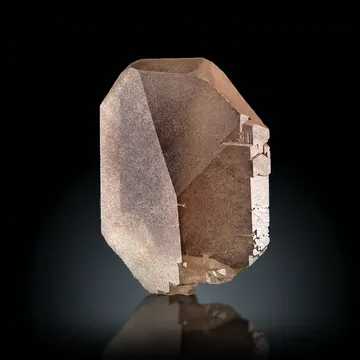
France: diverse fluorite colors, quartz, azurite, and rare arsenates from Alpine clefts to Cap Garonne; storied localities and prized, named specimens.
Key facts
France is not a single mineral locality so much as a whole collecting civilization compressed into one country: Variscan basement and late-Variscan hydrothermal veins in the Massif Central and Brittany; Alpine clefts in the Mont-Blanc and Oisans massifs; Mesozoic cover rocks carrying stratiform fluorite-baryte-lead-zinc systems; and copper, uranium, antimony, silver, gold, and rare-mineral districts that have fed cabinets for more than two centuries. For collectors, the country’s signature look is unusually varied: electric blue and honey-yellow fluorite cubes, raspberry-red Alpine fluorite octahedra on smoky quartz, grass-green pyromorphite from old lead workings, “chessylite” azurite from Chessy-les-Mines, transparent Dauphiné quartz from La Gardette and Bourg-d’Oisans, and microscopic but scientifically heavyweight arsenates from Cap Garonne.
Regional View
Country View
What makes France especially important is that its specimens sit at the intersection of beauty, mining history, and mineralogical nomenclature. Azurite was long known to collectors as chessylite after Chessy near Lyon. Autunite takes its name from the Autun district in Saône-et-Loire. Laumontite is tied to the Huelgoat lead mines of Brittany. Cap Garonne, above the Mediterranean near Le Pradet, is one of Europe’s great type-locality and micromount mines, with a dense suite of copper, lead, cobalt, mercury, uranium, sulfate, chloride, and arsenate species. Meanwhile, the French fluorite localities—Le Beix, Valzergues, Fontsante, Chaillac, La Barre, Le Burg, Montroc, and the Mont-Blanc clefts—created a distinct national collecting tradition in which color zoning, cleft associations, and old labels matter almost as much as size.

Photo: Wikimedia Commons
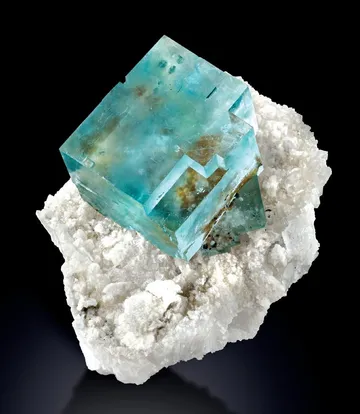
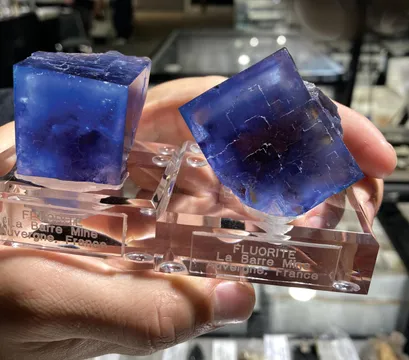
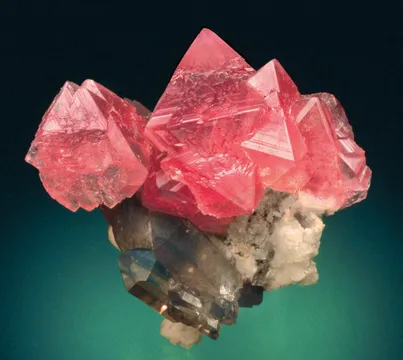
The best French pieces are rarely anonymous “pretty minerals.” They usually carry a geological accent. Le Beix fluorite often shows blue cubes and modified forms with quartz crusts or quartz veils. Valzergues is remembered for amber-yellow cubes, sometimes zoned with blue, from the celebrated Filon Jaune. Chaillac’s Rossignol vein and Redoutières baryte body are studied as a linked fluorite-baryte hydrothermal system, and their specimens commonly mix industrial ore minerals with collector-grade pyromorphite, baryte, fluorite, and iron oxides. In the Alps, the distinction is altogether different: crystals come from narrow high-mountain clefts, and the finest pieces can look as if smoky quartz and pink fluorite grew in deliberate sculptural balance.
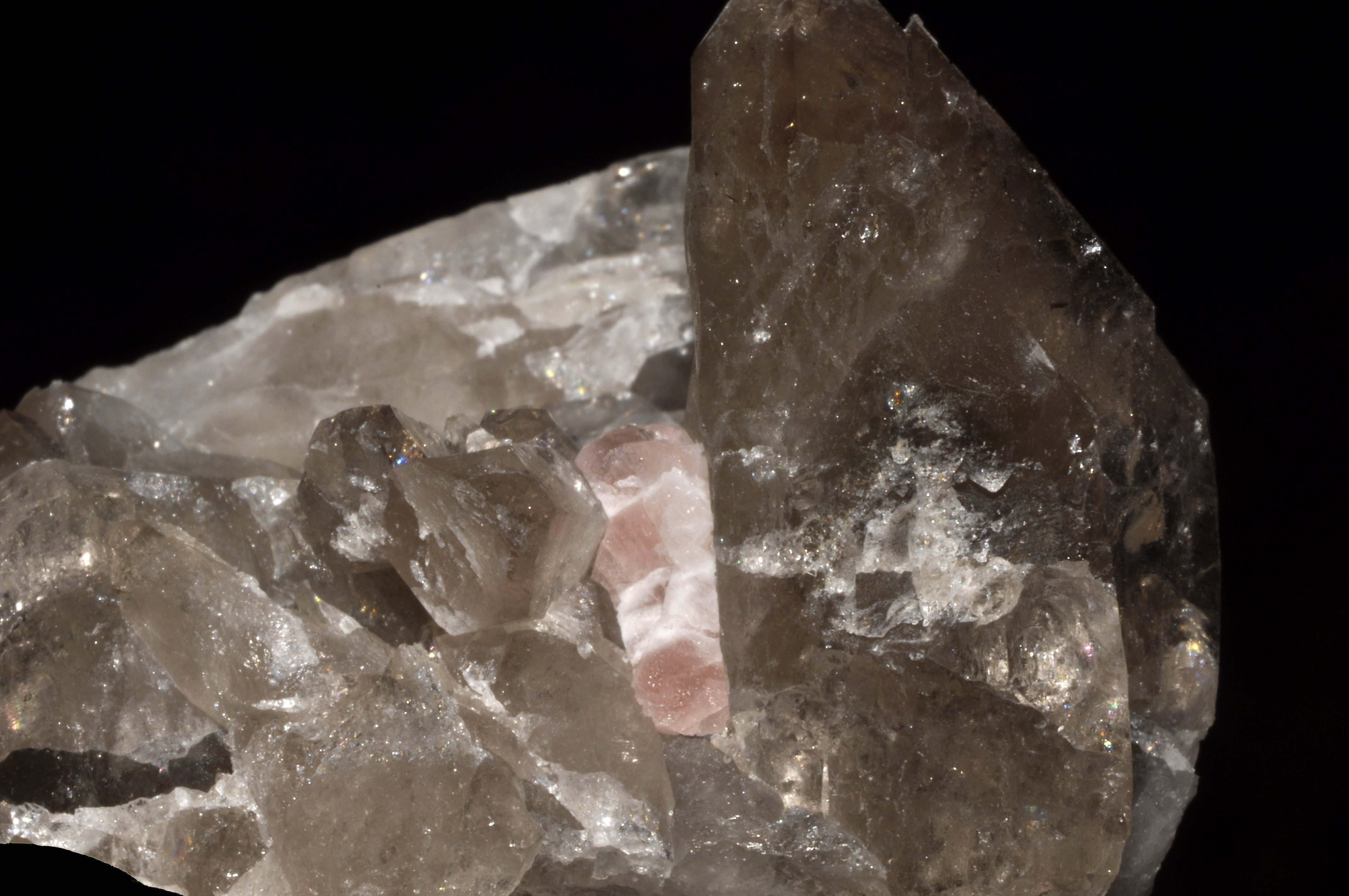
Photo: Wikimedia Commons
Search for specimens: View all specimens from France
French collector minerals come from several major geological families. The most visible on the specimen market are low- to moderate-temperature hydrothermal veins and replacement bodies carrying fluorite, baryte, quartz, galena, sphalerite, pyrite, chalcopyrite, and secondary lead and copper minerals. In the Massif Central, these deposits occur both in older crystalline basement and along the contact where sedimentary cover overlies the Variscan basement. The Chaillac district in Indre is a particularly instructive example: the Rossignol fluorite vein is rooted in basement rocks, while the Redoutières baryte body is a stratiform to sub-stratiform deposit related to the same hydrothermal system. The result is a locality famous both to economic geologists and to collectors, with fluorite, baryte, pyromorphite, goethite, galena, cerussite, quartz, and minor rare species recorded from the broader mining basin.
Chaillac’s mining history is unusually well documented and unusually visible today. Early iron workings preceded the fluorite-baryte era. Fluorite mining began after the first shaft was sunk in 1954, giving rise to the Rossignol underground mine; intensive work at Redoutières in 1970 confirmed major baryte reserves, and open-pit baryte exploitation began in 1975. The Rossignol vein was worked by underground methods with shafts, galleries, wagons, washing, and shipping of ore for metallurgical flux and chemical uses. By 1979 the exploited vein was reported at about 100 m depth along roughly 600 m of length; by 1990 it had reached about 250 m depth and 1,000 m of length, with annual extraction exceeding 20,000 tonnes. Redoutières baryte, a major French industrial source, came from the open pit and produced the red baryte specimens that are a collecting category of their own. The mines are inactive now, but Chaillac preserves the story through its mining and mineral museum.
Le Beix, in Puy-de-Dôme, is the great classic name for blue French fluorite. The mine was near the hamlet of Rozet, east of Lastic, and specimens may be labeled Le Beix, Bourg-Lastic, or Herment depending on the old collector, dealer, or shipping convention. Geologically, it was a hydrothermal fluorite vein in granite near the major coal-bearing structural line that crosses the Massif Central. The vein was recognized over about 250 m, mined down to roughly 235 m, and dipped steeply. Production is estimated at about 360,000 tonnes of ore. The mine was worked at least from the late 19th century and later by Teisset-Kessler from 1917 to 1973, then by SOGEREM, part of the Péchiney group, until final closure in July 1977. The site is no longer a collecting locality in any practical sense: the principal shaft was collapsed, surface installations removed, and the land is private agricultural property.
Fontsante, in the Tanneron area of Var, represents the Provençal fluorite districts. Its fluorite occurs in several colors—green, white, purple, yellow, colorless, and more rarely blue—with quartz, baryte, calcite, chalcopyrite, pyrite, dolomite, marcasite, galena, and other associates recorded. The locality is valued by collectors for variety rather than a single stereotyped look: different levels and habits produced cubes, modified crystals, and combinations on quartz or baryte. Provenance is important, because “Fontsante” can be used loosely in the trade for the wider fluorite-mining area; good labels should specify mine, district, and ideally the old collection.
Valzergues, in Aveyron near the Decazeville coal basin, is another classic fluorite name. The mine area includes fluorite, baryte, and white quartz along a small stream near Nespoulières, whose name is attached to the celebrated Filon Jaune. The deposit was discovered in 1926 by Victor Lassalle, and its operating history was intermittent: the Société Minière de Valzergues began work, recession interrupted operations around 1928–1930, activity resumed in 1939, employment rose from 19 workers in 1939 to 27 in 1940 before the Second World War stopped work, and later companies attempted restarts in the 1950s and 1960s. Bankruptcy was declared on 16 May 1967, and a 1970 review with SOGEREM found the mine uneconomic. Its commercial life was modest, but its collector life is enormous: amber-yellow cubes, often gemmy and sometimes edged or zoned in blue, made Valzergues one of the most recognizable French fluorite localities.
The Alpine localities belong to a different world. In the Mont-Blanc massif, collectors—cristalliers—work natural clefts in granite and related rocks, where hydrothermal fluids deposited quartz first and fluorite later into open spaces locally called “fours.” Quartz may be clear, smoky, or morion; fluorite occurs as octahedra, often pink to red and more rarely green. These are not mine-run specimens but high-altitude cleft specimens, and modern collecting is governed by access, safety, protected-area rules, and local tradition. The Chamonix crystal culture is formal enough that the commune developed an honor code for cristalliers after public attention around the famous Laurent fluorite specimen.
In Oisans, the La Gardette mine near Bourg-d’Oisans is historically a gold mine but mineralogically a quartz locality of world standing. The vein is a quartz-rich, east-west structure in gneiss, explored from the 18th century onward. Gold production was never truly industrially successful, but the open cavities yielded magnificent transparent quartz groups known as Dauphiné or Bourg-d’Oisans quartz, sometimes with chalcopyrite, baryte, galena, sphalerite, and minor supergene lead and copper minerals. French alpine-style quartz collecting cannot be understood without La Gardette.
Other French classics are more species-specific. Les Farges, near Ussel in Corrèze, is a major pyromorphite locality, with apple-green to grass-green prismatic crystals, hopper forms, barrel habits, and associations with baryte and quartz from a complex lead-silver-antimony-sulfosalt environment. Chessy-les-Mines near Lyon is the historic azurite locality behind the name chessylite, with blue azurite balls and crystal groups from the copper mines. Cap Garonne, a former copper-lead mine at Le Pradet in Var, is now a museum and one of the richest micro-mineral localities in Europe, especially for copper arsenates and type-locality species.
Collecting access in France must be treated locality by locality. Many classic mines are closed, fenced, backfilled, collapsed, private, or protected; some are museums rather than collecting sites; some dumps are managed by clubs or associations; and high-mountain clefts involve both mountaineering risk and local regulations. Serious collectors should approach modern field collecting through French clubs, municipal museums, quarry permissions, and published field-trip frameworks rather than relying on old guidebook coordinates.
French fluorite is a collecting field in itself: Le Beix is prized for blue cubes and modified crystals, commonly on or invaded by fine quartz crusts; Valzergues for amber-yellow to honey cubes, sometimes with blue zoning from the Filon Jaune; Fontsante for its broad color range and quartz-baryte associations; Chaillac for fluorite tied to the Rossignol vein and the baryte-pyromorphite suite; and Mont-Blanc for pink to red octahedra on smoky quartz from Alpine clefts. Size varies from sharp thumbnails and miniatures to cabinet specimens with multi-centimeter crystals, and the best pieces combine color saturation, transparency, intact edges, undamaged cleavages, and a matrix association that fixes the locality at a glance.
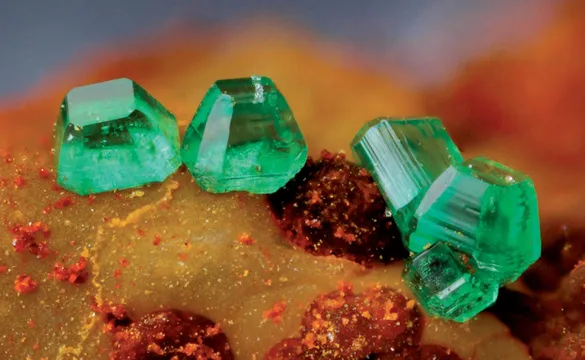
France’s broader mineral list is exceptional because many important specimens are historically or taxonomically anchored. Azurite from Chessy-les-Mines is the classic “chessylite” material; autunite is named for the Autun district; laumontite is linked to Huelgoat in Brittany; Les Farges pyromorphite is one of Europe’s great lead-phosphate occurrences; La Gardette quartz is a benchmark for Dauphiné habit and alpine cleft aesthetics; and Cap Garonne has yielded type-locality species including perroudite, geminite, camerolaite, capgaronnite, deloryite, pradetite, guarinoite, thérèsemagnanite, zdenekite, mahnertite, iltisite, pushcharovskite, bariopharmacoalumite, forêtite, gobelinite, and galeaclolusite. Add the old silver and polymetallic districts of Sainte-Marie-aux-Mines, the uranium minerals of Autun and Lodève, baryte and goethite from Chaillac, copper secondaries from Chessy and Cap Garonne, and Alpine quartz-adularia-anatase associations, and France becomes one of the few European countries where a collector can build both a display collection and a serious systematic collection from national material alone.
The chief authenticity issue with French specimens is usually not fakery but locality precision. Le Beix material may be labeled Le Beix, Bourg-Lastic, Lastic, or Herment; all can be historically plausible, but a high-value blue fluorite deserves old labels, collection history, or a confident stylistic match. Valzergues yellow fluorite is often described by vein, especially Filon Jaune; because its amber cubes with blue zoning are distinctive and desirable, vague “Aveyron” or “France” labels should be treated cautiously. Fontsante, La Barre, Le Burg, Montroc, and other French fluorite localities can overlap in broad color palette, so assigning an unlabeled loose fluorite cube to a mine from appearance alone is risky.
Condition matters greatly. Fluorite cleaves perfectly and old French pieces often have small edge bruises, contact marks, or rehealed-looking zones; these are common, but sharpness is a major price separator. Le Beix fluorite can show natural dissolution features and quartz impressions that should not be confused with damage, although broken edges will look glassier and less patterned. Valzergues cubes are frequently judged on transparency, color zoning, and edge integrity. Mont-Blanc pink fluorites are typically octahedral and can be perched on smoky quartz in exposed positions, making even slight bruising easy to see.
French pyromorphite, especially from Les Farges and Chaillac, should be checked for rubbed terminations and broken needles or barrels. The green color can be vivid naturally; avoid assuming brightness means treatment, but inspect for glued repairs on matrix plates. Chessy azurite is an old-label classic, and genuine early material may be compact, nodular, or composed of small blue crystal groups rather than dramatic modern-style sprays. Azurite can be brittle, and associated malachite or earthy copper secondaries may shed if roughly handled.
Radioactive French uranium minerals, especially autunite and related uranyl phosphates and vanadates, require disciplined storage and labeling. Do not abrade, grind, wash aggressively, or keep friable material loose in open drawers. Use boxes, avoid dust inhalation, and keep them away from children and food-preparation areas. Autunite-group specimens may dehydrate or alter over time; stable humidity, minimal handling, and containment are preferable to repeated display under strong heat or harsh lighting.
Market availability is uneven. French fluorite appears regularly but fine old Le Beix, top Valzergues, strong La Barre zoning, and Mont-Blanc pink fluorite on smoky quartz are all competitive. Chaillac material remains obtainable, especially baryte, fluorite, pyromorphite, and goethite, but quality varies widely. Les Farges pyromorphite is a recognized European classic and commands a premium for lustrous grass-green coverage on sculptural matrix. Cap Garonne species are mainly micromount material and should be bought with analytical confidence, especially for rare type-locality arsenates.
On 21 July 2006, the Chamonix cristallier Christophe Peray found the specimen that changed how France talked about mineral specimens. The piece, later named Laurent, came from the Aiguille Verte in the Mont-Blanc massif and combined smoky quartz with red to raspberry fluorite octahedra. Peray named it for Laurent Chatel, his rope partner, who had died in a fall in 2005 while the two men were searching for crystals. The specimen’s mineralogical quality was not merely private-collector good; it was judged to have national importance. France’s Commission des trésors nationaux classified it as a “bien culturel d’intérêt patrimonial majeur,” the first natural-history object to receive that status. It later entered the Muséum national d’Histoire naturelle in Paris, where its story is inseparable from the geology of Alpine clefts and the human risk of collecting them.
The Laurent episode also exposed the strange economics of great mineral specimens. The stone was valued at a level difficult for public institutions to match against private buyers, and the state turned to corporate patronage to secure it. The concern was not sentimental. Exceptional Mont-Blanc fluorite-quartz specimens are portable, beautiful, and internationally desirable; without intervention, such a specimen could easily disappear into a private collection abroad. After the publicity, Chamonix moved to formalize crystal collecting through a local code of honor. The old world of the cristallier—part climber, part prospector, part mountain historian—suddenly met the language of cultural patrimony.
La Gardette tells a very different kind of French mineral story: the gold mine that became more famous for quartz than for gold. The vein near Bourg-d’Oisans was scratched by local mountaineers in the early 18th century, investigated by royal order in 1735, and then worked again in 1765 down to about 11 m, only to produce mostly rock crystal. Gold was found in 1770 and again in 1779, and in 1781, after the mine passed to the comte de Provence, work expanded dramatically. Twenty-two separate attacks by shafts and galleries yielded enough gold to strike a commemorative medal in 1786, but that medal was nearly the mine’s triumph and its joke: the clearest profit remained the crystals. One later operator made enough noise in the press in the 1830s and 1840s to attract attention, but not enough gold to justify the excitement. The bitter local line was that he extracted no gold except “that of the subscribers.”
The scientific afterlife of La Gardette was more dignified. Later mineralogists described an east-west quartz vein in gneiss, dipping steeply south, known over hundreds of meters and containing rich constrictions where native gold occurred with galena, sphalerite, and tetrahedrite-group minerals. But in the swollen open parts of the vein, gold was scarce and the quartz took over: long, transparent rock-crystal groups, sometimes piercing chalcopyrite or accompanied by white baryte. Those are the pieces that carried the name Bourg-d’Oisans across Europe.
Valzergues is a story of false starts redeemed by specimens. Victor Lassalle discovered the fluorite deposit in 1926, and the first company soon built sorting facilities near the access bridge. Then the late-1920s recession cut the enterprise short. Another company restarted work in 1939 with 19 employees; by 1940 there were 27, and then war stopped the mine again. The decades that followed brought new companies, new hopes, and more interruptions: La Gagnières in 1955, the Société Minière des Caspanelles in 1961, the Compagnie Française des Mines de Dèze later that same year, then other reorganizations until bankruptcy on 16 May 1967. A 1970 review with SOGEREM judged the mine uneconomic. Yet collectors remember the place not for its failed balance sheets but for the Filon Jaune—amber cubes, sometimes edged blue, that entered major collections and made a small Aveyron mine internationally recognizable.

_rose_sur_quartz_fum%C3%A9_1(France).jpg)
