St Peters Mine, UK fluorite locality known for apple-green to pale lilac cubes, thinly zoned with quartz and siderite, prized by British collectors.
Key facts
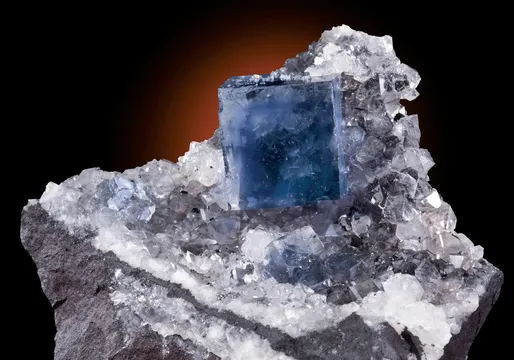
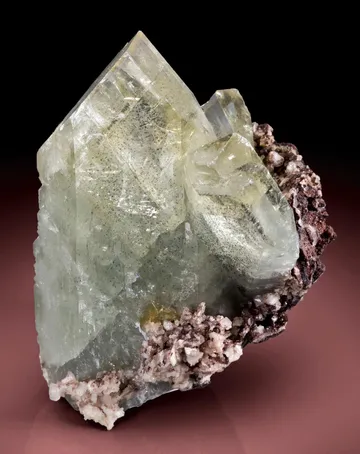
St Peters Mine is one of the quieter North Pennines fluorite localities: not a constant marketplace name like Rogerley, Diana Maria, Boltsburn, Heights, or Lady Annabella, but a mine whose best pieces carry a very particular East Allendale character. The classic St Peters look is cubic fluorite in yellow, honey-brown, straw, yellow-green, pale lilac, purple, and the prized bright apple-green tones, commonly on or with quartz, siderite, calcite, and galena. The best specimens have enough transparency to show soft internal zoning, glassy luster on the cube faces, and a mineralogical “North Pennine” balance of fluorite and iron-carbonate contrast: pale cubes edged or dusted by warm brown siderite, sometimes with quartz or calcite adding sparkle.

Photo: Wikimedia Commons
The locality sits at Sparty Lea in East Allendale, Northumberland, within the Northern Pennine Orefield. This is the great English province of Carboniferous limestone-hosted veins and replacement “flats,” where lead, zinc, iron carbonates, quartz, fluorite, baryte, and related minerals were deposited by hydrothermal fluids along faults, folds, and receptive limestone beds. St Peters belongs to the fluorite-rich part of that orefield, but its productive ore ground was unusually well tied to the Great Limestone and to the structural relationship between St Peter’s Vein, an accompanying monocline, and replacement flats.
The mine is historically important as a lead mine, but for specimen collectors its reputation rests on two very different eras. First are the classic bright apple-green fluorites of the 1930s, a celebrated find largely associated with Sir Arthur Russell and now represented in the Natural History Museum, London. Second are the specimen recoveries of the 1990s, when underground work produced many of the straw to light-brown and yellow fluorite groups seen in modern collections and dealer archives, commonly associated with siderite and quartz. These later pieces are often more available than true Russell-era green material, but fine examples are still scarce.

Photo: Wikimedia Commons
Collectors look for St Peters pieces that are unambiguously cubic, lustrous, and three-dimensional, with clean edges, attractive color zoning, and good contrast from siderite, quartz, or calcite. Large cubes are a major prize. Small-cabinet and cabinet specimens with cubes of several centimeters are the normal high-end target; the rarest reported modern groups carry fluorite cubes approaching 10 cm, while classic apple-green examples with old provenance occupy a different tier altogether.
Search for specimens: View all fluorite specimens from St Peters Mine, UK
St Peters Mine is at Sparty Lea, East Allendale, Northumberland, with the recorded mine position around NY8515 4876. The mine lies in the North Pennines, a region whose ore deposits are dominated by veins and flats in Carboniferous sedimentary rocks. In practical specimen terms, this means St Peters fluorite is not a simple open-vein product alone: much of the mine’s importance comes from replacement mineralization in limestone, especially in the Great Limestone, where the vein and flat system created cavities and mineralized zones capable of producing crystallized fluorite.
St Peter’s Vein trends roughly east-northeast and was worked as a lead-bearing structure. Geological descriptions record a small but significant fault throw, increasing northeast of the shaft, and a productive ore zone confined to the Great Limestone. Trials in other limestone horizons found fluorite but not payable lead values. The ore-bearing ground in the Great Limestone extended for about 3,400 ft, with both vein oreshoots and flats. The flats occur at the High Flat horizon and were controlled by bedding, minor strings, and the structural form of an elongate domal fold south of the vein. That structural detail matters to collectors because it explains the combination of vein mineralogy, replacement textures, and open-space crystallization seen on St Peters specimens.
The principal ore was galena, with small quantities of sphalerite and pyrite. The gangue suite included green and purple fluorite, quartz, ankerite, siderite, and calcite. These minerals were involved in replacement of the limestone, and the mine’s specimen suite still reflects that paragenesis: fluorite with quartz and siderite is more characteristic than fluorite alone, while galena, calcite, and occasional sphalerite or pyrite belong to the wider St Peters assemblage.
The St Peters deposit was discovered in 1902 during the driving of Blackett Level. It was initially thought to be a continuation of Swinhope Vein, and early development was from Blackett Level before later working from St Peters Shaft. The Weardale Lead Company subsequently worked the mine, and historical accounts place the main industrial life of the mine in the first half of the twentieth century, ending in the mid-1940s. Ore from St Peters was taken to Sipton Mill for treatment, tying the mine physically and operationally to the wider East Allendale mining system.
Collecting access should be treated as closed unless proper permission and competence are in place. The mine is on private land, and the underground workings are old, deep, and hazardous. St Peters is not a casual field-collecting locality. Most collectible fluorite in circulation came from historical mining, old collections, or controlled specimen recovery work. Modern labels referring to material “from the shaft,” “30 Fathom Level,” or 1990s work are plausible and important, but they need scrutiny because this is precisely the kind of locality where later attributions can become over-specific.
The two notable specimen-producing episodes are the bright apple-green fluorite find of the 1930s and the recovery work of the 1990s. The 1930s green material is the most storied: much of it was acquired by Sir Arthur Russell and passed with his collection to the Natural History Museum, London. The 1990s recoveries, associated in the literature and collector record with Dave Hacker, Northern Minerals, and underground access via the shaft, produced fine straw, yellowish, light-brown, and pale lilac fluorites, commonly with siderite and quartz. These later finds are the source of many of the recognizable St Peters pieces seen today.
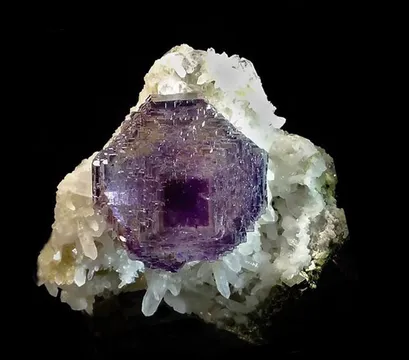
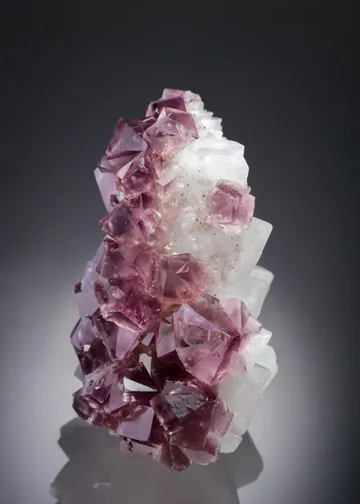
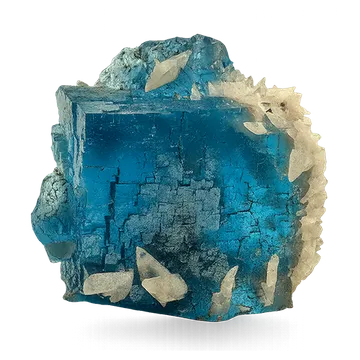
St Peters fluorite is overwhelmingly cubic. The standard habit is simple cubes, intergrown cube groups, stepped cubic clusters, and partial ribs or floater-like plates where crystals grew along a narrow mineralized seam or cavity. The cubes may be sharp and glassy or slightly frosted and etched; the finest pieces show bright luster and enough transparency to reveal internal zoning. Some groups are three-dimensional, crystallized on several sides, while others are matrix specimens with fluorite concentrated on one display face.
Color is one of the locality’s signatures. The best-known classic material is bright apple-green, especially the 1930s find, but most specimens encountered by collectors are more likely to be straw-yellow, honey-brown, pale yellow-green, pale lilac, purple, or color-zoned mixtures of these. Honey-brown to amber cubes with calcite are known, and some specimens show strong purple fluorescence under ultraviolet light. The fluorescence is not unique to St Peters within the North Pennines, but it is a desirable added feature when combined with good color, transparency, and old locality provenance.
Size varies considerably. Many matrix pieces carry cubes around 1 cm or less, especially on quartz- or siderite-rich matrix. Better cabinet specimens may have cubes of 4–6 cm. Reports from specimen recovery work describe straw to light-brown groups with cubes up to about 10 cm, often partly coated with siderite; those are exceptional and should be regarded as major St Peters specimens when well preserved. A documented Wikimedia specimen measures 9.3 x 7.2 x 4.5 cm and carries honey-brown cubes to 1.7 cm with calcite.
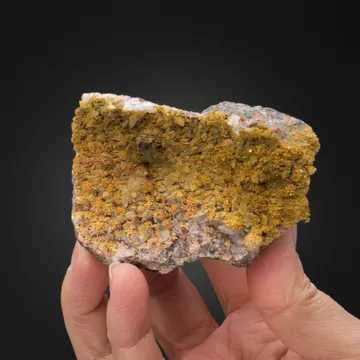
The most typical associated minerals are quartz and siderite. Mindat photo data and dealer descriptions repeatedly show these two companions, and they give many St Peters fluorites their recognizable look: yellowish or brownish cubes with sugary quartz and golden-brown siderite crystals outlining cube edges or coating selected faces. Calcite is a less common but attractive association, especially as colorless rhombs over fluorite. Galena belongs to the ore suite and appears on some specimens; sphalerite, pyrite, chalcopyrite, ankerite, and cerussite are recorded from the mine, though not all are common as visible display associations with fluorite.
Condition is especially important. Fluorite from St Peters cleaves easily, and old mine or collection specimens may have bruised cube corners, contacted edges, or dulled faces from carbonate coatings or underground handling. The best pieces have minimal peripheral damage, well-defined cube outlines, and a displayable balance between fluorite and matrix. Siderite coatings are attractive when they accent the crystals, but heavy siderite can obscure the fluorite and reduce desirability unless the specimen has strong form or provenance. Calcite and quartz can enhance a piece if they sit as later, sparkling accents rather than hiding the cube faces.
The premium St Peters qualities are, in order: secure locality and level/provenance data; unusually strong color, especially apple-green; large, sharp, lustrous cubes; transparency and internal zoning; attractive siderite, quartz, or calcite association; fluorescence; and historic collection history. A modest-looking specimen with a reliable Russell, Greenbank, Critchley, or well-documented 1990s provenance may be more important than a visually louder but poorly labeled piece.
The main authenticity issue with St Peters fluorite is not artificial treatment; it is attribution. The North Pennines produced many superficially similar fluorites, and older labels often used broad terms such as “Weardale,” “Northumberland,” “Allendale,” or simply “North of England.” A later owner or dealer may be tempted to upgrade a broad label to a famous precise mine. For St Peters, that temptation is especially strong because of the celebrated 1930s apple-green material and the relative scarcity of confirmed examples.
There is a documented collector discussion involving a fluorite on galena that had travelled through multiple respected collections with a St Peters attribution, including labels connected with Ralph Sutcliffe, Lindsay Greenbank, and Al and Sue Liebetrau. A Mindat photograph by Rock Currier showed the same specimen in 1972 in the Carnegie Museum of Natural History, then attributed to the William Jefferis collection. Since Jefferis died in 1906 and St Peters was only just entering its working life at that time, the St Peters attribution became highly suspect. The lesson is not that all old labels are wrong; it is that a St Peters label should make chronological and mineralogical sense.
For pieces said to be from the 1930s apple-green find, provenance is critical. Material from that find is famous precisely because so much of it was acquired by Sir Arthur Russell and went to the Natural History Museum. A loose “St Peters green fluorite” label without an old collection chain should be viewed cautiously. For 1990s material, labels naming a collector, recovery project, shaft access, or level are helpful, especially if the specimen matches the known straw, light-brown, yellow, lilac, quartz-siderite character of the later finds.
Condition problems are typical of fluorite from an old underground lead mine: cleaved cube corners, bruised edges, broken matrix, and faces dulled by iron carbonate or clay. Because some St Peters specimens are rib-like or nearly floater pieces, check all sides for old saw cuts, fresh cleaves, and hidden contact points. Siderite can be friable; calcite rhombs on fluorite can be easily bruised; quartz may protect parts of the specimen while leaving protruding fluorite cubes exposed.
Market availability is sporadic. St Peters fluorite appears in old-collection dispersals, dealer archives, and occasional auctions rather than as a steady modern supply. Recent public records include small-cabinet and cabinet specimens from the Harry Critchley, David Walker-Barker, Greenbank, and Liebetrau circles, with 2025 auction results for notable St Peters fluorites in the several-hundred-dollar range. The best apple-green material with deep provenance is far rarer than ordinary listings suggest, and confirmed large-cube 1990s pieces are increasingly difficult to replace.
The most memorable St Peters story is a cautionary tale about how a label can become too precise. A collector acquired a fluorite on galena carrying a chain of labels that all pointed to St Peters Mine. The chain itself sounded reassuring: the piece had passed through English dealer and collector Ralph Sutcliffe, then to Lindsay Greenbank in 1991, then in the early 2000s to Al and Sue Liebetrau, and finally out of the Liebetrau collection after it was acquired by a dealer in late 2024. For a North Pennines collector, that is the kind of provenance trail that usually makes a specimen more desirable, not less.
Then the chronology began to trouble the story. On Mindat, the collector found a photograph by Rock Currier of the same specimen, taken in 1972. At that time the specimen was in the Carnegie Museum of Natural History in Pittsburgh and was attributed to the William Jefferis collection. Jefferis was a major nineteenth-century American collector, and his collection entered the museum after his death in 1906. But St Peters Vein had only been discovered in 1902, and the mine’s meaningful development came after that. A specimen that had already entered an old American museum collection through Jefferis could not comfortably be one of the mid-1930s St Peters apple-green pieces, nor a 1990s recovery. The conclusion was not romantic, but it was useful: the specimen was probably a fine North Pennines fluorite whose later St Peters attribution had attached itself somewhere along the collecting chain.
The underground record gives St Peters a different kind of atmosphere. Blackett Level is repeatedly described in mine photographs and captions as the long access line by which St Peters was found and worked; one caption places a St Peters view in Blackett Level almost one mile from the portal. The level was driven from Allendale Town to drain and explore the East Allendale mines, and during that work the St Peters ore deposits were discovered. In collector terms, that means the locality was not a picturesque surface dig or a small spar pocket opened for specimens, but a working industrial system of levels, shaft, ore bins, and distant underground connections.
Photographs from the 1990s exploration record show the kind of objects that make old mines feel startlingly immediate. A small wooden tub was photographed on the 30 Fathom Level adjacent to St Peters Shaft in 1996. Another image records flat mineralisation in steeply dipping beds in 1999. Most striking is the caption for remains of a box of Polar Ammon Gelignite found in the flats and left there. That detail belongs in every serious collector’s mental picture of the locality: attractive fluorite came from the same old workings that still held abandoned explosive packaging, timber, tubs, and unstable mineralized flats.
The famous apple-green find of the 1930s has a quieter but more consequential afterlife. Much of that material was acquired by Sir Arthur Russell, whose collection became one of the great repositories of British mineral specimens. A photographed drawer in the Russell collection is described as containing fine St Peters fluorites, and the note attached to it specifically connects the bright apple-green 1930s find with specimens now in the Natural History Museum, London. For collectors, that museum drawer explains why so few unquestionable examples circulate: the best of the find did not disperse widely into the market. It went, largely, into one of the most important British mineral collections ever assembled.