Flor de Peña Mine, Mexico — type locality for legrandite; prized honey-yellow crystals on smithsonite, with intimate topotype specimens and collecting appeal.
Key facts
Flor de Peña is a small mine with an outsized name in mineralogy: it is the type locality for legrandite, Zn2(AsO4)(OH)·H2O, one of the most coveted yellow zinc arsenates in the collector world. The mine lies near Lampazos de Naranjo in northern Nuevo León, a semi-arid carbonate terrain on the Mexican side of the great lead-zinc-silver belts that continue through Coahuila and Durango. Its mineralization belongs to the familiar northern Mexican family of zinc-lead deposits in limestone: sphalerite and galena as primary ore minerals, pyrite and siderite in the older assemblage, and a strongly oxidized near-surface zone carrying smithsonite, iron oxides, carbonates, and arsenates.
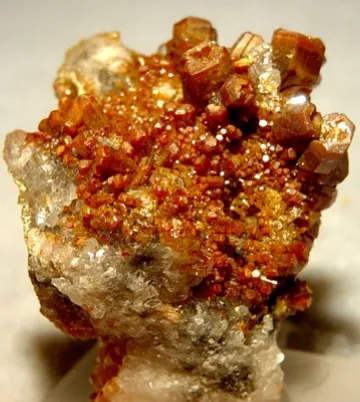
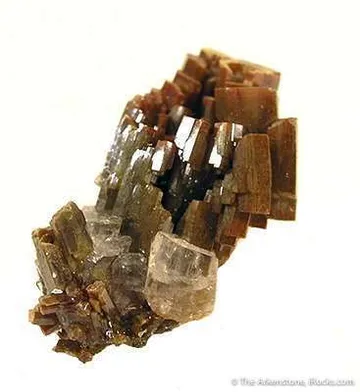
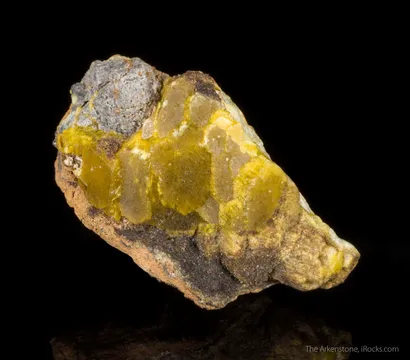
Collectors prize Flor de Peña not because it rivaled Ojuela in abundance or spectacle, but because it is the starting point of the species. The first legrandite was not discovered as a showy cabinet spray; it was noticed as a small quantity of bright yellow, transparent material on massive sphalerite from the mine. Later specimens proved that the locality could do more than micromount scraps: the best Flor de Peña pieces show honey-yellow to lemon-yellow prismatic crystals and sheaf-like or radiating clusters perched on white, yellowish-white, brown, or dark smithsonite-rich gossan. The most characteristic examples have a compact, somewhat blunt-ended habit that feels distinct from many of the elongated, chisel-tipped legrandites of Ojuela.
Regional View
Country View
The locality’s best specimens have a very different kind of authority from the giant legrandites of Mapimí. Flor de Peña material is generally more intimate: small crystals, miniature-size matrices, and a matrix association that can be nearly diagnostic when well documented. A fine example is not merely “pretty legrandite”; it is a topotype specimen, a physical connection to the mineral’s first description and to the complicated early-20th-century story of Louis Charles Antoine Legrand.
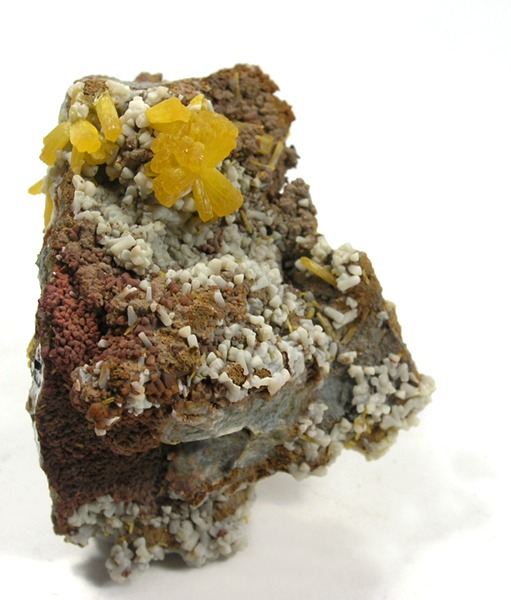
Photo: Wikimedia Commons
Search for specimens: View all specimens from Flor de Peña Mine, Mexico
Flor de Peña Mine is recorded at Lampazos de Naranjo, Lampazos de Naranjo Municipality, Nuevo León, Mexico, in the northern part of the state. The locality is small enough that the literature repeatedly describes it as obscure, yet its mineralogy places it squarely in the oxidized zinc-lead-arsenic environment that made northern Mexico so productive for secondary arsenates. The type material of legrandite is explicitly tied to the oxidized zone of an arsenic-bearing zinc deposit, and the associated primary suite at the type locality includes sphalerite, pyrite, and siderite; later locality lists add galena, smithsonite, calcite, barite, goethite, hematite, mimetite, aurichalcite, adamite, and carminite.
Regionally, the Lampazos area belongs to a belt of carbonate-hosted lead-zinc-silver mineralization in Cretaceous limestones and related sedimentary units. Servicio Geológico Mexicano mapping of nearby Sabinas-Lampazos mineralized ground describes Cupido Formation limestone, northwest-trending anticlinal structures, mantos and veins, and silver-lead-zinc mineralization in calamine and sulfide ores with pyrite, iron oxides, calcite, and barite as gangue. That regional picture matches what collectors see on Flor de Peña specimens: an oxidized, ferruginous, carbonate-rich matrix where smithsonite and limonite provide the ground for bright yellow arsenate growth.
The mine appears to have been worked intermittently by Compañía Minera Flor de Peña from the late 1880s until perhaps the 1920s. It never became a celebrated producer, and the scarcity of production records is itself part of the story. A label associated with the original Legrand material described the mine as carrying complex zinc and lead ore that was unfortunately very rich in arsenic, a telling phrase: excellent chemistry for unusual secondary arsenates, poor chemistry for straightforward ore treatment. Galena from the mine was sufficiently documented by the early 20th century to appear in official Mexican exhibition literature, but the locality’s mining identity soon became overshadowed by its mineralogical one.
Specimen production is patchy and poorly recorded. The first known legrandite specimen passed from the widow of Louis Legrand to Julien Drugman and became the basis for the 1932 description. Additional collecting apparently took place in the 1960s and 1970s, before Dr. Miguel Romero’s early-1980s visit, when numerous specimens were recovered from the main dump. Romero’s best Flor de Peña legrandite has been described as a 20 cm piece carrying stout yellow sprays to 3.5 cm on a smithsonite-coated matrix. A smaller lot appeared on the market in the mid-2000s, though published accounts leave open whether it was newly collected or older material finally released.
Collecting access today should be treated as uncertain and restricted. Flor de Peña is not a public collecting destination with documented open access. Any field visit would require permission from the relevant landowner and mineral-rights holder, as well as the usual mine-safety precautions for old workings, oxidized arsenic-bearing material, unstable dump rock, and desert conditions. For most collectors, specimens will come from old collections, dealer stock, estate material, or the occasional carefully attributed topotype released from a Mexican suite.
Legrandite from Flor de Peña is the locality’s defining species and its only verified type-locality mineral. The classic material occurs as yellow to golden-yellow prismatic crystals, radiating groups, sheaves, and compact sprays on smithsonite-rich gossan, commonly with white to yellowish-white botryoidal smithsonite or darker iron-stained smithsonite and limonite. Most market pieces show crystals in the millimeter to roughly 1.5 cm range, while exceptional historical material is reported with crystals to about 3.5-4 cm. Good Flor de Peña legrandite is judged first by provenance, then by saturated yellow color, transparency or translucency, clean terminations, undamaged exposed tips, and unmistakable contrast against smithsonite rather than a nondescript brown oxide crust; the best pieces also show the locality’s distinctive radiating or stout prismatic habit rather than looking like an ordinary Ojuela specimen with a changed label.
Smithsonite at Flor de Peña is important less as a standalone show mineral than as the matrix and paragenetic stage on which the finest topotype legrandites are built. It is documented as massive to botryoidal, white, yellowish-white, greenish, brown, and dark material, locally coating gossanous matrix and creating the pale “rice-grain” or botryoidal surfaces that distinguish many Flor de Peña pieces from the more familiar limonite-cavity legrandites of Ojuela. The most desirable smithsonite-bearing specimens are those where the carbonate matrix is visually active but not distracting: a clean, sparkling or botryoidal bed that lifts the yellow arsenate crystals, preserves the mine’s characteristic association, and carries convincing old or analytical documentation.
Other documented minerals from Flor de Peña include adamite, aurichalcite, barite, calcite, carminite, galena, goethite, hematite, mimetite, pyrite, siderite, and sphalerite. Of these, carminite is the notable rarity for arsenate specialists, while sphalerite, pyrite, siderite, and galena represent the older ore assemblage that supplied zinc, lead, iron, sulfur, and arsenic to the oxidized zone. Paradamite has been reported historically but is now treated with caution in modern locality databases because a cited specimen and its matrix were judged to resemble Ojuela material rather than Flor de Peña.
The central authenticity problem for Flor de Peña specimens is locality attribution. Because Ojuela Mine legrandite is vastly better known and far more abundant, specimens can be confused in both directions: good Flor de Peña pieces may be dismissed as Ojuela, while ordinary Ojuela pieces may be promoted as topotype material. A convincing Flor de Peña legrandite should have excellent provenance, ideally an old label, publication history, analytical support for the smithsonite association, or a chain of ownership traceable to a known collection. The association with botryoidal or rice-grain smithsonite is important, but it is not a certificate by itself; the safest purchases are those where morphology, matrix, and provenance all agree.
Condition is a serious issue. Legrandite is not a forgiving mineral: crystals are brittle, with exposed terminations and edges that chip easily. On many specimens the legrandite stands proud of a crumbly gossan or smithsonite-coated matrix, so even minor vibration or careless wrapping can abrade tips. Examine crystal ends, side faces, and the junction between legrandite and matrix under magnification. Small chips are common and sometimes tolerable on true topotype material, but a premium specimen should have at least one clean, well-displayed undamaged group.
There is no famous treatment tradition for Flor de Peña legrandite, but cleaning can be risky. Acid cleaning, aggressive ultrasonic work, or heavy mechanical preparation may damage smithsonite, loosen iron-rich matrix, or dull fragile arsenate crystals. The safest approach is dry storage, careful dust control with a soft brush or air bulb, and stable display away from jostling. As with all arsenates, Flor de Peña legrandite should be handled sensibly: avoid grinding or trimming without controls, do not inhale dust, and wash hands after handling friable pieces.
Market availability is low. Small topotype specimens appear intermittently, often from old collections or dealer archives, while fine miniatures and small cabinet examples are distinctly scarce. Recent auction and dealer records show that even modest Flor de Peña examples attract attention because they combine species beauty with type-locality status. For advanced collectors, a Flor de Peña legrandite with smithsonite is not a substitute for a flamboyant Ojuela cabinet piece; it is a different collecting category altogether.
The story begins not in a pocket, but in a widow’s parcel. Julien Drugman acquired a group of specimens from the widow of a Belgian mine manager, Mr. Legrand. Among them was a piece of massive sphalerite from Flor de Peña carrying a small amount of bright yellow transparent material that did not match any known species. Drugman and Max H. Hey examined it optically and chemically, recognized a new basic zinc arsenate, and in 1932 named it legrandite. Most of the remaining type material went to the British Museum, turning a small Mexican mine of little commercial renown into a permanent name in systematic mineralogy.
For decades, “Mr. Legrand” was a tantalizingly vague figure. Mineral collectors knew the name, but not the man. Later research untangled the identity: Louis Charles Antoine Legrand, born in 1861 and dead by 1920, a Belgian mining engineer and mineral collector who had visited Mexico in the early 1900s. The clue that tied the story down was not a dramatic ore ledger, but handwriting: labels associated with portions of the type specimen, including a note describing Flor de Peña as a complex zinc and lead ore mine, “unfortunately very rich in arsenic.” It is a wonderful collector’s irony. The chemical nuisance that likely hurt the mine’s practicality created the conditions for its immortal mineral.
The mine’s later collecting history is a sequence of small survivals rather than a continuous production story. Some collecting took place in the 1960s and 1970s, and then Dr. Miguel Romero visited in the early 1980s and recovered numerous specimens from the main dump. Romero’s finest reported piece was not a thumbnail curiosity but a 20 cm specimen covered with stout yellow sprays to 3.5 cm on smithsonite-coated matrix. That specimen is the sort of detail that changes how one thinks about Flor de Peña: not just a locality that supplied microscopic type material, but a small mine capable, on rare occasions, of producing genuinely important display specimens.
There is also the quieter afterlife of topotype material in old collections. One account describes a Flor de Peña legrandite micromount acquired at Ackley’s Rock Shop in Colorado Springs. Its box carried the name of Willard Wulff, a Colorado Springs micromounter and charter member of the Colorado Springs Mineralogical Society, and the label read “Flor de Peña Mine, Lampazos de Naranjo, Nuevo Leon/Mexico/TYP.” Such pieces are easy to overlook in an estate flat, yet they may preserve the very locality evidence that makes a specimen important.