A collector's guide to Erongo Mountains, Namibia: its geology, mining history and notable minerals, illustrated with the 1326 specimens documented from this locality on EarthWonders.
Key facts
The Erongo Mountains occupy one of the most distinctive places in the modern mineral-specimen world: not a conventional underground mine, not a single pegmatite quarry, but a broad, rugged Cretaceous volcano-plutonic complex whose granites and related pegmatitic miaroles have produced some of the most instantly recognizable combination specimens of the last generation. The classic Erongo look is architectural and high-contrast: sky-blue to blue-green aquamarine in hexagonal prisms rising from black schorl, with pale feldspar, smoky quartz, green fluorite, hyalite opal, muscovite, siderite, goethite, topaz, cassiterite, and rare borates completing the pocket assemblage.
Geologically, the collectible specimens come chiefly from miarolitic cavities and pegmatitic segregations in the Erongo Granite, an early Cretaceous anorogenic granite emplaced into older Damara Belt metasedimentary rocks. That setting matters because Erongo is chemically odd in exactly the way collectors love: a granite system enriched enough in boron, beryllium, fluorine, water, and incompatible elements to make open-space pockets rich in schorl, beryl, fluorite, topaz, and rare species. Modern analytical work has shown that Erongo is not a textbook “clean” NYF pegmatite environment; it carries a hybrid geochemical signature, with Damara metasedimentary contamination helping to introduce boron and to push late-stage fluids into the tourmaline-rich, beryl-bearing pocket regime.
Its collecting history is equally modern. Tin- and tungsten-bearing pegmatites around the Erongo area were known long before the collector boom, but the locality’s international mineral fame accelerated sharply from 1999 onward, when well-formed schorl, topaz, aquamarine, and later jeremejevite entered the market in quantity. The early 2000s made Erongo a household name among serious collectors: aquamarine-on-schorl became a new Namibian classic, and the 2001 jeremejevite discovery at Ameib Farm produced some of the world’s finest crystals of that rare species.
Regional View
Country View
The best Erongo specimens have a sculptural balance that is hard to fake visually: a blocky feldspar or tourmaline base, one or several freestanding beryl prisms, strong color contrast, and enough open-space crystal texture to show that the piece grew in a real cavity rather than as a loose crystal assemblage. Even ordinary Erongo material often has charm, but great examples are precise: undamaged aquamarine terminations, lustrous black schorl without heavy bruising, crisp feldspar architecture, and associations that look inevitable rather than cluttered.

Photo: Wikimedia Commons

Photo: Wikimedia Commons
Search for specimens: View all specimens from Erongo Mountains, Namibia
The Erongo Mountains rise in west-central Namibia between the broad collector reference points of Usakos, Omaruru, and Karibib. The massif is part of the Damaraland igneous province and is commonly described as an eroded volcanic-plutonic ring complex. Its mineral specimens are not produced from one formal mine with a single shaft and dump; they come from many small workings, pockets, claims, farms, and collecting sites distributed around the granitic portions of the mountain complex.
The collector deposit type is best understood as a subvolcanic granite–miarolitic pegmatite system. Late-stage fluids within the Erongo Granite created open cavities, pegmatitic pockets, and quartz-tourmaline segregations. These pockets produced beryl varieties, schorl and related tourmaline-group minerals, feldspar-group minerals, quartz, fluorite, topaz, opal, mica, cassiterite, siderite, goethite, and a long list of accessory phosphates, oxides, borates, uranium minerals, tungsten minerals, and rare-earth minerals. The most important specimen zones include areas around Bergsig Farm, Ameib Farm, Hohenstein Gorge, Tubussis, Lion’s Head, and other named farms and workings on the mountain’s flanks.
Ore history predates the collector boom. The broader Erongo area includes older tin, tungsten, rare-metal, and base-metal occurrences, including cassiterite-bearing pegmatites and tungsten mineralization such as the Krantzberg Mine. Tin-bearing pegmatites on farms in the Erongo area were already significant enough to appear in early twentieth-century geological and mining literature. Cassiterite, ferrotantalite, amblygonite, lepidolite, scheelite, wolframite-series minerals, and associated pegmatite species tie the collector locality to Namibia’s older rare-metal mining story.
The modern mineral-specimen story began in earnest in the late 1990s. Small-scale miners discovered well-crystallized schorl and topaz in miaroles in 1999, followed by major aquamarine pockets in 2000 and a spectacular jeremejevite occurrence in 2001. By 2002, the Erongo deposits were being worked by hundreds of people in small groups, often by hand, with limited equipment. Early production came from near-surface cavities, but productive pockets soon required deeper digging into hard granite.
Access today is not casual field collecting. Much of the Erongo Mountains is private farmland, conservation land, or ground covered by mineral rights. Namibia’s mineral rights are state-regulated, and legal collecting, purchasing, and exporting of mineral specimens require proper permissions and documentation. The practical collector’s route is to buy from reputable Namibian dealers, established international dealers, or collectors with clear provenance, rather than attempting unauthorized collecting on private or protected land.
The great pockets define the locality’s reputation. The April 2000 aquamarine discovery on Bergsig Farm 167, often remembered as the “Easter Pocket,” produced blue beryl with black schorl, orthoclase, and hyalite, and it helped launch Erongo as a world locality. Later pockets produced beryl networks, intense blue aquamarine on schorl and feldspar, large schorl groups, goethite pseudomorphs after siderite, fluorite combinations, and the famous Ameib jeremejevite crystals. Some later market groups, including strong aquamarine-schorl-feldspar pieces from 2009 and cassiterite-ilmenite specimens from more recent finds, show that the district has continued to yield collector-quality material long after the first boom.
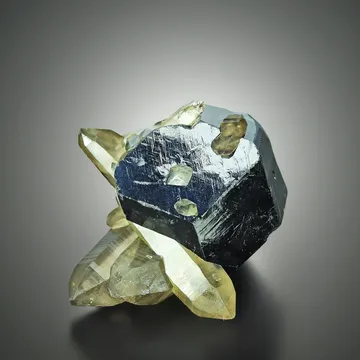
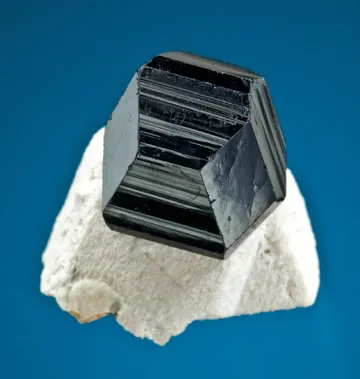
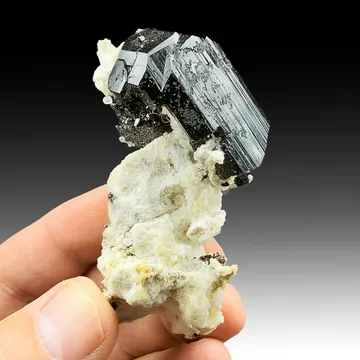
Schorl is the visual backbone of Erongo collecting: lustrous black prisms, radiating sprays, acicular bundles, tight nests, and blockier striated crystals provide the dramatic matrix for aquamarine, fluorite, quartz, opal, and feldspar. The finest pieces are not merely “black tourmaline” but sculptural frameworks of terminated crystals, commonly in compound aggregates that can look almost brushy or cockscomb-like at the terminations. Erongo schorl ranges from small needles and coatings to stout crystals and impressive groups, with documented finds including large crystals and groups from early modern workings. Good specimens show crisp termination, bright luster, minimal abrasion on exposed ridges, and a natural association with blue beryl, white feldspar, green fluorite, smoky quartz, or glassy hyalite; ordinary pieces are more massive, broken, or visually heavy.
Aquamarine from Erongo is famous for crisp hexagonal prisms in pale blue, rich blue, blue-green, and locally color-zoned crystals, many showing strong prism faces, flat basal terminations, and a classic blue-on-black association with schorl. Studied Erongo beryls are commonly subhedral to euhedral, and collector specimens include small gemmy crystals, cabinet-size matrix pieces, and exceptional larger groups; the best crystals may be transparent at the terminations even when the bases are included or fractured. Schorl inclusions, iron-oxide-filled cracks, quartz, muscovite, feldspar, cassiterite, foitite, rossmanite, and fluorite are all part of the Erongo beryl environment. Top pieces combine saturated color, transparency, intact terminations, and natural placement on schorl or feldspar; mediocre examples tend to be pale, contacted, heavily cracked, or stripped from context as loose crystals.
Erongo fluorite is a pocket mineral rather than the locality’s primary commodity, but it gives some specimens their most memorable color contrast: green, yellow-green, purple, color-zoned, included, etched, cubic, modified cubic, and locally spearhead-like or complex forms on schorl, feldspar, quartz, and aquamarine. The green fluorites on black schorl are especially recognizable, and fluorite may occur as isolated glassy crystals perched on tourmaline, as cavity linings, as inclusions in beryl or quartz, or as later crystals in feldspar-rich pockets. Fine pieces are judged by transparency, color zoning, sharpness, lack of bruising, and the strength of the association; loose, damaged, or cloudy fluorites are commoner and much less desirable.
Beryl at Erongo is not a single look but a family of pocket styles: aquamarine, goshenite, heliodor, greenish beryl, and color-zoned crystals all occur in the same broad granite-miarolitic system. The beryl is typically prismatic and hexagonal, with idiomorphic crystals common in good pockets, and associations include schorl, quartz, muscovite, alkali feldspar, plagioclase feldspar, iron oxides, foitite, rossmanite, cassiterite, fluorite, and opal. What separates superior Erongo beryl from routine material is the combination of strong form and display context: a clean termination, gemmy zones, attractive zoning, and placement on a contrasting natural matrix. Broken single crystals can still be useful study pieces, but the collector premium belongs to complete crystal groups and beryl-on-schorl or beryl-on-feldspar compositions.
Quartz from Erongo ranges from white to smoky crystals, small sharp druses, pocket linings, and matrix-forming crystals associated with schorl, feldspar, aquamarine, fluorite, topaz, opal, and siderite/goethite. Japan-law twinned quartz has been reported from the modern pocket period, and quartz can also host fine schorl inclusions or help frame aquamarine-schorl groups. The best Erongo quartz specimens are not usually valued as standalone quartz classics in the way Brandberg quartz is; they matter when they strengthen a combination piece through clarity, smoky color, geometry, or twinning. Dull, contacted quartz is abundant, while sharp, undamaged, well-positioned quartz in a multi-mineral pocket assemblage is much scarcer.
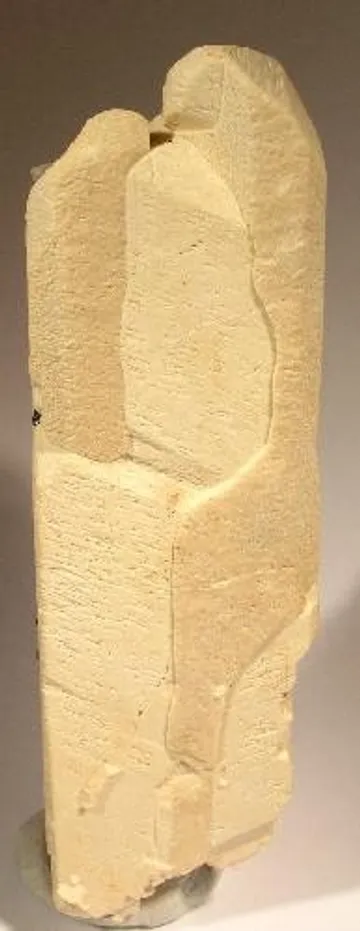
Feldspar is the quiet architecture of Erongo specimens: pale cream, white, tan, and locally etched or blocky crystals form the platforms on which aquamarine, schorl, fluorite, quartz, muscovite, and opal are displayed. Orthoclase, microcline, and albite all contribute to the feldspar story, with complex feldspar twins documented from important early aquamarine pockets. The best feldspar pieces are crisp enough to be more than anonymous matrix—sharp faces, attractive twinning, clean contrast with blue beryl or black tourmaline, and minimal iron staining make a large difference. Ordinary feldspar is plentiful and can be chalky, broken, or visually dead; fine feldspar gives Erongo combinations their structure and scale.
Smoky quartz occurs in the same Erongo miarolitic cavities and pegmatitic pockets that produced beryl, schorl, feldspar, fluorite, and topaz, and it is part of the locality’s early modern specimen assemblage. Crystals may be pale smoky gray to darker brown, sometimes arranged with schorl sprays or feldspar blocks, and they can create handsome, less-common alternatives to the standard aquamarine-schorl pairing. The most appealing pieces show sharp, lustrous terminations and balanced association rather than isolated, abraded smoky points. Because Namibia has multiple famous quartz localities, accurate labeling matters: Erongo smoky quartz should show the granitic pocket associations and provenance consistent with the Erongo Mountains, not be confused with Brandberg or Goboboseb material.
Orthoclase is one of the important feldspar species in the Erongo pockets, appearing as pale blocky crystals, matrix masses, and twinned forms associated with aquamarine, schorl, hyalite opal, quartz, fluorite, and other late-stage minerals. The early aquamarine pockets included complex orthoclase twins, and good orthoclase can be a meaningful specimen species in its own right when the crystals are sharp, clean, and visibly twinned. In combination specimens, orthoclase often supplies the white-to-cream contrast that makes blue beryl and black schorl stand out. Better pieces preserve crystal form and pocket texture; lesser pieces are simply feldspar rubble carrying more valuable species.
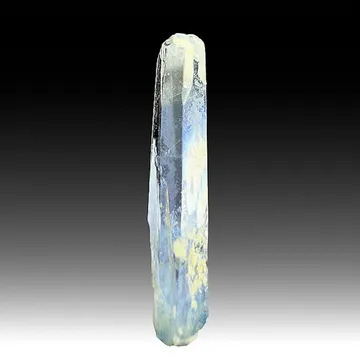
Jeremejevite is Erongo’s great rare-species triumph. The 2001 Ameib Farm discovery yielded needle-like to columnar crystals, mostly loose singles, in colorless to near-colorless, pale yellow, blue, saturated blue, greenish blue, and rare violet tones. Most crystals were small and narrow, but a limited number reached several centimeters, and a tiny elite reached the 5–7 cm range; the best blue crystals are among the finest known for the species. Matrix specimens are much rarer than loose crystals, so collector value hinges on verified provenance, color, transparency, length and diameter, intact termination, and freedom from repaired breaks. A clean blue Erongo jeremejevite is a serious rarity, while colorless small needles are more available but still locality-significant.
Goshenite from Erongo represents the colorless end of the beryl suite and occurs as clear to white hexagonal crystals in the same miarolitic pocket environment as aquamarine, heliodor, schorl, feldspar, muscovite, fluorite, quartz, and opal. Collector specimens can be sharply formed, glassy, and doubly terminated, and some are perched attractively on schorl or mica-rich matrix. The best goshenites are transparent, bright, undamaged, and compositionally well placed in a display piece; they can be underrated because they lack aquamarine color, but a water-clear crystal on black tourmaline has a refined Erongo aesthetic. Commoner material is milky, contacted, or visually lost among paler feldspar.
Opal at Erongo is best known to collectors as hyalite or hyaline opal associated with schorl, feldspar, aquamarine, and early pocket assemblages, sometimes adding a glassy, botryoidal, colorless to pale yellow or greenish accent. In the finest combinations, opal is not the main crystal species but the surface that makes the piece sparkle and, in some examples, fluoresce attractively. It may occur as coatings, rounded blebs, or cavity linings on feldspar and tourmaline-rich matrix. Good pieces retain glossy, fresh opal without dehydration cracking, abrasion, or distracting dirt; ordinary opal-coated matrix is less desirable unless it supports strong aquamarine, schorl, or fluorite.
Microcline from Erongo appears as pale feldspar matrix and, in better examples, as distinct blocky crystals or twinned forms associated with aquamarine, schorl, fluorite, quartz, opal, muscovite, siderite, and goethite. It is often collected because of what grows on it, yet the best microcline-rich specimens show etched faces, crisp geometry, and a clean color contrast that gives the whole piece its composition. Microcline also matters for locality recognition: Erongo combinations frequently rely on the white feldspar–black schorl–blue beryl triad. Superior pieces make the feldspar look intentional and architectural; weaker ones use it merely as a damaged or stained base.
Topaz was among the minerals that helped announce the modern Erongo pocket era, occurring in miarolitic cavities with schorl, feldspar, quartz, aquamarine, fluorite, and related late-stage species. Erongo topaz is typically colorless to pale, sharp, and glassy when fresh, though it is far less abundant in the collector market than aquamarine or schorl. Fine topaz specimens are judged by clarity, termination, matrix association, and freedom from bruising along the perfect cleavage; damaged or cleaved crystals quickly lose appeal. The best Erongo topaz pieces are pocket combinations rather than anonymous loose crystals, especially when they preserve the granite-miarole context.
Tourmaline at Erongo is more complicated than the market term “schorl” suggests. Analytical work has documented schorl-subgroup tourmalines as well as X-site-vacant tourmalines, including foitite and rossmanite components in certain materials, and black fibrous or acicular aggregates long sold simply as schorl may deserve more careful identification. Collector habits range from jet-black prismatic crystals and sprays to needle-like aggregates and color-zoned tourmaline in the broader Erongo system. The strongest tourmaline specimens show lustrous, terminated crystals in natural association with aquamarine, feldspar, quartz, fluorite, or opal; the weakest are massive black fragments whose species name may be assumed rather than tested.
Heliodor is the yellow to yellow-green beryl member in the Erongo suite and occurs much less commonly than blue aquamarine. Documented Erongo beryl ranges include yellow, greenish, blue-green, and color-zoned material, and bicolored beryl from the area has received gemological attention. Collector heliodor is valued when the yellow color is distinct, the crystal form is sharp, and the specimen retains a natural Erongo association with schorl, feldspar, fluorite, quartz, or opal. Pale yellow-green crystals can be attractive but may be visually subtle; the best pieces stand apart by color clarity, crystal completeness, and credible provenance, since pale beryl colors are easily over-described in the market.
Muscovite is a common accessory and matrix mineral in Erongo pocket assemblages, occurring with beryl, schorl, feldspar, quartz, fluorite, cassiterite, and iron oxides. It may form silvery to pale mica books, sparkling coatings, or supporting matrix beneath goshenite and aquamarine. As a collector species, muscovite from Erongo is usually secondary to beryl or tourmaline, but it can add brilliance and textural contrast when fresh and well crystallized. Fine pieces show clean mica luster and stable books without severe bending, flaking, or iron staining; ordinary mica-rich matrix can be fragile and visually distracting.
Ilmenite is a much less common Erongo specimen species but is documented in the locality’s broader assemblage and has appeared in association with cassiterite and schorl in recent collector material. It typically presents as dark metallic to submetallic crystals or plates, valued more for rarity and association than for bright color. Better examples show identifiable crystal form, fresh luster, and a clear relationship to cassiterite, tourmaline, quartz, or feldspar matrix. Because dark oxides can be difficult to identify visually, serious Erongo ilmenite specimens benefit from reliable labels, analytical confirmation, or provenance from a documented find.
Albite is part of the feldspar assemblage in Erongo pockets and occurs with aquamarine, schorl, fluorite, quartz, topaz, cassiterite, and other late-stage minerals. It may appear as white cleavable matrix, small bladed or blocky crystals, or pale feldspar contrast beneath brighter species. Albite-rich pieces are usually collected for their combinations rather than as standalone albite classics, but clean albite can sharpen the contrast in aquamarine-schorl specimens and help document the pocket paragenesis. Better examples have fresh surfaces and coherent crystal texture; lesser albite is chalky, bruised, or so massive that it contributes little beyond support.
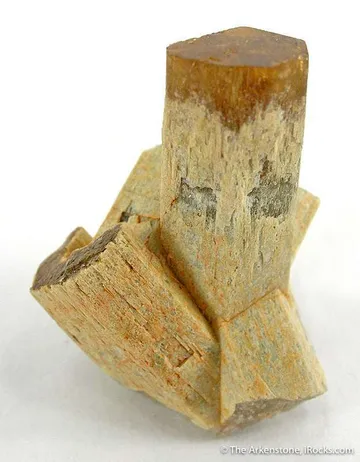
Cassiterite connects Erongo’s modern collector fame to its older tin-bearing pegmatite history. It occurs as dark brown to black, high-luster crystals, commonly small but locally attractive, associated with quartz, schorl, feldspar, ilmenite, beryl, and other pegmatite minerals. Recent collector specimens with cassiterite, ilmenite, and schorl have made the species more visible in the market, though it remains far scarcer than aquamarine or schorl. Good Erongo cassiterite shows sharp twinning or crystal form, strong adamantine to submetallic luster, and clean contrast on matrix; average material is small, embedded, or visually difficult to separate from other dark oxides.
Calcite is documented from the broader Erongo mineral list but is not one of the defining display species from the granite miaroles. Where present, it is best treated as an accessory late-stage carbonate or as part of the wider Erongo-area mineralization rather than as a principal pocket mineral like beryl, schorl, fluorite, quartz, or feldspar. Collector examples are uncommon and should be valued for confirmed locality, association, and crystal quality. Because calcite is soft and reactive compared with most Erongo silicates, specimens need protection from acids, rough handling, and careless cleaning; ordinary calcite from the area does not carry the same premium as classic Erongo aquamarine or schorl.
Siderite is important at Erongo chiefly through its association with goethite pseudomorphs and late-stage pocket mineralization. It may occur as brown carbonate crystals or as the precursor to iron-oxide replacements, with associations including aquamarine, schorl, microcline, fluorite, quartz, and goethite. The most interesting collector pieces are those that show crystal form clearly, either as fresh siderite or as goethite after siderite retaining rhombohedral shape. Good specimens have sharp geometry and stable surfaces; lesser examples are dull brown patches, crumbly remnants, or poorly preserved pseudomorphs.
Goethite at Erongo is most collectible as sharp pseudomorphs after siderite and as iron-oxide accents in pocket assemblages with aquamarine, schorl, fluorite, quartz, and feldspar. The early modern Erongo production included notable goethite-after-siderite finds, which gave the locality another distinctive mineral style beyond blue beryl. Fine goethite specimens preserve the original siderite crystal geometry with lustrous brown to black surfaces and attractive placement on matrix. Inferior pieces are simply rusty coatings or iron staining, which can obscure beryl and feldspar rather than enhance the specimen.
Spinel is a minor and uncommon species in the Erongo collector suite, represented far less often than beryl, schorl, fluorite, quartz, feldspar, or opal. In the market, the term may also appear around “spinel-law” twinning in fluorite or quartz discussions, so collectors should distinguish true spinel, the mineral, from twinning terminology. Genuine Erongo spinel specimens need careful provenance and, where possible, analytical support, especially if the crystals are small or embedded. The desirable pieces are those with identifiable crystal form and a documented association; vague labels on dark or small crystals should be treated cautiously.
Other documented minerals from the Erongo Mountains and its named sublocalities make the district far deeper than the standard aquamarine-schorl story. Foitite is especially important because black fibrous tourmaline aggregates once sold casually as schorl have been analytically tied to foitite in the Erongo system. Rossmanite components occur in some color-zoned tourmalines. Cheralite, formerly treated under the name brabantite, is a type-locality mineral from the Van der Made pegmatite on Schlucht Farm. The wider Erongo list also includes amblygonite, anatase, arsenopyrite, axinite-(Fe), bastnäsite-(Ce), bismuthinite, columbite-tantalite minerals, galena, goyazite, grayite, haiweeite, hematite, herderite, heterosite, hydroxylherderite, monazite-group minerals, pyrolusite, raspite, scheelite, uraninite, and many other rare accessory species tied to the region’s granites, pegmatites, tungsten deposits, and uranium-bearing mineralization.
Erongo specimens are actively traded and widely collected, which means authenticity issues are usually less about entirely fake locality names and more about precision, species identification, repair, and assembly. The strongest provenance is a label tied to a named farm, pocket, dealer, or old collection; “Erongo, Namibia” alone is acceptable for many older pieces but less satisfying for major specimens.
Mislabeling is a real concern. The Erongo Region includes multiple celebrated mineral districts, including Brandberg/Goboboseb, Spitzkoppe, Karibib-area pegmatites, Usakos-area deposits, and Erongo Mountain pockets. Smoky quartz, feldspar, schorl, topaz, fluorite, and beryl from these areas can be confused in commerce. A specimen labeled “Erongo” should ideally match the Erongo Mountains’ granite-miarolitic associations, not merely come from the administrative Erongo Region.
Tourmaline identification deserves care. Much black Erongo tourmaline has been sold as schorl, but analytical work has shown foitite and related tourmaline compositions in the system. For most display pieces, “schorl” remains the accepted market term when the crystals are classic black prisms, but unusual fibrous, acicular, color-zoned, or pale tourmaline should not be over-specified without analysis.
Repairs and restorations occur, especially on aquamarine-schorl matrix specimens. Erongo aquamarine crystals are exposed, brittle at terminations and edges, and commonly perched on uneven tourmaline or feldspar. Check for reattached beryl prisms, filled breaks at the base of aquamarines, glued schorl sprays, repaired fluorite, and reconstructed feldspar matrix. Ultraviolet light, magnification, and careful inspection around contact points are useful.
Condition issues are predictable. Aquamarine commonly has internal fractures, iron-oxide-filled cracks, included bases, edge wear, and contacted terminations. Fluorite can be chipped or etched, and some color centers may be light sensitive over long exposure. Feldspar can be bruised, cleaved, or chalky. Muscovite flakes easily. Opal coatings should be protected from heat, excessive dryness, and aggressive cleaning. Calcite, where present, should be kept away from acids.
Cleaning should be conservative. Iron staining is common in Erongo pockets, but acids can damage associated calcite, destabilize coatings, dull opal, and harm repaired areas. Mechanical cleaning around schorl, mica, fluorite, and beryl terminations can easily turn a sharp combination into a rubbed one. For high-value pieces, preserve pocket dirt unless it is clearly removable without risk.
Market availability remains good for schorl, aquamarine-schorl combinations, feldspar-associated beryl, and small fluorite or opal associations. Fine, undamaged aquamarine-on-schorl with saturated color is much scarcer than the overall quantity of Erongo material suggests. Jeremejevite is genuinely rare, particularly in blue, large, transparent, or matrix examples. Cassiterite-ilmenite combinations, high-quality goethite pseudomorphs, sharp topaz, and unusual beryl colors are specialist material and should be bought with provenance.
The modern Erongo story begins like many great specimen localities do: with a mountain that had already been known geologically, but not yet fully recognized as a world-class pocket producer. Tin and tungsten had drawn attention earlier, and pegmatites on farms around the massif were part of Namibia’s rare-metal story. Yet the collector market did not truly turn toward Erongo until the late 1990s, when small-scale miners opened miarolitic pockets containing well-formed schorl, topaz, and aquamarine. In a remarkably short span, the locality went from regional curiosity to one of the most important new specimen sources in Africa.
The April 2000 Bergsig discovery became the hinge event. Collectors remember it as the “Easter Pocket,” and the name is apt: it was the kind of find that seemed to resurrect a whole district in the eyes of the mineral world. Blue aquamarine came out with black schorl, hyalite opal, and twinned feldspar, creating the visual language that still defines Erongo specimens. The best pieces were not just blue crystals; they were compositions, with pale feldspar acting as stage, schorl as shadow, and beryl as the cool blue vertical note.
Then came the rare-mineral episode that made Erongo legendary beyond aquamarine collectors. In March 2001, gemmy, intensely blue crystals from a small cavity on Ameib Farm were first thought to be beryl. They were small, mostly under a centimeter, and at first did not command the attention they deserved. Georg Gebhard suspected something rarer and sent material to Dr. Jochen Schlüter at Hamburg University. X-ray powder diffraction proved the crystals were jeremejevite. Once local miners understood what had been found, more material emerged quickly: a few hundred crystals at first, then thousands from several pipe-like cavities before production ended in July 2001.
The numbers from that jeremejevite find still astonish. The reported production was roughly 3,000 to 3,500 crystals. About half were colorless or nearly colorless, many only up to 1 cm long and about 0.1 cm wide. Around 500 crystals reached 1–3 cm. Very few reached 5 cm, and fewer than ten were known in the 5–7 cm range. Most were loose, not on matrix. The colors ranged from pale yellow through blue and greenish blue to rare violet. For a mineral that had long been a collector’s rarity, Erongo suddenly produced some of the finest and largest single crystals ever seen.
The mining itself was never romantic in the easy sense. By 2002, hundreds of people were working the Erongo deposits, often in small groups and largely by hand. Early pockets near the surface were quickly exhausted, and miners began digging several meters into hard granite. Some used pneumatic hammers or heavy electric hammer drills, but many worked with basic tools. The specimens that now sit delicately in cabinets were extracted from steep granite country where heat, distance, water, ropes, unstable ground, and limited equipment all mattered.
A 2005 field account of the Erongo Mountains makes the landscape feel immediate. The approach skirted the western side of the massif from Usakos, sometimes under coastal fog carried inland from the Benguela Current. As the mist lifted, granite domes and rugged slopes appeared above the plains. Tracks gave way to rougher four-wheel-drive approaches, and the final access to workings required hiking through boulder scree and thornveld. On the slopes, quartz-tourmaline nests stood out from weathering granite like black knobs and ribs.
Some of the productive cavities were surprisingly small. Pocket openings could be less than 10 cm across; others were tubular holes perhaps 50–80 cm wide and more than 2 meters deep. At Tubussis, a pipe-like cavity about 2 meters deep and 60–70 cm in diameter was associated with large orthoclase, schorl, and yellow hyaline opal. This is part of the fascination of Erongo: a specimen may look like a grand mineral landscape, but its birthplace may have been a tight, twisting void in granite barely large enough for a person to work safely.
The human cost is part of the locality’s history. One field narrative records that shortly before a 2005 visit, a miner carrying a jackhammer on his back was climbing with a rope when the rope snapped; he fell and died. That detail should not be treated as background color. It belongs beside every fine aquamarine-on-schorl specimen because it reminds collectors that these objects were not simply “found.” They were won from hard rock in difficult terrain by people taking real risks.
There is also the quieter drama of exhaustion. At the jeremejevite site after the 2001 production, visiting collectors searched the tailings and found almost nothing—only a tiny blue chip in feldspar. The diggers had been thorough because they had to be. From the granite high ground, the reward was less mineralogical than geographic: views across the flats toward Gross Spitzkoppe, the dry Khan River country, and old cassiterite-bearing pegmatites on Ameib. Erongo’s story is not one pocket but a network of farms, private gates, claims, conservation land, old rare-metal workings, and relationships between miners, landowners, dealers, researchers, and collectors.