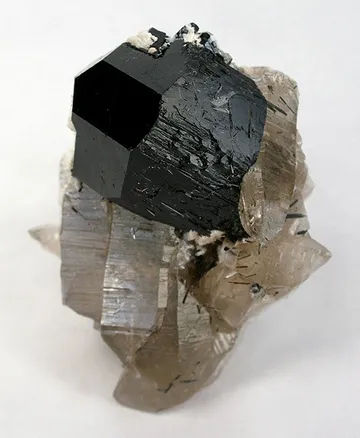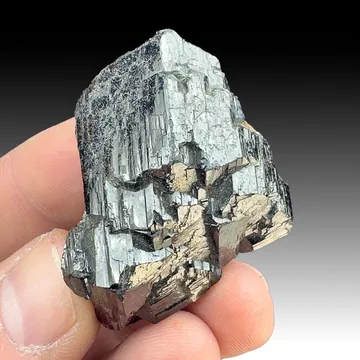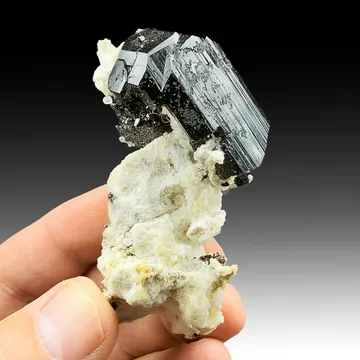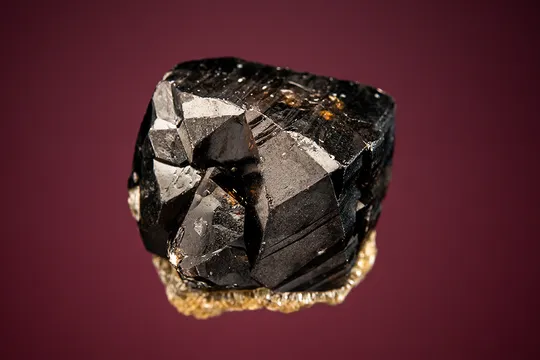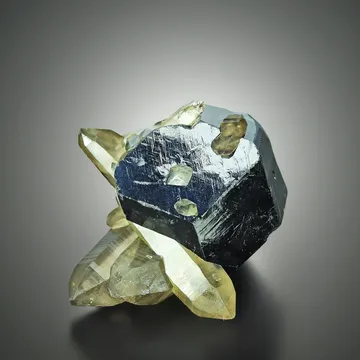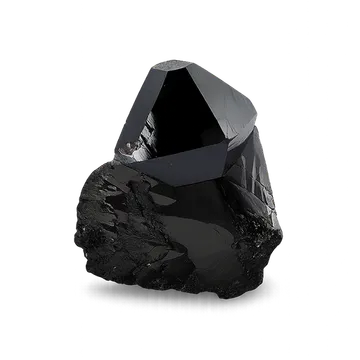
Cassiterite from the Erongo Mountains, Namibia — sharp, lustrous, twinned black crystals; scarce matrix pieces; prized for its Namibian mining history.
Key facts
Cassiterite from the Erongo Mountains is a locality-specialist’s cassiterite: not a common commodity specimen, but a distinctive Namibian tin oxide that bridges two worlds. One is the old Erongo tin-field world of cassiterite in coarse, zoned pegmatites and greisenized veins; the other is the modern Erongo specimen world of miarolitic pockets, black schorl, smoky quartz, ilmenite, feldspar, fluorite and aquamarine. The best pieces are not large ore chunks but sharp, lustrous, complexly twinned black crystals whose mirror faces catch light almost like polished obsidian.

Photo: Wikimedia Commons
The Erongo Mountains themselves are an eroded volcano-plutonic complex in central Namibia, commonly called “Erongo granite” by collectors even though the massif includes multiple intrusive and volcanic rock types. Their broader fame rests on aquamarine, schorl, fluorite and jeremejevite, but cassiterite is woven into the locality’s older economic history. Tin was recognized at Ameib 60 and nearby farms in the early twentieth century, and by the late 1920s several workings on the southwestern periphery of the mountains were already known.
Visually, Erongo cassiterite has two main personalities. The ore-field material from zoned pegmatites and greisen veins is typically brown to black, sometimes with ruby-red or transparent brown descriptions in early accounts, and may occur as grains, crystalline masses or simpler crystals. The collector-grade miarolitic material is more dramatic: black, highly lustrous, complexly intergrown and twinned crystals, sometimes perched with schorl, albite, muscovite, smoky quartz or ilmenite. Matrix specimens are notably scarce, which is part of the attraction. A well-composed Erongo cassiterite with sharp form, minimal bruising and a credible old locality label is much more than a species example; it is a compact piece of Namibian mining and collecting history.

Photo: Wikimedia Commons
Collectors look first for luster and architecture. The most admired crystals are razor-edged, deeply black, glassy to submetallic in brilliance, and visibly twinned or complexly stepped. On matrix, contrast is critical: cassiterite against pale feldspar, smoky quartz, or orange-brown ilmenite has far more visual power than a dark mass alone. Precise locality matters, too. “Erongo Mountains” is often used broadly in the market, but more specific labels such as Ameib, Erongorus-Bergsig, Davib Ost, Davib West, Krantzberg, Sandamap, Brabant or related pegmatites are especially valuable when supported by old labels or reputable provenance.
Search for specimens: View all cassiterite specimens from Erongo Mountains, Namibia
The Erongo Mountains rise southwest of Omaruru in central Namibia and form one of the country’s most important mineral-specimen districts. The massif is approximately 35 km across and stands prominently above older Damara metasediments and granites. Geological Survey of Namibia material describes it as the eroded core of an ancient volcano with peripheral and central granite intrusions, related to the Mesozoic magmatic events that accompanied Gondwana break-up and South Atlantic opening. For collectors, that volcanic-granitic architecture matters because it created both mineralized greisens and the pocket-bearing granites and pegmatites that have made Erongo famous.
Cassiterite occurs in more than one setting around the Erongo complex. The classic tin-bearing pegmatites lie mainly west, southwest and south of the mountains, where cassiterite was dispersed through veins and lenticular pegmatites, commonly as grains, crystalline masses and local lumps. The Sandamap-Erongo pegmatite belt includes highly fractionated, zoned rare-metal pegmatites in which cassiterite occurs in greisenized portions near internal pegmatite contacts, along with minerals such as triplite, lithiophyllite and columbite-tantalite. Other named cassiterite-bearing pegmatites and workings include Cameroon, Sidney, Borna, Carsie, Davib, Ameib, Drews, Brabant, Pietershill, Elliot claims, Schimanski’s claims, Wendroth’s workings, Riverplaats and Kanona-Erongo.
A second important setting is the Erongo granite-related tungsten-tin greisen system, especially at Krantzberg. There, cassiterite occurs with ferberite and other accessory species in greisen veins and breccia-related mineralization. The Krantzberg mine, on the northeastern flank of the Erongo Mountains, was mined principally for tungsten rather than cassiterite, but cassiterite is a documented accessory and specimen mineral there. The greisen assemblage includes quartz, topaz, fluorite, schorl and sericitic muscovite, with accessory cassiterite, chalcopyrite, ferberite, goethite, scheelite, powellite and minor sulfides.
The collecting history begins early. Cassiterite was first reported in the Erongo area around 1910 on Ameib 60, with economic tin workings shown on Wagner’s early map at Ameib 60 and Davib Ost 61. By 1928, additional tin mines were active in the district. A large cassiterite specimen collected in 1915 from Davib, historically spelled “Dawib” on the label, entered the Natural History Museum in London through Percy C. Tarbutt; it weighed 8.16 kg. Early accounts also record a remarkable solid mass from Davib Ost weighing 227 kg, and descriptions of “ruby tin” and beautiful brown transparent cassiterite.
The modern specimen era transformed Erongo’s reputation. From 1999 through the mid-2000s, the mountains produced major pockets of aquamarine, schorl, fluorite, jeremejevite and other species. Cassiterite was part of this specimen renaissance, though in smaller quantities than the celebrated beryl and schorl. Published Erongo discovery chronologies note cassiterite finds in June 2001, May–June 2003 and a second cassiterite pocket in July 2004. Later market descriptions record a limited 2022 cassiterite find with sharp, lustrous crystals on ilmenite and schorl, regarded by dealers as a new standard for Erongo cassiterite.
Access is not casual. Roads around the peripheral parts of the mountains are comparatively straightforward, and specimens have long been traded through local diggers and dealers, but much of the Erongo Mountains is private farmland or part of the Erongo Mountain Nature Conservancy. Namibian mineral rights are state-owned, and legal prospecting or collecting requires the proper permissions. Serious collectors should treat field-sourced Erongo material as a provenance-sensitive subject: a legitimate specimen should come through permitted diggers, established local channels, or reputable dealers who can document how and when the piece entered the market.
Erongo cassiterite is SnO2 and is typically black to very dark brown, with occasional early descriptions of ruby-red or transparent brown material in the broader tin district. The best collector crystals are lustrous to mirror-bright and may be complexly twinned or intergrown. Compared with many cassiterite localities where crystals occur as isolated prisms or simple bipyramids, the prized Erongo miarolitic pieces often show clustered, stepped, highly reflective faces that give the specimen a jagged, architectural look.
Crystal size varies strongly by occurrence type. Published descriptions of miarolitic Erongo cassiterite mention complex intergrown crystals measuring about 4 to 6 cm, while cassiterite on schorl from the Erongorus-Bergsig area has been described at about 1 cm. Kanona-Erongo workings are listed with cassiterite crystals to about 2.5 cm. Matrix pieces involving ilmenite have shown sharp cassiterite crystals to around 1.25 cm on orange-brown ilmenite and smoky quartz. Some recent market examples are cabinet-sized aggregates or plates, but much of the collector-grade crystal material remains thumbnail to small-cabinet in visual scale.
The associated minerals are one of the locality’s strongest signatures. In the pegmatite and pocket environment, cassiterite may appear with schorl, albite, muscovite, orthoclase or feldspar, smoky quartz, ilmenite and, more rarely, species from the broader Erongo miarolitic suite. In tin-bearing pegmatites of the district, associated minerals recorded with cassiterite include muscovite, lepidolite or lithian mica, triplite, garnet, apatite, topaz, fluorite, beryl, columbite-tantalite minerals, wolframite or ferberite, monazite, molybdenite and sulfides. At Krantzberg, cassiterite belongs to a tungsten-tin greisen environment with quartz, topaz, fluorite, schorl and ferberite.
The finest pieces are distinguished by five qualities. First is luster: the best black crystals should flash cleanly and sharply, not merely look dull and massive. Second is form: visible twinning, stepped growth and crisp terminations matter greatly. Third is contrast: cassiterite on pale feldspar, smoky quartz or ilmenite is far more desirable than a dark, visually flat aggregate. Fourth is completeness: because sharp twinned crystals bruise easily, small chips along projecting edges can noticeably affect value. Fifth is locality confidence: an Erongo label is useful, but a farm or mine name tied to an old collection or recognized find gives a specimen far more authority.
Erongo cassiterite should not be evaluated as if it were a Bolivian or Chinese showpiece. Its appeal is local and geological. A modest but sharp black twinned Erongo crystal can be more desirable than a larger generic cassiterite from a prolific district, because good Erongo matrix examples are scarce and because the species is a secondary actor in a locality dominated by aquamarine, schorl and fluorite. The charm is in the combination of rarity, luster and Namibian context.
No well-documented wave of fabricated Erongo cassiterite specimens is known in the way that some gem markets have suffered from dyed, glass or misrepresented cut stones. Still, Namibia has had publicized problems with fake cut and polished stones being sold to tourists in the broader Erongo-region roadside trade, so provenance discipline matters. For cassiterite, the practical authenticity checks are mineralogical: true cassiterite is very dense for its size, hard, commonly black to brown with adamantine to submetallic luster, and may show brown translucency only on thin edges or broken corners. Schorl and ilmenite can be visually confused with dark cassiterite by beginners, but they differ in crystal habit, density, cleavage or fracture behavior, and association.
The main risk is not treatment but attribution. “Erongo Mountains” is sometimes used loosely for a broad region, and older labels may carry historical farm names, variant spellings or district names such as Usakos, Omaruru, Karibib, Davib, Dawib, Erongorus, Bergsig or Krantzberg. A desirable label should ideally specify a farm, pegmatite, mine or collection history. Pieces sold simply as “Namibia cassiterite” should not be upgraded to Erongo without evidence.
Condition is critical. Erongo cassiterite crystals can have knife-like edges and exposed twin wings, and even a tiny ding on a principal edge is conspicuous under bright light. Matrix specimens should be checked for repaired quartz or feldspar contacts, glued-on dark crystals, reinforced bases and concealed breaks through schorl sprays. Cassiterite itself is tough enough for handling, but the best aesthetics often depend on fragile points, thin matrix attachments and high-relief crystal clusters.
Rarity is real, but it is nuanced. Massive cassiterite and cassiterite-bearing pegmatite material from the Erongo tin fields is historically abundant enough to have supported mining. Fine, sharp, aesthetic, well-provenanced cassiterite specimens from Erongo are scarce. Matrix pieces with cassiterite as the visual focus are much less common than Erongo aquamarine, schorl or fluorite. Small singles and thumbnails appear occasionally; cabinet pieces with cassiterite on quartz, schorl or ilmenite appear much less often.
The market remains thin and episodic. Old Charlie Key or Arkenstone-related thumbnails, mindat-photographed specimens, and 2022 limited-find examples have circulated through specialist dealers and auctions. Recent public listings show everything from modest small plates and dark aggregates in the low hundreds of dollars to sharper, association-rich cassiterite-ilmenite-schorl pieces priced well into four figures. The most durable value is in pieces that combine sharp twinned cassiterite, strong luster, aesthetic matrix, minimal damage and a trustworthy Erongo provenance.
The Erongo cassiterite story begins with heavy things: dry river gravels, pegmatite lenses, tin workings, and one astonishing lump. At Ameib 60, cassiterite was recognized in the early days of South West African mineral prospecting, and the surrounding farms soon drew tin miners into the southwestern flanks of the mountains. At Davib Ost, early geological accounts recorded a solid cassiterite mass weighing 227 kg, or 500 pounds. That is not the kind of object a collector imagines when looking at a glossy thumbnail crystal under a lamp. It is ore in the most physical sense: a dark, dense, tin-rich prize pulled from a landscape where cassiterite could occur not only as scattered grains but as crystalline masses large enough to become local legend.
One early specimen travelled all the way from that rough tin-field world into a museum drawer in London. Collected in 1915 from Davib, and labelled with the historical spelling “Dawib,” it weighed 8.16 kg. Percy C. Tarbutt presented it to the Natural History Museum. It was not the delicate, sharp, pocket-grown Erongo cassiterite that collectors chase today, but it is important for exactly that reason. It records the old economic phase of the locality, when Erongo cassiterite was not yet an aesthetic rarity but part of a working tin district.
The later specimen story is different: smaller, brighter, and much more selective. During the great Erongo mineral rush from 1999 to 2006, the headlines belonged to aquamarine, schorl and jeremejevite, but cassiterite made quiet appearances in the chronology. June 2001 brought yellow beryl and cassiterite. May–June 2003 brought cassiterite again. July 2004 brought a second cassiterite pocket, with a complex habit like the earlier material. These were not mass-market events; they were the sort of limited pockets that serious locality collectors remember because only a few pieces reach the open market.
One of the most memorable Erongo associations is cassiterite with ilmenite. On a small but striking specimen later photographed and published through Wikimedia Commons, a 3 x 3 x 1 cm ilmenite crystal is nearly embedded in smoky quartz, with sharp cassiterite crystals perched along its edges. The contrast is extraordinary: black and metallic-gray cassiterite against the orange-brown sheen of ilmenite and pale smoky quartz. It is the sort of association that makes Erongo so satisfying for collectors—not just a species from a locality, but a specific mineralogical scene.
Krantzberg adds a mining story with human color. African Mining and Trust, chaired by Guido Sacco, mined the tungsten deposit there in the 1950s into about 1960. Walter Parker, a mechanical engineer, was sent to build the processing plant and recruit miners. Years later, Desmond Sacco recalled travelling to Omaruru and meeting an old-timer in a hotel bar. When Sacco said his father was Guido Sacco, the man replied, “What? That famous man!” He remembered not only Guido but Walter Parker, and took Desmond to the Omaruru River to show him the place where Guido’s car had once become stuck in the riverbed during a rainstorm. They freed it just before a flash flood would have washed them away.
That same recollection gives a sense of the logistics behind mid-century Erongo mining. Guido Sacco drove from Johannesburg to Omaruru in a blue Buick Roadmaster, luggage tied to the roof, a journey of three to four days by car. He stayed for weeks at the mine before returning to South Africa. Krantzberg was not a great specimen producer in the Tsumeb sense, but it occasionally yielded memorable pieces; Desmond Sacco remembered his father bringing home two dinner-plate-sized ferberite crystals in the early 1960s. Cassiterite at Krantzberg was minor beside ferberite, but it belongs to the same rugged tungsten-tin story: a mineralogical side note in a mine remembered for rich ore, hard travel and narrow escapes.