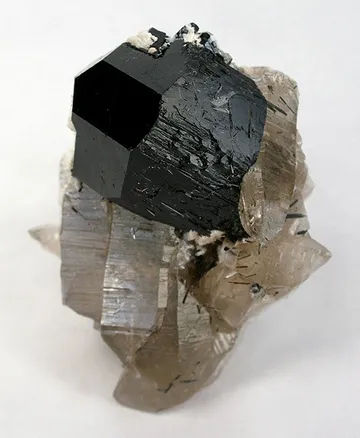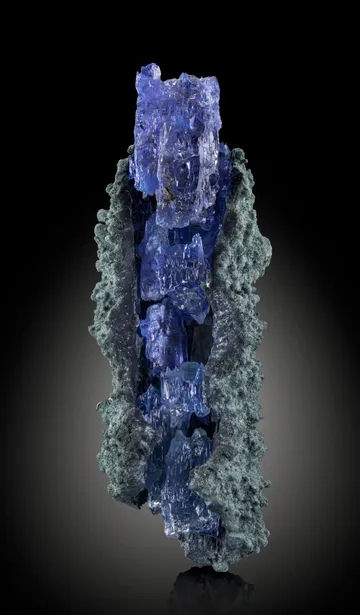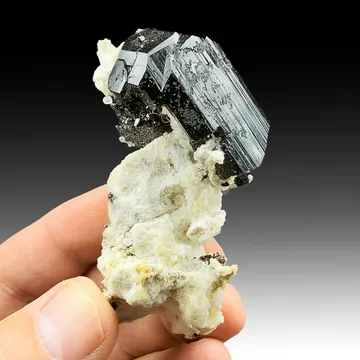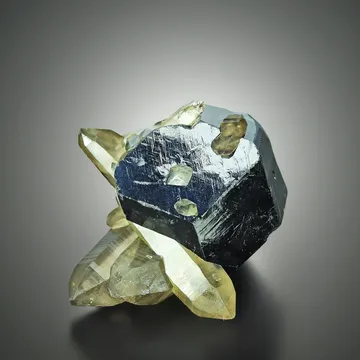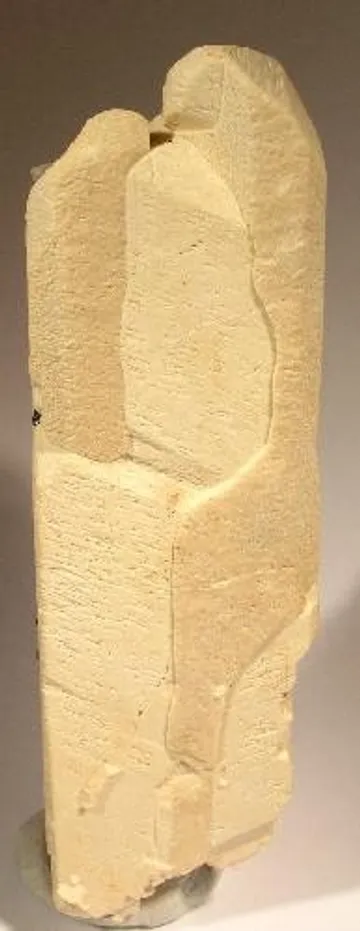
Jeremejevite - blue hexagonal prisms from Namibia’s Erongo Mountains; a rare, pleochroic borate with color zoning and terminations prized by collectors.
Key facts
Jeremejevite from the Erongo Mountains is one of the defining rare-mineral stories of early-21st-century Namibia: a tiny run of pale to saturated blue aluminum borate crystals, many initially mistaken for aquamarine, that turned a mineralogical rarity into a coveted collector species. The best Erongo examples are slender, transparent to gemmy prisms with a cool blue core, glassy luster, sharp hexagonal outlines, and color zoning that may fade toward a near-colorless or pale termination. In hand, fine crystals have the delicacy of aquamarine but a different optical personality—more steely, more pleochroic, and often with a columnar, needle-like poise that makes even a thumbnail feel important.

Photo: Wikimedia Commons
The locality is not a conventional gem mine but a granitic, miarolitic-pocket environment within the Erongo igneous complex. The mountains are the eroded core of an ancient volcano-plutonic system, famous to collectors for aquamarine, schorl, fluorite, smoky quartz, topaz, cassiterite, ilmenite, hyalite opal, and rare boron-bearing species. Jeremejevite belongs to the late, volatile-rich story of this granite: small pockets, quartz-tourmaline “nests,” and cavities in which boron- and fluorine-bearing fluids produced crystals of exceptional refinement.
Erongo jeremejevite owes much of its fame to the 2001 discovery near Ameib Farm 60, close to the borders with Davib Ost 61 and Brabant 68. The find yielded thousands of crystals, but most were very small, colorless to pale yellow, or narrow needle-like singles. The blue, transparent, well-formed crystals over a few centimeters are a sharply narrower category. Matrix pieces are scarcer still, because most crystals were recovered loose from pockets and weathered alluvium rather than preserved standing on feldspar, quartz, or smoky quartz.

Photo: Wikimedia Commons
Collectors look first for natural crystal form: a complete or nearly complete hexagonal prism, undamaged termination, bright luster, and enough transparency to see the internal blue. Stronger, evenly distributed blue is desirable, but Erongo’s characteristic blue-to-colorless zoning is itself a locality signature. Doubly terminated crystals, crystals with violet or lavender-blue overtones, large transparent singles, and any attractive matrix specimen all sit near the top of the locality’s hierarchy.
Search for specimens: View all jeremejevite specimens from Erongo Mountains, Namibia
The Erongo Mountains rise in west-central Namibia, in the Erongo Region, near the broad collecting and trading corridor that includes Usakos, Karibib, Omaruru, and Swakopmund. Geologically, they are part of the Damaraland alkaline igneous province and represent a large ancient volcanic-plutonic complex rather than a single simple granite body. The complex includes volcanic rocks, granites, granodioritic intrusions, ring structures, and mineralized satellite pegmatites around the mountain mass.
For jeremejevite collectors, the essential host is the Erongo Granite and its miarolitic cavities. The granite is enriched in boron and fluorine, a chemical endowment that explains the abundance of tourmaline, fluorite, topaz, beryl, and rare borates in the broader system. The pocket environment is not uniform: some cavities are little more than clay-filled voids, while others contain quartz, feldspar, schorl, fluorite, beryl, or rare accessory species. Jeremejevite is specifically documented from miaroles, and the classic 2001 occurrence was a set of small cavities excavated in granite on Ameib Farm 60 near the boundary area with Davib Ost 61 and Brabant 68.
Mining and collecting in the Erongo Mountains have a long pre-jeremejevite history. Tin and tungsten were known in the district early in the 20th century, and commercial mining was carried out at localities such as Krantzberg, where tungsten and tin mineralization were important. Specimen collecting intensified dramatically around 1999–2001 after major aquamarine and schorl pockets brought international attention to the mountains. The jeremejevite discovery of March 2001 occurred in this period of heightened activity, when local diggers were opening cavities on steep granite slopes.
The 2001 jeremejevite production was brief but remarkable. Early blue crystals were thought to be beryl until X-ray powder diffraction confirmed jeremejevite. Requests to miners for more material soon brought a few hundred crystals, then a much larger production from several pipe-like cavities. By July 2001, production had effectively ceased. Published accounts estimate roughly 3,000 to 3,500 crystals from that main event, about half of them colorless or nearly colorless and typically up to about 1 cm long and 0.1 cm wide. A smaller number—about 500 crystals—fell in the 1–3 cm range, and only a handful reached roughly 5–7 cm. Later Erongo finds, including material reported in 2006 and dealer-noted finds after that, added to the locality’s story but did not repeat the scale or quality of the 2001 discovery.
Collecting access is not casual. The famous jeremejevite ground lies on private farm land, and much of the broader Erongo area includes privately owned conservancy land, lodges, and protected wilderness. Mineral collecting without permission is not acceptable, and export of minerals from Namibia requires the proper official documentation. Historically, many Erongo specimens reached the market through local diggers, Namibian dealers, and international mineral dealers rather than through open recreational collecting.
Erongo jeremejevite most often appears as slender hexagonal prismatic crystals, from needle-like singles to more robust columnar crystals. The prism faces may be smooth and glassy or show natural etching and growth markings; terminations range from sharp and simple to etched, irregular, or partly contacted. Large crystals commonly taper toward the termination, and the bases may show stronger blue than the tips. Some crystals display longitudinal blue-white zoning, with stripes or bands running along the length of the prism.
Color is central to the locality’s appeal. Erongo material ranges from colorless and pale yellow through pale blue, sky blue, saturated blue, greenish blue, lavender-blue, and rare violet. The finest collector crystals are blue, transparent, and lustrous, but the species’ pleochroism is part of the magic: blue stones and crystals can shift toward near-colorless depending on viewing direction. In gem material, that pleochroism can be exploited by cutting orientation; in crystals, it gives the best pieces a subtle, living color rather than a flat surface hue.
Size distribution is strongly skewed toward small crystals. The majority of the 2001 production was under 1 cm, and many loose crystals were only slender needles a few millimeters thick. Good crystals from 1–3 cm are far more desirable; transparent blue crystals above 3 cm are major specimens; crystals approaching 5 cm or more are exceptional. Published accounts record very few crystals in the 5–7 cm class. A 5.3 cm blue floater from the Erongo Mountains and other 4–5 cm examples illustrate why such pieces became trophies almost immediately.
Associations are relatively simple compared with the full mineralogical diversity of Erongo. Documented Erongo jeremejevite associations include smoky quartz, quartz, schorl, foitite, orthoclase, feldspar, and rare matrix combinations. Matrix specimens on smoky quartz or orthoclase are especially valued because most crystals were recovered loose. A tiny, well-placed blue prism on contrasting pale feldspar can be more important than a larger loose crystal if the composition is natural, undamaged, and aesthetically balanced.
Quality is judged by a combination of species rarity and specimen aesthetics. The strongest pieces have a complete crystal, clean termination, no distracting chips, bright vitreous luster, visible internal transparency, and a pleasing blue body color. A clean, pale-blue 2 cm single can outrank a larger but opaque or broken crystal. Natural etching is acceptable when it is not destructive and when prism faces and terminations remain legible. A contact at the base is normal for many crystals; damage to the termination is much more serious.
The principal authenticity issue with Erongo jeremejevite is misidentification. The first Erongo crystals were believed to be aquamarine, and the broader gemological literature notes that jeremejevite can be confused with other pale blue or colorless gems unless its optical and physical properties are properly checked. Aquamarine, apatite, pale tourmaline, and other slender blue pegmatite crystals are the practical look-alikes in the collector market. For valuable specimens, provenance alone is not enough; confirmation by a reliable dealer, prior analytical record, refractive index and specific gravity where practical, or laboratory testing is appropriate.
There is no standard, widely accepted treatment routine for Erongo jeremejevite comparable to the common heating of some gem species. Collectors should still watch for ordinary specimen interventions: repaired breaks, glued terminations, stabilization of friable matrix, or reconstructed matrix pieces. Because jeremejevite crystals are commonly slender and brittle, old breaks at the base or along the prism can be difficult to see without magnification. A perfect-looking matrix specimen deserves close inspection, since true matrix pieces are scarcer than loose singles.
Condition issues are predictable for the habit. Termination chips, side-edge bruising, cleaves or cracks across the prism, and contacted or etched ends are common. Some internal feathers, growth features, and inclusions are natural and do not automatically reduce value unless they deaden transparency or threaten stability. For faceted stones, gemological studies note healing feathers, step-like growth features, included crystals, and color banding; those same internal growth characteristics can be visible in transparent crystals.
Rarity must be understood in layers. Small loose colorless to pale crystals exist in enough numbers that they appear periodically, but fine blue, transparent, undamaged Erongo crystals are genuinely scarce. Large crystals over 3 cm are scarce; 5 cm-class blue crystals are trophy-level; matrix specimens are scarce at almost any size. The main pocket production is long past, and most available pieces now come from old dealer stock, collection recycling, or sporadic small finds rather than sustained new mining.
Current market availability is thin but not absent. Dealer archives and recent marketplace listings show that Erongo jeremejevite still circulates, usually as thumbnails and small loose crystals, with fine blue crystals commanding strong prices. A nearly 5 cm Erongo crystal formerly offered by Collector’s Edge at $7,500 and older Marin Mineral examples listed between hundreds and nearly a thousand dollars show the range for attractive singles, while the finest large transparent crystals and matrix pieces can move into a different collector tier entirely.
The Erongo jeremejevite story begins with a mistake that could only happen in a place already famous for aquamarine. In March 2001, miners on Ameib Farm 60 found small blue prismatic crystals in granite cavities near the meeting area of Ameib, Davib Ost, and Brabant. The crystals looked plausible as beryl: blue, prismatic, and born from the same pocket world that had already produced aquamarine and schorl. Because many were less than a centimeter long, the first finds did not immediately command the attention they deserved. Suspicion grew only when the crystals looked just a little too unusual. Samples were sent to Dr. Jochen Schlüter at Hamburg University, where X-ray powder diffraction settled the matter: they were jeremejevite.
Once that identity was known, the quiet pocket became a rush. Requests to local miners produced hundreds of crystals, and the count eventually rose into the thousands. The best colors ranged through blue, greenish blue, and violet, while the majority of small crystals were colorless to nearly colorless. One published account records sky-blue or saturated blue crystals up to 7 cm long and 13 grams, with fewer than ten crystals known in the 5–7 cm class. Most, however, were tiny. At the time, dealers reportedly had small plastic bags filled with loose, pale yellow to colorless needle-like crystals without matrix—evidence of abundance in numbers, but not in display quality.
The gem world quickly followed. Some Erongo crystals were clean enough to cut, though their narrow diameter limited faceting yield. A tiny fraction of faceted stones exceeded 1 carat, only a few reportedly reached up to about 5 carats, and one exceptional stone from the Erongo material was reported at 12.92 carats, faceted by Helmut Schäfer of Walter Bohrer Co. in Idar-Oberstein. The Smithsonian’s National Gem Collection later acquired an 11.30-carat oval blue jeremejevite from the 2001 Erongo find, purchased with funds from the Tiffany & Co. Foundation in 2012—an institutional acknowledgment of how important the discovery had become.
The field setting was anything but genteel. In August 2005, Bruce Cairncross and Uli Bahmann visited the Erongo diggings and described a hard, steep approach over granite boulder scree. The mountains were dry that year, the thornveld and pale grass giving way to rocky terrain as the road turned from Usakos toward the mountain. A coastal fog, pushed inland by the cold Benguela Current, lay over the area in the morning. As it lifted, the granite peaks appeared through the mist.
At the foot of the mountain, the party left the vehicle and began climbing toward the old workings. The rock itself told the collector’s story: black schorl-tourmaline nests in coarse quartz protruded from weathered boulders, tougher than the granite around them and standing out as knobby markers of mineralized pockets. The route followed a valley, a “Schlucht,” because the alternative was nearly vertical granite. Local diggers sometimes used ropes on the steeper slopes; shortly before the visit, one had been killed while carrying a jackhammer on his back when a rope snapped.
The climb was still severe without a jackhammer. The coarse granite, made of quartz and interlocking feldspar laths up to 5 cm, gave enough grip for hiking boots, but the slopes ran at 40–60 degrees. The local guides moved over them casually. At one point a voice came from above, and a digger in a crevice about 100 meters up waved down from the rock face—the destination.
The old productive cavities were empty by then. Some were less than 10 cm across and as deep; others were tubular, 50–80 cm wide, winding down more than 2 meters. Diggers chose targets by the visible schorl and quartz nests, but not every pocket paid. Some were barren clay. At the jeremejevite diggings themselves, the slope was pockmarked with small excavations, most less than a meter across and a meter deep, though a few were larger. Jackhammer marks showed that some work had been systematic. The exact locality recorded during that visit was 21°45'26.4"S, 15°35'2.7"E.
By 2005 the diggers had left almost nothing. Cairncross and Bahmann scratched through the tailings and found only one tiny chip of blue jeremejevite in feldspar. The view, though, remained: Gross Spitzkoppe to the northwest, the flat plain stretching away from the Erongo foothills, the dry Khan River snaking into the distance, and old cassiterite pegmatites visible on Ameib 60 below. For a collector, that image is almost a summary of Erongo jeremejevite itself—great mineral wealth in a harsh, open landscape, extracted from small holes on a granite face, and gone almost as soon as it was recognized.