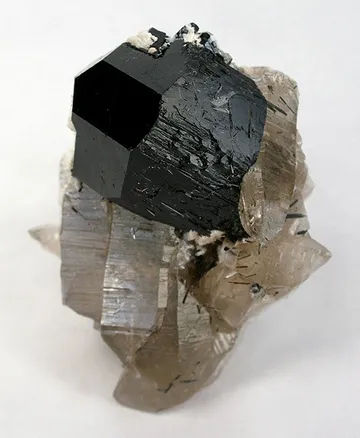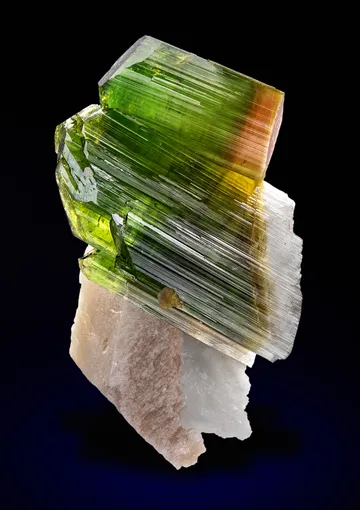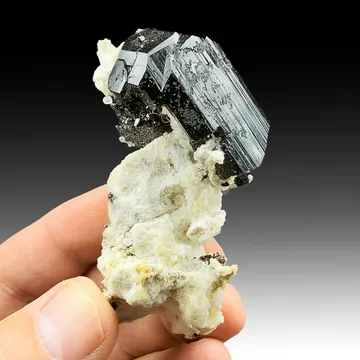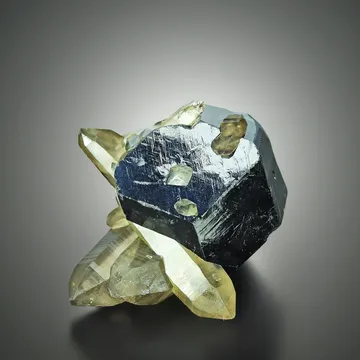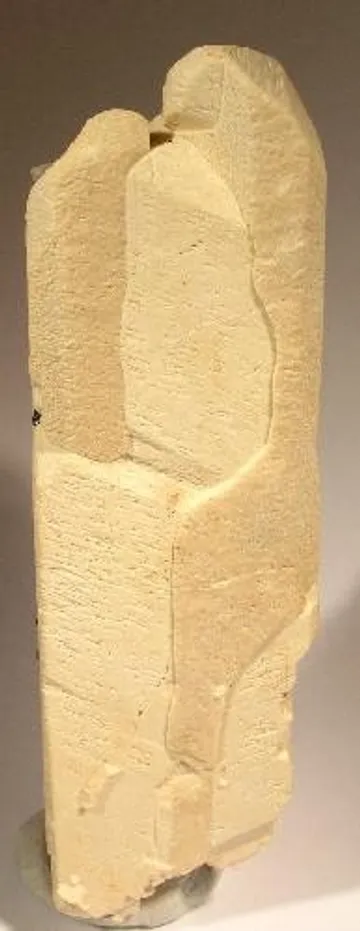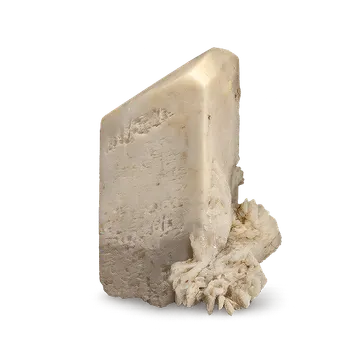
Erongo Mountains, Namibia — feldspar forms the pale matrix in iconic pegmatites, with aquamarine, schorl, fluorite, and smoky quartz, a prized Erongo hallmark.
Key facts
Feldspar from the Erongo Mountains is not usually collected as a solitary show-off mineral in the way that a Colorado amazonite or an Alpine adularia is. Its importance is architectural. At Erongo, creamy white to tan feldspar builds the matrix, the sculptural framework, and often the visual contrast for some of Africa’s most recognizable pegmatite specimens: pale to saturated blue aquamarine, jet-black schorl, green and purple fluorite, smoky quartz, opal, muscovite, and the occasional rarer accessory. A good Erongo feldspar specimen can be quietly superb on its own, but the finest pieces are those where the feldspar gives the specimen its balance—blocky, twinned, etched, and light-colored beneath stronger colors.

Photo: Wikimedia Commons / Rob Lavinsky, iRocks.com
The setting is one of Namibia’s classic mineral landscapes: a rugged, semi-arid ring of granite and volcanic rocks rising from the plains between Usakos, Omaruru, and Karibib. Collectors often say “Erongo granite,” and that shorthand is understandable, but the locality is really a complex volcano-plutonic massif—an erosional remnant of an ancient caldera system intruded by granodiorite and granite bodies. The specimen-producing cavities are miarolitic pockets in the Erongo Granite and related pegmatitic zones, made especially distinctive by abundant boron- and fluorine-rich fluids. Those fluids helped produce the locality’s signature schorl, foitite, aquamarine, topaz, fluorite, and jeremejevite associations.
The feldspar is chiefly K-feldspar, most reliably treated in the literature as orthoclase in the Erongo Granite, with albite as the plagioclase feldspar. Dealers and old labels may use orthoclase, microcline, K-feldspar, or simply “feldspar,” and those labels should be read carefully. The collector’s eye, however, sees the recurring Erongo look: ivory to tan blocky crystals, sometimes sharply twinned, frequently etched or corroded, and often forming pale pedestals for blue, black, green, or smoky crystals.

Photo: Wikimedia Commons / Géry Parent
Historically, feldspar is woven through nearly every chapter of the Erongo specimen story. Early economic work in the surrounding pegmatites focused on tin, tungsten, and related minerals rather than display feldspar. The great collector era began in earnest at the end of the 1990s, when miarolitic pockets began producing schorl, aquamarine, jeremejevite, fluorite, smoky quartz, opal, cassiterite, and feldspar combinations that quickly entered the international market. The 1999–2006 period gave Erongo its modern reputation, and feldspar appears again and again in those pieces: as twinned orthoclase with aquamarine, as white matrix under emerald-green fluorite, and as etched K-feldspar in the cavities from which many of the best crystals emerged.
Collectors look for crispness first. A feldspar crystal from Erongo should have readable form: blocky faces, strong termination geometry, visible twinning where present, and preferably clean contacts with associated minerals. Creamy feldspar with sharp black schorl is classic; feldspar with gemmy aquamarine is the iconic Erongo combination; and green-to-purple fluorite on white orthoclase is among the most colorful feldspar-supported pairings from the district. Because feldspar is softer and more cleavable than quartz, and because many Erongo specimens come from steep, hand-worked pockets, undamaged edges, clean terminations, and honest repairs matter greatly.
Search for specimens: View all feldspar specimens from Erongo Mountains, Namibia
The Erongo Mountains form a prominent granitic and volcanic massif in west-central Namibia, roughly north of Usakos and southwest of Omaruru. The complex is commonly described as a caldera-like volcano-plutonic structure, with the Erongo Granite representing a major intrusive phase. Modern geochemical work places the Erongo Granite in the early Cretaceous, about 132–133 Ma, within a broader short-lived magmatic episode linked to rifting and the breakup of Gondwana. It intruded much older Damaran metasedimentary rocks and granitoids, and its evolved, volatile-rich portions produced the miarolitic cavities that collectors now know so well.
For feldspar collectors, the key deposit type is the miarolitic granite-pegmatite cavity. These are open spaces in the granite where feldspar, quartz, schorl, beryl, fluorite, topaz, opal, cassiterite, and other minerals crystallized into collectible specimens. The Erongo Granite also contains quartz-tourmaline orbicules or “nests,” dark schorl-rich blebs with pale feldspar-quartz reaction halos. These features are important field guides for miners because schorl-rich zones can mark areas where cavities may occur.
The feldspar itself is part of both the host granite and the cavity assemblage. Albite is the plagioclase feldspar reported from the Erongo Granite, occurring as white, colorless, and pale tan crystals. K-feldspar is a major constituent and has been confirmed as structurally orthoclase in analytical work on the Erongo Granite, though specimen labels often use broader or less certain terms such as K-feldspar, orthoclase, or microcline. Orthoclase crystals may be quite large, and the literature records crystals exceeding 20 cm in maximum dimension. In display specimens, these feldspars commonly show white to tan color, microperthitic texture, etched surfaces, and Carlsbad, Manebach, or Baveno twinning.
Mining and collecting history around the Erongo Mountains began long before the modern specimen boom. Tin workings were already noted in the early twentieth century on farms around the southwestern periphery, including Ameib and Davib Ost. By the late 1920s, several tin mines were active in the area. The surrounding stanniferous pegmatites yielded cassiterite with quartz, K-feldspar, muscovite, schorl, and fluorapatite, while the Krantzberg mine became one of the better-documented tungsten-tin operations and worked intermittently until closure in 1979.
Specimen production before the late 1990s was sporadic. Historic pieces include early cassiterite from Davib, later schorl specimens, and a scattering of unusual minerals from Krantzberg and nearby localities. The modern collecting era began around 1999, when major pockets yielded excellent schorl and other species. In April 2000, the famous “Easter Pocket” on Bergsig Farm 167 helped launch Erongo’s aquamarine reputation. The following years brought jeremejevite, more aquamarine and schorl, quartz, cassiterite, opal, siderite-related material, and mid-2000s fluorite on white orthoclase. Feldspar was present throughout this period as matrix, crystal support, and occasionally as the main collector species.
Access is not casual. Much of the mineral-producing ground lies on private farms, in conservation areas, or on ground where mineral rights and permits matter. The mountains are steep, dry, and physically demanding; some productive sites are reached by scrambling over granite slopes and boulder scree rather than by easy mine roads. Namibia also regulates collection and export. Private collectors and researchers require permits for collected or purchased material, and commercial export requires additional documentation. For visiting collectors, the practical rule is simple: buy from reputable Namibian dealers or properly documented sources, do not trespass, do not dig without permission, and keep export paperwork with the specimen.
Erongo feldspar occurs in two collector-relevant forms: as individual blocky crystals, and as matrix or co-crystallized support for more colorful pocket minerals. The best feldspar crystals are pale cream, ivory, white, or tan, with sharp blocky habit and clear crystal architecture. Some are simple prismatic to blocky crystals; others show twinning. Carlsbad, Manebach, and Baveno twins are reported as common in Erongo orthoclase, and these twin laws are part of the locality’s appeal when the form is cleanly expressed.
The K-feldspar is commonly etched. This is not necessarily damage; it is part of the Erongo pocket character. Light etching can give the feldspar a soft, frosted, sculptural surface that contrasts beautifully with glassy aquamarine or fluorite. Heavy etching, however, can leave crystals chalky, rounded, or visually weak. The best pieces retain strong form despite surface corrosion.
Albite is less often marketed as the centerpiece, but it is important mineralogically. Analytical work describes albite as white, colorless, or pale tan and as the only plagioclase feldspar found in the studied Erongo Granite samples. In specimen descriptions, albite may be present as small pale crystals or as feldspathic matrix, especially in combination with aquamarine, schorl, quartz, and other pegmatite minerals.
Color is generally subdued. Erongo feldspar is prized less for vivid hue than for contrast and geometry. White orthoclase under green-purple fluorite is a classic color arrangement. Creamy feldspar with black schorl and blue aquamarine is the hallmark Erongo palette. Pale feldspar with smoky quartz creates a quieter, more granitic look. Some pale-green amazonite has been reported from the Erongo K-feldspar suite, but the locality is not chiefly an amazonite locality in the marketplace.
Typical display sizes range widely. Single feldspar crystals may be thumbnails to small cabinet pieces; documented orthoclase crystals can exceed 20 cm, though sharply crystallized display-quality examples of that size are much less common than smaller matrix crystals. Albite crystals in the studied granite reach up to about 5 cm. In the marketplace, most feldspar-bearing Erongo specimens are miniatures to cabinet specimens, with the feldspar serving as matrix for aquamarine crystals from a few millimeters to several centimeters, schorl from needles to robust prisms, and fluorite cubes or modified cubes scattered across pale feldspar.
The most important associated minerals are schorl, aquamarine, fluorite, quartz, smoky quartz, opal including hyalite or hyaline opal, muscovite, cassiterite, siderite or goethite after siderite, topaz, and jeremejevite. Foitite is a significant Erongo tourmaline species in analytical studies, especially in altered or fibrous parts of tourmaline crystals, though collectors often label black tourmaline simply as schorl unless analyzed.

Quality is judged by three things: form, association, and integrity. For feldspar alone, look for sharp blocky crystals, attractive twinning, clean faces, and minimal bruising along cleavage edges. For combination specimens, the feldspar must do compositional work: it should elevate the aquamarine, frame the fluorite, or provide a stable architectural base for schorl and quartz. The finest Erongo feldspar-bearing specimens have the look of a natural mineral sculpture rather than a loose crystal glued onto pale matrix.
Erongo feldspar is widely available as matrix on aquamarine, schorl, fluorite, and quartz specimens, but fine feldspar-dominant pieces are more selective. A simple feldspar crystal from Erongo can be affordable, while a sharp twinned orthoclase with aquamarine, schorl, or green fluorite can move quickly into serious collector territory. The market strongly favors complete, three-dimensional combination pieces with bright contrast, particularly aquamarine on feldspar with schorl, and fluorite on white orthoclase.
Condition matters. Feldspar has two good cleavages, so check edges and terminations carefully. Bruising on pale feldspar can be difficult to see in dealer photographs, especially when the specimen is shown under strong light. Look for crushed corners, rubbed high points, sawn bases, filled cracks, or isolated crystals that appear too perfectly posed. Small chips on feldspar matrix may be acceptable on otherwise fine Erongo combinations, but damage to a prominent twinned feldspar crystal affects value more strongly.
Repairs are a realistic concern. Many Erongo specimens were mined from steep granite faces and pocket cavities by hand, and delicate aquamarine-feldspar-schorl combinations can break during extraction or transport. A disclosed repair may be acceptable, especially on a major specimen, but undisclosed assembly is not. Examine the base of aquamarine crystals where they meet feldspar; natural contacts usually show intergrowth, feldspathic encrustation, pocket clay residues, muscovite, quartz, schorl needles, or continuous mineralization across the junction. Suspicious glue lines, unnatural gaps packed with loose mica or rock fragments, and crystals sitting on top of matrix without geologic continuity deserve caution.
For feldspar itself, treatment is not the main issue. The greater risk is mislabeling or over-specific labeling. Many pieces are sold as orthoclase, microcline, or K-feldspar without analysis. That is not automatically a red flag; it reflects the genuine ambiguity of older labels and the visual similarity of K-feldspar species. A conservative label of “K-feldspar” or “feldspar group” can be more honest than an overconfident microcline or orthoclase label unless there is analytical support. Analytical work on the Erongo Granite supports orthoclase as the structurally identified K-feldspar in studied samples, but specimen-level certainty depends on the individual piece.
Locality specificity also matters. “Erongo, Namibia” may refer broadly to the Erongo Mountains or, less precisely, to the wider Erongo Region. Better labels name the Erongo Mountains and, when known, farms or areas such as Bergsig Farm 167, Hohenstein, Davib Ost, Ameib, Tubussis, Lions Head, Hohenstein Gorge, or Krantzberg. Older material may carry obsolete farm names, district names, or German-influenced spellings. Preserve original labels; they can be more valuable than a modern simplified locality tag.
Availability remains good for small to mid-sized feldspar-bearing Erongo specimens. Online dealers regularly offer aquamarine on feldspar, aquamarine with schorl on feldspar, and fluorite on feldspar from the district. However, the best pieces from the famous early-2000s pockets are increasingly collection-held, and provenance to a recognized pocket, farm, or older collection adds appeal. Large, elegant, undamaged aquamarine-on-feldspar specimens from the great finds are no longer casual purchases.
The modern Erongo story begins with a long quiet prelude. Tin and tungsten miners knew the country for decades before collectors did. Early maps already marked tin workings near Ameib and Davib Ost, and by 1928 several tin mines were active around the southwestern fringe. In museum collections, that industrial era survives as mineralogical memory: a cassiterite collected in 1915 from Davib, presented to the Natural History Museum in London by Percy C. Tarbutt, weighed 8.16 kg. It was not a dainty display miniature; it was an eighteen-pound witness to the older Erongo tinfield.
Then came a trickle of collector specimens. A large half-bowtie schorl entered the Desmond Sacco collection in the late 1960s. A plumbogummite from Krantzberg was bought by the Natural History Museum in London in 1985 from Charles Key. A thumbnail schorl on granite matrix was purchased in Johannesburg in 1981. These were hints, not a rush. The mountain had not yet become the international name that dealers now recognize instantly.
That changed around 1999 and 2000. At Tubussis, a major schorl discovery produced large, well-formed black tourmalines, and the farm Bergsig 167 soon became linked to the aquamarine boom. The April 2000 “Easter Pocket” was one of those events that reorients a locality overnight. Suddenly Erongo was not just a geological complex or a source of occasional curiosities; it was a producer of first-rank aquamarine, schorl, and feldspar combinations. Informal miners moved into the mountains with new urgency, following dark schorl-quartz signs in the granite toward cavities that might contain blue beryl, black tourmaline, fluorite, opal, or feldspar crystals.
The landscape itself explains why Erongo specimens have a certain rugged personality. Field accounts describe a morning approach through chilly fog, the mountain peaks lifting through mist as the road from Usakos skirted the western side of the massif. On Bergsig, the route toward the diggings left the vehicle tracks and climbed through granite boulder scree. Even low on the slope, black schorl-quartz nests protruded from coarse granite boulders like hard knuckles, more resistant than the weathered feldspathic host.
The climbs were not gentle. Productive areas sat above steep granite slabs, and field parties walked up slopes of roughly 40 to 60 degrees. The coarse granite texture helped: interlocking quartz and feldspar gave rubber soles something to grip. Still, the work was precarious. Local diggers used ropes on near-vertical granite faces, and one miner was killed shortly before a 2005 field visit when a rope snapped while he was climbing with a jackhammer on his back. That fact hangs over every polished display case containing a fine Erongo piece. The specimens look serene; the extraction was not.
At one Bergsig locality, the productive zone lay around GPS S 21°45'6.4", E 15°31'50.2". The cavities were already empty by the time collectors documented them, but their shapes told the story. Some were small holes less than 10 cm across and equally shallow. Others were tubular openings 50 to 80 cm wide, winding more than 2 meters into the granite. Miners chose targets by the telltale schorl-and-quartz nests, but not every pocket rewarded them. Some were barren clay-filled disappointments. Others produced the kind of aquamarine, schorl, fluorite, opal, and feldspar combinations that defined the locality.
Because the climbs were so arduous, diggers made temporary camps among fallen boulders. Some slept under overhangs; others built lean-to shelters or rudimentary tents. Water was scarce, but one larger pocket had collected rainwater and reportedly held enough to last for months. The image is pure Erongo: a mineral pocket that first held vapor-grown crystals, then rainwater, then memory.
Tubussis adds another feldspar chapter. At a 1999 schorl discovery site in the northwestern part of the mountains, field visitors documented a pipe-like cavity about 2 meters deep and 60 to 70 cm in diameter at GPS S 21°34'28.4", E 15°31'4.5". From that pocket came schorl, yellow hyaline opal, and orthoclase feldspar crystals over 10 cm. Nearby rock faces carried Bushman paintings visible in the late afternoon sun—kudu, eland, giraffes, and human figures—placing the mineral diggings in a landscape already marked by older human presence.
The jeremejevite area near Davib Ost and Ameib was reached by an even steeper traverse. On the way, old excavations had yielded schorl, quartz, and aquamarine. One substantial cavity, about 5 to 6 meters wide and 4 to 5 meters deep, had produced aquamarine, smoky quartz, opal, and lustrous complex cassiterite in July 2004. Scratching through the remaining debris, visitors could still find smoky gray to black quartz crystals up to 6 cm and lime-green fluorescent botryoidal hyaline opal. A few hundred meters downslope lay the emptied jeremejevite pockets, where the tailings yielded only a tiny chip of blue jeremejevite in feldspar. The diggers, as field collectors dryly noted, did not leave much behind.
Krantzberg, the old tungsten-tin mine, gives the Erongo story a different mood. The mine sits high on Krantzberg Mountain, whose name refers to a circular wreath-like band of sedimentary rocks near the crest. Access in 2005 required permission from farm owners, coordination around a hunting party, and a four-wheel-drive ride up old tracks. What looked at first like an adit turned out to be a lower loading area where ore had once been dropped from above. The true access adit was higher up the slope. To reach it directly, one had to climb old concrete steps and pull over the last 20 or 30 meters on an old telephone cable tied to an iron pole. With the recent Bergsig fatality in mind, the more cautious route was the old access road.
Inside Krantzberg, the workings ran a few hundred meters into the mountain. Air entered through collapsed openings to the surface, but farther in it became foul. Bats hung from old cables and rock projections. Leopard droppings and spoor were found in the mine, though the leopard itself was absent. The mineral finds that day were modest—drusy cassiterite and blue-green secondary copper staining—but the place connected the modern collector locality to its older mining history: tungsten, tin, concrete steps, old cables, and feldspar-bearing granite country above the dry Namibian plain.