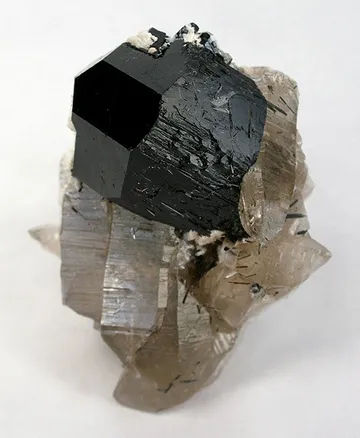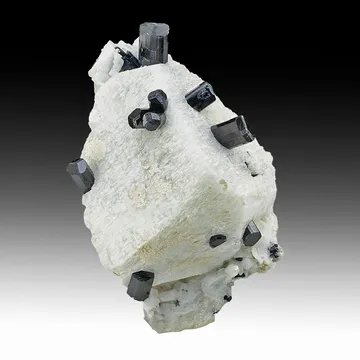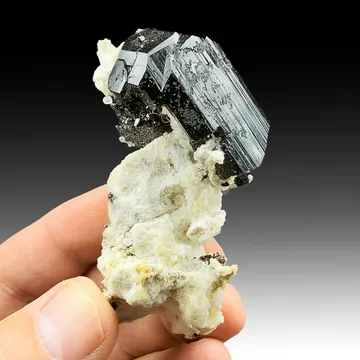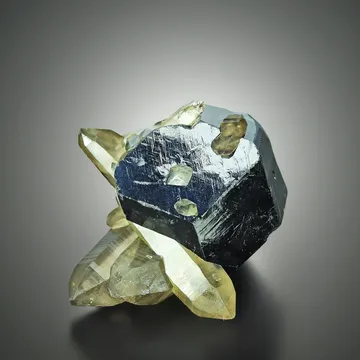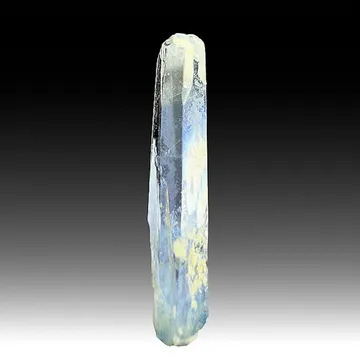
Microcline - Erongo Mountains, Namibia: pale cream feldspar with blue aquamarine and black schorl; renowned locality and notable for feldspar identification.
Key facts
Microcline from the Erongo Mountains sits in one of the most visually recognizable specimen associations in modern African pegmatite collecting: pale cream to porcelain-white K-feldspar carrying blue aquamarine, glossy black schorl, smoky quartz, green fluorite, muscovite, and late hyalite opal. In the cabinet, the feldspar is often the quiet architectural mineral rather than the loud color note, but it is what gives Erongo combination pieces their sculptural strength—the blocky white base against which aquamarine turns electric blue, schorl becomes lacquer-black, and fluorite reads as sharp green glass.

Photo: Wikimedia Commons
The locality is geologically unusual and collector-famous for good reason. The Erongo Mountains are the eroded remnant of a volcano-plutonic complex in northwestern Namibia, with granite, volcanic rocks, quartz-tourmaline nests, and miarolitic cavities produced during the Cretaceous magmatic history tied to the opening of the South Atlantic. Those cavities concentrated boron, fluorine, beryllium, tin, tungsten, and other volatile-compatible elements, producing the great Erongo suite: aquamarine, schorl, fluorite, topaz, jeremejevite, quartz, opal, cassiterite, and feldspar.
For the collector of microcline specifically, Erongo demands a little care in language. Many specimen labels and market descriptions use “microcline” for the white to cream K-feldspar matrix. Published locality work, however, has emphasized that much of the Erongo Mountains alkali feldspar is orthoclase, and some material is best treated as K-feldspar unless the species has been verified. Mindat records microcline from the Erongo Mountains as a believed-valid occurrence, but also notes the identification issue: material has been identified as either microcline or orthoclase, and unconfirmed pieces are sensibly called K-feldspar or potassium feldspar. That ambiguity is not a defect in the locality—it is one of the realities of collecting alkali feldspar from a complex granite system.
The finest microcline-labeled Erongo specimens are not usually collected as isolated feldspar crystals alone. They are prized as balanced combination specimens: sharp cream-white blocky feldspar with blue aquamarine sprays, lustrous schorl, smoky quartz, pale green to emerald fluorite, or late hyalite opal. Collectors look for strong crystal form, clean contrast, minimal iron staining, intact terminations on associated aquamarine and schorl, and feldspar that is not so etched or altered that it loses its role as a crisp, architectural matrix.
Search for specimens: View all microcline specimens from Erongo Mountains, Namibia
The Erongo Mountains form a prominent roughly circular to semicircular massif in Namibia’s Erongo Region, north of Usakos and northwest of Karibib. The mountains rise sharply from flatter surrounding country and include Hohenstein, the highest peak in the range. Much of the collecting area lies on private farmland or within the Erongo Mountain Nature Conservancy, and Namibia’s mineral rights are state-controlled; legal prospecting and collecting require proper permission.
Geologically, the collector material is tied to the Erongo Granite and its miarolitic cavities, together with related satellite pegmatites around the complex. The broader Erongo Volcanic Complex includes volcanic rocks, intrusive granites and granodiorites, ring structures, and late volatile-rich cavities. The granite contains quartz-tourmaline nests—rounded to irregular segregations rich in quartz and schorl—which are fundamental to the locality’s mineral identity. The same boron-rich, fluorine-bearing magmatic system that produced superb tourmaline and aquamarine also produced the K-feldspar matrices on which so many Erongo specimens are displayed.
Historically, the area was not first known to collectors for aquamarine on feldspar. Early economic attention went to tin and tungsten pegmatites around farms such as Ameib, Davib, Brabant, and related localities. Cassiterite-bearing pegmatites with quartz, K-feldspar, muscovite, schorl, and fluorapatite were known by the early twentieth century. Krantzberg, an outlier on the northeastern side of the Erongo area, became known for tungsten mineralization and ferberite, though it also belongs to the wider Erongo collecting story.
The modern collector era accelerated dramatically from 1999 onward. Between 1999 and 2006, the Erongo Mountains produced superb aquamarine, schorl, jeremejevite, fluorite, quartz, and related species that made a major impression at southern African and international mineral shows. The feldspar was often not the headline mineral, but it was the visual stage: blocky white to cream crystals supporting blue aquamarine, black tourmaline, vivid green fluorite, smoky quartz, and opal.
Production has largely been artisanal, from small diggings and pockets rather than a single industrial specimen mine. Important specimen-producing farms and areas reported for Erongo aquamarine and associated feldspar-bearing pieces include Bergsig 167, Erongorus 166, Tubussis 22, Davib West 62, Anibib 136, and nearby peripheral pegmatite areas. Access into the mountains can be difficult: the peripheral dirt roads are comparatively straightforward, but the pocket zones may require steep hiking in hot, dry country. Serious field access is therefore a matter of landowner permission, local knowledge, safety, and legal compliance rather than casual recreational collecting.
Microcline from Erongo is most familiar to collectors as pale cream, off-white, ivory, or porcelain-white K-feldspar in blocky crystals and aggregates. It commonly forms the matrix for later or associated pocket minerals. In many specimens the feldspar is partly etched or corroded, giving matte, satiny, or granular-looking surfaces rather than the bright, glassy faces seen on some feldspar from other classic pegmatites.
Crystal form is central to the appeal. Erongo feldspar specimens may show blocky, elongated, twinned, or composite growths. The locality is especially famous for alkali feldspar twins—Baveno, Carlsbad, and Manebach forms are repeatedly described for Erongo K-feldspar. This point is also where identification caution matters: those twins are commonly cited as evidence that much of the Erongo K-feldspar is orthoclase rather than microcline. True microcline should be confirmed analytically or by diagnostic optical features such as tartan twinning; without that confirmation, “K-feldspar” is often the most rigorous label.
Associated minerals define the locality’s best microcline-labeled specimens. The most important association is aquamarine and schorl on white feldspar: pale to rich blue hexagonal beryl crystals rising from cream feldspar, with black tourmaline providing contrast. Fluorite is another superb association, especially green to emerald cubes and modified cubes perched on feldspar. Smoky quartz, colorless quartz, muscovite, topaz, hyalite opal, goethite pseudomorphs after siderite, cassiterite, and foitite-group tourmaline associations are also part of the Erongo pocket assemblage.
Typical sizes range from thumbnail and miniature feldspar matrix pieces to small-cabinet and cabinet combinations. Individual associated aquamarines commonly range from small crystals to several centimeters; documented Erongo aquamarines can be much larger, with crystals to 10 cm common in some reported finds and larger crystals reported. Feldspar crystals in good combination specimens commonly provide centimeter-scale bases or blocky frameworks; isolated feldspar pieces may reach hand-size or larger, though the market usually rewards the best multi-species aesthetics more than feldspar size alone.
Quality depends on balance. The best pieces show a clean pale feldspar matrix with well-defined crystal form, strong contrast, and associated minerals placed naturally rather than crowded or visually confused. A single sharp aquamarine on a feldspar pedestal can be more desirable than a larger but jumbled plate. For fluorite associations, bright green cubes on white feldspar are especially attractive. For schorl associations, luster and intact terminations matter: glossy black tourmaline against cream feldspar is one of Erongo’s signature visual effects.
Condition issues are common. Feldspar surfaces are often naturally etched, altered, or partly replaced; that can be part of the locality character, but advanced alteration may leave a dull, friable, or chalky appearance. Iron oxide staining is frequent in cavities and fractures. Associated aquamarine may have bruised terminations, edge chatter, internal cracks, or inclusions; schorl may be broken, naturally resorbed, or coated by late opal. Hyalite opal coatings can be attractive when fluorescent and clean, but they may obscure crystal faces and are difficult to remove safely.
The first authenticity issue for Erongo microcline is not fakery but identification. Microcline and orthoclase have the same ideal formula, K(AlSi3O8), but different crystal structures. Many Erongo “microcline” specimens on the market are better described as K-feldspar unless the dealer, collector, or prior collection has analytical support. Published locality work has specifically cautioned that most Erongo Mountains alkali feldspar is considered orthoclase, and that claimed amazonite-type microcline attributed to Erongo may actually relate to nearby Klein Spitzkoppe, where microcline is well known. For serious labels, “microcline, reported,” “K-feldspar,” or “microcline/orthoclase” may be more honest than an overconfident species assignment.
There are no widely documented, locality-specific treatments for Erongo microcline comparable to irradiation or dyeing scandals in some gem materials. The practical concerns are more ordinary: repaired aquamarine crystals, glued-on associations, cleaned or acid-treated surfaces, and over-optimistic species names. Because the value is often carried by the associated aquamarine, fluorite, or schorl, inspect contact points closely. Natural pocket attachment has continuity of matrix, matching texture, and sensible growth relationships; suspicious joins may show glue films, unnatural gaps, mismatched dirt, or a mineral perched too conveniently on a flat broken surface.
Iron staining is common and may be reduced by cleaning, but aggressive cleaning can damage associated species or remove desirable natural patina. Hyalite opal, if present, is a late coating and can be either an asset or a nuisance. Do not assume that opal coatings should be removed; on some Erongo specimens the opal is part of the aesthetic, especially when it fluoresces. On others it masks luster and terminations. Any cleaning should be conservative, especially where aquamarine terminations, schorl faces, fluorite cubes, or friable feldspar alteration are involved.
Market availability is relatively good for Erongo combination specimens, but fine microcline-labeled pieces with strong species verification are less common than general “feldspar matrix” material. Miniatures and small-cabinet aquamarine–schorl–feldspar pieces appear regularly. Larger, balanced cabinet specimens with sharp aquamarine, clean black schorl, and attractive feldspar command stronger prices. Fluorite on feldspar from Erongo can also be highly desirable, particularly when the fluorite is bright green, lustrous, undamaged, and well placed on a clean white matrix.
For an advanced collection, the most satisfying Erongo microcline suite would include three styles: a feldspar-dominant piece showing the blocky K-feldspar habit; an aquamarine-on-feldspar specimen with schorl for classic color contrast; and a fluorite-on-feldspar specimen showing the green-on-white Erongo look. Labels should preserve any older locality data, farm names, collection history, and whether the feldspar was identified analytically or by visual convention.
The Erongo story begins long before the blue aquamarines made the mountains internationally fashionable. Early geological descriptions appeared during the German colonial period, and by the second decade of the twentieth century the pegmatites around the mountain were already being examined for tin. Wagner’s early map showed tin workings at Ameib 60 and Davib Ost 61, and by 1928 several more tin mines were active in the same southwestern sector. One relic of that early economic period is a cassiterite specimen collected in 1915 and later held by the Natural History Museum in London: a crude, heavy piece from Davib, weighing 8.16 kg—18 pounds—presented by Percy C. Tarbutt.
Then came the modern specimen boom. The first major wave of Erongo collector material broke in 1999, when aquamarine, schorl, and jeremejevite from the mountain began to appear in quality and quantity that changed the reputation of the district. The April 2000 aquamarine discovery on Bergsig 167 became especially important: crystals commonly graded from opaque blue bases into translucent sections and finally into transparent, potentially facetable terminal zones. For collectors, that meant a single crystal could show the whole drama of the pocket—milky base, saturated blue body, and clear termination—while sitting on pale feldspar and black schorl.
The mountain kept producing oddities. Some early September 1999 discoveries yielded transparent green, fluorescent beryl. Later pockets produced blue crystals in a wide range of tones, some transparent throughout, others completely included and opaque. In November 2000, one cavity produced an interlocking “jackstraw” cluster of opaque cornflower-blue aquamarine. In May 2001, aquamarines associated with schorl showed the so-called “cotton-reel” habit: narrow blue-white rims projecting from both terminations beyond the prism edges. Some of those rims were later naturally etched away, leaving tapering cone-shaped terminations instead of the original spool-like silhouette.
The fluorite pockets added their own visual vocabulary. In July 2005, diggers on the steep slopes of Bergsig 167 recovered vivid emerald-green fluorite on white feldspar, commonly as clean cubes, some with dark purple corners. The same period also produced strange included specimens: gemmy aquamarine crystals containing small greenish-yellow fluorite cubes, with additional fluorite sometimes attached to the outside of the aquamarine. In January 2006, one pocket produced stalactitic fluorite tapering to points, built from drusy green and dark purple fluorite with colorless beryl and minor schorl.
The feldspar itself is not merely passive matrix. In August 2003, Erongo produced some of its most unusual feldspar-related pseudomorphs: quartz after orthoclase. Some were single crystals several centimeters long; others formed groups up to 30 cm. In some, quartz only coated the feldspar as an epimorph. In others, replacement progressed until the feldspar had partly or completely vanished, leaving a hollow quartz shell that preserved the old feldspar architecture. Muscovite after orthoclase also occurs, including fine-grained muscovite completely replacing Carlsbad-twinned crystals.
Even the access has become part of the lore. The outer roads around the Erongo are manageable, and local dealers at Tubussis have long been part of the specimen trade, but the pockets themselves may lie high in steep granite country where water, boots, heat, land access, and local permission matter as much as a hammer. Modern Erongo specimens carry that landscape in their forms: etched feldspar, fractured cavities, opal-coated schorl, aquamarine grown in pulses, and white K-feldspar blocks that look as if they were carved out of the bones of the mountain.