






A collector's guide to Eagle's Nest Mine, USA: its geology, mining history and notable minerals, illustrated with the 187 specimens documented from this locality on EarthWonders.
Key facts
Eagle’s Nest Mine is one of the modern benchmark localities for crystallized native gold from the United States. The mine is in Placer County, California, in the Sage Hill area of the Michigan Bluff Mining District near Foresthill, on the west flank of the northern Sierra Nevada. Although the surrounding district became famous through hydraulic and drift mining of ancient auriferous gravels, Eagle’s Nest matters to collectors for a different reason: it is a lode-gold occurrence in a shallow, pockety quartz-vein system that has repeatedly yielded specimen-grade crystallized gold rather than ordinary mill ore.
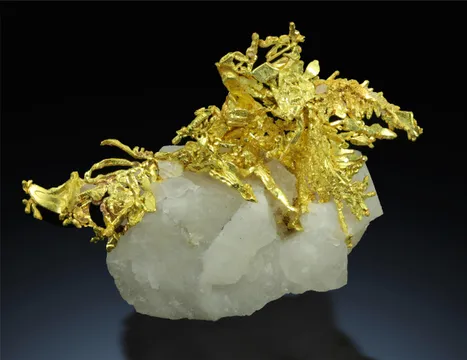
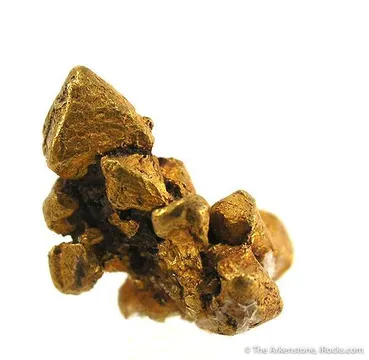
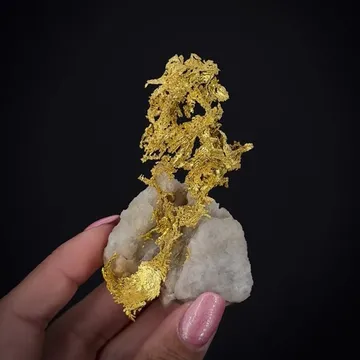
The deposit belongs to the northern Sierra Nevada gold-quartz environment: deformed metamorphic terranes, faulting, quartz veining, and carbonate alteration near productive structures. In the Eagle’s Nest workings, gold occurs in narrow, shallowly dipping quartz veins where they intersect more vertical control structures. The best pockets produced gold that is not just rich, but sculptural—bright yellow leaves, dendritic branches, plates, wires, herringbone growths, flattened octahedra, and sharp crystals standing on or emerging from milky to gray-white quartz. Fine pieces can be remarkably three-dimensional for a locality whose vein openings are often narrow, and the most desirable specimens balance visible crystallography, natural architecture, strong luster, and an undisturbed quartz matrix.
Historically, the locality is tied to the De Maria and Garbe workings on the same crystallized-gold deposit. Older labels may read Eagle’s Nest, Eagles Nest, De Maria, Garbe, Michigan Bluff, or Mystery Wind; the last of these was a concealment name used in the specimen trade rather than a separate mine. The modern collector story begins in earnest in the early 1980s, when crystallized gold from the Michigan Bluff area began attracting wide attention, and it continues today through intermittent specimen mining, modern permitting, and the notable Valentine’s Day 2024 pocket.
Regional View
Country View
The finest Eagle’s Nest specimens have a recognizable California look: saturated native gold set off against white quartz, with the gold forming coherent branching “trees,” flat crystalline fans, or detached floaters that appear naturally finished on all sides. Unlike placer nuggets, which are valued largely for mass and shape after transport, Eagle’s Nest gold is valued for in-situ crystallization. Under magnification, good examples show crisp crystal faces, tiny octahedral and dodecahedral forms, spinel-law twinning in some wires and leaves, and bright metallic surfaces that have not been rubbed, bent, or over-cleaned.

Photo: Wikimedia Commons

Photo: Wikimedia Commons
Search for specimens: View all specimens from Eagle's Nest Mine, USA
Eagle’s Nest Mine is in the Sage Hill area of the Michigan Bluff Mining District, Placer County, California, near Foresthill and Lady Canyon. The accepted mineral-locality usage places it at Eagle’s Nest Mine, Sage Hill, Michigan Bluff Mining District, Placer County, California, USA. The workings are associated with the same five-level crystallized-gold deposit as the De Maria Mine, with Eagle’s Nest material coming from the upper levels and De Maria representing the older, lower workings. The locality lies in sections 29 and the SE¼ of section 30, T14N, R11E, Mount Diablo Meridian, in the Foresthill area.
The deposit is a lode Au occurrence, not a placer mine in the collector sense, even though the surrounding Michigan Bluff district was built on placer and hydraulic gold mining. Regionally, Michigan Bluff lies on the Forest Hill Divide between the North and Middle Forks of the American River, in country underlain by complex northern Sierra Nevada metamorphic and ultramafic rocks. The broader district includes slate, serpentinite, metavolcanic rocks, Tertiary rhyolitic tuffs, and auriferous gravels. Eagle’s Nest itself exploits narrow quartz veins in structurally complex metamorphic rocks, close to serpentinite and within the northern Sierra Nevada gold-quartz province.
The ore system is pockety and structurally controlled. Modern descriptions emphasize shallowly dipping quartz veins that become productive where they intersect erratically spaced vertical control structures, interpreted as weakly mineralized joints. Carbonate alteration is developed near productive veins, and carbonate minerals can accompany gold. The locality’s small but important mineral suite reflects this setting: native gold in quartz, with pyrite and dolomite recorded as associates. Some veins yielded bright, lacy, dendritic, or wire-like gold with little matrix; in other areas, unleached quartz remained, producing the classic gold-on-quartz specimens for which Eagle’s Nest is best known.
The mining history is entangled with several names. The De Maria or Garbe Mine was already noted in early twentieth-century California mining literature. In 1915 the De Maria/Garbe property was associated with C. J. De Maria and Mr. Garbe of Spring Valley, and the older reports describe free crystallized gold in quartz seams and occasional pockets of coarse crystallized gold. The name Eagle’s Nest became the published collector locality for the upper workings of the same deposit. “Mystery Wind,” though found on older labels, should not be treated as a separate mine; it was a concealment name used for specimens from the Eagle’s Nest/De Maria deposit.
Modern specimen mining brought Eagle’s Nest to the front rank of California gold localities. Crystallized gold from the Michigan Bluff area was noted in the mineralogical press by the early 1980s, and from that period through the early 2000s the mine became a comparatively consistent producer of high-quality crystallized gold. The Sykora family operated the mine during the period referenced in modern symposium literature, and later sources record the property as remaining connected with original families until its acquisition by Daniel Trinchillo in 2019. Recent county records list Eagle’s Nest Mine as an active mining operation under Eagle’s Nest Mining, LLC, with Ian Merkel named in public planning documents connected to a reclamation-amendment project.
Current collecting access is not casual. Eagle’s Nest is an active permitted mine, not a public collecting site. Public county and federal-land planning materials describe an existing vested mining operation, waste-rock management, reclamation requirements, and a proposed amendment to allow continued underground expansion into new ore bodies and provide emergency access to an underground exit portal. The mine site is in steep Sierra Nevada terrain within the Tahoe National Forest setting, and older mine and hydraulic scars are hazardous. Collectors should regard the locality as closed except through the operating company and should acquire specimens only through reputable dealers, auctions, museum deaccessions where appropriate, or documented private collection transfers.
The most celebrated finds are the pockets that produced crystallized gold on quartz and matrixless floaters. Early De Maria/Garbe descriptions already mention coarse crystalline pockets, but the modern collecting fame rests on production since the early 1980s and on later specimen pockets that brought large, bright, well-crystallized pieces to the market. The Valentine’s Day 2024 pocket is the most publicized recent find. It produced complex, large, three-dimensional crystallized specimens as well as smaller pieces of unusually consistent quality, renewing collector attention after a period of relative dormancy.
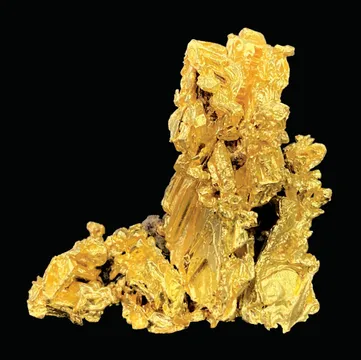
Gold from Eagle’s Nest is native gold, Au, in one of California’s most distinctive modern crystallized habits: bright yellow to rich golden-yellow leaves, plates, wires, dendritic sprays, flattened octahedra, and branching crystalline clusters, commonly on milky to gray-white quartz. Mindat records small sharp octahedra to about 1 cm, with dendrites, plates, and wires reaching many centimeters; museum and auction examples show cabinet-size pieces over 10 cm, while most market specimens are thumbnails, miniatures, and small cabinets. The best pieces are not merely heavy: they show crisp microcrystallography, strong luster, natural branch endings, a balanced quartz pedestal when present, and convincing three-dimensional growth rather than a compressed bullion mass. Many matrixless “floaters” were naturally loosened or leached from quartz, but matrix examples remain especially prized when the gold rises cleanly from the quartz instead of appearing glued, perched, or over-etched.
Quartz at Eagle’s Nest is the essential matrix and vein mineral rather than a separate display species in most collections. It is usually milky white to gray-white, locally iron-stained, and forms the narrow shallowly dipping vein seams and broken pocket quartz in which the crystallized gold grew. Good quartz matrix does more than hold gold: it gives the specimen geological context, contrast, and stability, ideally exposing enough white vein quartz to frame the yellow metal while leaving the gold naturally embedded. Ordinary Eagle’s Nest quartz fragments without visible gold have little specimen value, but quartz attached to lustrous crystallized gold can be decisive in value when the matrix is undamaged, naturally proportioned, and not aggressively trimmed or acid-undercut. Some specimens preserve gold partly enclosed in quartz; others have been professionally prepared so the quartz recedes and the gold stands proud without losing the sense that it formed in the vein.
The documented associated mineral suite at Eagle’s Nest is notably spare. Pyrite, FeS2, is recorded from the locality and fits the low-sulfide gold-quartz setting, but it is rarely the collector focus and is more important as a geological associate than as a cabinet species. Dolomite, CaMg(CO3)2, is also recorded, consistent with carbonate alteration near productive veins. No named type-locality mineral or broad suite of rare accessory species defines Eagle’s Nest; the locality’s importance rests overwhelmingly on the exceptional crystallized native gold and its intimate association with quartz.
The first authenticity issue with Eagle’s Nest is locality nomenclature. Older labels reading “Mystery Wind Mine” should be interpreted carefully: the name was used to conceal the source of specimens and is not accepted as a separate mine locality. “De Maria,” “Garbe,” “Michigan Bluff,” “Eagle’s Nest,” and “Eagles Nest” may all appear on legitimate older labels depending on the specimen’s history. A strong modern label should preserve the old wording as provenance while clarifying the accepted locality as Eagle’s Nest Mine, Sage Hill, Michigan Bluff Mining District, Placer County, California, USA.
There is no widely documented epidemic of Eagle’s Nest-specific fakes in the mineralogical literature, but crystallized gold is one of the most repair-sensitive mineral commodities. The habits that make Eagle’s Nest desirable—thin leaves, fine wires, dendrites, and gold emerging from quartz—are exactly the forms that can be bent, broken, glued, remounted, or over-prepared. Detached gold may be reattached to quartz; quartz may be etched or carved away to exaggerate exposure; broken tips may be disguised by careful positioning. Disclosure is everything. Professional preparation is normal for some Eagle’s Nest pieces, especially where quartz had to be removed to reveal crystal architecture, but undisclosed assembly or repair sharply reduces collector confidence and value.
Use magnification. Check the contact between gold and quartz for glue sheen, unnatural dark seams, resin fluorescence, or a suspiciously clean halo around the metal. Compare protected recesses with exposed high points: natural Eagle’s Nest gold can be very bright, but it should retain crisp crystalline relief rather than a smeared or burnished surface. Broken leaves tend to show dull torn metal, while rubbed high points may appear polished and rounded. Matrix pieces should be examined from the back and sides as well as the display face, because a specimen that looks natural head-on may show trimming, attachment, or support issues from another angle.
Condition is central. A small amount of edge bruising may be acceptable on an otherwise outstanding old specimen, but broken branch tips, bent wires, flattened leaves, and unstable quartz matrix are major concerns. A fine Eagle’s Nest piece should look naturally resolved: branches should end convincingly, leaves should not be mashed flat by handling, and the quartz should support the gold rather than overwhelm it. Complete matrixless floaters are especially desirable when crystallized 360 degrees and free of obvious contact damage.
Market availability is intermittent but real. Eagle’s Nest remains one of the few classic American gold localities with modern specimen production, and fresh pieces from recent pockets have reached the collector market through major dealers and online platforms. The most available specimens are thumbnails, miniatures, and small-cabinet examples. Fine larger cabinet specimens are scarce and can bring high five-figure to six-figure prices when the crystallography, size, luster, condition, and provenance align. Auction records for major pieces from named collections show that Eagle’s Nest gold is no longer merely a California specialty; it is a benchmark category within high-end native gold collecting.
Care is simple but strict. Do not polish Eagle’s Nest gold, do not put it in an ultrasonic cleaner, and do not experiment with acids on a finished specimen. Gold is soft and malleable, and the best Eagle’s Nest habits are mechanically delicate even when they look sturdy. Dust only with air or a very soft brush, support specimens by the quartz or custom mount rather than by the gold, and pack with no pressure on leaves, wires, or dendritic branchlets. High-value pieces deserve custom acrylic mounts and fitted transport boxes.
The larger story begins on the Forest Hill Divide, where Michigan Bluff rose over gold-bearing gravels perched high above the modern American River drainage. Hydraulic mining began at Michigan Bluff in 1853, and during the 1850s the camp was one of Placer County’s prosperous gold communities. Reported shipments between 1853 and 1858 reached as high as $100,000 a month, a figure that explains why men were willing to carve the bluff apart with water.
The camp paid for that prosperity in dramatic fashion. Michigan City burned in 1857. Then, in 1858, the hydraulic workings beneath the settlement undermined the ground badly enough that the townsite began to settle and slide downhill. The community was rebuilt farther uphill, and by 1861 most of the town had been moved and renamed Michigan Bluff. For mineral collectors, that episode is more than local color: it explains why the district’s most visible historical identity is placer mining, even though the tiny lode pockets at Eagle’s Nest later became vastly more important as mineral specimens.
One of Michigan City’s early residents gives the district an unexpected historical footnote. Leland Stanford arrived in 1852 as a miner, opened a general store, served as justice of the peace, and left for Sacramento in 1855. The same gravel camp that helped define California’s gold economy briefly held a future California governor and one of the founders of the Central Pacific Railroad.
The De Maria/Garbe workings provide the bridge between Gold Rush history and mineral collecting. Early twentieth-century reports describe the mine on Lady Canyon and record free crystallized gold in quartz seams, plus occasional pockets of coarse crystallized gold. One description of the workings evokes a specimen mine in all but modern language: crooked drifts, badly decomposed ground, oxidized zones, and a flat seam dipping east at about 15°. That is the setting collectors still imagine when they handle a bright Eagle’s Nest leaf perched on quartz.
The modern naming story is almost as interesting as the geology. “Mystery Wind” has the sound of a romantic lost-mine name, but its function was concealment. Specimens circulated under that name before the locality was clarified; serious modern usage treats Mystery Wind as Eagle’s Nest material from the upper levels of the De Maria property. A Mystery Wind label, then, is not necessarily a warning that the gold is false. It is a clue that the specimen passed through an era when source protection, dealer secrecy, and locality scholarship were still being sorted out.
The recent Valentine’s Day 2024 pocket gave the old locality a new chapter. After years of comparative quiet, the mine produced a pocket of crystallized gold on February 14, 2024, described in contemporary symposium and specimen records as the most important new production in more than a decade. The standout point was not only that some large specimens came out, but that the pocket yielded complex, three-dimensional pieces across several size classes. In a specimen-gold pocket, the usual pattern is one or two great pieces and a lot of compromised fragments. The Valentine pocket mattered because many smaller examples still retained real Eagle’s Nest character: bright gold, quartz matrix, and crisp crystallized architecture.
Auction records add a different kind of story. A Rock H. Currier specimen sold by Heritage in 2019 carried Currier’s understated note: “A cluster of fairly well crystallized gold growing out of milky quartz. Bought the specimen from Wayne Leicht.” The specimen measured 12.0 x 8.0 x 2.5 cm and sold for $37,500. Another Heritage example, a thick crystallized gold specimen nearly 15 cm across and weighing 308 grams, sold in July 2019 for $187,500. These are not just market numbers. They show how Eagle’s Nest specimens moved from mine pocket to dealer inventory, from connoisseur collections to auction catalogs, and finally into the small circle of American gold specimens used as comparisons for the very best modern finds.

_1_(16420790564).jpg)