






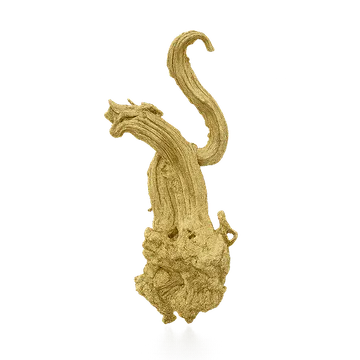
Gold from Eagle’s Nest Mine, California — specimen-grade native gold with sharp octahedra and dendritic forms, prized for locality and pocket material.
Key facts
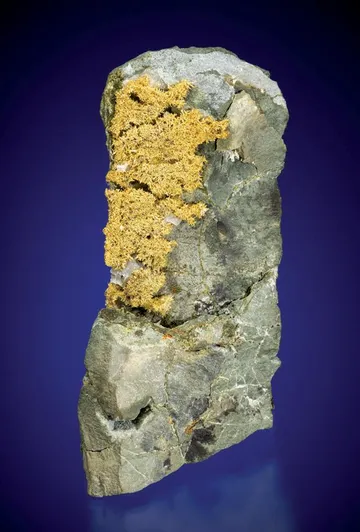
Eagle’s Nest is one of the essential modern localities for crystallized California gold: bright, sculptural native gold from a lode setting, typically in or on white to gray-white quartz, with the kind of crisp octahedra, flattened plates, dendritic sprays, wires, spinel twins, and arborescent “leaf” growths that make a specimen recognizable across a room. The best pieces combine three virtues that do not often coincide in gold: sharp crystallography, lively three-dimensional form, and the clean yellow color expected of relatively high-purity native gold.

Photo: Wikimedia Commons
The mine lies in the Michigan Bluff district of Placer County, in the Foresthill–Sage Hill area of the northern Sierra Nevada foothills. It is a lode-gold occurrence within the broader Mother Lode gold-quartz vein province: a region where mineralizing fluids moved along faults and fractures in metamorphosed oceanic, volcanic, sedimentary, and ultramafic rocks west of the Sierra Nevada batholith. For the collector, however, Eagle’s Nest is less about bulk mining tonnage than about pocket mineralogy. The mine is known for specimen-grade crystallized gold in quartz seams, often recovered from pockets or from quartz-rich material that must be prepared with exceptional care.
Eagle’s Nest has a complicated nomenclatural history. Specimens have circulated under “Eagle’s Nest,” “Eagles Nest,” and “Mystery Wind,” while the De Maria mine is part of the same five-level crystallized-gold deposit. Modern locality practice treats “Mystery Wind” as a concealment name rather than a separate mine, and serious labels should place the material at Eagle’s Nest Mine, Sage Hill, Michigan Bluff Mining District, Placer County, California, USA, with older De Maria/Mystery Wind associations preserved as provenance notes when documented.

Photo: Wikimedia Commons
The locality’s historical setting is classic Gold Rush country, but its collecting reputation is largely modern. By the early 1980s, crystallized gold from what is now known as Eagle’s Nest was entering the specimen world in quantity significant enough to attract notice in the mineralogical press. Since then, the mine has become a recurring source of fine crystallized gold, with production intermittent but still relevant to the high-end market. Recent public planning records identify Eagle’s Nest Mine as an active operation, and the Valentine’s Day 2024 pocket brought renewed attention to the locality with a run of lustrous, sharply crystallized specimens across several size classes.
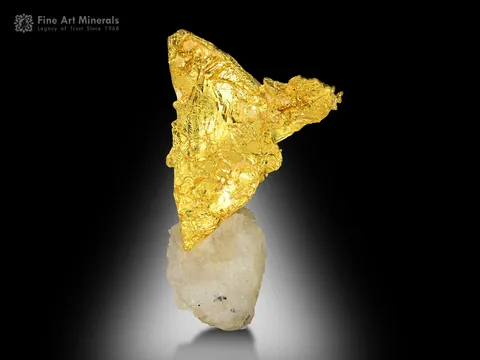
Collectors look first for natural architecture. Fine Eagle’s Nest gold is not merely “rich”; it is composed. The most desirable pieces show gold standing proud of quartz, branching in open space, or forming coherent leafy and herringbone masses with individual crystals visible under magnification. Cabinet and small-cabinet pieces on quartz are especially prized when the matrix serves as a natural pedestal rather than a bulky distraction. Matrixless “floaters” are also valued when they are complete, crystallized on all sides, and free from obvious points of attachment or preparation damage.
Search for specimens: View all gold specimens from Eagle's Nest Mine, California, USA
Eagle’s Nest Mine is located in Placer County, California, in the Sage Hill area of the Michigan Bluff Mining District, near Foresthill and Lady Canyon. Mindat places the locality at approximately 39.02361, -120.77583, describing it as a lode Au occurrence in sections 29 and the SE¼ of section 30, T14N, R11E, Mount Diablo Meridian, along French Meadow Road and on private land. That location is tied to the De Maria mine level of the same deposit; the Eagle’s Nest workings occupy upper parts of a five-level crystallized-gold system.
The deposit is best understood as specimen-grade lode gold in quartz seams and veins, not as a conventional placer occurrence. This distinction matters because Michigan Bluff is historically famous above all for placer and hydraulic mining of ancient auriferous gravels. The district sits at the intersection of old Tertiary channels and later intervolcanic channel systems, and its nineteenth-century wealth came largely from hydraulic and drift mining of quartz-rich gravels perched high above the modern American River drainage. Eagle’s Nest, by contrast, belongs to the smaller but mineralogically far more important lode component: free gold in quartz, in a bedrock environment related to the Mother Lode and northern Sierra Nevada foothills gold-quartz systems.
Regionally, the Michigan Bluff district lies near the northern continuation and branching of the Melones Fault Zone system. Basement rocks in the district include slate, schist, serpentinite, and ultramafic rocks of the Feather River Peridotite belt, with the broader northern Sierra Nevada gold-quartz veins occupying faults and fractures in deformed metamorphic terranes. Published geochronologic work on gold-bearing quartz veins of the northern Sierra Nevada foothills gives mineralization ages broadly around 140 to 110 million years, with many ages centered near 120 to 115 million years. The Eagle’s Nest specimens are therefore not isolated curiosities; they are exceptionally collectable expressions of a major Mesozoic orogenic gold province.
The older De Maria or Garbe mine was already known before the modern specimen boom. A 1917 State Mineralogist report described the De Maria or Garbe mine in the Michigan Bluff district and noted free crystallized gold in quartz seams. A 1936 California Journal of Mines and Geology report was even more explicit from a specimen standpoint, stating that the Garbe & de Maria mine had long been noted for occasional pockets of coarse crystallized gold. Those early descriptions are important because they show that the locality’s “specimen character” is not a late dealer invention; pockety crystallized gold was part of the mine’s identity decades before the modern collector market absorbed the Eagle’s Nest name.
Modern specimen production began to matter to collectors in the early 1980s. Wayne Leicht’s 1982 notice brought crystallized gold from the Michigan Bluff area to the attention of the wider mineral community, and by 2004 Wayne C. Leicht and Robert B. Cook could describe Eagle’s Nest as a more-or-less consistent source of fine crystallized gold specimens since 1982, with interruptions caused by legal challenges. Their article in The Mineralogical Record remains the central published treatment of the locality.
The site remains sensitive from an access standpoint. It is an active, permitted mining operation, not a public collecting site. Public county documents for 2024–2025 list Eagle’s Nest Mine as active and describe a reclamation amendment intended to allow the existing operation to continue as underground workings expand into new ore bodies and to provide emergency access to an underground exit portal. The mine is operated under modern permitting, reclamation, erosion-control, and waste-dump requirements, and the surrounding steep Sierra Nevada terrain is not appropriate for casual collecting. Specimens should be acquired through reputable dealers, auction records, or documented collection transfers—not by field trespass.
Notable recent production includes the Valentine’s Day 2024 pocket, described in contemporary specimen records and the 2024 New Mexico Mineral Symposium program as the mine’s most important new find after years of inactivity. The pocket produced complex, large, three-dimensional crystallized gold specimens and a range of smaller pieces notable for unusually consistent quality. This find reinforced Eagle’s Nest’s standing as an active benchmark locality rather than merely a historical California gold source.
Eagle’s Nest gold is native gold, Au, most often associated with quartz, SiO2. Mindat’s locality species list for Eagle’s Nest includes native gold, quartz, pyrite, FeS2, and dolomite, CaMg(CO3)2. Collectors will encounter most specimens simply as gold or gold on quartz; pyrite and dolomite are mineralogical associates rather than the visual focus of most cabinet pieces.
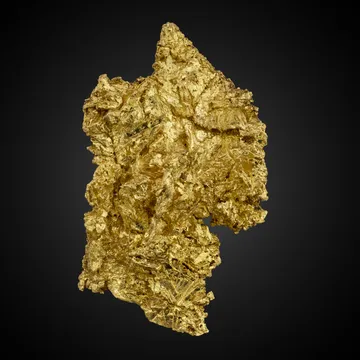
The finest habit is crystallized, not nuggety. Small sharp octahedra may reach about 1 cm, and the locality is especially noted for dendrites, plates, wires, and arborescent growths extending to many centimeters. Many specimens show flattened octahedra, triangular to diamond-like crystal faces, hoppered faces, and repeated spinel-law twinning. In strong examples, the gold reads as a crystalline framework rather than a lump: leafy panels, herringbone branches, stacked plates, or upright “trees” emerging from quartz.
Color is usually a saturated yellow to rich golden yellow, enhanced by strong metallic luster. The best specimens are brilliant under point light but still reveal crisp microtopography under a loupe. Some modern descriptions note approximate chemistry near 87.5% gold with roughly 11.5% silver and minor trace elements for analyzed Eagle’s Nest material; visually, the locality’s better pieces tend toward a warmer yellow than pale electrum-rich gold.
Quartz matrix is a defining aesthetic element. Classic specimens show bright gold rising from milky to gray-white quartz, producing the familiar California contrast of yellow metal on white vein quartz. Some pieces remain partly embedded in quartz; others have had quartz selectively removed during preparation so the gold stands in relief. Matrixless specimens, including “floaters” leached from quartz, can be exceptional when crystallized all around, but many collectors still prefer matrix pieces because the quartz gives scale, context, and display stability.
Size ranges are broad. True thumbnails occur as small, complete crystallized leaves or clusters under 2 cm, sometimes weighing only a few grams but carrying strong locality character. Miniatures and small-cabinet pieces, roughly 3 to 9 cm, form the heart of the collector market and can be remarkably showy when the gold is free-standing on quartz. Cabinet specimens over 10 cm are much rarer and can become major collection or museum pieces, especially when they preserve three-dimensional crystallized gold rather than merely rich massive metal in quartz.
The quality factors are demanding. The best Eagle’s Nest specimens have visible crystal faces, open architecture, minimal bruising, natural termination to branches or leaves, strong luster, and a matrix that looks original rather than contrived. A high gold weight is not enough. A heavy but compact mass may be less desirable than a lighter specimen with elegant branching, sharp spinel-twinned wires, and a well-balanced quartz pedestal. Collectors should study both sides: many fine Eagle’s Nest pieces are dimensional enough to display from multiple angles, and some have no obvious “back.”
Preparation is part of the locality’s story. Much Eagle’s Nest gold is intimately intergrown with quartz. Professional preparation may involve trimming, mechanical work, and selective chemical etching to expose gold without crushing or deforming it. Properly executed preparation can reveal superb crystallography; poor preparation can leave undercut quartz, sugary surfaces, broken wires, or an unnatural perched look. Because gold is soft and malleable, crisp texture is essential evidence of careful handling.
Eagle’s Nest gold occupies a premium niche in the market: recognizable, historically important, still intermittently available, but never common in truly fine quality. The mine’s continuing activity and the Valentine’s Day 2024 pocket have kept fresh material visible, especially through major dealers and online specimen platforms, but top pieces remain scarce and are often quickly absorbed into private collections. Prices vary widely, from small repaired or modest thumbnails into the low thousands, to fine miniatures and small-cabinet matrix pieces in the five figures, to major cabinet specimens that have sold at auction for tens or even hundreds of thousands of dollars.
Authenticity begins with locality discipline. “Mystery Wind Mine” labels should be treated as Eagle’s Nest/De Maria locality history rather than as evidence of a separate mine. Older labels may read Michigan Bluff, De Maria, Garbe, Mystery Wind, Eagle’s Nest, or Eagles Nest. A good modern label preserves the older wording but clarifies the accepted locality: Eagle’s Nest Mine, Sage Hill, Michigan Bluff Mining District, Placer County, California, USA. Provenance to Kristalle, Wayne Leicht, De Maria-family material, The Arkenstone, Fine Minerals International, or a named collector can add confidence, but the specimen itself should still make mineralogical sense.
Documented fake issues specific to Eagle’s Nest are not prominent in the literature, but gold is a species where repairs, assemblies, polishing, and over-preparation must always be considered. Because Eagle’s Nest gold commonly occurs in quartz, detached leaves can be reattached, gold can be mounted into prepared pockets, and quartz can be etched away to create a more dramatic display. Such work is not automatically disqualifying if disclosed and skillfully done, but undisclosed assembly or repair materially affects value.
Use magnification. Look for glue lines where gold meets quartz, unnatural halos in the matrix, smeared or burnished gold surfaces, and broken branch tips with a dull or torn texture. Under ultraviolet light, some adhesives may fluoresce, though absence of fluorescence is not proof of no repair. Compare the gold’s surface on protected recesses with exposed highlights: natural Eagle’s Nest luster can be very bright, but it should retain crisp microcrystalline relief rather than a rubbed, polished sheen.
Condition issues are common because the best habits are delicate. Thin leaves, spinel-twinned wires, and dendritic branchlets can bend, bruise, or break. A very small flattened contact on an exposed edge may be acceptable on a specimen with otherwise superb form, but broken tips along the main display line reduce desirability quickly. Matrix pieces should be checked for quartz breakage, unstable support points, and whether the gold is truly embedded or merely perched by repair.
Market availability is healthiest for miniatures and small-cabinet pieces. Recent public examples include a 1.6 x 2.8 x 1.2 cm Eagle’s Nest gold-and-quartz miniature listed at $9,500, a 3.2 cm Valentine’s Day pocket thumbnail recorded at $1,950, a 7.0 x 4.7 x 2.0 cm Valentine pocket gold-on-quartz specimen, and older auction records such as a 12.0 x 8.0 x 2.5 cm Rock H. Currier specimen sold by Heritage in 2019 for $37,500. At the high end, Heritage offered a 14.82 x 7.88 x 2.08 cm crystallized Eagle’s Nest gold weighing 308 grams that sold in July 2019 for $187,500. These figures underscore the spread: locality name alone is not the price driver; crystallography, display, size, condition, and provenance are.
For long-term care, treat Eagle’s Nest gold as a delicate crystallized native-metal specimen, not as bullion. Do not polish it. Do not clean with acids. Avoid ultrasonic cleaning. Dust gently with air or a very soft brush only if the specimen is stable. Store and ship with the gold suspended away from pressure points; a foam cavity should support the quartz or base, not the gold leaves or wires. High-value specimens deserve custom mounts and transport boxes because a single bent branch can change both appearance and value.
The story begins in a district that was already rich before Eagle’s Nest became a collector’s name. Michigan Bluff was built above gold-bearing gravels high on the Forest Hill Divide, and by the 1850s the district was one of the prosperous placer camps of Placer County. Hydraulic mining began in 1853, and between 1853 and 1858 gold shipments from Michigan Bluff reportedly reached $100,000 a month. That wealth came at a cost measured not just in money but in landscape: in 1857 Michigan City burned, then in 1858 the hydraulic workings below the settlement caused the townsite itself to settle and slide downhill. The camp was rebuilt farther uphill, and by 1861 most of the town had been relocated and renamed Michigan Bluff.
One of the early residents of Michigan City was Leland Stanford, who arrived in 1852 as a miner, opened a general store, served as justice of the peace, and left for Sacramento in 1855. That footnote gives the district a strange double resonance: the same gravel camp that produced gold and scars also briefly housed a future California governor and founder of the Central Pacific Railroad. It is the sort of historical overlap that makes California localities feel crowded with stories even before a mineral collector opens a drawer.
The old placer history also explains why Eagle’s Nest can be overlooked by non-specialists. Michigan Bluff was primarily a placer district; the lode mines were fewer and smaller. Yet the little lode pockets were the mineralogical jewels. The 1917 State Mineralogist report on the De Maria or Garbe mine noted free crystallized gold in quartz seams. In 1936, Clarence Logan’s report described the Garbe & de Maria mine on Lady Canyon and recorded that it had long been noted for occasional “pockets” of coarse crystallized gold. At the time of that visit, the workings were a network of crooked drifts in the oxidized zone, following a flat seam dipping east at about 15° in badly decomposed rock. That image—crooked drifts, oxidized ground, flat seams, and rare pockets of coarse crystal gold—still feels close to the specimen collector’s experience of the locality.
A second naming story belongs to the modern specimen trade. “Mystery Wind” sounds like a romantic mine name, but the name’s romance was partly strategic. It was used to conceal the origin of specimens. Later locality clarification by Wayne and Dona Leicht established that Mystery Wind did not exist as a separate mine and that specimens so labeled should be treated as Eagle’s Nest material from the upper levels of the De Maria property. For collectors, this is more than trivia. A Mystery Wind label is not a red flag in the sense of false gold; it is a red flag in the sense of locality history that must be interpreted carefully.
The modern collecting era took shape in the early 1980s, when crystallized gold from the Michigan Bluff area reached the mineral community through Wayne Leicht’s notice in The Mineralogical Record. By 2004, Wayne C. Leicht and Robert B. Cook could write that Eagle’s Nest had been a more-or-less consistent source of fine crystallized gold specimens since 1982, except during periods when legal challenges diverted resources from mining to litigation. That sentence captures the unusual economics of specimen mining: the continuity of a world-class locality can depend as much on law, access, and financing as on geology.
The recent Valentine’s Day 2024 pocket added a new chapter. Public specimen descriptions and Daniel Trinchillo’s 2024 New Mexico Mineral Symposium abstract describe a discovery after years of inactivity, with a pocket of breathtaking crystallized gold specimens found on February 14, 2024. The pocket produced complex, large, three-dimensional pieces and also a spread of smaller specimens with unusually consistent quality. In a field where many pockets produce one or two headline specimens and a long tail of compromised fragments, that consistency matters. It meant collectors outside the narrow museum-piece tier could still obtain specimens with real Eagle’s Nest character: lustrous crystallized gold, exposed on quartz, with the growth habits that define the locality.
Auction records supply their own vignettes. A Rock H. Currier specimen sold by Heritage in 2019 carried Currier’s note: “A cluster of fairly well crystallized gold growing out of milky quartz. Bought the specimen from Wayne Leicht.” The phrasing is wonderfully restrained for a specimen that sold for $37,500. Another Heritage specimen, nearly 15 cm across and weighing 308 grams, was described as an unusually thick crystallized gold with vibrant luster and superb octahedra; it sold in July 2019 for $187,500. These are not merely prices. They document the way Eagle’s Nest gold moved through the hands of connoisseurs, dealers, and auction houses, becoming a benchmark for what a modern California crystallized gold can be.

_1_(16420790564).jpg)