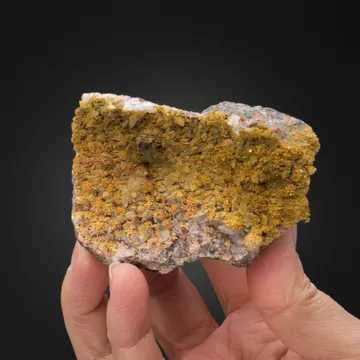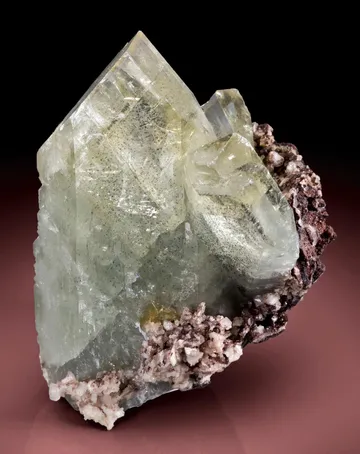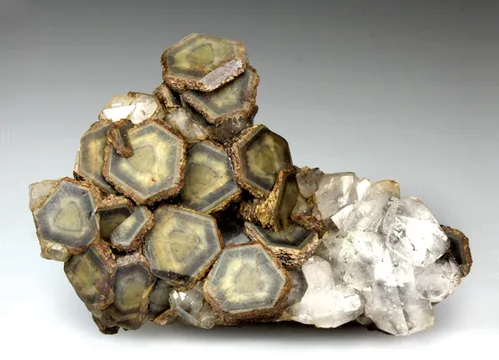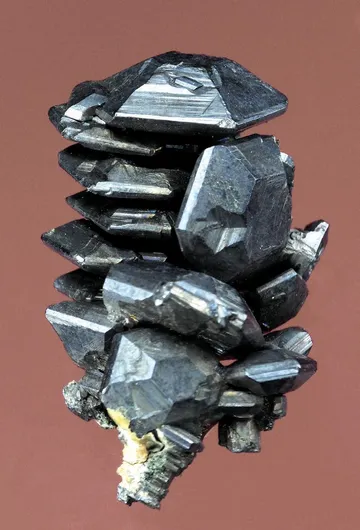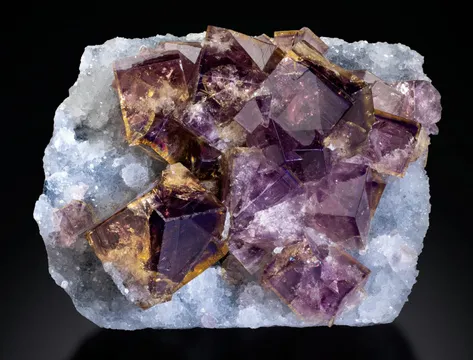
Dirtlow Rake, UK - a defining Castleton–Bradwell vein locality, notable for calcite- and baryte-rich specimens with purple fluorite and replacement textures.
Key facts
Dirtlow Rake is one of the defining vein localities of the Castleton–Bradwell district in the South Pennine Orefield: a long, powerful ENE–WSW hydrothermal fissure system cutting Carboniferous limestone on Bradwell Moor, south of Castleton in the White Peak. For collectors it sits at a productive intersection of mining history, ore geology, and specimen character. The old lead miners followed galena-bearing ground along the rake; later operators returned for the once-discarded gangue minerals — fluorspar and barytes — and those late workings exposed some of the locality’s most collectible material.
The deposit is not a simple single vein. Dirtlow Rake and the adjoining Pindale ground are important because they show fissure-vein mineralization, pipe and chimney-like replacement bodies, silicified limestone, breccia domes, and late-stage cave or vein-cavity development in one compact area. The Laporte Minerals open pit, developed after a fluorspar orebody was found in 1984, worked a dome-like fluorite-rich body adjacent to the main rake; the rake itself is more characteristically calcite- and baryte-rich, with subordinate galena. This geological split explains the look of many specimens: pale, cream, white, pinkish, yellowish, and banded baryte over or beside purple to blue-purple fluorite, commonly with calcite and occasional galena.
Regional View
Country View
The best Dirtlow pieces are unmistakably Derbyshire but not simply “Blue John” lookalikes. Their personality is more structural and textural: cockscomb baryte crusts on purple fluorite, spherical and rosette-like baryte made of tight curved blades, pseudo-stalactitic tubes and cross-sections with hollow centres, pink-and-white banded baryte slabs, small fluorite cubes on quartz or calcite, and specimens where late calcite has either protected or obscured earlier crystals. In polished or broken sections the baryte can show concentric growth, but the cabinet-grade crystallized specimens are prized for intact bladed surfaces, contrast with fluorite, and survival of delicate tube or spiral forms.

Photo: Wikimedia Commons
Search for specimens: View all specimens from Dirtlow Rake, UK
Dirtlow Rake lies south of Castleton, in High Peak, Derbyshire, within the Peak District National Park. The broader Dirtlow Rake–Pindale site is a classic South Pennine Orefield locality where mineralizing fluids moved through faults, joints, bedding planes, permeable horizons, and pre-existing or developing solutional voids in Carboniferous limestones. The main rake can be followed for kilometres in an ENE–WSW direction and is reported as a major fissure-vein complex varying substantially in width and mineral content. Around Pindale and Bradwell Moor it is associated with silicified limestone and quartz rock, fluorite-barite replacement bodies, mineralized scrins, pipes, and breccia bodies.
The Laporte Minerals open pit exposed the most famous modern orebody. It lay on the north side of Dirtlow Rake and was described as a dome-shaped mass roughly 100 m across and 30 m deep, with largely unmineralized limestone above and the Upper Miller’s Dale Lava forming the floor. The lower part consisted of altered limestone, capped by collapse breccia interpreted as related to a Carboniferous cave chamber. In that orebody fluorite was the dominant mineral; along the adjacent rake, calcite and baryte are more abundant, with lesser galena. The relationship between fluorite-rich replacement ground and the more baryte-calcite-galena rake assemblage is central to the locality’s specimen character.
The older history is lead mining. Dirtlow Rake is named in documentary sources as early as the sixteenth century, and direct mining references begin in the seventeenth century. The open cuts between How Grove and Pindale preserve evidence of pick work that predates common use of gunpowder in the district and may represent very early working. By the seventeenth and eighteenth centuries the deeper ground required engine shafts and gin engines, and the Castleton Barmaster Books give an unusually detailed picture of ownership, disputes, shares, stowes, and production along the rake from the mid-eighteenth century onward.
How Grove, a preserved island of older hillocks on Dirtlow Rake about 1 km south of Castleton, is now a Scheduled Monument. It was worked almost continuously from 1752 to 1886, with later survival into the early twentieth century as an exceptionally late lead-mining and dressing-floor site. Its remains include a coe or miner’s hut, dressing floors, a horse-drawn crushing circle, ore-dressing pits and channels, a circular buddle, a D-shaped buddle, and a water-storage dam. For collectors, How Grove is more important as a historical anchor than as a modern collecting ground: it shows what was lost elsewhere when twentieth-century reworking removed many earlier surface features along the rake.
The western part of the system includes Hollandtwine and Hazard, names that recur in both mining history and specimen labels. Hazard Mine at Dirtlow Rake Head was documented in the eighteenth century and became one of the more productive mines in the liberty during the 1826–1838 period, with workings on north and south veins, deep levels, and cartgates. Hollandtwine lay immediately to its east. Later twentieth-century mineral extraction and reworking destroyed or transformed much of this older surface archaeology, but labels reading Hazard Mine, Hollandtwine Mine, How Grove, Laporte Minerals openpit, and Dirtlow Rake all occur in collections and should be read with care.
Modern industrial work began after the fluorspar orebody adjacent to the rake was discovered in 1984. The open pit was worked for acid-grade fluorspar by a contractor for Laporte Minerals, with Peak Minerals named as the subcontractor in locality accounts. Extraction continued under planning permissions until the contractor entered receivership in 1996. A later plan would have consolidated Dirtlow Rake with the adjacent Hollandtwine and Hazard workings, but the full scheme was not completed; operations ended in 1999. Restoration began in late 2006, backfilling the open pits while preserving exposed geological features on the northern face.
Collecting access today is restricted. The area includes private land, restored workings, Scheduled Monument ground, old shafts, grilles, unstable mine features, and conserved geological exposures. Any visit requires permission from the relevant landowner and careful attention to safety and legal protections. The collector market is therefore supplied almost entirely by old material, pieces recovered during late twentieth-century working, and specimens already dispersed through UK collections, dealers, and educational stock.
The notable specimen finds came chiefly from the periods when the rake and open pit were actively exposed: older dumps and hillocks before they were removed or reworked, the fluorspar and barytes operations of the 1970s–1990s, and collector recovery of baryte forms from calcite-bearing material. Reports from collectors emphasize abundant galena, fluorite, calcite, and especially pink-and-white banded baryte in the early 1970s, followed by extensive removal of baryte-rich material in the 1980s for industrial use. The best surviving specimens are consequently fragments of a much larger lost output: pockets and seams that could easily have gone to crushers or drilling-mud feedstock instead of cabinets.
Using the international “barite” spelling, Dirtlow material is best known for pale cream to white, pinkish, and yellowish BaSO4 in tabular blades, cockscomb crusts, rounded rosettes, banded masses, and pseudo-stalactitic tubes. Laporte open-pit specimens include small spherical aggregates to about 10 mm composed of curved micro-blades, as well as cockscomb baryte coating fluorite on calcite matrix; collector-reported older pieces range from hand specimens around 7.5 x 5 cm to cabinet pieces near 20 x 10 cm. Superior examples have undamaged bladed terminations, strong pink-white or cream-purple contrast, visible association with fluorite or calcite, and three-dimensional tube or rosette form rather than merely broken massive baryte.
Under the British spelling “baryte,” Dirtlow Rake is a particularly characteristic Derbyshire locality because the species occurs not only as ordinary heavy white vein fill but as collector-grade cockscomb rosettes, tabular plates, convoluted tube-shaped masses, spiral aggregates, and banded pink-and-white pieces. The most desirable material comes from the baryte-rich rake and its late twentieth-century exposures, including the Laporte, Hollandtwine, and Hazard-labelled ground, where baryte may sit with purple fluorite cubes, scalenohedral calcite, galena, goethite staining, or quartz-coated fluorite. The crucial distinction is texture: common Dirtlow baryte is massive or bruised; good Dirtlow baryte preserves sharp blades, hollow or concentric tube sections, clean colour banding, and convincing locality-associated matrix.
Dirtlow Rake fluorite is less often seen as large freestanding crystals than as purple to blue-purple cubes, clear fluorite with pyrite inclusions, yellow fluorite interbanded with baryte, or massive to crystalline fluorite in the breccia and replacement orebody worked for fluorspar. Documented specimen pieces include small cubes around 4–5 mm on quartz or with white calcite, solid blue fluorite with yellow baryte and quartz-like coating, and purple cubic fluorite partly covered by cream baryte. The best collector examples are those with saturated colour, identifiable cubic faces, and baryte or calcite association that places them visually within the Castleton district; massive ore fragments are far less desirable unless polished sections show exceptional banding or colour.
Other documented minerals from Dirtlow Rake and its named sublocalities include calcite, galena, cerussite, goethite, marcasite, pyrite, quartz, and wulfenite. Calcite is integral to the specimen assemblage, especially as scalenohedra in cavities and as the mineral from which some unusual baryte aggregates were reportedly etched by collectors. Galena represents the original economic target of the rake, with cerussite as an oxidation product; goethite and marcasite are recorded from the Laporte open pit. Quartz is important both as ordinary vein material and as part of the silicified limestone or quartz-rock story at Pindale. Wulfenite is the notable rarity: recorded from the Dirtlow Rake region but not a common market mineral from the locality. Dirtlow is not primarily valued as a type-locality district; its importance lies instead in the unusually instructive range of fluorite-baryte mineralization styles and the quality of its baryte forms.
Dirtlow Rake labels deserve close reading. “Dirtlow Rake” may refer broadly to the rake system, while more precise labels can name How Grove, Hollandtwine Mine, Hazard Mine, Nether Dirtlow Mines, or the Laporte Minerals open pit. That distinction matters: older lead-mining material, late twentieth-century fluorspar-pit material, and baryte-rich reworked dumps may look related but do not all come from the same exact exposure. Specimens simply labelled “Castleton,” “Derbyshire,” or even “Blue John area” should not be upgraded to Dirtlow Rake without an old label, collection history, or a very characteristic baryte-fluorite association.
The main authenticity issue is not widespread faking but casual mislabelling. Baryte, fluorite, and calcite from Derbyshire can be difficult to separate by sight from pieces from other Peak District rakes unless the specimen has distinctive tube or cockscomb baryte, purple fluorite association, or solid provenance. “Barite” and “baryte” labels may describe the same mineral species under different spelling conventions, not two different minerals. Likewise, massive purple fluorite from the Castleton area may be confused with Blue John, but typical Dirtlow Rake fluorite-baryte specimens should not be sold as Blue John unless they genuinely come from the named Blue John veins.
Condition is a major value factor. Dirtlow baryte blades chip easily, and pseudo-stalactitic or tube-like masses are often broken across their growth structure. Rosette and cockscomb pieces should be checked under magnification for bruised blade edges, iron-stained repairs, glue in hollow tube sections, and trimmed backs that remove geological context. Fluorite cubes are commonly small and may be partially coated, etched, or cleaved; strong colour and lustre are less common than massive industrial fluorspar fragments. Calcite associations can be attractive but are prone to cleavage bruising and acid sensitivity.
Fluorite from Derbyshire is often of interest to collectors who use ultraviolet light, but fluorescence should be tested specimen by specimen rather than assumed from locality alone. Dirtlow material may include hydrocarbons, pyrite or marcasite inclusions, goethite staining, and carbonate matrix, all of which can complicate both appearance and stability. Avoid acid cleaning: it can damage calcite matrix and may alter the look of delicate baryte surfaces. Mechanical cleaning should be minimal on cockscomb and tube baryte.
In the market, small Dirtlow baryte specimens remain obtainable, including educational-grade pieces and modest hand specimens. Fine locality pieces are much scarcer: intact pseudo-stalactitic baryte, strong pink-and-white banded baryte, sharp cockscomb baryte on purple fluorite, and fluorite groups with good lustre are the specimens serious collectors compete for. Because the site is restored, private, and historically reworked, future supply is likely to come from old collections rather than new collecting.
The modern Dirtlow story has a striking geological ending: after the fluorspar orebody had been removed, the restoration did not simply bury the evidence. Beginning in late 2006, the open pit was backfilled with overburden and reshaped for grazing, but the northern quarry face was deliberately left visible. What remained was not a glittering pocket wall but a cross-section through the hidden plumbing of the limestone — two great vertical, pipe-shaped vein cavities, each about 20 m high and 7 m wide, with remnants of at least six smaller cavities around them. Their ribbed walls, poor scalloping, and lack of waterfall fluting told a phreatic story: slow-moving groundwater, below the water table, enlarging spaces that are normally accessible only to cavers. At Dirtlow, mining briefly turned that underground architecture outward.
How Grove tells a different kind of story, closer to the hands of the miners. On a preserved island of hillocks, archaeologists uncovered the workings of a small but organized lead mine that had adapted late, almost defiantly, after the traditional industry was already failing. The coe was a rectangular limestone hut about 4.5 m by 2.9 m inside, with a small fireplace in the north wall and an iron grate found in the collapse. Nearby lay the horse-drawn crushing circle: 23 large limestone slabs forming a ring about 4.8 m across, with a timber post stump at the centre. From the surrounding field a horse would have entered through a narrow gateway in the belland yard wall and followed a made path to the crushing floor. Beside it, water channels, pits, a circular buddle about 2.75 m across, a D-shaped buddle, and a dam for a storage pond preserved the wet, repetitive business of dressing lead ore from dirt.
The Barmaster Books make the old rake unusually human. How Grove was not a faceless mine but a web of shares, families, debts, and agreements. In 1755 the Barmaster awarded half of How Grove “in an Action of Debt,” and in 1757 William and Martin How of Bradwell sold a one-third share to members of the Bagshaw family for £20. In 1815, one agreement recorded that the owners of How Grove could use the neighbouring Prince West End engine shaft, provided they paid 18 shillings for every fifty barrels of deads and 3 shillings for every fifty barrels of boose. The words are old, but the problem is timeless: who owns the access, who pays for waste, who gets the ore, and who keeps the mine working?
Hazard Mine supplied the grander drama. In 1838 the Barmaster ordered six men of the Grand Jury to descend a climbing shaft on Hazard North Vein, proceed southward through sumps and gates, reach Hazard South Vein, and judge whether it was a new vein. That inspection took place in ground that had already been heavily worked, which even later historians found puzzling. Between 1826 and 1838 Hazard produced more than 5000 tons of lead ore, enough to make it briefly one of the most productive mines in the liberty. A section dated 1837 showed workings more than 600 feet below surface, four cartgates at different depths along the vein, and nearby a large “self open” known as the Great Swallow in the Twine — an immense limestone cavity at depth, probably linked to the Castleton cave drainage story.
Collectors remember a later rush, less formal but no less consequential. One field collector recalled visiting with his father in the early 1970s and finding “lots of galena, fluorite and calcite,” while the pieces he still prized decades later were pink-and-white banded barytes. In the 1980s the old dumps were cleaned out and the baryte removed on an industrial scale as weighting material for North Sea oil drilling mud. That is why good cabinet pieces from Dirtlow feel like survivors: specimens that escaped not only weather, blasting, and restoration, but also the practical appetite of industry.