Detroit City Mine, Colorado — noted rhodochrosite locality with cherry-red rhombohedra in a high-elevation vein; quartz, fluorite, and greisen-style assemblage…
Key facts
The Detroit City Mine—better known in the mineral market as the Detroit City Portal of the Sweet Home Mine—is the late chapter of one of America’s most storied rhodochrosite deposits. It lies high on Mount Bross above Alma, Park County, Colorado, in the same Detroit City claim block that contains the classic Sweet Home Mine workings. For collectors, its importance is not that it replaced Sweet Home, but that it tested the upward continuation of the same vein system after the original portal was sealed in 2004. Beginning in 2016, Collector’s Edge drove a new tunnel roughly 200 feet, or about 60 meters, above the old Sweet Home level, seeking the same combination that made the lower mine legendary: sharp rhombohedral rhodochrosite in open pockets, set with quartz, fluorite, pyrite, tetrahedrite-tennantite, sphalerite, chalcopyrite, galena, calcite, and other vein minerals.
Geologically, Detroit City belongs to the Alma District’s polymetallic Ag-Pb-Zn-Cu-rhodochrosite-fluorite vein system, a high-elevation expression of late Oligocene magmatic-hydrothermal activity linked to the Climax-type molybdenum environment of the Mosquito Range. The veins cut ancient Proterozoic metamorphic and granitic rocks, with Tertiary porphyry intrusions nearby; the Detroit City level was especially important to modern researchers because new workings exposed greisen-style quartz-fluorite-pyrite-hübnerite-molybdenite assemblages and the Contact Structure in ways the old Sweet Home workings had not. That scientific context matters to collectors because it explains why the best pieces are not simply “red carbonate on matrix”: they are the products of a narrow, chemically evolving vein environment in which hard rock, open space, and the right late fluids had to coincide.
Regional View
Country View
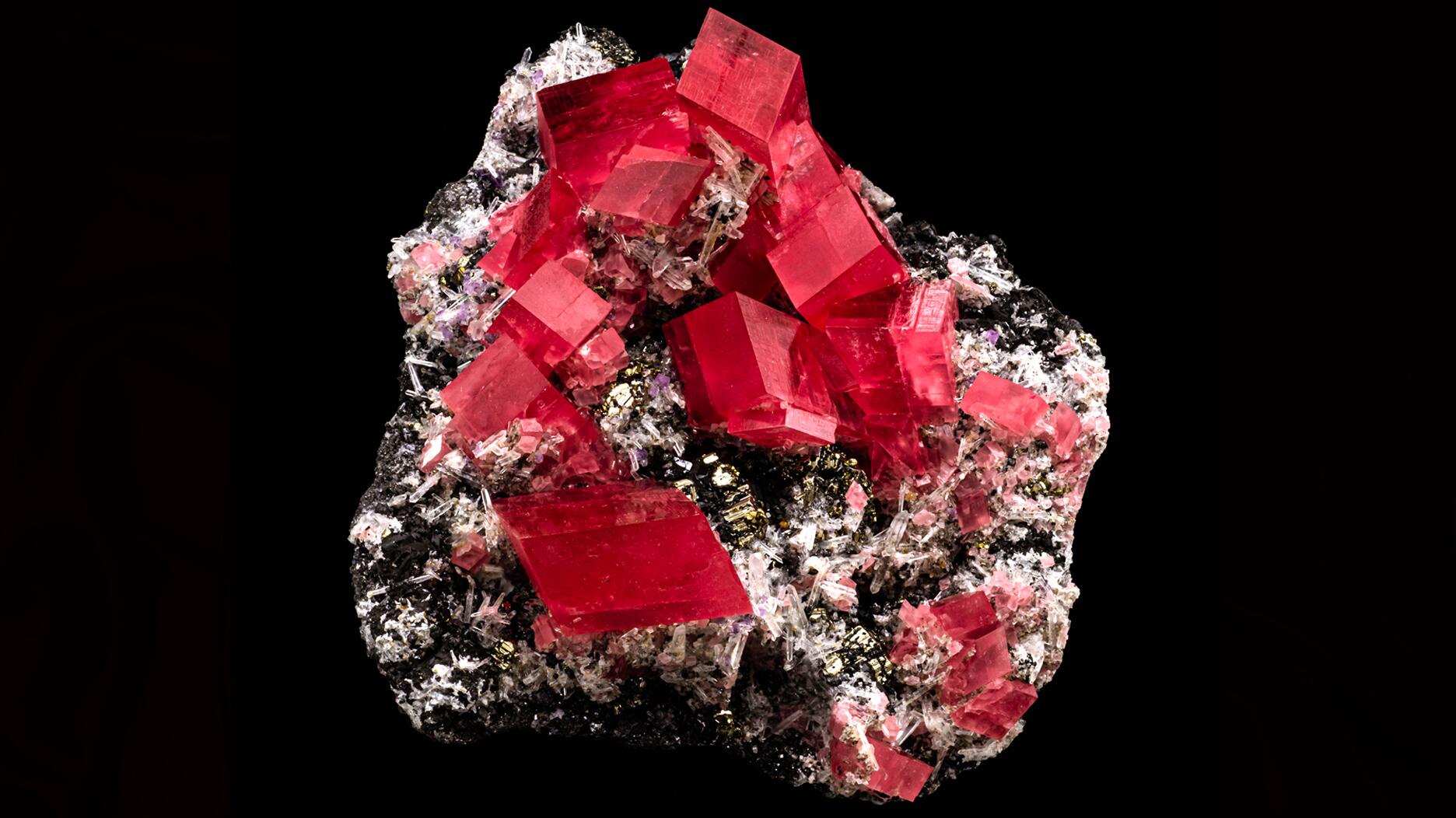
Detroit City specimens have their own personality. The best are cherry-red to strong rose-red rhombohedra, commonly translucent and sometimes backlighting a deep red, scattered over metallic sulfide matrix and accented by purple to blue fluorite, bright pyrite, white quartz needles or drusy quartz, and occasional yellowish calcite. Compared with the celebrated 1990s Sweet Home classics, Detroit City production was smaller, less consistent, and less likely to yield the enormous, museum-defining crystals that made names such as the Alma King famous. Yet its top pockets—especially Deano’s Pocket and Zack’s Pocket in 2020—produced serious modern Colorado rhodochrosite: fresh, well-documented, and mined specifically for specimens under a professional preparation and disclosure regime.
Search for specimens: View all specimens from Detroit City Mine, USA
The Detroit City Mine is an inactive mineral-specimen mine on Mount Bross, Alma Mining District, Park County, Colorado, at the Detroit City Portal above the historic Sweet Home Mine. Its recorded coordinates are approximately 39.31270, -106.11665. The workings were driven by Collector’s Edge Minerals as a new mine rather than a reopening of the old Sweet Home adit; the two systems were on the same property and vein trend but were not intended to intersect. The target was the upward continuation of the Sweet Home vein system, famous for open pockets of rhodochrosite in polymetallic veins.
The deposit is best described as a polymetallic epithermal to mesothermal vein system tied genetically to the Climax-Alma magmatic-hydrothermal province. In the broader Sweet Home–Detroit City system, mineralization occurs mainly in narrow veins hosted by Proterozoic metasedimentary, metamorphic, and granitic rocks of the Mosquito Range, with relationships to Tertiary porphyry magmatism. Studies of the Detroit City Portal showed early greisen and phyllic assemblages rich in quartz, fluorite, pyrite, muscovite, hübnerite, sphalerite, and locally molybdenite. These were followed by main sulfide-stage veins containing galena, chalcopyrite, sphalerite, bornite, tetrahedrite-tennantite, quartz, rhodochrosite, and minor purple fluorite, then later rhodochrosite, fluorite, calcite, barite, and apatite. For specimen collectors, the crucial feature was not simply ore grade but the formation of vugs—open cavities in competent rock—where rhodochrosite could grow freely as lustrous rhombs instead of massive carbonate.
The Detroit City Portal began as a modern exploration and specimen-mining venture in 2016 after years of planning, permitting, and geological modeling. Collector’s Edge began mining operations in the 2016–2017 period, with the new adit driven roughly 200 feet above the original Sweet Home portal. The early work required barren tunnel development before the vein target was reached; production began in 2018, when the first specimen pockets started yielding rhodochrosite and associated minerals. The operation continued through 2024, but the mine was permanently closed and sealed in September 2024 after production failed to keep pace with the cost of running the project. Collector’s Edge described Baker’s Pocket as the last pocket at the mine, with remaining Detroit City specimens offered after closure through its own sales channels and major mineral shows.
The mine’s best documented specimen production came from named pockets and numbered pockets rather than broad ore zones. Deano’s Pocket, mined in 2020, produced some of the strongest Detroit City rhodochrosites, including clusters of large rhombohedra on sulfide matrix with fluorite and chalcopyrite; one documented small-cabinet specimen from that pocket measured 3.0 x 10.0 x 6.0 cm and carried a largest rhomb nearly 4.5 cm across. Zack’s Pocket, also publicized in 2020, yielded vivid cherry-red rhodochrosite that helped reintroduce fresh Sweet Home-type material to the collector market. Other documented labels include 18-03 Pocket, 18-04 Pocket, 19-02 Pocket, 22-02 Pocket, and Baker’s Pocket, along with material from the Main Vein and Main Stope area. Fine pieces typically carry unusually precise provenance—pocket name, year, portal designation, and often Collector’s Edge stock or preparation information—which has become an important part of their value.
Collecting access today is closed. The Detroit City Portal is private, sealed, and strictly off-limits to unauthorized visitors; no fee-digging or casual collecting should be expected. Contemporary availability is therefore limited to specimens recovered during the 2018–2024 mining run, pieces retained by Collector’s Edge, dealer stock, museum acquisitions, and the secondary market.
Detroit City rhodochrosite is prized as modern Sweet Home-system material: sharp rhombohedra ranging from small thumbnail crystals to multi-centimeter faces on matrix, most often rose-red to cherry-red, with the best examples showing strong luster, saturated color, translucency, and dramatic contrast against black sulfides and white quartz. Deano’s Pocket and Zack’s Pocket in 2020 supplied many of the most admired pieces, with Deano’s Pocket producing large rhombs on sulfide matrix with fluorite and chalcopyrite, including documented crystals approaching 4.5 cm across; Mineralogical Record market reporting also noted a 7.2 cm Deano’s Pocket specimen with rhodochrosite crystals to about 3 cm on pyrite-tetrahedrite matrix with quartz and blue fluorite. Ordinary Detroit City pieces may be attractive but cloudy, pale, contacted, or sparsely crystallized; the good ones have bright red, well-separated rhombs, clean geometry, matrix balance, and enough transparency to glow rather than merely look pink.
Quartz at Detroit City is both a specimen mineral and the structural stage on which the rhodochrosite drama plays out. It occurs as milky to clear euhedral crystals, drusy coatings, and needle-like sprays in the vein assemblage, associated with fluorite, pyrite, sphalerite, hübnerite, tetrahedrite-tennantite, and rhodochrosite. The geologic work at the Detroit City level distinguished early quartz-fluorite-pyrite-hübnerite greisen-style assemblages from the later sulfide-rhodochrosite stages, so quartz is not merely decorative gangue here; it records several pulses of the hydrothermal system. Collectible quartz-only pieces from Detroit City are secondary to rhodochrosite, but quartz is essential in the best combination specimens, where bright white points or glassy needles provide scale, contrast, and relief around red rhombs and purple fluorite.
Other documented Detroit City minerals include fluorite, calcite, tetrahedrite-tennantite, pyrite, sphalerite, galena, chalcopyrite, bornite, fluorapatite, apatite, hübnerite, dickite, ankerite, dolomite, muscovite, chlorite-group minerals, feldspars, hematite, malachite, goyazite, and svanbergite. Fluorite is especially important aesthetically, occurring as purple to blue crystals that set off the rhodochrosite; calcite is notable because it was reported as more frequently encountered in Detroit City production than in earlier Sweet Home operations. Sphalerite from the Detroit City suite has been documented fluorescing bright orange-yellow under longwave 365 nm ultraviolet light, with minor fluorite showing purple response. Svanbergite, an uncommon strontium aluminum sulfate-phosphate, is documented from the portal as orange crystals on quartz. Detroit City is not known as a type locality, but it is a significant modern source for a sharply constrained, well-documented subset of the Sweet Home mineral assemblage.
The most important authenticity issue is locality precision. Many specimens are marketed broadly as “Sweet Home Mine,” and that is understandable because Detroit City is part of the Sweet Home property and vein system; however, a serious Detroit City specimen should ideally say “Detroit City Portal” or “Detroit City Mine” and include a pocket name, year, Collector’s Edge stock number, or other documentation. A label that simply says “Sweet Home Mine” may refer to older lower-level production rather than Detroit City Portal material, and the distinction matters. Original 1990s Sweet Home material and 2018–2024 Detroit City material overlap in appearance, but they do not carry the same production history or market hierarchy.
Repairs, stabilization, and restoration deserve careful attention. Collector’s Edge publicly describes a disclosure policy for repaired, stabilized, and restored specimens, and individual Detroit City pieces may legitimately have repairs or matrix stabilization because the material was mined from fragile sulfide-carbonate pockets. One documented Deano’s Pocket specimen, for example, was disclosed as repaired through the middle after recovery in two pieces. This is not automatically a disqualifier for a display specimen, but it must be disclosed and priced accordingly. Ask whether rhombohedra are repaired, whether matrix has been stabilized, and whether any missing crystal faces have been restored.
Condition is often the difference between a good Detroit City piece and a merely pretty one. Rhodochrosite has perfect cleavage and modest hardness, so bruised rhomb edges, cleaved corners, rubs on lustrous faces, and contact marks are common. The dark sulfide matrix may be friable, and delicate quartz needles or fluorite corners can chip during extraction, trimming, preparation, or shipment. Avoid ultrasonic cleaning, acids, and aggressive water treatment. Keep specimens out of strong prolonged sunlight and handle by the matrix, not by the rhodochrosite crystals.
The mine is closed, so there is no new production. Detroit City material is currently available only from remaining inventories and resales, and pocket-specific labels are already becoming more important. The very best Detroit City pieces remain expensive but generally trade below top-tier 1990s Sweet Home icons; the best documented examples with large red rhombs, fluorite, quartz, and metallic matrix are the ones most likely to appreciate as the locality settles into history.
The Detroit City story begins with unfinished business. The lower Sweet Home Mine had already entered mineral legend by the time its portal was sealed in 2004: Bryan and Kathryn Lees, Collector’s Edge, Sweet Home Rhodo, and their investors had turned a marginal old silver mine into the world’s benchmark locality for cherry-red rhodochrosite. But the mountain was not exhausted in any simple sense. The old access was gone, the celebrated lower pockets had played out, and the remaining question was vertical: would the same vein system remain productive higher on Mount Bross?
The answer required a new hole in the mountain. Detroit City was not a tourist reopening and not a romantic crawl into old workings. It was driven from scratch, about 200 feet above the former Sweet Home portal, with a practical and expensive goal: reach the upward continuation of the mineralized veins and hope the rock still had the right chemistry and the right open-space structure. The first job was not collecting red crystals but drilling, blasting, bolting, mapping, and advancing through unmineralized rock. By late 2018 the gamble began to pay back in specimens, and for the first time since the Sweet Home closure, newly mined rhodochrosite from that famous property reached collectors.
The 2020 season gave the portal its best public excitement. Zack’s Pocket produced the kind of image that ricochets through the mineral world: clean, saturated red rhombohedra sitting on dark matrix, the crystals fresh enough that collectors could feel the immediacy of extraction rather than the nostalgia of an old label. Deano’s Pocket became another landmark, yielding clusters with large rhombs, fluorite, chalcopyrite, and sulfide matrix. One Deano’s Pocket specimen documented by Collector’s Edge carried a largest rhomb nearly 4.5 cm across, self-stood as pictured, and backlit a deep cherry red. That is exactly the Detroit City ideal: not merely “a rhodo,” but a complete Colorado association with red, purple, black, brass, and white all working together.
But the portal also became a lesson in how unforgiving specimen mining can be. The Detroit City level contained rhodochrosite, and the geologic model was not fantasy, but the rock was not the same as the lower Sweet Home. Bryan Lees later explained that at about 200 feet higher, both chemistry and host-rock mechanics had changed. The phrase that stuck was that the system had “starved out the fluid.” There was rhodochrosite, but too few of the open, hard-walled pockets that allow great crystals to grow undamaged. In the old Sweet Home years, Collector’s Edge had found dozens of pockets; at Detroit City, only a couple were considered truly strong by comparison. The best Detroit City pieces were serious minerals, but there was no Alma King-scale discovery.
The end came in September 2024. Collector’s Edge announced that after seven years of mining operations, the Detroit City Portal was permanently closed, with Baker’s Pocket named as the last pocket at the mine. Crews removed equipment and reclaimed the site. The company’s public language carried both pride and disappointment: years of science, investment, and optimism had produced real specimens, but not enough great pockets to keep the project alive. Lees called it a “large-scale treasure hunt,” which is exactly what high-end specimen mining is when stripped of romance: geology, money, risk, and patience aimed at the rare moment when a dark cavity opens and a red crystal looks back.