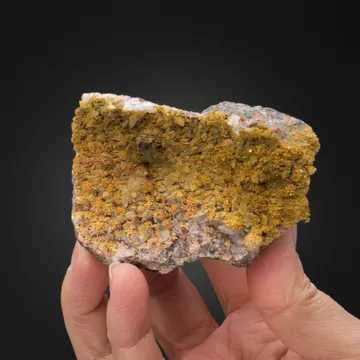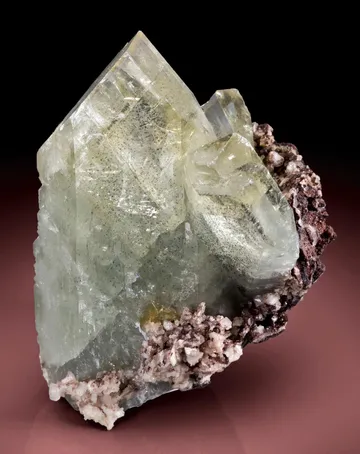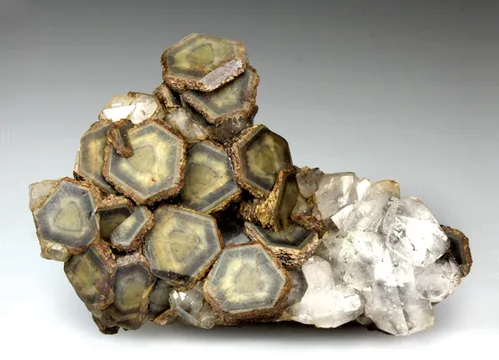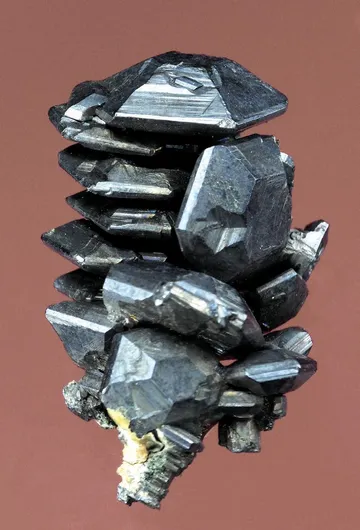
A collector's guide to Derbyshire, UK: its geology, mining history and notable minerals, illustrated with the 79 specimens documented from this locality on EarthWonders.
Key facts
Derbyshire is one of the essential names in British mineral collecting: a classic lead-zinc-fluorite-baryte-calcite orefield set in the Carboniferous limestones of the Peak District, worked from antiquity and still capable of producing specimens with a look that is unmistakably English. The great collecting area is the White Peak and its margins, where hydrothermal mineralization occupies steep fissure veins known locally as rakes, smaller scrins, pipes, flats, caverns, and replacement bodies in limestone and dolomitized limestone. The productive veins cut through Dinantian limestones and are locally controlled by shale cover, impervious clay bands, and basaltic lava and tuff layers traditionally called toadstone.
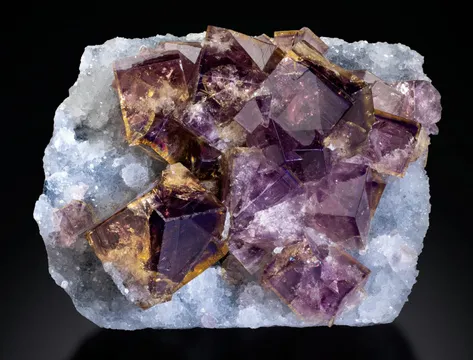
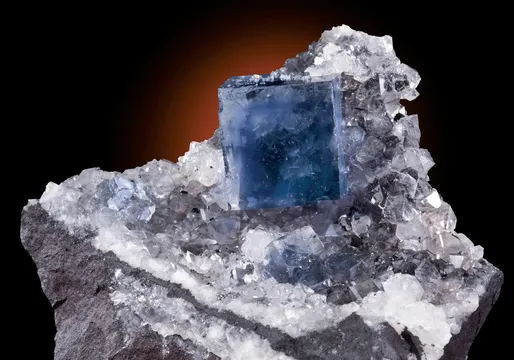
Collectors know Derbyshire first for fluorite: the purple-blue and yellow-white banded Blue John of Castleton; the clear, grey, amber, honey, lilac, violet-edged, and sulphide-included cubes from Ladywash, Milldam, Pindale, Dirtlow Rake, Fall Hill, Crich, Bonsall Moor, and other old workings; and the highly prized combinations with calcite, baryte, galena, sphalerite, pyrite, marcasite, and chalcopyrite. But the county is just as important for calcite—especially dog-tooth and large scalenohedral groups—together with bladed and cockscomb baryte, bright galena, dark resinous sphalerite, clear quartz and smoky quartz, and a remarkably rich secondary lead-zinc suite. Several Derbyshire localities also matter to systematic collectors: Bage Mine is the historic type locality for matlockite, while Milltown Quarry at Ashover is the type locality for sweetite and ashoverite.
The best Derbyshire cabinet specimens rarely rely on size alone. Their appeal is architectural: sharply zoned fluorite cubes perched on white or pinkish baryte blades; double-terminated calcite rising from a carpet of small pale fluorite; dark sphalerite and galena embedded in pale carbonate gangue; or Blue John showing saturated purple-blue bands curved through cream and yellow fluorite. In fine pieces the colour is not flat but layered—purple concentrated on cube edges, amber cores shifting to violet rims, or internal sulphide dust giving smoky warmth to otherwise pale crystals.
Regional View
Country View
Derbyshire specimens also carry an industrial history that is unusually visible in the landscape. The county’s lead mining was governed by distinctive mining customs and Barmote Courts; its old rakes can still be traced by lines of hillocks, coes, engine houses, washing floors, and collapsed shafts. In the twentieth century the economic focus shifted from galena to the gangue minerals once thrown aside by lead miners: fluorspar, barytes, and calcite. That long afterlife is why Derbyshire remains a living mineral locality rather than only an old label in antique collections.


Photo: Ra'ike / Wikimedia Commons
Search for specimens: View all specimens from Derbyshire, UK
The classic Derbyshire collecting area is the South Pennine Orefield of the Peak District, especially the Carboniferous limestone country around Castleton, Eyam, Hucklow, Bradwell, Bonsall, Matlock, Cromford, Winster, Wirksworth, Ashover, Sheldon, and related districts. Mineralization is dominantly low-temperature hydrothermal vein and replacement mineralization hosted by Dinantian limestones, with ore fluids moving along faults, joints, fissures, and palaeokarst cavities. The major vertical fissure veins are the rakes; thinner fissures are scrins; and the ore also occurs in flats, pipes, cavities, and replacement bodies where mineralizing brines reacted with limestone or were ponded beneath shale, clay, or toadstone.
The normal Derbyshire assemblage is galena and sphalerite with calcite, baryte, and fluorite. Pyrite, marcasite, chalcopyrite, bravoite, and other sulphides occur locally, and oxidation produced cerussite, anglesite, smithsonite, hydrozincite, hemimorphite, pyromorphite, wulfenite, and rarer lead-zinc species in the weathered parts of veins and mine tips. The mineral zoning is important to collectors. Fluorite is especially characteristic toward the eastern parts of the orefield and in places such as Longstone Edge, Hucklow, Eyam, Ashover, Crich, and Castleton, whereas calcite and baryte become more prominent in other sectors. Mine evidence also suggests vertical zoning, with fluorite and galena giving way in places to calcite and sphalerite at depth.
The veins themselves can be structurally complex. Simple veins may be only a few centimetres to tens of centimetres wide and show neat zonation, but the large rakes can be metres wide and strongly brecciated. On Longstone Edge, High Rake and related structures carried fluorite, baryte, calcite, and galena in repeated crusts and broken, re-cemented masses. Hucklow Edge veins yielded colourless to dark purple fluorite, calcite, baryte, galena, sphalerite, and later specimen material from Ladywash and Milldam. At Bradwell, Castleton, Dirtlow Rake, Pindale, Odin, Treak Cliff, and Blue John Cavern, the mineralization includes both ordinary fluorspar and the unique Blue John variety. Around Bonsall Moor and Cromford, fluorite, baryte, calcite, galena, cerussite, and secondary zinc minerals occur in small veins, quarries, old mine dumps, and dolomitized limestone.
Mining for lead in Derbyshire reaches back at least to Roman times and possibly earlier. Roman lead pigs associated with the Lutudarum mining district preserve the antiquity of the trade, and by the medieval period Derbyshire lead was sufficiently important to support a distinctive legal culture of mining liberties, Barmasters, and Barmote Courts. From the seventeenth through nineteenth centuries, lead mining was a central industry of the White Peak, with major workings at places such as Odin Mine, Magpie Mine, Lathkill Dale, Millclose, Bonsall, Via Gellia, Winster, Wirksworth, Matlock, Cromford, and Eyam. The number of surviving shafts and hillocks is large enough that the mining landscape itself has become one of the county’s defining geological features.
The twentieth century changed the economics of the orefield. As lead declined, operators increasingly worked fluorspar, barytes, and calcite from old veins, opencuts, underground workings, quarries, and waste tips. Important modern names include Laporte Minerals, Glebe Mines, INEOS Fluor, British Fluorspar, and later Fluorsid British Fluorspar. Cavendish Mill near Stoney Middleton became the key processing plant for Derbyshire fluorspar. Surface fluorspar extraction by British Fluorspar ceased in 2017, and production shifted to underground mining at Milldam Mine near Great Hucklow, which had planning permission extending to 2028; local reporting in 2023 stated that Milldam and Cavendish Mill had been put on care and maintenance after cessation of operations.
Specimen production came from many different kinds of workings. Ladywash Mine at Eyam, closed in 1979, is famous for clear to grey and pale coloured fluorite, included fluorite, attractive fluorite-baryte-calcite combinations, sphalerite including red “ruby” material, calcite, marcasite, chalcopyrite, and occasional wulfenite. Milldam Mine produced clear calcite, clear to dark purple fluorite, anglesite, and wulfenite from the Hucklow vein system. Pindale and Dirtlow Rake near Castleton yielded purple fluorite cubes, pale crystals with dark edge zoning, cockscomb baryte, calcite, and fluorite-baryte combinations. Fall Hill Quarry at Ashover produced fluorite cubes to about 50 mm, sphalerite, marcasite, hydrocarbons, and sharp dog-tooth calcite from veins cutting limestone and toadstone. Bonsall Moor and Moor Farm Quarry are known for calcite, galena, baryte, fluorite, cerussite, and the occasional axe-head calcite twin. Millclose Mine, east of Darley Dale, was the great lead producer of the district and is remembered by collectors for galena, sphalerite, calcite, marcasite, fluorite, and greenockite-coated sphalerite.
Collecting access today is highly restricted compared with the old days. Many mines are dangerous, collapsed, gated, flooded, protected, on private land, or within the Peak District National Park and Sites of Special Scientific Interest. Permission is essential for quarries, mine tips, and farmland; underground collecting should not be attempted without proper authority, competence, and local knowledge. For most collectors, legitimate Derbyshire material now comes from old collections, historic mine dumps where access is lawful, dealer stock, estate collections, show-cave shops, and limited contemporary material released through legitimate channels. Blue John is still mined only in small amounts at the Castleton show caves, primarily for lapidary and souvenir use rather than mineral specimens.
Derbyshire fluorite ranges from massive banded Blue John to sharp cubes on matrix, and the finest examples are locality-specific in a way serious collectors value: Castleton material shows purple-blue, yellowish, white, and colourless bands; Ladywash gives colourless, grey, yellowish, lilac, violet-edged, and sulphide-included cubes, often with calcite, baryte, marcasite, chalcopyrite, galena, or sphalerite; Pindale and Dirtlow Rake produce purple cubes and edge-zoned crystals scattered on baryte; Fall Hill yielded beds of clear and included cubes up to about 50 mm; and Milldam is known for clear to dark purple fluorite with bright calcite and lead-zinc species. Ordinary Derbyshire fluorite is often massive or bruised spar, but good collector pieces show sharp cubic form, strong lustre, distinct internal zoning, attractive sulphide inclusions rather than muddy staining, and undamaged associations that preserve the vein architecture.
Derbyshire calcite is a major specimen mineral in its own right, not merely gangue: collectors prize the sharp dog-tooth scalenohedra, doubly terminated scalenohedra, pale yellow to cream crystals, clear “Iceland spar” rhombs from old spoil, large sprays from Magpie and other lead mines, and distinctive twins including the axe-head calcites reported from Bonsall Moor workings. Ladywash produced some of the county’s best calcite combinations, including translucent cream scalenohedra on small colourless to pale lilac fluorite cubes, while Moor Farm Quarry yielded scalenohedral twins on beds of dog-tooth crystals and Millclose and Milldam produced large calcite groups associated with fluorite, marcasite, galena, and sphalerite. Good pieces have clean terminations, minimal iron staining, translucency or internal zoning, and a balanced relationship to the underlying fluorite or sulphide matrix rather than a broken cluster of common spar.
Under the American spelling “barite,” Derbyshire specimens most often refer to BaSO4 in the same fluorite-lead-zinc veins that produced the county’s classic fluorite, with the best crystallized examples forming white, cream, pinkish, pale brown, or grey bladed aggregates, cockscomb groups, crusts, and vein sections. Pindale, Dirtlow Rake, Bonsall Moor, Ladywash, Masson Hill, and the Castleton area all produced barite/baryte associated with fluorite, galena, sphalerite, calcite, marcasite, and cerussite; at Bonsall Moor, cockscomb barite on fluorite and large barite cavities were documented, while Dirtlow Rake produced small purple fluorite cubes with cockscomb barite and scalenohedral calcite. The best crystallized Derbyshire barite has free-standing blades, attractive contrast with purple or clear fluorite, and intact crests; lesser pieces are common massive vein barytes or iron-stained fragments lacking open crystal display.
Derbyshire sphalerite is the principal zinc sulphide of the orefield and appears in many collecting contexts: dark brown to black resinous crystals and massive material with galena in lead veins; red “ruby” sphalerite from Ladywash; sphalerite crystals at Fall Hill, sometimes reported with greenockite coatings; sphalerite at Millclose in one of the richest lead-zinc systems of the district; and sphalerite in fluorite-galena associations from classic Derbyshire specimens. It is commonly associated with calcite, fluorite, baryte, galena, marcasite, pyrite, chalcopyrite, and secondary zinc minerals such as smithsonite and hemimorphite. Fine Derbyshire sphalerite is scarcer than fluorite or calcite and is judged by lustre, freedom from dull oxidation, crystal definition, attractive colour in transmitted light where present, and a convincing old Derbyshire association rather than anonymous dark sulphide in carbonate.
Galena is the historical ore mineral that made Derbyshire famous, although most veins contained only modest percentages of ore and far more gangue; as specimens, Derbyshire galena occurs as bright cubic to cubo-octahedral crystals, cleavable masses, grains and strings in fluorite-baryte-calcite vein fill, and weathered crystals carrying cerussite, anglesite, or other oxidation products. Important specimen contexts include old-time galena from Gregory Mine at Ashover, regarded among the best British examples, Millclose galena from the county’s great lead mine, Bonsall Moor galena with cerussite and baryte, Masson Hill galena with fluorite and secondary lead minerals, and fluorite-galena-sphalerite combinations from the broader orefield. Good Derbyshire galena shows bright metallic lustre, geometric faces, sharp contrast against pale baryte or fluorite, and credible old provenance; damaged cleavages, dull black oxidation, or detached ore fragments are much less desirable.
Quartz is not the headline mineral of Derbyshire’s lead-fluorite veins, but it is well documented and can be quite collectible where it appears as clear rock crystal, smoky quartz, amethystine quartz, chalcedony, beekite, or small crystals associated with fluorite, galena, sphalerite, baryte, calcite, and iron oxides. Calton Hill near Taddington is noted for cavities in volcanic rock carrying small amethystine and smoky quartz, sometimes with hematite-included calcite, while Matlock-area localities include quartz varieties in old mine assemblages and some Derbyshire specimens show quartz with fluorite and galena. Good Derbyshire quartz is usually valued as an association piece or as a locality specimen rather than for large standalone crystals; the best examples have clean terminations, smoky or amethystine colour, and a clear link to a specific Derbyshire mine, quarry, or vein system.
“Baryte” is the British spelling used in much Derbyshire literature, and the county has produced both crystallized specimens and ornamental massive varieties. Besides the bladed and cockscomb baryte of Bonsall Moor, Dirtlow Rake, Ladywash, Pindale, and Masson Hill, the Arbor Low–Middleton Moor area is famous for brown to orange banded stalactobotryoidal baryte known locally as Oakstone, which takes a polish and can show eye-like concentric patterns. Portway and Hollandtwine workings near Castleton produced large baryte boulders with attractive banded patterns when sawn and polished, while vein baryte in fluorite-rich rakes may occur as pale brown colloform wall zones, blocks enclosed in coarser fluorite, or blades overgrown by sulphides and calcite. The most desirable baryte pieces retain crisp bladed structure or strong lapidary patterning, while ordinary massive barytes, however historically important, are far more common.
Derbyshire’s rarer minerals are a serious reason to collect the district systematically. Bage Mine near Cromford is the accepted type locality for matlockite, PbFCl, and also yielded phosgenite, historically called cromfordite on Derbyshire material, with anglesite and galena. Milltown Quarry near Ashover is the type locality for sweetite, Zn(OH)2, found as colourless to whitish millimetre crystals, and for ashoverite, another Zn(OH)2 polymorph occurring as tiny tabular-platy crystals. The wider orefield has also produced aurichalcite, hemimorphite, smithsonite, hydrozincite, cerussite, anglesite, pyromorphite, wulfenite, greenockite, enargite, palygorskite, litharge, hydrocerussite, weddellite, vanadinite, descloizite, leadhillite, lanarkite, scotlandite, mattheddleite, and other specialized lead-zinc-vanadium and oxidation-zone species from localities such as Golconda, Milltown, Whitwell, Masson Hill, Pike Lane, Crich, and the Matlock Bath mine complexes.
Derbyshire collecting rewards precise labels. “Derbyshire” alone is acceptable for old historical material, but the market strongly prefers a mine, quarry, rake, cavern, or village: Ladywash Mine, Milldam Mine, Pindale Quarry, Dirtlow Rake, Treak Cliff Cavern, Blue John Cavern, Fall Hill Quarry, Bonsall Moor, Millclose Mine, Magpie Mine, Bage Mine, Masson Hill, Wapping Mine, Golconda Mine, Crich, Ashover, Matlock Bath, Cromford, or Castleton. Because many specimens moved through old British collections, antique labels can be more valuable than a modern best-guess attribution; keep every scrap of provenance.
The main authenticity issue is Blue John. True Blue John is the distinctive banded fluorite of the Castleton area, especially Treak Cliff Hill and the Blue John/Treak Cliff cave system. Chinese banded fluorite and some amethyst or other purple banded materials have been sold or mistaken as Blue John. Derbyshire material typically lacks the green banding often seen in modern Chinese ornamental fluorite, and experienced dealers can sometimes recognize named Blue John veins by their colour rhythm and pattern. For valuable Blue John carvings, specimens, or slabs, buy from established Derbyshire sources or demand old provenance.
Another locality-specific caution concerns old British mineral labels tied to A.W.G. Kingsbury. Some reported British mineral occurrences by Kingsbury are now treated with caution or considered fraudulent; Mindat explicitly flags cinnabar at Masson Hill as an erroneous literature entry with high probability of fraudulent recording. Collectors should be skeptical of improbable Derbyshire rarities without analytical support, especially when a species is not otherwise credible for the locality.
Condition is often the deciding factor. Derbyshire fluorite cleaves easily, bruises on cube corners, and can carry natural internal fractures; old pieces may have edge chipping from mine handling. Calcite is softer and vulnerable to broken terminations, acid cleaning, and iron staining. Baryte blades and cockscomb crests break readily. Galena may be dull, oxidized, or cleaved; bright old galena should be protected from abrasion and stored away from humid, sulphur-rich environments. Sphalerite can be deceptively fragile where it is intergrown with calcite or marcasite.
Fluorescence in Derbyshire fluorite is variable. Some Ladywash and other Derbyshire fluorites fluoresce well, but Derbyshire is not as consistently fluorescent as the North Pennine fluorite districts. Blue John is famous for colour and history rather than predictable fluorescence, although scientific work recorded a red-fluorescing zone in a Treak Cliff specimen under 365 nm ultraviolet light. Do not assume every Derbyshire fluorite will glow strongly; test individual pieces if fluorescence matters.
Market availability is uneven. Small Derbyshire fluorites, barytes, calcites, and galena associations appear regularly from old stock and UK dealers, but sharp, undamaged, well-provenanced cabinet pieces from Ladywash, Milldam, Pindale, Fall Hill, Millclose, or classic Castleton localities are much less common. Fine Blue John remains available mostly as polished slices, jewellery, small carvings, and carefully controlled modern material, while large historic decorative pieces command a separate lapidary and antiques market. Type-locality species such as matlockite, sweetite, and ashoverite are specialist rarities and should be bought only with excellent provenance or analytical documentation.
At Magpie Mine near Sheldon, the romantic ruins hide one of the grimmest stories in British mining. In the 1820s and 1830s, Magpie miners and men from neighbouring workings such as Maypitts and Great Red Soil fought bitterly over rights to the same vein. Underground, where boundaries were not lines on paper but holes broken through into another party’s ground, the conflict became physical. Miners lit fires to smoke rivals out of contested workings. In 1833, three Red Soil miners died from suffocation after a fire was lit by Magpie men. Twenty-four Magpie miners were put on trial, but the case collapsed because blame could not be pinned on individuals and because the rival miners’ own provocations complicated the evidence. The local story says the widows of the dead men cursed the mine; whether one believes the curse or not, Magpie closed in 1835, was reopened by the celebrated engineer John Taylor in 1839, and never entirely shook off its reputation as a place where ore, law, and vengeance met underground.
The Castleton Blue John story has a very different atmosphere, but it is just as memorable. Treak Cliff Cavern’s Blue John workings are thought to have begun between 1745 and 1750, when the mine was known as Miller’s Mine. By the late eighteenth century the banded fluorite was fashionable enough to be made into vases, columns, and ormolu-mounted ornaments for great houses, including Chatsworth and Buckingham Palace. The tragedy, from a mineral collector’s point of view, came during the First World War, when fluorspar was in demand as a flux for blast furnaces and Blue John—rare ornamental fluorite—was mined for industrial use. Much good decorative stone was lost to the furnace rather than saved for lapidary art.
One of the best modern Blue John episodes began as a secret lost with a miner. In the 1940s, John Royse knew of a vein in Treak Cliff, but he died before he could tell the young Peter Harrison exactly where it lay. Decades passed. In 2013, Peter Harrison’s grandson John Turner rediscovered the “Lost Vein” hidden beneath wooden battens, an old carpet, clay, and the silence of nearly seventy years. For collectors, that detail—the old carpet over a hidden vein of purple-blue Derbyshire fluorite—is the kind of story that makes a locality more than a map reference.
Two years later, Treak Cliff produced another surprise. In 2015, mine manager Gary Ridley was testing a stone chainsaw just off the tourist route, in an area that would normally have been impractical for traditional plug-and-feather work because of the noise. He noticed a small amount of crystallization near the handrail, close to water and easy standing room on the concrete path. Within minutes, the saw opened a substantial deposit of Blue John unlike the known veins. Dr Trevor Ford, the leading authority on Blue John, judged it a major development: the Ridley Vein became variant number 15, the first new variety of Blue John recognized in more than 150 years.
Milltown Quarry near Ashover gave Derbyshire a quieter but scientifically important story. In February 1982, S. A. Rust found tiny colourless to whitish crystals in a disused limestone quarry 200–300 m northwest of Milltown. The crystals were sprinkled over colourless fluorite cubes in small cavities between narrow fluorite veins, in an oxidized zone carrying altered galena, anglesite, cerussite, hydrocerussite, litharge, and a white fibrous clay mineral then identified as attapulgite. Only about twenty sweetite specimens were found, and three went to the British Museum (Natural History). What began as an unknown millimetre-scale mineral became sweetite, Zn(OH)2, named for Jessie May Sweet, curator of minerals at the British Museum. A later zinc hydroxide polymorph from the same quarry, ashoverite, made Milltown one of the most important micromineral localities in the county.
Odin Mine at Castleton carries the weight of antiquity. It is the oldest documented lead mine in Derbyshire, with firm documentary evidence by the medieval period and traditions that push its origins back to Saxon or Roman work. The site preserves the classic surface grammar of a Peak District lead mine: spoil heaps, shafts, washing floors, water channels, a drainage level, and a crushing circle. Knowles Shaft was recorded as 240 feet deep and flooded, and the nineteenth-century crushing wheel with its iron tyre and circular track survives as a reminder that the beautiful fluorite and baryte of the Castleton district were once part of a hard industrial machine.
Aitkenhead, N., Chisholm, J. I., and Stevenson, I. P. 1985. Geology of the Country Around Buxton, Leek and Bakewell: Memoir for 1:50,000 Geological Sheet 111. British Geological Survey. A core geological reference for the Peak District limestones, Derbyshire hydrothermal mineral deposits, galena-sphalerite ores, and calcite-baryte-fluorite gangue assemblages.
Bevins, R. E., Young, B., Mason, J. S., Manning, D. A. C., and Symes, R. F. 2010. Mineralization of England and Wales. Geological Conservation Review Series No. 36: Treak Cliff, Derbyshire. Geological Conservation Review account of Blue John at Treak Cliff, with discussion of the local Carboniferous setting and banded fluorite formation.
Cornwell, J. D., and others. Geology and Mineralisation: Geophysical Investigations over the Long Rake, Haddon Fields, Derbyshire. British Geological Survey / NERC Open Research Archive. Detailed technical report on the Long Rake style of Derbyshire mineralization, including fluorite-rich veins, lead-zinc minerals, baryte, calcite, toadstone controls, and ore zoning.
Dunham, K. C., and Dines, H. G. Geology of the Derbyshire Deposits, United Kingdom. Classic description of Derbyshire vein, rake, scrin, replacement, and flat mineralization, including examples from High Rake, Hucklow Edge, Bonsall Moor, Cromford, and Shuttle Rake.
Clark, A. M., Fejer, E. E., Couper, A. G., and Jones, G. C. 1984. “Sweetite, a new mineral from Derbyshire.” Mineralogical Magazine, 48, 267–269. Original description of sweetite, Zn(OH)2, from Milltown Quarry, Ashover, including occurrence, associated minerals, and type material.
“Sweetite: Mineral information, data and localities.” Mindat. Summary of sweetite mineral data, type locality, associated type-locality minerals, and references.
“Milltown Quarry, Milltown, Ashover, North East Derbyshire District, Derbyshire, England, UK.” Mindat. Locality record for Milltown Quarry, including ashoverite and sweetite, secondary lead-zinc minerals, fluorite, galena, and calcite.
“Bage Mine, Derbyshire.” GeoGuide. Account of Bage Mine as the type locality for matlockite, with discussion of phosgenite, the Bage/Cromford Level workings, historic discoveries, and the Natural History Museum type specimen.
Braithwaite, R. S. W., Flowers, W. T., Haszeldine, R. N., and Russell, M. 1973. Study of the colour of Blue John fluorite, Mineralogical Magazine, 39, 401–411. Scientific treatment of Blue John and other purple fluorites, including Castleton, Ladywash, and other Derbyshire comparison material.
Galwey, A. K., Jones, K. A., Reed, R., and Dollimore, D. 1979. “The blue colouration in banded fluorite (Blue John) from Castleton, Derbyshire, England.” Mineralogical Magazine, 43, 243–250. Important paper on the cause of Blue John coloration.
Peak District Mines Historical Society. The principal society for Peak District mining history, conservation, fieldwork, and publications including Mining History.
“Fluorite from Ladywash Mine, Eyam, Derbyshire, England, UK - 9.3 x 7.6 x 4.3 cm / 2 x 1.2 cm” — Fabre Minerals. Specimen video of a colour-zoned Ladywash fluorite with yellow basal tones passing into violet outer zones.
“TUC4271 Calcite on Fluorite, Ladywash Mine, Derbyshire” — Crystal Classics. Dealer video showing a classic Ladywash calcite-on-fluorite specimen.
“Fluorite with Baryte from Dirtlow Rake, Castleton, High Peak District, Derbyshire England, UK” — Fabre Minerals. Specimen video illustrating a Castleton-area fluorite-baryte association from Dirtlow Rake.
Derbyshire — Steetley Minerals One of the most useful collector-oriented summaries of Derbyshire specimen localities, with notes on minerals from Ladywash, Milldam, Fall Hill, Bonsall Moor, Castleton, Bage Mine, Milltown, Masson Hill, and many others.
Geology of the Country Around Buxton, Leek and Bakewell — British Geological Survey Authoritative geological and mining context for the Peak District orefield and its lead-zinc-fluorite-baryte-calcite deposits.
Vein Minerals Background Paper — Derbyshire County Council Planning and industry background on Derbyshire fluorspar, barytes, calcite, operators, Cavendish Mill, Milldam Mine, and modern production history.
Chapter 7.4 Vein Minerals — Derbyshire Minerals Local Plan Concise modern planning summary of fluorspar and associated vein minerals in Derbyshire and the Peak District.
Milldam Mine planning application NP/DDD/0913/0838 — Peak District National Park Authority Official planning record for renewal of consent for underground mining of fluorspar and associated mineralization from the Hucklow vein system.
Milldam Mine cessation of operations — Great Hucklow Parish Council Local report on the 2023 cessation of operations and care-and-maintenance status at Milldam Mine and Cavendish Mill.
Treak Cliff, Derbyshire — GeoGuide / Geological Conservation Review Excellent geological account of the Castleton Blue John locality and its place in the South Pennine Orefield.
A History of Blue John and Treak Cliff Cavern — Treak Cliff Cavern Primary local account of Blue John mining, Treak Cliff history, modern small-scale extraction, and the Harrison/Turner family stewardship.
The Discovery of the Ridley Vein — Treak Cliff Cavern Detailed account of the 2015 discovery of the fifteenth recognized Blue John vein by Gary Ridley.
Blue John Stone Useful background on Blue John, Castleton, banding varieties, and modern Derbyshire Blue John working.
Blue John fluorite, Corsi Collection — Oxford University Museum of Natural History Museum reference for a historic Blue John specimen, with useful comments on Derbyshire material versus modern Chinese banded fluorite.
Derbyshire Blue John Veins — Blue John Gallery Practical gem and jewellery trade notes on named Blue John veins and common imitations.
Magpie Mine — Derbyshire Heritage Readable historical account of Magpie Mine, the 1833 Red Soil deaths, the trial, and the widows’ curse.
Magpie Mine, Sheldon — Peak District Mines Historical Society Visitor and conservation information for one of the best-preserved lead mine sites in Britain.
Odin Mine, Castleton — Derbyshire Historic Environment Record Detailed heritage record for Odin Mine, including documentary history, protected status, shafts, crushing circle, and associated ore works.
A Brief History of Derbyshire Lead Mining — Derbyshire Heritage Compact overview of Derbyshire lead mining, vein terminology, galena grades, rakes, and the broader mining landscape.
Minerals of Derbyshire — Wikimedia Commons Open image category for Derbyshire mineral specimens including fluorite, baryte, galena, sphalerite, quartz, pyromorphite, and related species.