Copper Queen Mine, USA — Bisbee’s iconic locality for azurite, malachite, cuprite, and native copper; historic specimens prized by collectors and museums.
Key facts
The Copper Queen Mine at Bisbee is one of the touchstone American localities for oxidized copper minerals: a mine whose name became shorthand for deep blue azurite, velvety and stalactitic malachite, cherry-red cuprite, native copper, calcite cave material stained by copper salts, and a long tail of rare secondary copper species. Its specimens came from a carbonate-replacement copper system in the Mule Mountains of southeastern Arizona, where intrusive-related sulfide mineralization in Paleozoic limestones was later oxidized with unusual depth and intensity. The result was not merely ore, but pockets, caves, and soft iron-oxide zones lined or filled with copper carbonates, oxides, sulfates, chlorides, silicates, and later carbonate dripstone.
For collectors, the Copper Queen matters on two levels. First, it was a major early Bisbee producer and part of the Copper Queen Consolidated Mining Company ground that made Bisbee famous as the “Queen of the Copper Camps.” Second, its classic specimens entered the market and museums early, at a time when American mineral collecting was rapidly becoming institutional. The best pieces have a nineteenth-century look that is difficult to mistake: bright royal to midnight-blue azurite rosettes and blades in cellular limonite or carbonate matrix; malachite pseudomorphs retaining the sharp form of former azurite or cuprite; cuprite crystals with dark red internal fire and metallic luster; and pale to turquoise-blue chalcoalumite crusts that look deceptively soft against brown gossan.
Regional View
Country View
The classic Copper Queen aesthetic is inseparable from Bisbee’s oxidation caves. Early accounts describe limestone caverns and open spaces in which malachite, azurite, calcite, aragonite, goethite, and limonite developed as crusts, stalactites, stalagmites, botryoids, and replacement masses. Unlike many copper camps where fine specimens were incidental casualties of ore extraction, Bisbee benefited from unusually specimen-aware mine management and from miners who were permitted to save collectible material when it could be done without interfering with work. That policy is why so many early Copper Queen and Czar specimens still reside in museums and old private collections.

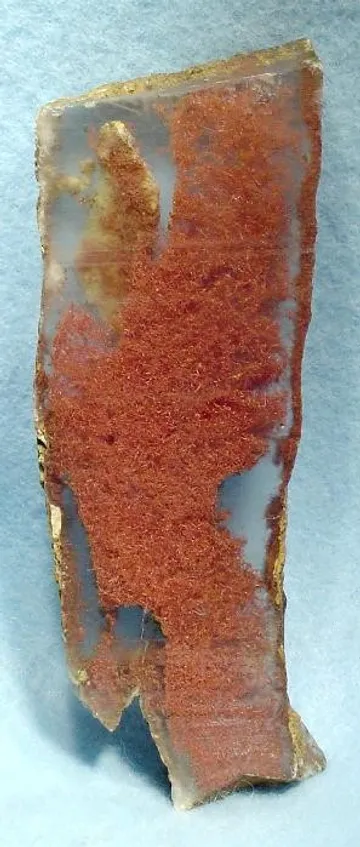
Photo: Wikimedia Commons

Photo: Wikimedia Commons
Search for specimens: View all specimens from Copper Queen Mine, USA
The Copper Queen Mine is on Queen Hill at Bisbee, in the Warren Mining District of Cochise County, Arizona. In mineral labels the name can refer narrowly to the original Copper Queen workings, but collectors must be aware that early Bisbee usage was often looser: material hoisted through or owned by the Copper Queen Consolidated Mining Company was frequently called “Copper Queen” even when the immediate working was the Czar, Holbrook, Spray, or another closely related shaft or orebody. That label history is not a small detail; it affects the interpretation of many old azurites, chalcoalumites, cuprites, and paramelaconites.
Geologically, the district is a carbonate-replacement copper system tied to the Sacramento stock complex and related Laramide intrusive activity. The productive underground orebodies were irregular replacement masses in Paleozoic limestones, especially the Martin and Escabrosa limestones, with some ore also in other carbonate units. The economic copper zones were commonly associated with larger bodies of siliceous pyrite and pyritic replacement rock. Oxidation transformed these sulfide bodies into soft limonitic masses and carbonate-rich secondary copper ores; where volume loss and solution activity opened space, spectacular oxidation caves developed above or within the oxidized ore.
The original Queen orebody was unusually rich and close to the surface. Early miners worked copper carbonate ore from the outcrop and from an open cut, following blue and green copper minerals in limestone. Ransome’s classic USGS work describes Bisbee ore masses as irregular, commonly tabular or lenticular bodies broadly parallel to bedding, with gradual margins into limonitic “ledge matter” rather than clean vein walls. That geologic style explains why Copper Queen specimens so often show cellular iron oxide, altered limestone, calcite, and mixed copper minerals rather than isolated crystals on a clean quartz vein.
Mining began on a limited basis around 1880 after the discoveries associated with Jack Dunn, George Warren, and the financiers behind the Queen claim. The Copper Queen Mining Company and neighboring interests consolidated in the mid-1880s, and the Copper Queen Consolidated Mining Company, later under Phelps Dodge influence, became the dominant operating force in Bisbee. The Czar shaft, begun in 1885, became especially important for accessing rich ore beneath Queen Hill, and many specimens historically sold as Copper Queen almost certainly came from this shared Queen Hill system. Underground mining in Bisbee continued until Phelps Dodge closed the underground mines in the summer of 1975. The Queen Mine Tour opened to visitors on February 1, 1976, preserving part of the mine as a public heritage attraction rather than a collecting site.
Specimen production was strongest during the early mining decades, when oxidized ore, caves, and large stopes were being opened in relatively fresh ground. The most storied finds include the nineteenth-century azurite and malachite masses from the Queen Hill/Czar workings, malachite and calcite stalactites from oxidation caves, cuprite-rich pockets with native copper and copper chlorides, and the chalcoalumite material that established the species from Bisbee. A five-foot-tall, multi-ton block of azurite and malachite prepared for the 1893 World’s Columbian Exposition became one of the emblematic Bisbee display pieces; it represents the scale at which the early oxidized ore could also be mineral-specimen material.
Collecting access today should be treated as closed except for authorized tour visitation. The mine is historic, underground, unstable in places, and part of managed property; collectors should not enter workings, dumps, cuts, or fenced areas without explicit permission from the current land or mineral-rights holder. Modern collector availability is therefore almost entirely through old collections, estate dispersals, museum deaccessions where legal, and specimens preserved by dealers. Provenance matters strongly: a piece with a credible early label identifying Copper Queen, Czar Mine/Copper Queen, Holbrook Mine/Copper Queen, or Queen Hill is far more meaningful than a vague “Bisbee” attribution added later.
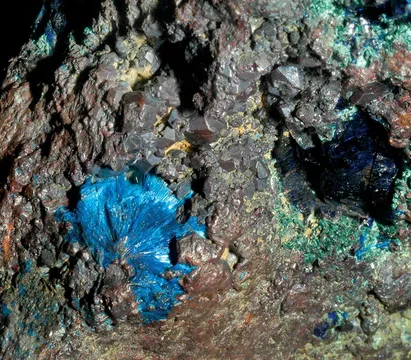
Copper Queen azurite is classic Bisbee material: deep royal-blue to nearly black-blue crystals, druses, rosettes, lenticular blades, sparkling cavity linings, and massive or stalactitic aggregates in limonite, malachite, calcite, and altered limestone. The best specimens show sharp, lustrous rosettes or bladed groups rather than merely blue crusts, and many old pieces preserve striking associations with malachite pseudomorphs after azurite or cuprite. Fine crystals are generally thumbnail to miniature scale, but historic pieces and ore-cave masses could be far larger; the most desirable cabinet specimens combine intense saturated color, undamaged terminations, open vugs, and contrasting green malachite or brown gossan. The Queen Hill and Czar-associated Copper Queen material is particularly important because early dealers and museums treated it as among the finest azurite then known from the United States.
Malachite from the Copper Queen ranges from fibrous globular coatings and rich velvety green crusts to stalactites, polished cave material, and pseudomorphs after azurite or cuprite. The great pieces are not just green; they carry form. Collectors prize sharp bladed malachite after azurite, compact pseudomorph groups retaining the geometry of the precursor crystals, stalactitic pieces with banded or calcite-coated structure, and specimens where malachite frames azurite in the cavities of limonitic ore. Ordinary Copper Queen malachite can be dull, scaly, or massive, especially later post-mining crusts, but the finest old material has rich color, silky luster, sculptural relief, and an unmistakable oxidation-cave or replacement texture.
Native copper at the Copper Queen is a secondary mineral of the oxidized copper system rather than the abundant lake-copper style seen in Michigan, so good crystallized examples are substantially scarcer than the famous azurite and malachite. It occurs as small sheets, masses, crystallized patches, and arborescent or microcrystalline aggregates, commonly with cuprite, limonite, malachite, calcite, and altered copper ore. Strong specimens show recognizable metallic copper color or patina, clear crystal form or branching texture, and a credible old Bisbee/Copper Queen provenance; weak examples are often just coppery smears in gossan. Association with bright cuprite crystals is especially attractive, because it captures the red-metallic copper oxide assemblage for which Bisbee’s oxidized zones are also admired.
Calcite from the Copper Queen is important less as isolated colorless crystals than as part of the mine’s cave story: crystalline masses, stalactites, stalagmites, crusts, and carbonate dripstone colored or penetrated by malachite, azurite, and other copper-bearing solutions. Early accounts specifically describe calcite in the oxidized Copper Queen ore, including stalactitic forms and showy crystalline masses, sometimes with copper carbonate zoning or later coatings. Collectors value pieces that preserve the cave habit, copper-green coloration, association with malachite or azurite, and old labels; plain calcite without copper mineral context is much less compelling. Because calcite is soft and cleavable, broken tips on stalactitic pieces and bruised crystal faces are common condition issues.
Copper Queen cuprite occurs as massive red to dark red-brown ore, crystalline coatings, octahedral to modified cubic or cuboctahedral crystals, and in some cases as the precursor or partner to malachite, azurite, native copper, and rare copper chlorides and sulfates. The best specimens show bright, sharply formed crystals with cherry-red translucency on thin edges or mirrorlike dark red faces, often scattered over massive cuprite or limonitic matrix. Cuprite quality varies enormously here: many pieces are dark, earthy, or massive, while the fine ones have crisp form, luster, and association. Specimens with native copper, connellite, malachite after cuprite, or a strong old Copper Queen/Czar label are especially desirable because they represent the richer, more complex oxidized copper pockets rather than ordinary ore.
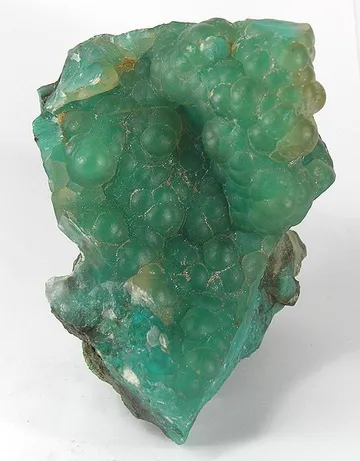
Chalcoalumite is one of the defining rarities of the Copper Queen system, described from Bisbee material as a delicate blue-green copper aluminum sulfate occurring as crusts, botryoidal coatings, and fine microcrystalline to crystalline aggregates on limonitic, azurite-, and malachite-bearing matrix. Copper Queen and Holbrook-associated specimens usually attract the eye with pale robin’s-egg to turquoise-blue surfaces rather than large discrete crystals, and fine examples depend on freshness, continuous coverage, sculptural vuggy form, and correct identification. Because visually similar pale blue-green secondary minerals, gibbsite-like crusts, and copper alteration products can be confused with it, the strongest collector pieces are old, well-provenanced, or analytically supported examples from the type-locality suite.
Other documented Copper Queen and closely associated Queen Hill minerals include paramelaconite, spangolite, connellite, brochantite, chrysocolla, aragonite, goethite, limonite, cerussite, sphalerite, galena, and a wide range of secondary copper species. Paramelaconite is the most historically charged rarity: the species was described from material credited to the Copper Queen Mine, though later Bisbee specialists have argued that the Czar workings within the Copper Queen company ground may be the more likely immediate source. Chalcoalumite is a confirmed type-locality mineral for the Copper Queen/Holbrook mine system. Spangolite, while more complicated in its original type-locality history, is one of the great Bisbee rarities and is documented from Copper Queen/Czar material; connellite on cuprite is another prized micro-to-small-cabinet association from the same oxidized environment.
Copper Queen specimens are usually judged on three intertwined criteria: mineral quality, label quality, and whether the label means the original Copper Queen mine or the broader Copper Queen company ground at Queen Hill. Many legitimate old pieces labeled “Copper Queen” may have come from Czar, Holbrook, or another associated working. That does not necessarily make them undesirable—indeed, the Czar produced superb specimens—but it does mean that serious collectors should preserve old labels and avoid “improving” the locality beyond what the evidence supports. A safe modern label often reads “Copper Queen Mine, Queen Hill, Bisbee” or, when applicable, “Czar Mine, Copper Queen Mine, Queen Hill, Bisbee.”
No well-documented, systematic fake industry is known for Copper Queen azurite or malachite comparable to the treatment problems seen in some gem materials, but mislabeling is common. Generic Bisbee azurite, Morenci azurite, Mexican azurite, and other copper-carbonate specimens may be casually or optimistically assigned to Copper Queen because the name is marketable. Conversely, old Copper Queen Consolidated labels may hide the exact working. For chalcoalumite, visual identification alone is risky; pale blue-green secondary crusts from Bisbee can be miscalled chalcoalumite without analytical support or strong provenance.
Condition is a major issue. Azurite blades and rosettes bruise easily, and their dark color can hide edge wear until examined under good light. Malachite pseudomorphs may have rubbed high points, dusty fibrous surfaces, or repaired projections. Calcite stalactites and cave pieces are prone to cleaved or broken ends. Cuprite can look excellent in low light but reveal dull, pitted, or earthy surfaces under magnification. Old cave specimens may also carry natural iron oxide, clay, and historic dirt; over-cleaning can strip the very surface texture that gives them character.
Handling should be conservative. Do not soak azurite, malachite, chalcoalumite, or mixed Bisbee oxidized ore in acids or aggressive cleaners. Keep azurite out of prolonged strong light and away from humid, dusty display environments. Chalcoalumite and other hydrated secondary sulfates should be kept stable and dry, with minimal handling. Calcite-bearing pieces should be protected from acids and abrasion. Fluorescence is not a principal selling point for most Copper Queen classics, though calcite and post-mining hydrozincite from Bisbee can respond under ultraviolet light; fluorescence should be treated as an added observation, not as proof of locality.
Market availability is steady but finite. Small azurite and malachite specimens from old collections appear regularly, while top Copper Queen azurite rosettes, large malachite pseudomorph groups, stalactitic cave specimens, sharp cuprite with native copper, and convincing type-locality chalcoalumite are much scarcer. Prices rise sharply with pre-1900 provenance, old institutional or dealer labels, aesthetic contrast, and clean condition. The best advice is simple: buy the specimen and the label together.
The origin story of the Copper Queen reads like frontier folklore because it is frontier folklore with real ore at the center. In the late 1870s, Jack Dunn, attached to a cavalry scouting party from Fort Huachuca, found mineralized rock in the Mule Mountains while the army was searching the region during the Apache period. Unable to leave his duties and develop the find himself, Dunn brought in prospector George Warren. Warren’s part in Bisbee history became both famous and infamous: he staked claims, cut Dunn out of the arrangement, and later became so emblematic of Arizona mining that his image appears on the Arizona state seal. DeWitt Bisbee of San Francisco helped finance the Queen Mine in 1880, gave his name to the town, and, in one of those historical ironies collectors love, never visited the place that made his name permanent on mineral labels.
The early mine did not just produce ore; it opened into caves. One nineteenth-century description of the Copper Queen open cut imagined that a great cave had once occupied the space, its floor and walls gradually coated with ore. From the roof hung calcite stalactites, some containing carbonate of copper as well as carbonate of lime, with concentric rings in which the lime carbonate finally covered the copper ore. This is the physical origin of the old Bisbee cave specimens: not abstract “secondary enrichment,” but hanging forms, green copper-stained dripstone, and cavities where carbonate minerals grew in open air spaces before the miners arrived with drills, picks, candles, and square-set timber.
James Douglas, the mining engineer and company leader associated with the Copper Queen Consolidated Mining Company, was unusually important to mineral collectors because he understood that the caves contained more than ore. Under his management and influence, exceptional specimens were saved and distributed to institutions. Company employees collected many pieces; miners were allowed to collect as long as they did not neglect their duties or take foolish risks. That policy changed the afterlife of Bisbee’s minerals. Without it, many Copper Queen azurites, malachites, cuprites, cave calcites, and rare copper species would have gone through the crusher, furnace, or waste pile.
By January 7, 1889, Bisbee cave specimens had already reached the New York Academy of Sciences. Dr. James J. Friedrich exhibited a green calcite and an aragonite stalactite from the Arizona copper district, describing calcite embedded in malachite and stalactitic columns with fine central apertures around which silky malachite fibers were arranged concentrically. In some columns, the green color was confined to the center; in others, the whole calcite mass was penetrated and tinted. That is exactly the sort of early descriptive mineralogy that makes an old Copper Queen cave piece more than a decorative object: the nineteenth-century observers were looking closely at growth structure, replacement, and solution pathways.
The greatest single narrative belongs to William Niven, who went to Bisbee in late 1890 on behalf of the New York mineral dealer George English. Niven entered a huge cave in the Czar Mine beneath Queen Hill, part of the Copper Queen company ground. He described a cavern 500 feet long, at least 150 feet high, 80 feet wide at the mouth, widening to 270 feet near the center and 250 feet at the end. It had four chambers, each with its own crystal habit. One held acicular aragonite, another flos ferri, and a third was “the grandest of all,” like a cathedral with green copper-colored stalactites and stalagmites resembling immense organs and a hanging cluster like a gigantic chandelier.
Niven spent 14 days in that cavern selecting specimens. He had a photographer take pictures, and he described the main chamber illuminated by 200 candles: a “scene of dazzling beauty,” with countless stalactites in shades of green, blue, red, and snow-white. He compared the forms to roses, fringe, coral, palm leaves, trees, toadstools, glaciers, and fields of ice. In one place he saw sheets of aragonite three to four feet long, two to three feet wide, and about one-half to three-quarter inch thick, translucent and banded green, white, and blue like tapestry when backlit. It is difficult to overstate what that meant in 1890: a remote Arizona copper mine had suddenly produced cave mineral specimens that could compete in drama with the great European cabinet classics.
The Copper Queen company also understood the theater of mineral display. At the Denver Exhibition in 1882, the company reportedly showed an ore specimen weighing 1,150 pounds and assaying 27.8 percent copper. For the 1893 World’s Columbian Exposition in Chicago, the company prepared an even more astonishing azurite and malachite block from the 200 level of the Czar Mine. Newspaper accounts said the work of chiseling it out had been going on for some time, with great care, and estimated that the finished block would weigh five tons in the shape of a brick. The surviving display block, later described as roughly five feet tall and four tons, became a centerpiece mineral object. It was donated to the American Museum of Natural History in New York, where the Bisbee blue-and-green mass became not just a specimen, but a public symbol of Arizona’s mineral wealth.
The museum traffic continued. The U.S. National Museum received 260 specimens of malachite, azurite, cuprite, calcite crystals, and stalactite from the Copper Queen Mine, collected by W. P. Jenny, in the year ending June 30, 1890. The American Museum of Natural History received boxes of stalactites, stalagmites, crystals, wall material, ores, and native copper with cuprite from the Copper Queen company in the early twentieth century. These were not occasional souvenirs; they were organized transfers of geological material at a time when museums were building the mineral displays that shaped public ideas of the American West.
There is also a modern afterword. When Phelps Dodge closed the Bisbee underground mines in the summer of 1975, the Copper Queen could have become only a sealed industrial relic. Instead, Bisbee mayor Chuck Eads pushed to convert part of the mine into a tour. Volunteers cleared fallen rock and re-timbered old workings; local groups fed and supported the effort; federal economic-development help followed. The Queen Mine Tour opened on February 1, 1976, and has since carried visitors 1,500 feet into the mountain. For collectors, that ride is not a collecting opportunity. It is something rarer: a chance to see the physical environment from which the labels, pockets, and old stories came.