Czar Mine, USA — Bisbee-area locality famed for dark blue azurite and malachite on oxidized copper ore; rich old-time character and cabinet-quality specimens.
Key facts
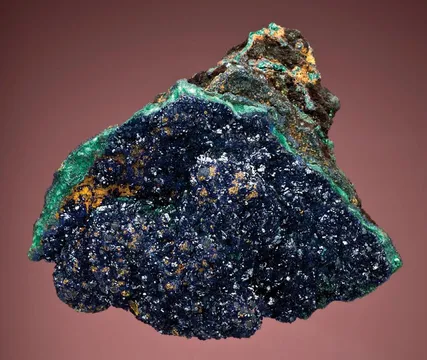
The Czar Mine is one of the essential old names in the Bisbee suite: a Queen Hill workings of the Copper Queen system in the Warren mining district, Cochise County, Arizona, and a locality whose best specimens carry the unmistakable look of Bisbee’s richest oxidized copper ores. Collectors know it first for dark, glassy, saturated blue azurite and strong malachite—often not as dainty isolated crystals, but as robust secondary-copper pieces born in the same oxidation caves, stopes, and shattered limestone that made Bisbee a world-class copper camp. The Czar material has a particularly old-time character: blue-black to royal-blue bladed azurite, rosettes and botryoidal aggregates, green malachite replacing or encrusting azurite, velvety surfaces, lumpy stalactitic forms, cuprite-bearing associations, and, in rarer pieces, calcite enclosing or carrying red cuprite and native copper.
Geologically, the mine belongs to the classic Bisbee pattern: intrusive-centered copper mineralization tied to the Sacramento Stock complex, structurally guided replacement bodies in carbonate rocks, and intense supergene oxidation that converted sulfide ores into masses of iron oxides, copper carbonates, cuprite, native copper, and an extraordinary suite of rare copper minerals. The Czar stood in the western, deeply oxidized part of the district, where caves above oxidized ore bodies were common and where the distinction between ore, open void, specimen pocket, and dangerous broken ground could be very thin. That setting is the reason Czar pieces can show both bold cabinet-mineral aesthetics and the dense, earthy, goethitic matrix of a working copper mine.
Regional View
Country View
Historically, the Czar is important well beyond specimen collecting. The shaft was sunk in 1885 on the Copper Czar claim as the Copper Queen operation outgrew the old Copper Queen Incline. It became a major hoisting and service shaft, a pumping shaft for Czar and Holbrook water, and eventually a place where miners learned their trade before being sent into other Bisbee workings. Mining at Czar continued, intermittently and increasingly by lease, into the 1930s and early 1940s; by the time specimen collecting became a post-mining pursuit, the mine was already partly caved, wet, and dangerous. Its best specimens therefore have the aura collectors prize in old Bisbee material: early, hard-won, often label-rich, and not replaceable by modern collecting.
Search for specimens: View all specimens from Czar Mine, USA
The Czar Mine is properly placed at the Czar Mine, Copper Queen Mine, Queen Hill, Bisbee, Cochise County, Arizona, USA. In collecting language it is often shortened to “Czar Shaft,” “Czar Mine,” or simply “Czar, Bisbee,” but those abbreviations matter: the mine is one of several closely linked workings on and around Queen Hill, and old labels can blur Czar, Copper Queen, Holbrook, and Southwest relationships. For serious cataloging, a Czar attribution is strongest when it is supported by an old label, a documented collection history, or a specimen habit known from the Czar workings.
The deposit is part of the Warren, or Bisbee, mining district in the Mule Mountains of southeastern Arizona. The district’s ores are best understood as carbonate-hosted replacement and related porphyry-associated copper mineralization, with later lead-zinc and multi-element phases adding to the unusual mineral diversity. The broader Bisbee system was controlled by intrusive activity around the Sacramento Stock complex, by the major Dividend fault zone, and by steep cross-faults including the Czar fault. In the carbonate rocks, copper-bearing fluids replaced limestone and dolomite along favorable beds, fractures, faults, and breccias; later oxidation and supergene enrichment produced the spectacular secondary copper minerals for which Bisbee is famous.
The western part of the district, where the Czar workings are situated, was especially important for thoroughly oxidized ore. At Bisbee, oxidation caves developed above and within oxidized replacement bodies as sulfides were converted to iron oxides, carbonates, sulfates, and copper oxides. These caves and cave-like voids were not mere geological curiosities. They guided prospecting, concentrated high-grade ore, created specimen cavities, and also made ground control a constant problem. Soft, clay-rich oxide ore could be removed with a pick, but the surrounding ground demanded heavy timbering and repeated maintenance.
The Czar Shaft itself was begun in 1885 on the Copper Czar claim after Ben Williams recommended a new hoisting shaft in the 1884 annual report of the Copper Queen Consolidated Mining Company. The old Copper Queen Incline was too limited, with small compartments for manway and hoisting, and ore was being raised in small one-ton cars. The new Copper Czar Shaft soon lost the longer name in daily use and became simply the Czar. By 1886 a smelter was being built beside it, and after 1888 the shaft hoisted not only its own ores but also ore from the Holbrook and Cave Mining Company operations.
Water was one of the mine’s defining problems. The Czar’s position near Mule Gulch and in ground affected by mining subsidence made it vulnerable to seasonal water inflow. On September 1, 1903, after rain, some crosscuts were reported flooded with two feet of water. The 400 level had a pump station, first steam-driven and later supplemented by electric pumps. The mine handled both cleaner water and copper-rich acidic water separately. That “copper water,” formed as rainwater moved through oxidizing sulfide stopes, was reactive enough to attack exposed metal; porcelain-lined pump cylinders and wood-lined steel pipes were used, and after 1906 the copper-bearing water was run into precipitation vats filled with scrap tin cans so that copper precipitate could be recovered and sent to the smelter.
The Czar also evolved operationally. In 1907 the aging shaft was shut down for retimbering from just below the 200 level to the surface, and the pipe compartment was enlarged. During that period, Shattuck & Arizona miners were lowered to the 200 level of the Czar and then walked underground to the 800 level of the Shattuck Mine rather than climbing the hill along Uncle Sam Gulch. Exploration emphasis shifted around 1910 from simply going deeper to testing Queen Hill above the Czar collar elevation. Raises and internal shafts developed ore within the hill; by 1914 these upper workings were treated as the Southwest Mine rather than as part of Czar proper.
The 1920s brought a different role. The Czar and Southwest workings served as a mining school while still active, producing mines. Men were trained in underground terminology, navigation, and jobs before being transferred to other Bisbee mines, though some remained in the Czar-Southwest area. Ore reserves dwindled, and the mine worked off and on until it was shut down in August 1930. It reopened to lessees in 1932. Leases had existed in parts of the Czar since at least 1911, usually for small, difficult, or marginal ore, but after 1932 lessees mined it exclusively until 1942. In 1942 Phelps Dodge reopened the 300 and 400 levels for exploration; in 1944 the leases were canceled, mining ceased, and salvage of wire, rail, pipe, and fittings began.
Collecting access today should be regarded as closed except through legitimate public interpretation at Queen Mine Tours and through existing specimens on the market. The shaft was maintained briefly after World War II, later capped to stop trespassing, and eventually backfilled after deterioration. A 1995 collapse in the Queen Mine parking lot was traced to settlement into the old Czar Shaft, an instructive reminder that this is not a casual collecting locality but an historic underground mine in subsidence-prone ground. The modern Queen Mine Tour site preserves the mining story, but it is a guided heritage attraction, not a collecting venue.
The best documented specimen-producing zones include the 200 level, which yielded important azurite and malachite pieces, and the 400 level, known for calcite with cuprite and native copper associations. The old accounts make clear that the Czar was never a fantasy cavern lined throughout with blue crystals. Miners and lessees removed sellable mineral specimens early, ore was scavenged repeatedly, and by the post-mining collecting years large areas were caved or wet. That scarcity is part of the locality’s appeal: a fine Czar piece is a survivor from a productive but difficult section of the Bisbee underground.
Czar Mine azurite is the locality’s signature species and is best when it shows the mine’s old Bisbee combination of very dark, glassy blue color, bright luster, and strong sculptural habit rather than merely powdery blue staining. Documented Czar examples include bladed, fan-like and partial-rosette groups in thumbnail to miniature size; richer cabinet pieces with multi-hued bladed azurite botryoids distributed over malachite; a 22 cm specimen from the 200 level showing second-generation azurite over large malachite pseudomorphs after azurite; and a 19 cm azurite vug from the 200 level with goethite-coated malachite and minor cuprite. The usual associations are malachite and iron oxides, with cuprite and rare spangolite or chalcoalumite associations adding importance. Good Czar azurites have open crystal faces, a saturated blue that still flashes under light despite the dark tone, and undamaged edges on the blades or rosettes; ordinary examples tend to be massive, abraded, or heavily dulled by goethite and post-mining grime.
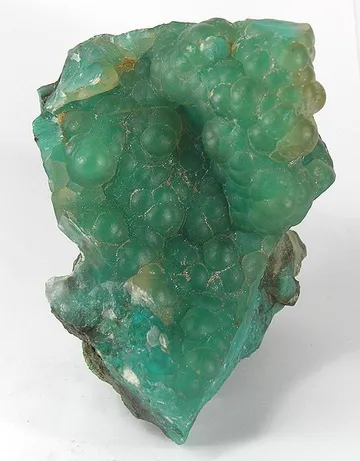
Malachite from the Czar Mine ranges from ore-forming green masses to highly collectible botryoidal, coliform, stalactitic, fibrous, and pseudomorphic pieces. Among the better documented Czar examples are a 23 cm coliform mass in the Graeme collection, a 17 cm high Smithsonian specimen, lumpy layered malachite forming a “porch” beneath azurite on an 11 cm Czar Shaft cabinet specimen, and malachite/azurite dripstone forms with hollow centers. The species also appears as replacements after azurite, as green crusts and velvety coatings on goethitic matrix, and as coarse crystals on azurite in small, sharp specimens. The best Czar malachite is not merely green copper ore; it has chatoyance, undamaged botryoidal skin, clear pseudomorphic form, stalactitic architecture, or crisp contrast with dark azurite. Pieces with bruised velvet, sawed-looking breaks, or dull granular surfaces are far less desirable unless they carry a strong old label or a rare association.
Czar Mine calcite is a collector’s mineral chiefly when it carries the copper story with it: red cuprite inclusions, chalcotrichite, native copper, or attractive goethitic matrix. The best-known material is from the 400 level, where calcite with included cuprite is repeatedly documented in Bisbee displays and collections. A Mindat-documented Czar specimen measures 73 mm by 60 mm by 15 mm and shows native copper crystals to 5 mm scattered on chalcotrichite-included calcites on a copper matrix; another documented cabinet specimen from the Czar is an 11 cm calcite colored red by cuprite inclusions. Czar calcite can also be significant under shortwave ultraviolet light, especially where associated with native copper, with reported red to red-orange fluorescence in copper-calcite specimens. Good Czar calcite pieces are judged less by perfect calcite crystal form than by clean red internal color, visible copper or chalcotrichite association, transparency sufficient to show inclusions, and an undamaged display face.
Other documented Czar Mine minerals include native copper, native silver, pyrite, cuprite including chalcotrichite, tenorite, goethite, brucite, aurichalcite, chrysocolla, chalcoalumite, connellite, rhomboclase, and spangolite. The rare-mineral side of Czar is especially important. Connellite from the Czar occurs in classic association with massive cuprite, malachite, azurite, chrysocolla, and minute spangolite, and it has figured in the complicated history of the discredited species “footeite.” Spangolite is one of Bisbee’s great rarities; although the original type locality was historically given only broadly in southern Arizona, Czar material was studied in later crystallographic work and Bisbee is widely treated as the probable source area for the type. Paramelaconite is the headline rarity: a documented co-type specimen has been described from the Czar Mine, with a superb 3 cm black tetragonal crystal associated with connellite and cuprite, making Czar one of the most significant named localities in the history of that copper oxide species.
Czar Mine specimens should be bought with attention to provenance. The mine sits within the Copper Queen–Queen Hill complex, and older labels may say “Czar Shaft,” “Copper Queen,” “Queen Hill,” or simply “Bisbee.” Some of that overlap is historically reasonable, but market value can change substantially when a specimen is specifically Czar rather than broadly Bisbee. A precise Czar attribution is strongest when supported by an early collection label, a known dealer or collection chain, a museum record, or a habit and association matching documented Czar material such as dark glassy azurite with malachite, 200-level azurite-malachite pieces, or 400-level cuprite-included calcite.
No well-documented modern industry of fake Czar specimens stands out in the literature, but ordinary Bisbee mislabeling is common. Be cautious with pieces offered as Czar solely because they are azurite or malachite from Bisbee. Also be wary of specimens with suspiciously fresh glue lines, reconstructed stalactites, or added matrix; malachite dripstone and azurite-on-malachite pieces can break cleanly and tempt repair. Repairs are not inherently disqualifying on historic Bisbee specimens, but they should be disclosed, and price should reflect them.
Condition issues are predictable but important. Azurite blades and rosettes chip along edges, and velvet-like or microcrystalline surfaces can be dulled by handling. Malachite botryoids and stalactites bruise, polish at high points, and collect dust that is hard to remove without damaging the surface. Calcite cleaves, scratches, and reacts with acids; do not clean cuprite-included Czar calcite with acid, and avoid aggressive ultrasonic cleaning on mixed copper-carbonate pieces. Cuprite and native copper associations may darken or show old oxidation, which is normal and often part of the specimen’s history.
Fluorescence can add value in Czar calcite specimens, particularly calcite associated with native copper or cuprite, where shortwave response may be red to red-orange. This is a bonus feature, not a substitute for visible aesthetics. For storage, keep azurite and malachite dry, away from acidic vapors and excessive heat, and away from hard quartz-rich specimens that can abrade them in drawers. Historic Czar pieces are finite; the mine is not a modern collecting source, and the best material circulates primarily from old Bisbee collections, dealer inventories, and deaccessioned or estate specimens.
The Czar began as a practical answer to a bottleneck. In the mid-1880s the Copper Queen Incline was too small for a growing copper camp: one small compartment for men, another for hoisting, and little one-ton cars being hauled up a narrow shaft. Ben Williams urged the company to sink a new hoisting shaft on the Copper Czar claim, and work began in 1885. The name was quickly shortened by use. “Copper Czar” became simply Czar, and by 1886 the shaft was important enough that the company built a smelter beside it. Within a few years, it was hoisting not only Czar ore but ore from neighboring operations as well.
The surface plant had its own dramas. A new change house with 12 showers was built in 1900, a small luxury in a dusty underground copper camp. On June 24, 1902, a fire started in the rope shop and spread rapidly to the change house. The damage was reported at $12,000, with three reels of cable destroyed, the trestle to the waste dump burned, and about $3,000 in miners’ personal belongings lost inside the building. The men were without a proper change house for just over a month. Then, on July 29, the replacement was celebrated not with a quiet reopening but with a large dance inside the new building—a very Bisbee mixture of danger, industry, and social life.
Water gave the Czar a different kind of personality. Summer monsoon rains could change the underground abruptly, and after a storm on September 1, 1903, some crosscuts held two feet of water. The 400-level pump station was steam-driven and uncomfortably hot. Later, electric pumps were installed, but the old steam equipment was wisely left in place for emergencies. The mine handled only 300 to 400 gallons a minute, but much of that flow was copper-rich acid water. Anything exposed and metallic that met it could be attacked, dissolved, and replaced by crude copper precipitate. The solution had to be lifted through porcelain-coated cylinders and wood-lined steel pipe, then poured over vats of scrap tin cans so that copper could be recovered rather than simply lost with the mine water.
The underground routes were complicated enough that the Czar became part of the daily geography of other mines. During retimbering in 1907, Shattuck & Arizona miners were allowed down to the 200 level of the Czar and then walked underground to the 800 level of the Shattuck Mine. That saved them from climbing the hill along Uncle Sam Gulch before starting their real work. A miner’s commute could therefore be a descent into one company’s shaft, a walk through the dark across mine boundaries, and arrival at another mine’s level hundreds of feet away in the structure.
The ground itself moved. Subsidence affected Queen Hill and the Czar-Holbrook area for decades, bending the practical life of the town as well as the mine. By 1918, the Czar hoist had to be realigned. The city even had trouble building a sidewalk across the old slag dump because mining along the Dividend fault had disturbed the ground; bricks were used instead of concrete. In the oxidized stopes, soft ore and clay-like alteration products squeezed workings with relentless pressure. Contemporary descriptions emphasized that heavy timbering was not optional. One account noted that the mine required about “thirty feet of timber” for every ton of ore removed, and that openings had to be bulkheaded to keep the creeping ground from closing them.
By the 1920s the Czar and Southwest workings served as a mining school. New men learned terminology, how to find their way, and the basics of underground jobs in workings that were still producing ore. Some moved on to other Bisbee mines; others stayed. The Czar’s role had shifted from expansion shaft to training ground, then to lessee country. After the 1930 shutdown it reopened in 1932 for lessees, who worked the scraps, difficult ore, and remnant blocks that a large company had little interest in chasing. In 1944 the leases ended, mining ceased, and the remaining months were spent salvaging trolley wire, rail, pipe, and fittings.
Collectors entered the story after the miners had already taken most of what was easy. Local lore inflated the Czar into a cavern of blue crystals, but the reality was harsher and more interesting. By the 1940s much of the mine was already caved, miners had saved specimens for decades, and lessees had worked remaining ore hard. After the Copper Queen Incline caved in 1958, collectors used two main access routes: the Czar main shaft manway, still in decent shape above the wet lower section, and the Crazy Horse Pete Incline down to the 300 level, which avoided some water. In the 1960s the 100 level was largely caved, most of the 200 level was caved, parts of the 300 were open, and the 400 level connected into Holbrook workings. Abandoned underground tool rooms still held usable equipment—a pipe threader with dies, pipe cutters, wrenches, an ax—left behind as if a shift had ended and no one had returned.
Even after the shaft was closed, it kept asserting itself. In March 1995, part of the Queen Mine parking lot collapsed under the weight of a tour bus. After the bus was safely removed, a sinkhole roughly one meter deep and 4.5 meters across was found. Attempts to flood and consolidate the fill sent 20,000 to 40,000 liters of water a day into the depression for a week; excavation widened the collapse area to about 12 meters. Engineering work confirmed that the settlement lay over the old Czar Shaft. The solution was not a simple concrete plug but a flexible geosynthetic cap with settlement monitoring—modern engineering laid over a nineteenth-century mine that was still settling into itself.